What Today’s Broadcast News Regards As “Credentials”

"Yes, yes...journalism degree, experience at a local affiliate, blah, blah...but no rapes? Arrests? Scandals? Sexual abuse? Miss, you have NO credentials that make you valuable as a network reporter! Wait--what's your bra size?"

Good for media ethics pundit Howard Kurtz for blowing the whistle, however gently, on ABC News’s hiring of Elizabeth Smart as a contributing on-air expert on missing children cases. “Does that strike anyone as odd?” he writes.

Well, it depends what you mean by “odd,” Howard.

If you mean, does it surprise me that a broadcast media outlet, one of the journalistic mutations that hired Eliot Spitzer, fresh off his prostitution disgrace, to headline a current events show on CNN, that puts a giggly fold-out-come-to-life  like Robin Meade in charge of Headline News’ morning, and that, like Fox News, chooses its female newsreaders and guest pundits according to their degree of resemblance to Mamie Van Doren or Raquel Welch, would hire a young, attractive blond woman with no credentials other than her role as the victim of kidnapping, sexual abuse and rape, as a correspondent, why no, I don’t find it odd at all.

If you mean, do I find it odd that a supposedly professional news network would so blatantly abandon professional standards  just to cash in on the Casey Anthony uproar, however, then…wait, no, I don’t find that odd either. Revolting, but not odd. Continue reading

No Excuses and No Mercy For Lance Armstrong

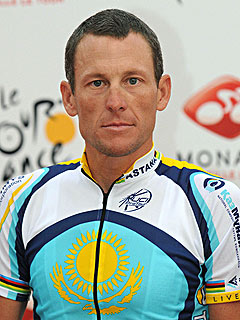
Sorry, Lance…good guys don’t cheat.

Back when Barry Bonds was still playing baseball, a sportswriter mused about why it was that everyone assumed  Bonds was a performance-enhancing drug cheater despite his protestations to the contrary, while most Americans and sports journalists brushed away similar allegations regarding Lance Armstrong. Both competed in sports with acknowledged steroid abuse problems; indeed, the problem in bicycle racing was presumed to be more pervasive than in baseball. (A few years later, with the banning of multiple Tour winners, the presumption became a certainty.) Both athletes had improbable late career improvements in their performance to reach previously unimaginable dominance in their respective sports. Both had to explain or deflect multiple credible accusations of cheating and circumstantial evidence that suggested that they were doping. Both claimed they had never failed drug tests, and there were good reasons to doubt the denials.

So why was Bonds a villain by consensus and Lance an untouchable hero? The sportswriter explored many theories (Apologies: I cannot locate the article. If someone can, please send it), among them the greater popularity of baseball over cycling, Bond’s startling physical transformation into a behemoth while Armstrong remained cyclist-sinewy,  Armstrong’s inspiring story as a cancer survivor, Armstrong’s philanthropic work,and the fact that Bonds, unlike Armstrong, was black. The biggest difference, however, and to the writer the key one, was that Armstrong acted the role of a hero, while Bonds refused to. Armstrong was friendly and accommodating, while Bonds was angry, intimidating and antagonistic. Armstrong seemed like someone who played by the rules, and who lived his ethical values. Bonds seemed like a rebel, one who wouldn’t hesitate to break the rules for his own benefit. In short, the public wanted Armstrong to be the hero he seemed to be, so they ignored the evidence linking him to performance-enhancing drugs.

After last Sunday, the disparate public perception of Bonds and Armstrong, always illogical, became unsustainable. Continue reading

Ethics Dunce: Buzz Bissinger

It took about an hour after the  Barry Bonds verdict for the first ethics-challenged national sports writer to write something outrageous about it. Not surprisingly, it was Buzz Bissinger, a the member in good standing of the Daily Beast’s stable of annoyingly hypocritical, biased or appallingly cynical writers, Bissinger belonging to the last category.

His post, which pronounced the Barry Bonds conviction “a travesty” in the title, contained one ethics howler after another, any of one of which would have justified an Ethics Dunce prize.

Here they are:

“It is true that the case of Barry Bonds does hit a new low, a new low in the waste of millions of dollars of taxpayers’ money, a new low in the witch hunt of a player who, because he was considered surly and arrogant and unlikable, is now having intimate details of his life revealed (such as testicle shrinkage), a new low in outrageous abuse of government power.” Continue reading

The Bonds Verdict: Fair Enough

The results of the Barry Bonds trial, which today concluded with the jury finding baseball’s all-time home run champion guilty of obstructing justice by misleading a grand jury investigating the distribution of illegal and banned steroid to professional athletes but unable to agree on the perjury charges, helps to balance the ethical scales. It should silence the shameless Bonds defenders who misused the “innocent until proven guilty” standard to maintain poor Bonds was being unfairly suspected of inflating his biceps, head, statistics and income through the marvels of chemistry, though it was blatant and obvious in dozens of ways. Now he has been proven guilty—not of everything, but for celebrity justice, in a trial where much of the most damaging evidence was withheld from the jury, enough—, so the claims of racism and unfair prosecution will ring even hollower now. Continue reading

Manny Post Script: The Signature of a Jerk

Manny Ramirez, the now-retired ex-baseball slugger, provoked the predictable responses from the media and fellow players in the wake of his sudden retirement after being notified that he would be the first major league player to face a 100 game suspension for failing a mandated PED test (that’s “performance enhancing drugs” for all of you who don’t know who Barry Bonds is), because no player had ever been caught TWICE before.

Everyone was in agreement that this meant: Continue reading

Manny Ramirez’s Perfect Exit

The most unethical baseball player since the Black Sox

From  Major League Baseball:

“Major League Baseball recently notified Manny Ramirez of an issue under Major League Baseball’s Joint Drug Prevention and Treatment Program. Rather than continue with the process under the Program, Ramirez has informed MLB that he is retiring as an active player. If Ramirez seeks reinstatement in the future, the process under the Drug Program will be completed. MLB will not have any further comment on this matter.”

Perfect. Perfect.

Manny Ramirez was an impressively talented baseball player with discipline of an untrained Irish Setter, and the selfishness of a six-year-old. Throughout his career, he was a textbook example of the management fallacy known as the star principle, in which an extremely talented individual is allowed to break the rules and defy an organization’s culture in direct proportion to his perceived value. Continue reading

The Ethics of Nailing Barry Bonds

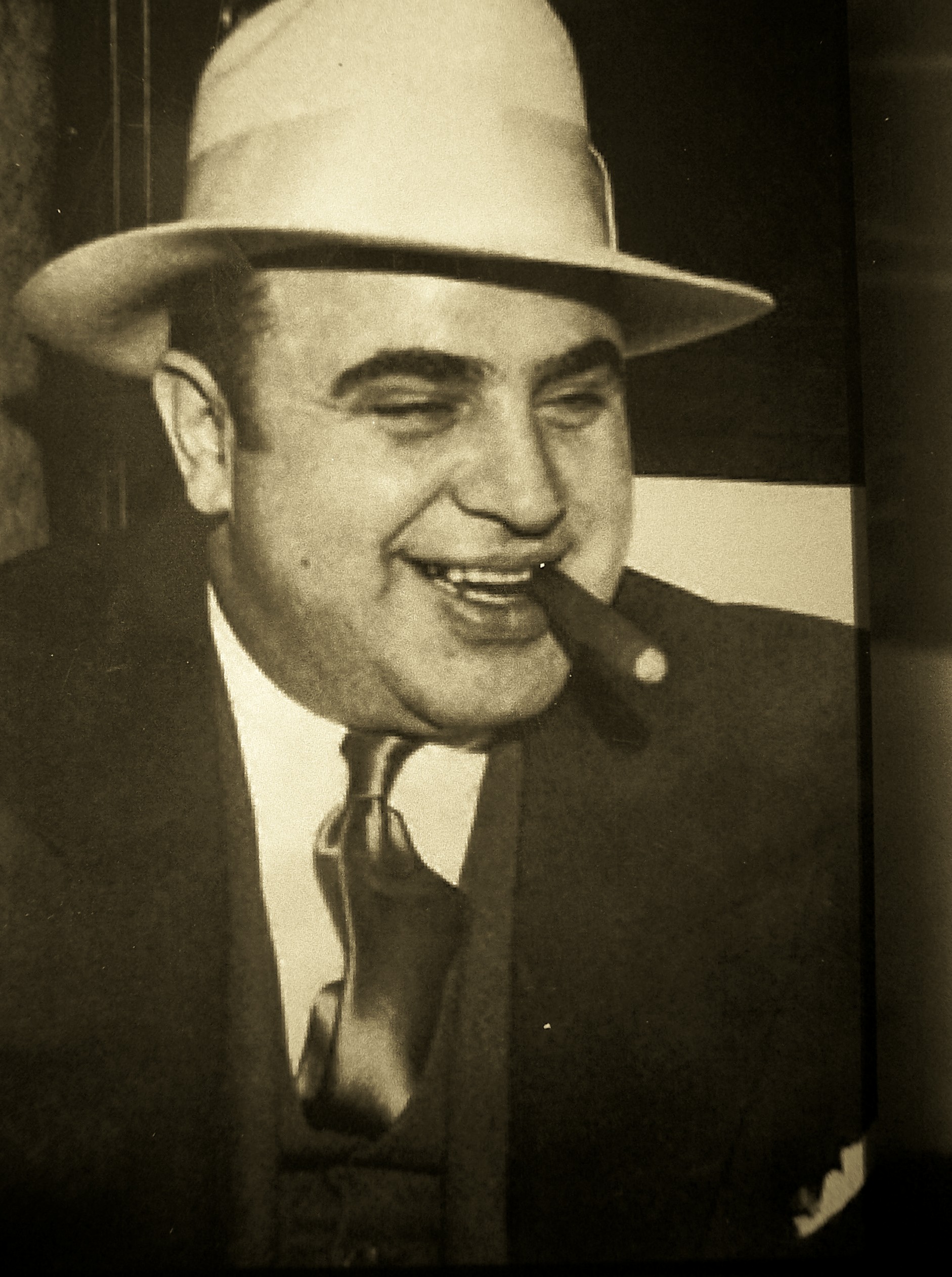
Is Barry Bonds getting the Al Capone treatment? Should we care?

Baseball’s all-time home run king Barry Bonds is finally on trial for perjury and obstruction of justice relating to his 2003 testimony before a grand jury that he never knowingly used steroids. It looks like he may get convicted too, even though the one man who could harm him most, his trainer and childhood pal Greg Anderson, once again has refused to testify and is in jail for contempt of court. (Many—including me— believe that Anderson has a promise of a pay-off from Bonds.)

Essentially everyone who isn’t actively trying to protect Bonds, completely ignorant of the facts of his career, or mentally handicapped knows he was lying and knew it at the time of the grand jury hearings. Barry has been both lucky and relentlessly dishonest, however, seemingly happy to spend the millions he made while cheating and permanently damaging his sport, and pleased with himself for retiring in possession of baseball’s most prestigious home run records, the most homers in a single season, and the most homers in a career.  That Bonds achieved these, and several of his Most Valuable Player awards, while enhanced with the surreptitiously induced body chemistry of a Bulgarian weight-lifter in the 1972 Olympics doesn’t seem to faze him at all. Meanwhile, critics are dredging up the old rationalizations to defend Bonds, none of which apply to his current fix. Continue reading

Ethics Uber-Dunce: Jose Canseco

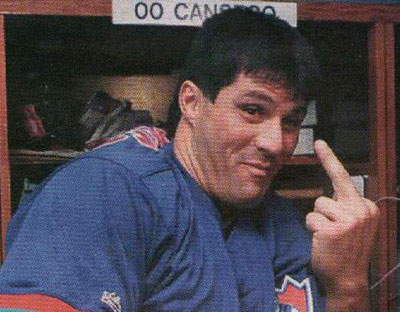
Jose Canseco...or is it his twin?

Mere Ethics Dunce is an inadequate title for former baseball slugger Jose Canseco, somehow. He has dabbled in extortion and assault, but his real contribution to making the world worse was serving as a one-man steroid epidemic, using the performance-enhancing, testicle shrinking drugs himself to win an American League  Most Valuable Player award, then making sure that as many players as possible on the various teams he played with used them too. Continue reading

Hall of Fame Ethics: The Jeff Bagwell Dilemma

Members of the Baseball Writers Association of America have been turning in their ballots for the Hall of Fame, their collective totals eventually determining which retired major league baseball stars will have plaques in Cooperstown. If you follow baseball closely, you are aware of the big debates this year: Is Tim Raines worthy? Will Bert Blyleven finally make it? Has Alan Trammel been unfairly neglected? What about Jack Morris and Roberto Alomar? If you don’t follow baseball, you couldn’t care less, and I pity you. One controversy this year, however, should be of interest to non-fans as well as fans, because it involves the proper application of the ethical principles of fairness and equity in an environment of doubt. It is the Jeff Bagwell dilemma. Continue reading

The Replay and Integrity: Baseball at an Ethics Crossroads

On the final day of baseball’s regular season, the San Francisco Giants were playing the San Diego Padres in a contest with post-season implications for both teams. Had the Padres won , it would have forced two one-game playoffs, with the loser of a Giants-Padres showdown today facing the Braves on Tuesday to determine the National League Wild Card team. In the bottom of the first, the Giants’ Andres Torres smashed a Mat Latos  pitch down the left-field line. The ball clearly landed right on the chalk-marked foul line, kicking up a cloud of white dust as undeniable proof that the ball was fair,and the batter destined for second base or beyond. Third-base ump Mike Everitt called it foul, however. Broadcasters, the Giants managers, everyone protested and pointed, but to no avail.

The Giant’s won anyway, so it only mattered to Torres’s batting average. But a time-bomb is ticking. Baseball, which was embarrassed last season into adopting video replay for home run calls, allows no videotape mandated reversals on other blown umpire calls. As the game heads into its period of highest visibility, when casual baseball fans start paying attention to the best teams playing for the title, the likelihood of an obviously wrong call by an umpire leading to an undeserved win in a crucial game is unacceptably high. Why does baseball’s leadership resist a solution? Continue reading