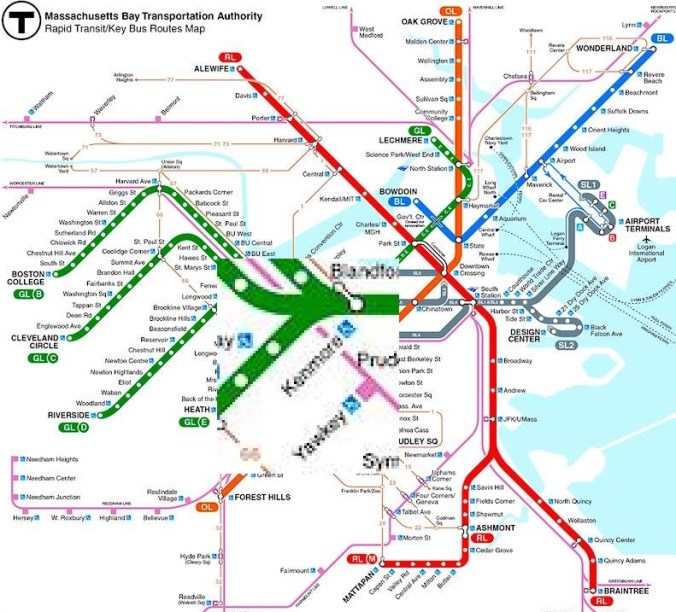
(I enlarged the two Fenway Park stops for your convenience…)
I grew up rising the buses and subways in Boston, and later oversaw a huge U.S. Chamber of Commerce study on transportation infrastructure funding problem (hopeless then, much worse now) , so the Boston Councilwoman’s fascinating theories about how making public transit in Beantown free to riders immediately interested me…since I knew it was crap.
I probably should delve into this issue more frequently, so I was pleased and relieved that fellow New Englander Rich in CT gave us this Comment of the Day on the post, “More Evidence That Arthur Herzog’s Novel “IQ 83” Is Coming True—Beside The Fact That Bernie Sanders Is Leading The Race For The Democratic Nomination, That Is”:
The economics of public transportation are counter intuitive, and this plan is not as insane as it sounds. However, for a city like Boston, it would be absurd to eliminate ridership fare.
Let’s look at my hometown. We have one bus hourly from 7 AM to 10 AM, and 2 PM to 6 PM, that connects to a neighboring city. The farebox recovery ratio is about 15%: For every dollar spent on the service, customer fares return $0.15 – 15 cents on the dollar.
The bus is provided as a bare bones courtesy for those who need it. If the bus company raises the fare, ridership will go down, because people cannot afford to use it anymore (they then cannot get to work…). Fare recovery goes down with an increase in fare, but the cost of running the shuttle remains the same. The very population it is meant to serve is not served. We’d be running an empty bus back and forth.
In all truth, my town subsidizes 100% the cost of the shuttle under its contract with the city; the $2.00 fare effectively pays for the transfer to a city bus. Eliminating the bus fare only modestly increases the necessary public subsidy; any expansion of hours or geographic distance would also require an increase in subsidy.
If we look at a city like Boston, the economics are very different. The service is still provided for those who need it, but a great many more need it. The fare box recovery is closer to 30%-50%. The cost of the service is the same whether people are on it or not, so the city offers discounts for bulk purchases to attract people who would otherwise use a car. This has the positive effect of increasing ridership and improving the fare box recovery slightly; it also has the perverse effect that the people who need it the most pay the most for it. Continue reading

 Ethics Alarms