Unethical Quote of the Week: University of Wisconsin-Stout Chancellor Charles W. Sorensen

"Oh, HELP me, University administrators! A poster says that a fictional space cowboy from a TV series that isn't on anymore might kill me, or someone, under certain conditions!"

“UW-Stout administrators believe strongly in the right of all students, faculty and staff to express themselves freely about issues on campus and off.  This freedom is fundamental on a public university campus. However, we also have the responsibility to promote a campus environment that is free from threats of any kind—both direct and implied. It was our belief, after consultation with UW System legal counsel, that the posters in question constituted an implied threat of violence.  That is why they were removed. This was not an act of censorship.  This was an act of sensitivity to and care for our shared community, and was intended to maintain a campus climate in which everyone can feel welcome, safe and secure.”

—-

, one featuring a humorous quote from a cult TV science fiction series, the other a satiric poster opposing fascism, as in cases where speech-censoring university administrators remove harmless pop culture references they don’t understand. Continue reading
Comment of the Day: “The University of Wisconsin’s Lesson: Ignorance + Political Correctness = Repression”

Michael posted the Comment of the Day (though I am posting it here a day late), discussing the plight of the U. of Wisconsin professor whose “Firefly” poster was deemed to create an unacceptable risk of violence. Here is his perceptive addendum to  The University of Wisconsin’s Lesson: Ignorance + Political Correctness = Repression:

“I think you are missing another force at work here: the bureaucracy . They have gladly embraced the political correctness of the liberal majority on campus, not because they necessarily believe in it, but because it lets them have power. There is a wonderful quote from P.J. O’Rourke on this, “bureaucracy is attractive because it gives every piss-ant an anthill to piss from”. Chief Walker got to exercise arbitrary and petty authority in tearing down the posters. People who enjoy the exercise of unrestrained power over people are attracted to such positions. By challenging her, Miller was challenging the entire bureaucratic ruling class of the university, and that couldn’t be allowed. From that moment on, he was going to be picked on and subject to unreasonable scrutiny, subjected to endless requests to comply with the most outrageous interpretations of every University regulation. He will be subjected to endless meetings to explain and justify every time he goes to the bathroom before a “Hearing consisting of both faculty and administrators”:

“Section IV, paragraph 5 of the faculty clearly state that “when not teaching, faculty should be available to students”. By using the men’s room, you were unavailable to female students. This was a blatantly sexist act of your part and under my authority as gender relations officer are ordering you to attend sensitivity training.”

The University of Wisconsin’s Lesson: Ignorance + Political Correctness = Repression

Why does a defunct cult TV space Western threaten the University of Wisconsin? Good Question!

As in the disturbing incident at Widener Law School, in which a professor has been persecuted and punished for the imagined sexist and racist implications in his  fanciful classroom hypothetical, a theater professor at the University of Wisconsin in Stout, is now being subjected to full-fledged censorship by the university’s administration because of a pop culture reference that it finds “threatening.”

And also as in the Widener situation, one wonders if the school’s faculty cares enough about academic freedom and free speech to support their colleague. So far, they have not.

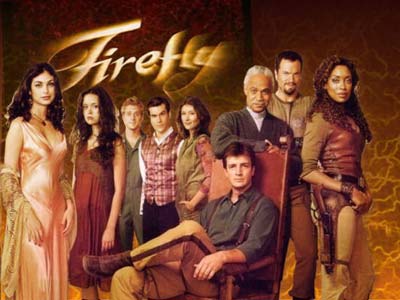
Prof. James Miller is, like me, a fan of “Firefly,”  Joss Whedon’s late, lamented science fiction TV series. He mounted a poster on his door that shows actor Nathan Fillion as Malcolm “Mal” Reynolds, captain of the spaceship that cruised through the series.  The poster includes a famous line (well, famous with fans of the show, at least) by Reynolds in the first episode,  delivered in response to a passenger who asked if he was in danger of being murdered while he slept. “You don’t know me, son, so let me explain this to you once,” Fillion’s character said. “If I ever kill you, you’ll be awake. You’ll be facing me. And you’ll be armed.”

Lisa Walter, the university’s chief of police, took down the poster, stating that “it is unacceptable to have postings such as this that refer to killing.” Walter said that the poster was not covered by the First Amendment:

“ We were notified of the existence of the posting, reviewed it and believe that the wording on the poster can be interpreted as a threat by others and/or could cause those that view it to believe that you are willing/able to carry out actions similar to what is listed. This posting can cause others to fear for their safety, thus it was removed.”

Absurd. Ignorant. Offensive.  And an abuse of power. Continue reading

Ethics Quote of the Week: Justice Antonin Scalia

“Justice Alito recounts all these disgusting video games in order to disgust us — but disgust is not a valid basis for restricting expression.” 

Justice Supreme Court Justice Antonin Scalia, in the majority opinion of Brown v. Entertainment Merchants Association that over-turned a California law restricting the access of children to violent video games. Scalia was responding to the argument by conservative colleague Joseph Alito, who described the wide range of violent and offensive experiences a child could have though video-gaming, such as reenacting the shootings at Columbine High School and Virginia Tech,  raping Native American women or killing ethnic and religious minorities.

Scalia is the Supreme Court justice liberals love to hate, but he is the most stalwart defender of the First Amendment since Justice William O. Douglas and Justice Hugo Black on the Warren Court. As political warfare increasingly focuses on the tactic of suppressing and inhibiting speech and ideas rather than rebutting them, Scalia’s uniform rejection of any effort to squelch the free exchange of ideas, even disgusting ideas, is the last line of defense against government-imposed political correctness, nanny state thought control, and puritan censorship. While sufficiently important ends, such as protecting our children and our culture, may justify some extreme means, Scalia’s opinion reaffirms the core American principle that those means can never include government restriction of speech in its broadest definition. Continue reading

The Supreme Court Saves An Ethics Principle

Mayor Quimby is honest about being corrupt. Isn't that good enough?

Rescuing the states’ power to insist on more ethical conduct from their elected legislators, The U.S. Supreme Court ruled Monday that there was no Constitutional prohibition on state rules against legislators voting on issues in which they have a private, personal interests.

The unanimous decision upheld a Nevada ethics law that governs when lawmakers recuse themselves from voting on official business because they might have conflicts of interest. The challenge to the  law came from Michael Carrigan, a conflicted city council member from the Sparks, Nev., who was reprimanded by the state ethics commission after he voted  on a casino proposal though his campaign manager had been hired as a consultant to the project.

The law prohibits a public official from voting on an issue when a “reasonable person” would suspect a conflict because of financial ties or the interest of a spouse or family member. This is the essence of “the appearance of impropriety.” It also includes “any other commitment or relationship that is substantially similar” to those spelled out.  Carrigan had argued that the Nevada’s law was overly broad and that he should be able to vote on the project, so long as he disclosed his relationship with the consultant.

Ah, disclosure! Continue reading

The Attack of the Grievance Bullies Continues…on “Napoleon Dynamite”???

So...I guess "Tropic Thunder" is out of the question, right?

A bulletin from the Austin (Texas) Parks Foundation:

“The Austin Parks Foundation is canceling tonight’s (Wed, 5/25) showing of Napoleon Dynamite at Republic Square. A new movie will be shown next month. A number of people contacted us objecting to a word used by actors in the movie. We didn’t recall that this word was used and we did not mean to offend anyone. Our apologies for this as well as for the last minute cancellation.”

The PG movie, you see, about a maladroit teen, upset advocates and defenders of the mentally challenged, or whatever code words are deemed politically correct these days–I haven’t checked my “Offense-O-Meter” in the last couple days—because one of the characters uses the word “retarded” exactly once…not to describe someone who is actually laboring with a disability, mind you, but to insult his friend, as teenagers are wont to due, and as they were especially wont to do in the Eighties, when “retarded” was used the way my generation used “spaz.” In other words, there was no justification whatsoever for either the complaint or the movie’s cancellation. Continue reading

The Internet Censorship Bill and Escalating Abuse of Government Power: Why Do We Continue to Trust These People?

Yesterday, the Senate Judiciary Committee unanimously approved a bill giving the U.S. Attorney General the power to shut down any website with a court order, if  he determines that copyright infringement is  “central to the activity” of the site.  It doesn’t matter if the website has actually committed a crime, and there is no trial, which means that the law is a slam dunk violation of the U.S. Constitution.  The Combating Online Infringement and Counterfeits Act (COICA) is a little goody bought by the lobbyists and PACs of Hollywood, the recording industry and the big media companies, to block the rampant internet file sharing that has cost them a lot of money in lost sales and profits over the past decade.

I am adamantly opposed to filesharing and the ethically dishonest arguments used to defend it, most of which begin with “Everybody does it.” I sympathize with the artists whose work is being stolen, and the companies who have complained to Congress. But all the strong condemnation of filesharing by lawmakers and corporate executives doesn’t change a central fact: the Constitution says you can’t do what COICA allows. It says this in at least two places: the First Amendment, which prohibits government interference with free speech, and the Fifth Amendment, which decrees that property can not be taken from citizens without Due Process of Law. A law that lets a government official just turn off a website without a hearing or showing of proof? Outrageous. and unconstitutional. Continue reading

9-11 Conspiracy Claims: The Hate Crime We Cannot Stop, But Must Not Tolerate

The stated belief that the United States government murdered its own citizens and military personnel on September 11, 2001 is, if sincere, proof that an individual possesses intractable misconceptions, hatred and disrespect for America’s history, culture, and ideals. If the belief is not sincere, then the claim that the Bush administration orchestrated (or allowed) the Twin Towers and Pentagon attacks is an effort to harm our nation by destroying its reputation and honor, dragging it into the swamp of other nations to which murder and dictatorship are traditional. The First Amendment requires that we allow these individuals, be they deranged, sinister, irresponsible or merely stupid, to deny what makes the United States unique and slander its elected leaders, but it does not require that we accord them respect or tolerance. Continue reading

Ethics Tip For Police Being Videoed: Smile!

Every now and then one learns about a practice that seems so obviously wrong that it is difficult to believe it could really occur in America. The police’s broad power to confiscate property used in the commission of a crime stunned me when I first read about it in law school. Municipal government use of the power of eminent domain to take private property and turn it over to corporate interests for profit-making development, as in the Kelo case, was another example. During the health care reform debate, I learned that our elected representatives not only didn’t bother to read major legislation, they thought there was nothing wrong with not reading it. I’m still scratching my head over that one.

The increasingly common phenomenon of police arresting citizens for recording arrests and other police activity on video is the most recent example of conduct that is so wrong it is hard to believe it happens—but it does. Continue reading

Avocations and Conflicts of Interest, Part II

As if to give ethical guidance to conflicted umpire Joe West, a similarly conflicted judge has shown Country Joe the way by quitting the bench to avoid ethical conflicts.

Admittedly, the ethical issues surrounding independent filmmaker/ New Jersey Judge Kenneth Del Vecchio are a little bit different from Joe’s. One of his creative efforts was called “O.B.A.M. Nude,” and was a satirical critique of the President, though Del Vecchio played the Obama-like hero himself. A judicial ethics panel opined that his film exploits raise the specter of an ethical conflict under the Code of Judicial Conduct, presumably including the section that reads, Continue reading