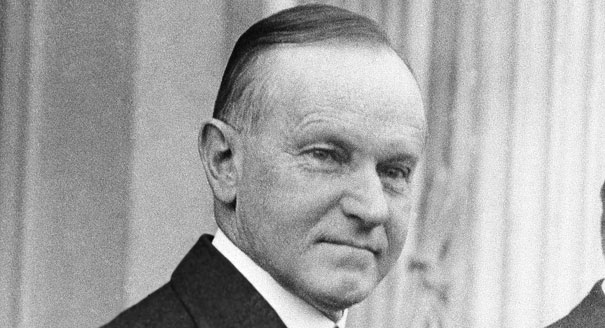
“About the Declaration there is a finality that is exceedingly restful. It is often asserted that the world has made a great deal of progress since 1776, that we have had new thoughts and new experiences which have given us a great advance over the people of that day, and that we may therefore very well discard their conclusions for something more modern. But that reasoning can not be applied to this great charter. If all men are created equal, that is final. If they are endowed with inalienable rights, that is final. If governments derive their just powers from the consent of the governed, that is final. No advance, no progress can be made beyond these propositions. If anyone wishes to deny their truth or their soundness, the only direction in which he can proceed historically is not forward, but backward toward the time when there was no equality, no rights of the individual, no rule of the people. Those who wish to proceed in that direction can not lay claim to progress. They are reactionary. Their ideas are not more modern, but more ancient, than those of the Revolutionary fathers.”
—President Calvin Coolidge
For no particular reason, this is the third post in less than 24 hours to reference Silent Cal. As this speech, on the occasion of the 150th anniversary of the signing of the Declaration of Independence, shows, Cal wasn’t so silent, and when he has something to say, he was often worth listening to. Coolidge’s reflections are thoughtful and characteristic. His ultimate point is that the document is rooted in spirituality and morality, which is to say that it is virtuous and right. Morality, along with religion, has been in steep decline in the public square, academia and in the culture since 1926, but Coolidge’s argument is no less valid and persuasive if transferred to the realm of ethics. Though they were, as Coolidge says, guided by their understanding of religious principles, the Founders were also students of philosophy and ethical analysis. The Declaration, the Constitution and the United States of America are all the offspring of ethics, as well as morality.
Here and below is the whole speech. (Pointer, and gratitude, to Instapundit) Continue reading





With so much loose talk about impeachment going around (and by “loose” I mean “inexcusably ignorant”), texagg04’s review of the Constitutional standard for the removal of a President is a gift to readers of Ethics Alarms, and one of the most interesting and informative comments ever to appear here.
He was reacting to a New York Times op-ed, cited by another commenter, by political scientist Greg Weiner (no relation) titled, “Impeachment’s Political Heart,” in which the author concluded,
Having studied the issue myself, I immediately rejected Weiner’s analysis (which still is worth reading in its entirety) on the ground that a constantly evolving standard of what is a “high crime and misdemeanor” simply means that Presidents can be impeached for behaving, or governing, in ways that enough members of Congress, the news media and the public don’t like. That is what is being advocated now, and that approach would undermine our democracy, the power of elections, and the office of the President.
My gut response, however, is wan and insubstantial compared to tex’s masterful historical review and astute analysis, which (whew!) reaches a similar conclusion.
Here is texagg04’s fascinating Comment of the Day on the post, “Reluctant Additional Ethics Notes On A Manufactured “Crisis”: The Comey Firing Freakout”…I’ll have one brief comment afterwards: