Last year, once again pondering the date in history that most Americans of my generation look back on as The Day We Remember Where We Were the way more recent generations think of 9/11/2001, I wrote in part,
“Today I barely saw a mention of Kennedy’s assassination, and, frankly, I very much doubt that anyone who didn’t experience the national reaction to the events of November 22, 1963 and its aftermath could comprehend what it felt like to be an American jerked violently out of the sedate 1950s into the turmoil, anger, fear and upheaval of the mad 1960s.
“November 22, 1963 was the catalyst for that cultural shift, and we will never know what was lost or gained. All we can know is that all of our fates, and the fates of everyone who follows us, was altered forever.
“I have always looked back on November 22 as a cursed day. Tomorrow is my wedding anniversary, now another sad day, but I changed our wedding date from the 22nd, when it was originally scheduled, because I could not conceive of being completely happy on the day John F. Kennedy, so young, inspiring and full of hope, died
“And you know, I sometimes think that this country has never been as happy and optimistic as it was before Lee Harvey Oswald fired his rifle from that warehouse. I wonder if it will ever be again.”
Well, the past year certainly has not provided a hopeful answer to that query, has it? That thought pointed me to another November 22 Ethics Alarms post, that one from 2013. I think it is especially relevant today, so I am reposting it.
Grassy Knoll Ethics: How Deception Breeds Distrust
We once again must squarely face the hoary quote from Walter Scott’s epic poem Marmion: “Oh what a tangled web we weave when first we practice to deceive.” It is hoary because it is true, and this month’s Smithsonian Magazine reminds us of how true it is, recounting how well-intentioned deceptions by the news media regarding evidence in the assassination of President Kennedy helped create a conspiracy theory that will not die, and that may have begun the slow, relentless deterioration of America’s trust in its own government that has reached dangerous proportions today.
Frame 313 of Abraham Zapruder’s accidental record of one of the pivotal moments in U.S. history gave him nightmares, and when he sold the rights to his amateur movie to Life Magazine, he insisted that frame be withheld from the public, and not published. “We like to feel that the world is safe,” documentary maker Errol Morris explains in the article.“Safe at least in the sense that we can know about it. The Kennedy assassination is very much an essay on the unsafety of the world. If a man that powerful, that young, that rich, that successful, can just be wiped off the face of the earth in an instant, what does it say about the rest of us?” I understand, but withholding the truth is not the way to make the world seem safer. As the story of the conspiracy shows, it is how we end up trusting no one.
For Life finally did withhold frame 313 from the public, the frame that showed the young President’s head exploding from a rifle bullet, and when the frame was finally revealed (by, of all people, Geraldo Rivera in 1975), and with it the truth that key evidence had never been exposed for public examination, the public was shocked at what it didn’t know and hadn’t been allowed to see.
“Which resulted in a kind of collective national gasp as millions of Americans simultaneously saw something that they had previously only read about, “ the Smthsonian article notes. “The Zapruder shock and other doubts raised about the underside of recent American history such as Watergate helped impel the creation in 1976 of the Senate’s Church Committee (named after Sen. Frank Church of Idaho). It turned over the rock that was the CIA at the time, and discovered, among other scandals wriggling underneath, the CIA/Mafia assassination plots against Cuban President Fidel Castro, some of them fostered during the Kennedy administration—plots that would provide possible assassination motives for Castro, for anti-Castro forces, for the CIA, for the Mafia, or some unholy alliance of more than one of these. Indeed the committee ultimately determined that both the CIA and the FBI had withheld material information about these matters from the Warren Commission.”
The Church Committee, though we forget this now, concluded that Oswald was not a “lone gunman,” primarily through a mistaken expert interpretation of a motorcycle cop’s recording of the gunshots, which forensic examination seemed to show were four, rather than three. Though this was later debunked (though not to everyone’s satisfaction, of course) , the Kennedy conspiracy theories were given new credibility, culminating in Oliver Stone’s truly despicable film, “JFK” which spiced them up with slanderous accusations against President Johnson and other nonsense, all disguised in documentary form to make pure fantasy appear to be verified fact. (“JFK” is one of the six movies I have walked out on in a theater, though I forced myself to watch the whole, nauseating thing later. One of my favorite deceits was Stone’s key “fact” that a marksman couldn’t get off three shots with Oswald’s rifle in six seconds, a lie that almost drove my late father, a lousy infantry marksman (by his own assessment) who could squeeze off that many shots in six seconds, to apoplexy.)
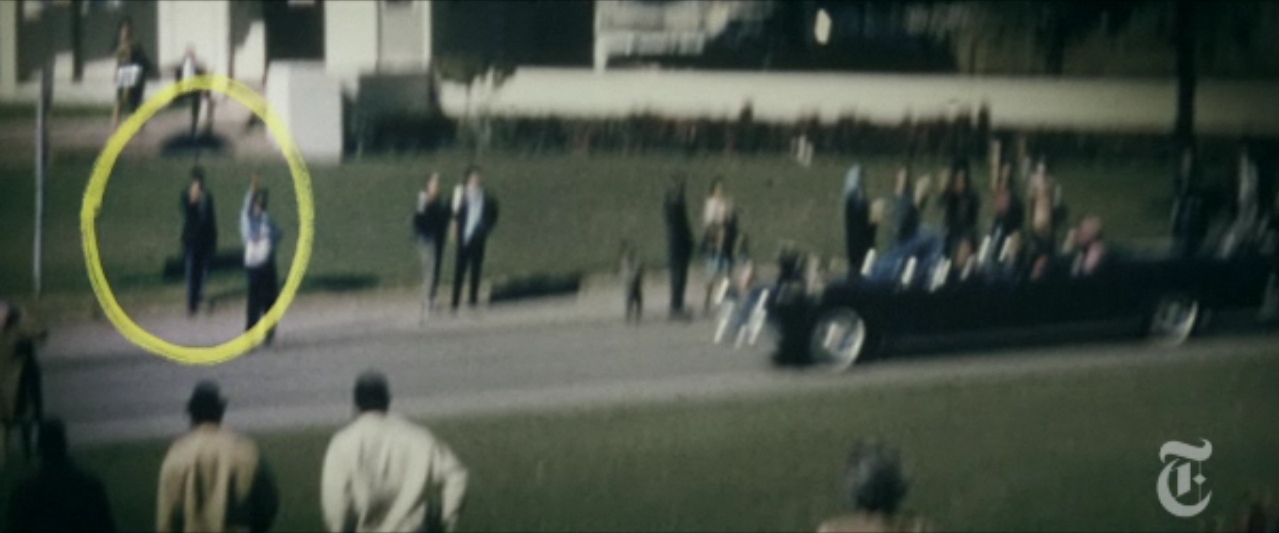
The article, “What Does The Zapruder Film Really Tell Us?” demonstrates how once proof is found that dishonesty and secrets withheld have polluted the accounts of events, random, unpredictable occurrences suddenly take on a sinister significance. The most fascinating example is how the accidental appearance of “the Umbrella Man” on another frame of Zapruder’s film became a key feature in assassination conspiracy lore. The film shows a mysterious man in the Dallas crowd opening an umbrella for no apparent reason as the the President’s motorcade passes. A signal to shoot? A weaponized bumbershoot? Actually, we learn, the umbrella action was a wacky and obscure protest by a fanatic hater of JFK’s pro-Hitler father, Joseph Kennedy Sr., and was meant to symbolize Neville Chamberlain’s fateful capitulation at Munich….Chamberlain was famous for carrying a black umbrella, you see.
Thanks to a well-meaning but unethical censoring of a crucial historical record, a toxic seed of distrust was planted that turned a trivial act into confirmation of a conspiracy. (In a final example of Chaos Theory run amuck, it also resulted in a clever parody of the Zapruder film in a Seinfeld episode, including “the Umbrella Man’s” protest as a brilliant grace note.) The frame gave the film-maker nightmares, you see, and he didn’t want others to suffer as he was; and a family photography magazine decided to spare the American public of the trauma from a frightening image, for our own good, of course. But the collective, unpredictable, metastasizing results of this well-intentioned, deceptive censorship, combining with so many other deceptions, large and small, trivial and vital, in unpredictable ways, created a hopeless tangle of cynicism, confusion and distrust, that has not served the public good.
Deceptions never do.
__________________________
Spark and Facts: Smithsonian Magazine

