Ethics Hero: Angela Martin, As St. Paul Strangers Prevent A Suicide

Angela Matin

Remember Raymond Zack?  In 2011, 50-year-old Raymond Zack waded into the surf at an Alameda, California beach and stood calmly in the 54-degree water, apparently waiting to die. His suicide took nearly an hour, but eventually he drowned, with no rescue attempts from any of the 75 San Franciscans, including firefighters, who gathered on the shore to watch the entire tragedy. I am so used to reading about bystanders allowing desperate people, sick, wounded or otherwise in peril, to perish because they “didn’t want to get involved” that a story like this one, the opposite of the Raymond Zack tragedy from St. Paul, Minnesota, comes as a shock.

How sad is that?

Motorist Angela Martin  saw a woman  climb onto a concrete wall and scale a chain-link fence above Interstate 94 in St. Paul, Minnesota. Martin could have continued driving, but she acted immediately, parking her car and calling 911. But she sensed there was no time to lose. Martin ran over to the woman, who  having climbed over chain-link fence was now clinging to it with her fingers above heavy highway traffic.

“ No, honey. Don’t do this,” she shouted. Martin told reporters that the distraught young woman kept repeating,  “My mom don’t love me. My mom don’t care for me.’”

“No, we love you, ” Martin told her. Martin reached through the links  and grabbed the woman’s shirt and  belt, just as the would-be suicide released her grip so she could fall to her death. Other motorists on the overpass saw the unfolding scene and came to Martin’s aid, and joined her in reaching through the fence to keep the woman from falling. Continue reading

“Such Is Life,” The Kindness Of Strangers, And The Wonderful Ethics Saga Of Moises Treves And Judy Anderson

Such is life

This is an old story, but I’ve never written about it, and I need to be reminded that there is good in the world.

In the mid 1970s, Moises Treves was a day cook at a small taco stand on the island of Cozumel, Mexico, By all accounts he made the best tacos in town, and  American tourist Judy Anderson, a school teacher who visited the island several times, was a special fan of them. On one visit in 1977, Judy, traveling alone as usual, invited him to accompany her to the Mayan pyramids in the Yucatan Peninsula. Moises happily agreed and served as her tour guide. They had  lunch, speaking as best they could to each other using Judy’s limited Spanish and Moises’ broken English.

During the meal, Judy asked Moises if he had any ambition to open his own restaurant. Ah, he said, that was his dream, but he despaired of it ever coming true. He just didn’t have the money, and couldn’t seem to save anything.  Judy responded,”Such is life!,” an expression that Moises had never heard. He asked Judy about it, and the saying stuck in his mind.

As the lovely day came to a close, the two friends said goodbye:  Moises was about to take  the ferry back to the Cozumel, and Judy was heading o the airport and then home to United States. Mysteriously,  Judy gave Moises a sealed envelope and told him not to open it until he was home.

When Moises opened the envelope, he found five $100 bills.  They were accompanied by a letter that said,

“Dear Moises. Go make ‘Such is Life’ happen. Love Judy.”

Continue reading

Behold..THE DUMBEST ETHICS STORY EVER TOLD!!!

peetoy

Are you ready?

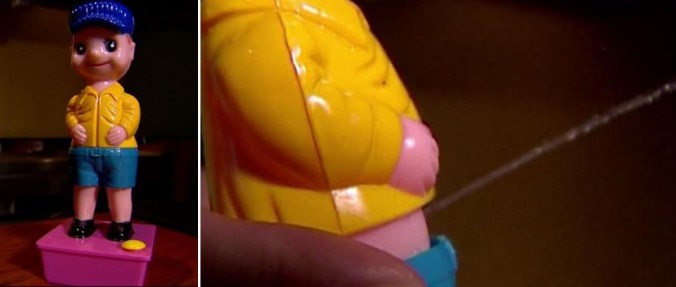
James and Isabelle Lassiter, who hail from Texas, were visiting Murfressboro, Tennessee and stopped into a Wasabi Japanese Steakhouse recently with their children. Apparently the sense of humor at hibachi restaurants has declined precipitously since the last time I ate at one, for I am told that the gag the Lassiters endured is now common fare. One of the Wasabi chefs held up a plastic toy depicting a little boy, and when the boy-toy dropped his shorts, he squirted water in a long, thin stream, as if urinating. The children were delighted! They were especially delighted when the stream hit their mom in the face.

Isabelle Lassiter was not delighted. In fact, she and her husband called the police, and accused the chef of sexual assault. “It peed on me…basically, out of his… wee wee area,” Isabelle explained, delicately.”It really didn’t have a wiener, but you got the point.” Investigators, who briefly took the toy into custody, indeed noted that the toy wasn’t anatomically correct. An officer wrote, “I observed the toy to have no penis and just a hole for the water to shoot out.”

PLEASE don’t tell me that if the toy did have a plastic penis, the claim of “sexual assault” would have been taken more seriously.

The Lassiters agree that this detail should not matter. “Just because somebody cut off a piece of plastic…doesn’t change the fact that you’re getting peed on,” said James Lassiter. “It was a sexual style assault on my wife.”

This is not a hoax. I wish it was a hoax. Reading about it has temporarily disrupted my capability to organize my thoughts, so I’ll just note the following in no particular order:

1. It was not sexual assault, by any stretch of the imagination. Nobody “peed on” Mrs. Lassiter. The cook squirted water on her, using a juvenile, risqué version of a squirt gun.

2. If Isabelle thought even  for a second that the stream of liquid was urine, she has a cognitive problem. Isabelle, pay attention: plastic figures do not urinate. They are toys. They have no bladder or kidneys. Even if the liquid comes from the toy’s “wee wee area,” it can’t possibly be urine.

3. Calling the police was beyond an over-reaction; it was truly idiotic, and it should be punishable. I’m trying to think of any reason not to have an ordinance that declares a spurious and wasteful call for police a misdemeanor carrying a hundred-dollar fine. Of course, such an offense should only be declared in extreme circumstances…like this, for example.

4. The manager of Wasabi did issue an apology to the couple, but claims he has never had any complaints about the toy in the past. “The kids like it, they think it’s a water gun, kind of like a water gun you know,” said Mr. Huang. Ah! The old “if kids think it’s funny, it’s ethical” standard. This standard is not reliable. The Lassiter kids might well have also found it hilarious if the chef hit their surprised mother with a cream pie, a pillow, or a dead cat. Continue reading

Photojournalism Ethics: The Faces Of Hillary

Clinton fair

Long ago, a Pennsylvania governor named William Scranton ran for the Republican nomination. He wasn’t a bad-looking man, but he was given to extreme facial expressions, the most grotesque or silly of which always seemed to be captured by photographers and put on front pages. I was a kid, but just reading my dad’s Time Magazines was sufficient to make me feel sorry for Scranton. The photos made him look like lunatic or a drunk. Yet on TV there was nothing unusual about Bill Scranton at all. He had an expressive face, and a fleeting look that might pass his countenance in a nanosecond, barely visible to observers, could make him appear frightening or ridiculous when captured and frozen in time. I wondered then why editors chose and published such misleading and unflattering photographs.

Now I know. They do it because they can, and because they are mean and irresponsible.

As a victim of this tactic, Scranton got off easy compared to Hillary Clinton. Camera technology now permits even more fleeting expressions to be captured, and while the largely Clinton-protecting newspapers shy away from unflattering Clinton photographs, the web is teeming with them. Like Scranton, Hillary has a very expressive face, and one that has become more expressive with age. Unfortunately, this means that she has left a damaging trail of photos of her split-second facial reactions that make her look crazy, sinister, or ridiculous. Matt Drudge, in particular, revels in them. Yes, I have used them myself; like Clinton or not, they are almost irresistible. I’m not proud of it. I’m not doing it any more.

I have concluded, belatedly, that using these misleading and unflattering photos of Mrs. Clinton is very unfair, and the visual equivalent of an ad hominem attack. I know all the rationalizations: The camera doesn’t lie (but we know it does), the camera captures the soul (suuure it does), it’s a joke, and she can take it ( a double rationalization there); everybody does it.

None of them are persuasive. Doing this to anyone, celebrity or not, funny or not, is cruel and  unfair; I think most people know it’s cruel and unfair.

It is also conduct that violates the Golden Rule. Your host knows this as well as anyone: I’m not hideous in real life,  but photos of me often make me looks deranged or worse. Like these, for example: Continue reading

Ethical Quote Of The Week: Relationship Advice Columnist Carolyn Hax

befriend-v-t-to-make-an-ingrate-quote-1

“[I]t’s time you made the acquaintance of an institution we all must embrace at some point in life: the thankless task. That’s how you file away changing a baby’s diaper, paying your taxes, visiting a relative turned cranky from infirmities, throwing in extra toward the tip because everyone else left the table. You do these because they’re the right thing to do, even though babies don’t sit up and say thanks for the squeaky-clean butt.”

—–Syndicated advice columnist and natural-born ethics whiz Carolyn Hax, answering a young woman’s question regarding the proper response to someone who should have thanked her for a kindness, but did not.

The letter writer was a high school athlete who, like most high school students today, had never been introduced to the satirical wisdom of philosopher/humorist Ambrose Bierce in his indispensable “The Devil’s Dictionary.”  The young woman had organized a senior night tribute to a graduating teammate, who then expressed no gratitude after the event.

“I am not sure whether or when I should broach the subject. Am I being needy and selfish, or do I have a legitimate case for feeling disowned?” she queried Hax.

As she is about 98% of the time, the columnist was spot on in her response. Doing good things and right things do not assume some kind of quid pro quo, cosmic or otherwise, in this  world or a subsequent one. Learning to feel good about doing the right thing whether you are praised, rewarded, thanked, or derive any tangible benefits yourself is one of the hardest lesson on the way to ethical living, and one of the most important. No, you shouldn’t assume that you will be treated unfairly, as Bierce suggests. As he meant to warn you, however, you shouldn’t be surprised, either.

Do not expect karma, or justice, or thanks—don’t even hold out for credit. Just figure out the right thing to do–how you would want to be treated, how you wish everyone would act, the conduct that will make society better for everyone by solving problems or making them bearable—and do it. Those who don’t understand that it’s also right to reciprocate by exhibiting recognition and gratitude  haven’t figured things out yet, and their ethics alarms are jammed.

Be glad yours are in good repair.

Ethics Dunce: Guardian Journalist Mona Chalabi

But Mona, doesn't you correcting people who correct people's grammar and calling them purveyors of white privilege make you an ANTI-grammar snob?

But Mona, doesn’t you correcting people who correct people’s grammar and calling them purveyors of white privilege make you an ANTI-grammar snob?

This won’t take long. It’s like shooting fish in a barrel.

Mona Chalabi, a  journalist for the British tabloid “The Guardian,” has asserted that correcting someone’s grammar (and presumably word use, sentence structure and other aspects of effective communication) is racist.

“Grammar snobs are patronizing, pretentious, and just plain wrong, ” she says. “It doesn’t take much to see the power imbalance when it comes to grammar snobbery. The people pointing out he mistakes are more likely to be older, wealthier, whiter, or just plain academic than the people they’re treating with condescension. All too often, it’s a way to silence people, and that’s particularly offensive when it’s someone who might already be struggling to speak up.”

Of course, correcting anyone to humiliate them, embarrass them, or make them hesitant to speak is cruel and wrong, as would be slapping them in the face and shouting, “Shut up, fool!”  Neither of these, or other examples of bad manners and disrespectful treatment, is the conduct that Chalabi is condemning as a demonstration of white privilege, however. (Glenn Reynolds, the Instapundit, frequently quips, “White privilege—is there anything it can’t do?”) No, she is saying that the simple act of one human being pointing out to another that they have made a verbal mistake that may embarrass the speaker in the future makes the person offering the correction a “grammar snob,” and is unethical.

To the contrary, correcting anyone’s mistakes in speaking, when done with discretion and proper attention to the speaker’s feelings, is a gift, an act of social kindness and even a social obligation. Expressing oneself in a manner that causes others to conclude, possibly correctly, that you do not know correct meanings, grammar, construction and etiquette is a serious life handicap and an obstacle to success. A listener may conclude that you are badly educated, do not read, do not listen to those who speak to you correctly sufficiently to learn from them, are ignorant, are not very bright, or worse, know how to communicate but don’t have enough respect for the rest of the world to make an effort to do so. Unlike concluding such unflattering things about a stranger or casual acquaintance based on an accent or verbal regionalism, making judgments based on poor communication skills is not prejudice or bias. Communication is a vital life skill and occupational tool. Every individual has an obligation to master these as early as possible, certainly by young adulthood. Believing one has done this and being wrong is a dangerous and potentially tragic situation. Continue reading

Carolyn Hax Sides With Bobby Darin, And Dazzles With Her Ethics Advice Again

Syndicated relationship advice columnist Carolyn Hax is as trustworthy an ethicist as I know. She doesn’t call herself an ethicist, and probably doesn’t think of herself as one, but she is far better qualified in the field than many with advanced degrees and tenured teaching positions, not to mention the corporate compliance hacks who write Ethics Codes for the likes of Enron. Carolyn Hax is an ethicist and a superb one because she has an innate, instinctive, nuanced and perceptive understanding of right and wrong, as well as remarkable skill at ethical analysis.

She proves this routinely in her weekly columns, but occasionally special attention should be paid. That was the case last week, when she was asked her blessing by an annoyed fiance on a decision to exit the relationship because her betrothed had decided to reject an offer to enter the world of high finance in favor of pursuing a career as a carpenter, concluding:

I’m seriously considering walking away because I think he is being really selfish given the long-term prospects. I am a professional and have supported us through his two-year master’s program. I am at my end here — what do you think?

In as nice a manner as possible, Hax nails what is wrong with this, saying in part: Continue reading

An Urgent And Probably Futile Call For Empathy And Compassion For The Victims Of Cultural Whiplash

north-carolina-protest-transgenderIt is sobering to read  the hateful and contemptuous comments from so many of my Facebook friends about the legislators of Georgia, Indiana, North Carolina, Mississippi and other states that have either passed or have tried to pass laws allowing citizens to opt out of the cultural freight train that gives them the option of boarding or getting crushed. Whether these are “religious freedom” laws or “bathroom laws,” aimed at transgendered interlopers in the once orderly realm of public bathrooms, or whether they are designed to fight for the definition of marriage as “between a man and a woman,” these laws, every one of them unwise and unethical, and probably unconstitutional too, need to be regarded as the inevitable and predictable result when human beings are forced to absorb cultural shifts in a matter of years or less that properly would evolve over generations

Culture–what any society, country, region, religion, business, organization, club, family, secret society or tree house agrees over time as how they do things, think about things, what is right and what is wrong, what is remembered and what is forgotten–is a constantly evolving process. Efforts to freeze it inevitably fail, because human beings as a species can’t stop themselves from learning. Efforts to rush the installment of major changes, however, can be disastrous, even when there seems like no alternative but to rush.

Laws don’t automatically change culture. They are part of the process, both reflecting and facilitating cultural shifts, as well as institutionalizing them. They do not even mark the end of such shifts. Nobody should be surprised, angry or abusively critical when those who have been raised to believe in certain values and practices feel betrayed and mistreated, and see the need to resist when their sense of what is right is suddenly proclaimed as not only wrong but the sign of a character deficiency and a cause for denigration and disrespect. Continue reading

Ethics Quote Of The Month: Ann Althouse

battery

“To everyone who likes that Lewandowsky got charged: Will you agree that everyone who does nothing more than that should undergo criminal prosecution? Are you willing to pay the taxes to cover that? Are you ready to find out that you’ve already done it and you’re going to be needing to hire a lawyer? Oh, but it’s so funny when it happens to somebody else, somebody you don’t like. If that’s what you think, please just admit to yourself that you are entirely morally corrupt.”

–Law professor and blogger Ann Althouse, taking the popular position among the talking legal heads on CNN and elsewhere that charging Trump’s campaign manager for the technical crime of battery for for what appears to be minor contact on videotape is an abuse of prosecutorial discretion.

Ann is playing law professor here, and it’s hard to tell if she is asking these questions to provoke thought from the knee-jerk partisans and virulent Trump-haters, or if she really believes everything she wrote. I;m a fan of Professor Althouse, so I want to find  a way to justify this post of her’s, which raises valid points and ignores others equally valid.

Do I “like” the fact that Lewandowsky was charged? I probably wouldn’t have charged him, but I’m not sorry he was charged. Why was a campaign manager grabbing a reporter? Why did the Trump organization react to the reporter’s complaint by attacking her honesty and character? I know the law shouldn’t be used to inconvenience people who act badly, and that doing this is usually an abuse of power. Still, do I like the fact that one of Trump’s thugs isn’t getting away with the thuggishness encouraged by his boss? Yes, I guess I do.

The charge can be justified on utilitarian grounds. Today I saw a cable TV news exchange regarding Fields’ complaint on CNN, where a lawyer explained that any unconsented touching is battery, and the interviewer was shocked. “What?” she said. Yes, I remember a lot of classmates in first year of law school being surprised at that too.

It’s the Common Law: nobody has a right to touch anybody else. I love that principle, myself: I don’t touch people unless I have permission, and they better not touch me. It’s  per se battery, and while we usually don’t press it, we might if the batterer is enough of a jerk, or does more harm than he intended. If charging Lewandowsky makes people think twice before laying their hands on me or anyone else, good. Sending a message to discourage others from wrongful acts is always a valid reason to charge someone. Continue reading

Unethical Quote Of The Week: Nautika Harris

miami-teen-home-intruder

“You have to look at it from every child’s point of view that was raised in the hood. You have to understand … how he gonna get his money to have clothes to go to school? You have to look at it from his point of view.”

Nautika Harris (above, right), the cousin of a 17-year-old teen shot dead by a 54-year-old Miami woman as he tried to exit her home, which he had entered to burglarize.

Miami-Dade police say that Trevon Johnson, 17, burglarized the home of a 54-year-old old woman last week.

She was not in the house when the break-in occurred, but after being alerted by her surveillance system, she rushed home and found Johnson climbing out of a window. She shot him dead, and his relatives are outraged.

“I don’t care if she have her gun license or any of that. That is way beyond the law … way beyond,” Johnson’s cousin Nautika Harris told local radio station WFOR. “He was not supposed to die like this. He had a future ahead of him. Trevon had goals … he was a funny guy, very big on education, loved learning.”

And loved burglary, apparently. Continue reading