I Found It! Presenting The Lost Rationalization, #57: The Golden Rule Mutation, or “I’m all right with it!”

sleeping woman

Every time I come across a rationalization for the Ethics Alarms list, I metaphorically, and sometimes literally, slap myself on the forehead. How could I have missed it? Thus I have been long convinced that there was a huge, obvious, missing rationalization that somehow got lost in the search for others. Jimmy Durante did a piano routine called “I’m the Guy Who Found the Lost Chord!” (“The Lost Chord” is a previously famous composition by Sir Arthur Sullivan) in which he celebrated finding the chord, then lost it again mid-song. (Jimmy later found it again when he sat on the keyboard in disgust, and the magic chord issued forth. “Strange” he said, “I usually play by ear!”) This is how frustrated I was until today, when  veteran commenter Tim LeVier led me to the Lost Rationalization, #57, “The Golden Rule Mutation,” or “I’m all right with it!” It’s a major one:

57. The Golden Rule Mutation, or “I’m all right with it!” Continue reading

Dead Ethics Alarms And Dead Brains In Cleveland

In other words, be just like Cleveland, Ohio.

In other words, be just like Cleveland, Ohio.

When I read that Cleveland was trying to bill the family $500 for the fatally wounded  Tamir Rice to be carried by an ambulance after an incompetent police officer shot the 12-year-old boy as he played with a toy gun in a city park, I began a mental countdown. How long would it be before a public outcry forced the Cleveland municipal government to cover the bill and apologize? It took about a day.

It doesn’t matter how one regards Rice’s death: a racist murder by a cop, excused by the justice system ( black activists, anti-polce race-hucksters  and too many journalists and pundits), blatant incompetence on the part of many adults and institutions, leading to the negligent, tragic death of an innocent child (Ethics Alarms), or something in between. The incident was a massive humiliation for Cleveland, its leadership and the police, justifying all of the anger and raw emotion in its aftermath. Tamir and his family were undeniably victims, and the city was the entity that harmed them. If there is a single individual on the city payroll who is incapable of immediately recognizing the grotesque insult of billing the family for removing the body of the dead child killed by city police, then the city itself is untrustworthy and dysfunctional. As it happens, many city employees must have been aware of the disgusting bill, and every one of them should have been smart enough to know that this was one expense the city had to eat or else. Now we know how and why Tamir died. Incompetent people are running the city, and incompetent people are dangerous.

Cleveland Mayor Frank Jackson apologized at a news conference yesterday, and said that the city would pay whatever wasn’t covered by Medicaid. “It was mistake in terms of us not flagging it, but it was not a mistake in terms of the legal process,” Jackson said. This logic echoes the rationalizations for the conduct of “The Worst Aunt Ever,” who sued her 12-year-old nephew to get insurance covered damages. Continue reading

A “When Ethics Alarms Don’t Ring” Case Study: The Angouleme International Comics Festival Thinks Announcing the Wrong Award-Winners Is Funny

In December, comedian Steve Harvey inadvertently announced the wrong winner of the Miss Universe Pageant on live, national TV. It was horrible. He then had to correct his mistake, the wrongly crowned Miss Columbia had to be uncrowned, and everyone except the sadists in the audience felt awkward and embarrassed. Harvey sincerely apologized, more than once.

How anyone could be aware of that fiasco, which received world-wide attention, and conclude that it would be hilarious to do the same fake-winner bit intentionally is beyond my small mind to comprehend. Such individuals would have to have their ethics alarms installed backwards, or buy them from the Bizarro World of Superman Comics. Yet the organizers of the Angouleme International Comics Festival this tear decided exactly that: “Let’s announce the wrong winners! It will be great!

The ceremony began with the MC, comedian Richard Gaitet,  announcing that“This will be the shortest ceremony in history, because all we want to do is drink and dance!” He then presented all nine awards in rapid succession, including the Fauve d’Or, the biggest award of the show, to Arsène Schrauwen, by Olivier Schrauwen. Then two women appeared and announced that the awards just handed out were fake, and they presented the real awards to completely different artists. The “winners” who just accepted their prizes in the exhilaration of pride and recognition, were as stunned as Miss Columbia.

The audience reaction, meanwhile, was exactly as you, I or any sane person would expect. Nobody laughed. Everyone felt that the targets of the practical joke had been abused. “We were all happy, we had tears in our eyes, and then we were humiliated,” said Sam Soubigui of Komikku, one of the publishers whose book won a “Faux Fauve” (fake prize). Another publisher who accepted a phony prize had already relayed the news of the honor to the writer and artist of the book that “won,” and then had to call them back and explain. One editor whose comic won a “Faux Fauve” left the auditorium in tears when she realized it was fake.

The condemnation of the stunt on social media was swift and unanimous. The organizers of the festival thought this was an appropriate response (courtesy of the French to English Google app, further translated by me from the typical gibberish these programs often create): Continue reading

From A Proud Abortion Defender, An Inconvenient Truth….

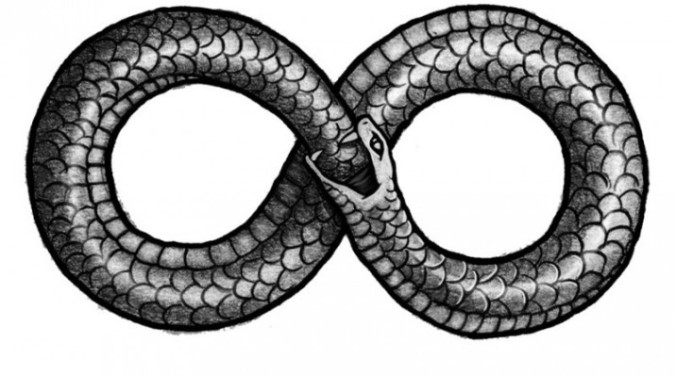
Snake eating its tail

A New York lawyer named Janice Mac Avoy gifted the Washington Post with an op-ed that was supposed to be a powerful brief for abortion. Viewing it as someone who is deeply conflicted about the ethics of abortion, which is to say, someone who is objective and who didn’t make up his mind first and then look for rationalizations to support that position, I recognized it as a perfect example of why abortion advocates still haven’t made a strong enough case for me, and perhaps why they can’t.

I am still surprised, somehow, when lawyers, like Mac Avoy, display poor reasoning skills. I shouldn’t be, I know: I’ve known plenty of dumb lawyers, even rich and successful dumb lawyers. I suppose I am hostage to the mythology of law school, that professors take students whose “minds are much,’ to quote Professor Kingsfield, and transform those minds into whirring computers of emotion- and bias- free rationality. Unfortunately, mush in, mush out tends to be reality.

Mac Avoy places her own mind in the mush column immediately, with her title “I’m a successful lawyer and mother, because I had an abortion.” This shows her adoption of the classic logical fallacy Post hoc ergo propter hoc, or “After this, thus because of this.” The statement is factually nonsense, and her column takes off from there.

Some highlights:

1. She writes…

“In spring 1981, I knew I wanted to be a lawyer. I was about to become the first person in my family to graduate from high school. I had a scholarship to college, and I planned to go on to law school. I was determined to break a cycle of poverty and teenage pregnancy that had shaped the lives of the previous three generations of women in my family — all mothers by age 18. Then, just before graduation, I learned I was pregnant. Knowing that I wasn’t ready to be a mother, I had a friend drive me to a Planned Parenthood clinic, where I had an abortion.”

Pop quiz: What crucial piece of information is glossed over, indeed strangely omitted, from that account? Mac Avoy “was determined to break a cycle of poverty and teenage pregnancy” —so determined and laser focused on the life goal that she suddenly woke up pregnant! How did that happen? Apparently, despite her representation to the contrary, she was not sufficiently determined that she was willing to refuse  to engage in the exact and only conduct that could foil her intent, and that she knew could foil her intent.

I’m not arguing that a teenage mistake of judgment should derail a life, but I am pointing out that to ignore that personal conduct, as Mac Avoy does, and pretend that pregnancy in every case is some unavoidable random tragedy like a rape or incest, is self-serving and intellectually dishonest, and like most pro-abortion rhetoric, avoids the key issues that make abortion a difficult ethical problem.

2. She writes… Continue reading

The Seventh Annual Ethics Alarms Awards: The Best of Ethics 2015, Part II

DavisHand

The Awards continue (Part I is here)….

Most Important Ethical Act of the Year:

The US Supreme Court’s Decision in  Obergefell v. Hodges in which the Supreme Court considered whether states had to recognize a right to same-sex marriages, and narrowly decided that they must. The prejudice against homosexuality is ancient, deep, and complex, mixed up in confounding ways with morality and religion, and deeply divisive. Nonetheless, I felt that the opinion should have been unanimous; it’s a shame that it was not, but in the end, this will not matter. The result was preordained from the moment gays began coming out of the shadows and asserting their humanity and human rights. Since the Stonewall riot, the nation and the culture has learned a great deal about the number of talented and productive gay men and women in our society and our history, the pain, ostracizing, discrimination and mistreatment they have suffered, and the falseness of the myths and fears that lead to this suffering.  In the end, as Clarence Darrow said about blacks, it is human beings, not law, that will make gays equal. No topic immediately causes such emotional and intense debate, on this blog or in society, as this one, but the Supreme Court’s decision is a major step toward changing the ethical culture, by asserting  that gay men and women have the same rights,  in the eyes of the state, to marry those they love and want to build a life with, and by implication, that the beliefs of any religion regarding them or their marriages cannot eliminate that right.

Outstanding Ethical Leadership

Senator Rand Paul.   I am neither a Rand Paul supporter, nor an admirer, nor a fan.  However, his June filibuster-like Senate speech against National Security Agency counter-terrorism surveillance was a brave, principled,  important act, and a great public service. The point Paul made needs to be made again, and again, and again:  there is no reason to trust the NSA, and no reason to trust the current federal government either. The fact that on security matters we have no real choice is frightening and disheartening, but nevertheless, no American should be comfortable with his or her private communications, activities and other personal matters being tracked by the NSA, which has proven itself incompetent, dishonest, an untrustworthy.


Parent of the Year

Tonya Graham

Toya Graham, the Baltimore mother caught on video as she berated and beat on her son in the street for participating in the Freddie Gray rioting and looting. Continue reading

The Unethical Web-Shaming Destruction Of Holly Jones

kilroysFB.0

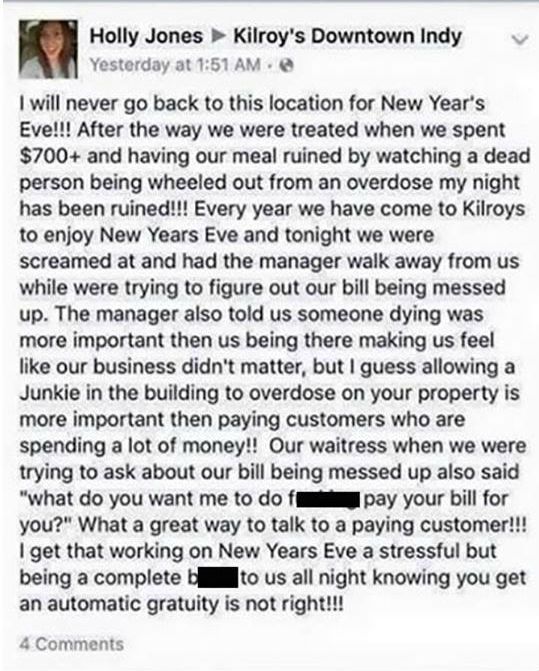
“I will never go back to this location for New Year’s Eve!!!” young Holly Jones ranted on an Indianapolis bar and restaurant’s Facebook page. “After the way we were treated when we spent $700+ and having our meal ruined by watching a dead person being wheeled out from an overdose my night has been ruined!” The angry post accused the evening’s restaurant manager of rudeness, the party’s waitress of profanity and the establishment itself of inattention.

After a sharp on-line rebuttal by the restaurant, the Web Furies were unleashed. Jones’ post became the latest web-shaming catalyst and an invitation to join a cyber-mob where fun could be had by all turning an ordinary jerk into a national villain. Lots of people signed up. The mob tracked down Jones and bombarded her own Facebook page with hate—she took the page down—then moved on to the salon where she worked as a hairdresser, threatening a boycott unless it fired Jones.

So it did.

These exercises in vicious web shaming can be ranked along an ethics spectrum. At the most unethical end is the destruction of Justine Sacco, who had her legitimate marketing career destroyed by social media’s  hysterical over-reaction to a self-deprecating, politically incorrect tweet. Now she works promoting a fantasy sports gambling website, a sleazy enterprise that entices chumps into losing serious cash with a business model derived from internet poker—she not only had her life derailed, she was corrupted too.

At the other end is Adam Smith, the one-time executive who wrecked his own career, with the help of another cyber-mob, by proudly posting a video of himself abusing an innocent Chic-fil-A  employee because Smith didn’t like her boss’s objections to gay marriage.  Somewhere between the two is Lindsay Stone, who lost her job by posting a photo showing her pretending–she later said— to scream at the Tomb of the Unknown Soldier while flipping the bird at the “Silence and Respect” sign.

The distance between Smith and Jones is the difference between words and conduct. Smith’s video showed him abusing a young woman, and his posting of the video indicated that he saw nothing wrong with it. Jones, in contrast, did nothing, other than prove herself to be, at least at the moment she posted her rant, an utter jerk. Everyone along the spectrum, however, including Jones, were excessively and unjustly harmed by the web-shaming  campaign against them. Last I checked, Smith was unemployed and destitute three years after his episode of atrocious judgment.

In the current case, the cyber-mob forcing Holly’s employer to fire her is ethically worse, by far, than anything she can reasonably be accused of doing by posting her criticism of the restaurant. Continue reading

Sign Language Interpreter Ethics Epilogue: “A Christmas Carol”

Gavin Alvedy rehearses a scene from the Downriver Youth Performing Arts Center's "Miracle on 34th Street" as DYPAC alum Emily Zaleski signs alongside him. Zaleski, who grew up performing on DYPAC’s stage, now is a certified American Sign Language interpreter with Synergy on Stage and will interpret during the Dec. 8 performance.

Sign language interpreters and their advocates descended on Ethics Alarms in indignation aftert  my March post about “showboating sign language interpreters for deaf audience members.” It took until December for my commentary to reach this passionate interest group, but when it did, I was called many names, including “ablist,” and had to put up with comments like this one from the ironically named “Danny Who Knows About Stuff”:

I would take this “ethics” person seriously if he/she seemed to know anything about the ethics that guide sign language interpreting. And, I suppose it would be helpful if the person understood anything about linguistics, sign language, Deaf culture, or audience response theory. This article is more about the individual than than the issue. In short, this person is no more an ethicist that is Donald Trump.

How I love the quote around “ethics.”

Danny was pretty typical. See, I don’t need to know about any of Danny’s “stuff” as a director of a play or musical. All I need to know is whether a feature of the performance detracts from it by foiling the focus that the staging was designed to facilitate. Every competent director knows that. The needs of the signer and the signer’s much, much smaller audience cannot be permitted to wag the dog, or make the dog trip on its tongue.  or perish of neglect.

“Danny Who Knows About Stuff” became “Danny Who Is Banned From Ethics Alarms,” in case you didn’t guess.

If I had already experienced what I experienced yesterday with a “professional” signer, that March post would have been much tougher. I directed an staged reading of “A Christmas Carol” with a cast of 30 terrific actors for a single free performance for D.C.’s Martin Luther King Library, and was told that the library would be sending a signer. Now, a signer for your usual staged reading is like having a signer for an oil painting. It makes no sense. In readings, the actors mostly read. Presumably the deaf can read “A Christmas Carol” themselves. You could say they would want to see the performers, but  in readings the performers’ acting mostly consists of vocal expression, which the deaf audience can’t hear, and facial expressions, which they won’t see if they are watching the signer. As it happens, I don’t do staged readings like that; there is a lot of movement and staging, so a signer makes some sense.

But they didn’t know how I would stage it.

By the time we got to the final rehearsal, I had forgotten about the alleged signer, who was supposed to at least attend one rehearsal so I could fit her onto the stage where she would be seen and not get in the way. She arrived, for the first time, 15 minutes before the performance, and immediately announced that she didn’t know whether she would be signing or not.  That’s helpful. She also complained that the script was very well adapted for signing (Why, thank-you!) and that the show, at 90 minutes, was impossibly long for a single signer to do: she was waiting to see if a second signer was coming, as she had assumed. Now, nobody warned me that I had to make room for two signers in the small performing space, neither of whom would deign to attend a rehearsal. ( Her complaint about length was also nonsense. I have had single signers for many shows longer than 90 minutes, and they didn’t collapse from exhaustion or finger cramps.) Continue reading

Update On “The Worst Aunt Ever” Debate

Auntie Maim and Nephew Maimer...

Auntie Maim and Nephew Maimer…

Remember the Ethics Alarms post about the favorite aunt who sued her 12-year old nephew for damages based on her injury when he jumped into her arms at his birthday party when he was 8? Remember the indignant plaintiffs lawyer who couldn’t get his mind around the fact that normal people don’t (ande shouldn’t) always see right and wrong like lawyers do, or that “it’s done all the time” (that is, The Golden Rationalization, #1 on the Rationalizations list, “Everybody does it”) and “there are worse lawsuits” ( or the worst of all rationalizations, #22, “Comparative Virtue” or “Its not the worst thing”) are not sufficient ethical defenses of a woman who voluntarily traumatizes a child who trusts her and who just lost his mother?

The Weekly Standard looks at the episode from some different angles, and writer Charlotte Allen does an excellent job providing a balanced analysis of the case (which I am now using in my ethics seminars to explain to lawyers how legal ethics alone is often not enough to make lawyers ethical). I am awash with regret that I didn’t think of the gag  “Auntie Maim” in the original post, which admittedly went a bit overboard in its condemnation as it was. Mostly, however, I am gratified that I was quoted in the piece after a well-handled interview with Charlotte, and indeed that she used my perspective to sum up the significance of the episode.

You can read it all here.

The Starbucks Stupid Red Cups Uproar Is Trivial, But The Growing Cultural Insanity That Caused It Is Not

STARBUCKS-cups

On one level, the angry protests by some evangelicals and others regarding Starbucks’ eschewing the placement of snowmen, Christmas tree ornaments, reindeer and whatever other holiday kitsch they have festooned their coffee cups with in past years is too stupid to waste time discussing. Here, read all about it if you have a strong stomach. It appears to be yet another of those issues that deserves the George S. Kaufman rebuke. [ “Mr. Fisher, on Mount Wilson there is a telescope that can magnify the most distant stars to twenty-four times the magnification of any previous telescope. This remarkable instrument was unsurpassed in the world of astronomy until the development and construction of the Mount Palomar telescope. The Mount Palomar telescope is an even more remarkable instrument of magnification. Owing to advances and improvements in optical technology, it is capable of magnifying the stars to four times the magnification and resolution of the Mount Wilson telescope.Mr. Fisher, if you could somehow put the Mount Wilson telescope inside the Mount Palomar telescope, you still wouldn’t be able to see my interest in your problem.”]

Yet the fact that not just a few recently escaped inmates of a mental institution would make an issue of the design of Starbucks coffee cups, but lots of people, is significant. Continue reading

Ethics Musings I : The Dark Side Of Personal Injury Lawyers

better-call-saul

I’ve been reflecting, since yesterday, on the bizarrely angry and intellectually dishonest protests registered here and on his own blog by trial lawyer Eric Turkewitz regarding the aunt who sued her 12-year-old nephew. His arguments, if you can call them that, consisted of constantly shifting the issue from ethics (what the aunt should have done) to law (what the aunt had a legal right to do), denying the core problem (Why would anyone assume that a child is harmed by dragging him into court, subjecting him to examination in front of strangers, and focusing on him as a wrongdoer and responsible for his aunt’s alleges misery, all mandated by the aunt who supposedly loves him?), and appealing to a dizzying list of rationalization and fallacies. He then made his exit by accusing me, a lawyer, of “knowing nothing about the law” (I made no assertions about the law at all—this is not a legal issue) making everyone stupid, and being a narcissist, a full-bore ad hominem attack ending in an ominous “May God have mercy on your soul!” Why would he act like that?

The reason, I realize, is that my posts challenge the basic belief system of the plaintiff’s bar, which I know very, very well having worked in an executive position and run such diverse programs as the research data base, conventions, sections, litigation groups and more over seven years with the Association of Trial Lawyers of America. Now ATLA is called “The American Association for Justice,” a name chosen purposefully to disguise the fact that it is a plaintiff’s lawyer’s lobby by keeping “trial lawyers” out of the name because it had a negative response in marketing studies. (I kid you not.)

Trial lawyers have done a lot of good and important things and continue to, but the profession is corrupting. There is a lot of money to be made, and ATLA–excuse me, AAJ, is devoted to eliminating any limits on their members’ ability to sue anyone for any amount, no matter what harm it does to the economy, the nation, the cost of health care, the bonds of trust in society, personal liberty, or public respect for the civil justice system. Individually, members of AAJ are among the top donors to the Democratic Party, in part to make sure that they can block all Republican efforts to limit jury awards, spurious lawsuits, and damages that have to be paid by negligent corporations when they destroy lives through shoddy products, conspiracies, and other conduct. The other reason is that Democrats support the redistribution of wealth, and trial lawyers profit by it.

In the matter of keeping corporations accountable, the AAJ is, as they will constantly remind us, on the side of the angels. But like other interest groups (the NRA, the ACLU, NOW, and may more) that stake out  extreme, self-serving and unethical positions in defense of legitimate rights, trial lawyers often feel that they must take the position that every injury and misfortune deserves compensation by someone else. Eventually, they believe it. Justice is taken out of the equation for all but the plaintiffs bar’s clients. Justice means that someone else is always at fault. Continue reading