Resolving An Ethics Alarms Ethics Conflict

poof-smallI just took down a post, something I have only done four times previously. This decision, unlike the others, was the resolution of a genuine ethics conflict, created in part by the recent discussions here.

Tonight I received a terse demand, phrased as a request but with a time deadline,* from a former commentary subject insisting that I remove a critical post here from nearly a year ago. The post was not factually incorrect, nor  did it make any factual assertions that could support a credible defamation claim. My commentary was pure opinion, though a fairly harsh one. I have pledged, following the inspirational example of Ken at Popehat and also attorney/blogger Marc Randazza, not to countenance web censorship involving bogus legal threats, and thus drafted and came within a finger-stroke of sending a rejection of the demand, and a strongly worded one.

Then I re-read the post at issue. It was a criticism of a tweet from a professional that I believed, and believe, had the effect of unfairly impugning an entire workplace and the identifiable colleagues of the tweeter. The tweet was wrong, but I realized that I was also wrong to highlight it here. I have been writing quite a lot lately about the inherent Golden Rule violation of web-shaming individuals for single and isolated unethical acts that fall short of illegality or such outrageous callousness or cruelty that there is a duty to warn others. I think there is a toxic cultural trend, fed by the power of the internet, that will soon make web bullies and assassins of us all, and potential victims as well. I want to fight that trend, not contribute to it. I think, in the case of that post, I was on the side that I now believe is the wrong one. It was a stupid and thoughtless tweet. It did not justify a web-shaming on Ethics Alarms. Continue reading


Ethics Alarms, Shaming, and Clarifying the Audrie Pott Tragedy Post

facefist-thumb

There I go again…

I prefer to let arguments over what I write, mean and imply in the posts here resolve themselves in the comments; after all that’s the point of my writing them. I don’t like to write clarifications and re-considerations, and have posted very few. That is not to say that every post is a polished gem and perfectly articulates the often complex and contentious observations I’m attempting to make…far from it. Virtually everything I write would benefit greatly from being able to take the time to review it, think about it, run it by a few trusted colleagues, re-write it a few times, and post it a day or two later. I know that.  I write quickly, often in one draft, trying to keep up with a dynamic and diverse topic with a balance of quantity and quality I have time to deliver. It’s a trade off, and one that, fortunately, a passionate and articulate group of readers help make work.

For several reasons, the post “Audrie Pott, Web-Shaming And Moral Luck” has sparked confusion and discord, and I will accept the responsibility for that. Not every post works. Often, regular readers will note, I will choose a current event to use to highlight an ethics issue that is not the one most people are focusing on—sometimes this has yielded a very good post, and other times, I don’t quite pull it off. The danger is always that by not focusing on the primary issue, I will unintentionally send the message (to some) that I don’t think it still is an important issue, or that what I have chosen to write about instead is more important. That happened with this post. Continue reading

On The Duty To Snuff Out Web Hoaxes

nigerian prince“Today’s” web page has a well-considered feature dealing with the common situation of a friend on Facebook or e-mail who is spreading a web hoax, false rumor or bad information. It’s threshold query: do you have an obligation to correct it? The short answer is yes, but with caveats. You can’t spend all your time knocking down web nonsense, and there are some hoaxes that aren’t important enough to devote much time to killing.

A few years ago, a smart and canny lawyer friend circulated an e-mail advising people who were in the throes of a heart attack to intentionally cough, citing a source that had given this as a helpful survival tip. One of those on her distribution list immediately e-mailed her and everyone else alerting them that the advice was completely wrong, and potentially deadly. That timely correction may have saved a life.

It is also prudent and kind to be especially protective of seniors and others you know who may be new to the internet. That damned Nigerian prince and your friend who is stranded in a foreign country and needs money to get home still fool nice, gullible people after all the warnings and articles. It’s a jungle out there, and we all have a duty to warn each other when we see predators lurking.

The Today article, “Friends Spreading Internet Hoaxes?…” is here.

____________________________________

Pointer: Fark

Source: Today (NBC)

Audrie Pott, Web-Shaming And Moral Luck

Audrie Potts, in a photo she didn't mind others seeing, in a way she wouldn't mind being seen

The late Audrie Pott, in a photo she didn’t mind others seeing, in a way she wouldn’t mind being seen

Before we consider the tragic story of Audie Pott, let’s return to an earlier, certainly less tragic tale, that of the annoyed Applebee’s waitress who posted on Reddit an ungenerous female pastor’s obnoxious scrawl on her meal receipt, apparently refusing to tip the pastor’s server. Imagine that instead of demanding that the waitress be fired, the publicly humiliated pastor slit her own throat in despair and shame, but not before pinning a sad note to clerical robe reading, “I am so, so sorry! I didn’t mean to hurt anyone. I am disgraced forever before my Church and my God, and my life is worthless.”

Presumably this result would have splashed a little cold water on the enthusiastic supporters of the vigilante web-shaming waitress, but it should not have. Either taking someone’s conduct, words or appearance that was not intended for public consumption and publishing it to the world, knowing they will be embarrassed, is ethical, or it is not. The fact that the victim of this treatment takes it unexpectedly hard, even irrationally hard, is irrelevant to judging its ethical nature. If you really think that the pastor deserved to have her stupid and mean note, intended,for only the eyes  one or two individuals, used to make her a nationwide pariah, then the fact that she killed herself over it shouldn’t change your view at all. “Too bad, but she had it coming,” should be your response.

Now let’s consider Audrie Pott, the victim in an ugly variation on the Steubenville rape. She was a 15-year-old Northern California girl who killed herself a week after three teenage boys allegedly assaulted her at a party while she was passed out, drunk. They violated her (though there may have been no actual rape), wrote crude things on her naked body and breasts, and took photographs. After the party, when Pott realized that the photographs, text-messages and e-mails describing her assault were circulating among her friends and others, she took to her Facebook page to write, “worst day ever….The whole school knows…My life is like ruined now.” A week later, she committed suicide. Three 16-year-olds have now been arrested on suspicion of sexual battery against Audrie, and the fact that their callous treatment of her culminated in her death has greatly intensified the public outcry against what they did. But it should not, in fairness and logic. If Audrie had been a hardier young woman, vowed the see the boys punished and resolved to learn from the incident and go on to a happy and productive life…indeed, even if her criminal mistreatment at the hands of these heartless young men proved to be a catalyst that propelled her to such a life, it wouldn’t make what they did any less miserable and heinous. Continue reading

Ethics Hero: Michael Bublé

This video, and therefore the incident, is three years old now and viewed on YouTube by millions,  but it’s new to me, and it raises my opinion of Michael Bublé , an old-fashioned but youngish Vegas-style crooner in the Andy Williams mold, but cuter.

Here is what’s ethical about the singer’s spontaneous conduct:

  • He was kind. Few performers allow their concerts to be hi-jacked like this.
  • He was courageous. Professionals know that any time you give up control, anything can happen.  Bublé was confident that he could handle whatever came his way, but it is still a risk.
  • He was generous. His reaction to realizing the kid could really sing was pitch-perfect.
  • He demonstrated the Golden Rule, and explicitly so, when he made the decision to bring the 15-year-old on stage, saying, “I remember being your age.”

…all marks of an Ethics Hero, and a lucky one, because this could have gone horribly wrong.

_________________________________

Pointer: Kathleen Dunn (via Facebook)

“House of Cards” Ethics: Zoe’s Unethical Tweet And The Right To Talk To Just One Person

house_of_cards

At the risk of stirring up the incorrigible defenders of the vigilante Applebee’s waitress, I must again point out that using social media to make a private indiscretion a public disgrace is terrible, grossly unethical conduct that threatens our freedom, trust,privacy and quality of life. The fact that the practice is gaining acceptance as something to be feared and expected is a frightening cultural development, and we are all obligated to do what we can to condemn it and eradicate it before it becomes a toxic social norm.

The Netflix political drama “House of Cards” provided a perfect example of what is wrong with this despicable trend in its fourth episode.  Zoe Barnes, the ambitious, unethical reporter in league with Kevin Spacey’s deliciously diabolical House Majority Whip, has brought her newspaper’s editor to the point of apoplexy in a confrontation in his office.  Already considering leaving for greener pastures, the reporter goads her sputtering boss into calling her a misogynistic epithet that she senses is just on the tip of his tongue. “Go ahead,” she taunts. “Say it.”

“You’re a cunt,” he finally replies. Zoe whips out her smart phone and tweets this exchange to her thousands of followers. “Call me whatever you want, “she sneers, “but remember, these days, when you’re talking to one person, you’re talking to a thousand.”

Wrong—not unless the person you’re talking to is unethical, vindictive, has rejected the social conventions of private conversation and is consigning the Golden Rule to the cultural trash heap. Continue reading

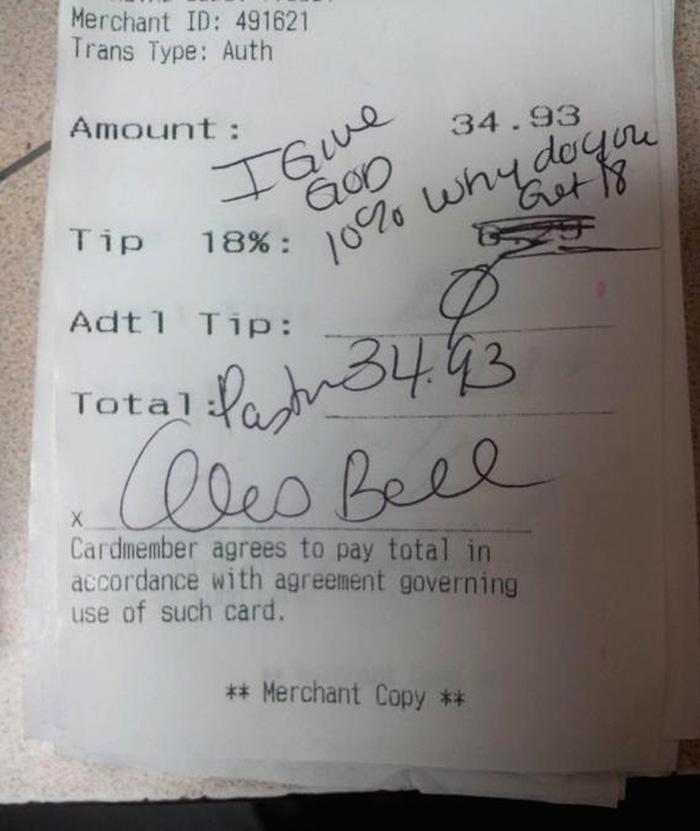
Mutual Destruction At Applebee’s: An Uncharitable Pastor and a Vengeful Waitress Do Each Other In

1aloisreceipt

The Combatants!

  • Alois Bell, a pastor at Truth in the World Deliverance Ministries Church. Uncharitable, vengeful, arrogant and cheap, she complained about an autotip of 18% added to her Applebee’s check that was triggered by the size of her group. The bill was small, but the group was large. Crossing out the tip amount and replacing it with nada, she scrawled, insufferably, on the bill, “I give 10% to God, why do you get 18?”, thus stiffing the waiter whom the party later said had rendered impeccable service. She also scrawled “pastor” by the bill amount, thus presuming a clergy discount that didn’t (and shouldn’t) exist. After a waitress colleague of the un-tipped waiter posted the bill on Reddit to inspire some well-earned web-shaming, Bell complained to Applebee’s management, successfully getting the waitress fired.

Verdict: Contemptible jerk. She abused her position to claim a discount that she wasn’t entitled to, and punished an innocent server by withholding a fair tip. [This may not be so; see UPDATE at the end] Then she set out to take vengeance on the young woman for exposing her despicable conduct. So much for showing the other cheek. Bell’s conduct was as far from the teachings of Christianity as one can get, at least at an Applebee’s.

  • Chelsea Welch, the now ex-Applebee’s waitress. She posted the obnoxious bill and scrawled comments online, whereupon the pastor was identified by her handwriting, and perhaps her jerkish personality.

Verdict:  Unethical conduct, though provoked. Her colleague was wronged by the cheap pastor, but she forgot she wasn’t free to do as an Applebee’s employee what she might choose to do as a private individual. Applebee’s can’t have its customers worrying about whether real or perceived slights to restaurant staff will land them on various websites to be mocked and vilified. Her actions were irresponsible and a violation of her duties as an employee, even though her anger was certainly justified. And her method of retribution was excessive and unethical too. Continue reading

A Compliant, Law-abiding and Unethical Murder House Sale

Immaterial

Immaterial

We last considered the issue of realtors sneaking murder houses by trusting purchasers nearly two years ago, when Jon Benet Ramsey’s home and place of death came up for sale. We had a knock down, drag out argument about it too. My position: while it might be legal for a seller not to disclose that a home was the site of a murder or worse (and in most places it is), and while many regard sensitivity on such matters mere superstition not worthy of serious respect, the seller and the realtor have an ethical obligation to inform  potential buyers when the property for sale is a murder scene As I wrote in the conclusion to the post about the Ramsey home:

“The truth is still this: there is something about the $2,300,000 house that makes it undesirable to a lot of prospects, and that means that even if the law doesn’t require the seller to tell interested house-hunters the story of the little dead girl in the basement, fairness and the Golden Rule do.”

This applies to the case at hand, where Pennsylvania’s Superior Court recently ruled that a murder-suicide occurring in a home is not a “material defect” that requires disclosure in that home’s sale. While a murder-suicide occurring in a house might be “psychological damage” to the property or its reputation, the court said, realtors don’t have to disclose it. Continue reading

The Golden Rule Sets Off An Ethics Alarm At Popehat

I posted earlier here about the efforts by lawyers (and bloggers) Marc Randazza and Ken at Popehat to foil the despicable operators of “IsAnybodyDown?” That vile website solicits and uses nude photos of women who have not given permission for them to be posted. It often posts contact information for the women as well, and, as a final touch, promotes an alleged legal service that guarantees that it will get the photos taken down. This is a good bet, since the legal service is operated by the same two men who run the site, though it is very unlikely that the “lawyer” really exists. After Marc and Ken challenged the site, its purveyors launched another one accusing them of secretly working for pornography interests and being funded by the Mob.

These are not, in other words, nice people.

In his most recent post about their ongoing battle, Ken recounted an e-mail exchange with Chance Trahan, who founded and operates  “IsAnybodyDown?”with Craig Brittain. It is an exchange that confirms what one would assume about someone who engages in a business like his. A typical tweet from Chance to Craig reads in part, “You aren’t shit to the world you immoral fuck.” Yet Ken was moved to reflect upon even this individual’s humanity, applying the Golden Rule to and musing about how even the likes of Trahan and Brittain can have redeeming qualities. In doing so he provided as profound and lovely reflection on the ethical process of reciprocity, as well as kindness, fairness, forgiveness and empathy. With Ken’s permission, I present it here. Continue reading