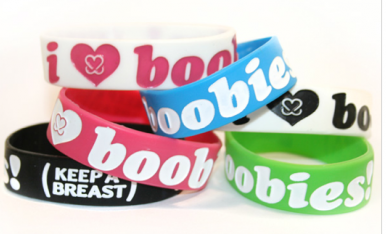
The “I ♥ Boobies” Saga

boobies bracelet

Some time in the foreseeable future, we may have the pleasure of reading the various opinions of sages like Antonin Scalia and Ruth Bader Ginsberg regarding the import of bracelets bearing the message, ” I  ♥ Boobies,” and whether it is a constitutional violation for public schools to ban students from wearing them. In August, the Third Circuit U.S. Court of Appeals rejected Pennsylvania’s’ Easton Area School District’s  prohibition of the breast cancer awareness bracelets on the grounds that they were potentially disruptive and inappropriately vulgar.

In late October, the District voted  authorize the district’s solicitor to file a petition with the U.S. Supreme Court seeking to have the high court hear arguments in the case. The controversy has been going on for three years, has cost the district  thousands of dollars in litigation costs that should have been spent on education, and will result, you can bet, in even more egregious expansion of vulgar language in the schools.

This easily avoidable Ethics Train Wreck occurred when two middle school students in Easton wore the bracelets to school with their parents’ permission despite a school ban that called them “distracting and demeaning.”  ETHICS FOUL #2  School is about learning and facilitating learning, not making an effort to intentionally pick fights  in the shadowy realm of First Amendment law. Why did the parents do this? Are the provocative bracelets really essential school fare? Will their presence in the schools have a measurable impact on breast cancer awareness? Was the ability of the girls to wear the bracelets, and their opportunity to bend the school to its will worth all the cost, time and disruption this defiance of a dress code was likely to cause a legitimate utilitarian trade-off?  I don’t think so. Continue reading

“Would You Rather”: An Ethics-Horror-Health Care-Dinner Party In Hell Movie You May Have Missed

“Would You Rather” is an odd 2012 film that sets up a film-long set of unlikely ethical dilemmas for its characters to solve. Desperate to save her dying brother with expensive medical treatment she can’t afford, the heroine (played by Brittany Snow) finds herself at a dinner party with seven other desperate strangers, hosted by a wacko family of millionaires who will help one of them after the others have been “eliminated” during the course of the evening. As what is described as a game progresses, each contestant is put through escalating rounds of risk, pain and torture in which they must make various Sophie’s Choices, such as…

  • Would you rather administer a painful shock to yourself with high-voltage electricity, or the person next to you? What if that person has been weakened by a previous shock? What if she is in a wheelchair?

CBS’s “Blue Bloods”: Endorsing the Saint’s Excuse and Polk County Justice


Time for the department ethics training, Chief. You should sit in on it too...

Time for the department ethics training, Chief. You should sit in on it too…

“Blue Bloods,” Tom Selleck’s New York police family drama on CBS, began as a paean to the core values of public service, nobility, justice, courage and honesty as it chronicled the work and lives of three generations of the Reagan family. The Reagan men are all cops, the one female is a DA, and Selleck is the paternal Chief of Police. Based on last night’s episode, “The Truth About Lying,” series creators Mitchell Burgess and Robin Green have permitted the show’s writing staff to be infiltrated by the Dark Side in its fourth season, and now its calling cards will include the enthusiastic promotion of the abuse of power and the celebration of lying as long as it’s all for a good cause. That’s the Saint’s Excuse, one of the most deadly of the rationalizations, in which “good” people decide that they are empowered to do unethical things in the pursuit of what they believe are worthy goals. The Saint’s Excuse is something of a theme in the United States these days. Now “Blue Bloods” is making sure popular culture spreads the word.

The episode, which you can watch here, was ostensibly about Selleck’s Chief’s efforts to foil the city’s newly appointed “inspector general,” installed in the wake of a “ripped from the headlines” court rejection of an effective “stop and frisk” program by New York’s finest. Continue reading

“Print the Legend” Ethics (Again): Does It Matter If Matthew Shepard’s Death Was Really A Hate Crime?

Powerful story; moving story; useful story. Does it matter if it isn't a true story?

Powerful story; moving story; useful story. Does it matter if it isn’t a true story?

It apparently matters to a lot of people for the wrong reasons—unethical reasons, in fact. As a result, legitimate efforts to determine what really happened to the gay rights icon, then a 21-year-old University of Wyoming student, who was beaten,  tortured and murdered  in Laramie, Wyoming  in 1998, have been exploited for ideological goals by adversaries of gay rights, and attacked by the media, gay rights advocates and good progressives everywhere. Just as it is important to the civil rights establishment, the black grievance community and anti-gun advocates that Trayvon Martin be seen as the innocent victim of a racist vigilante with murder in his heart—a characterization of Martin’s murder at war with all known facts and rejected by a jury after a fair trial—thus is it crucial to gay advocacy groups and others that Shepard be remembered as the victim of a hate crime, brutally killed because he was gay.

And facts be damned. Continue reading

“Yeccch!” Ethics, The Saint’s Excuse, and Shotgun Shock PSAs

crap poster

The above poster is being used by the Bristol, England, city council to get dog owners to pick up after their pets.

My reaction:

Yecccch! Ack!!! Gag!

Also this: What a lazy, inconsiderate, unfair and unethical assault on the majority in order to make an impact on a minority. Given the choice between wiping dog poop off my shoe or having my stomach turned by the image of a child eating it, I’m not sure which I’d take, or who I hate more, the inconsiderate dog owner, or the jerk who is willing to sicken me to get at him.

Good, noble, arrogant, self-righteous advocates for responsible behavior increasingly behave as if any collateral damage is acceptable, while their dubiously effective advocacy gets more shrill and ugly. Every time that current TV ad featuring the croaking, hideously disfigured ex-smoker talking while a photo of her lovely pre-cancer visage shows us the ravages of tobacco, I literally dive for the remote, just as I do when the animal cruelty spots begin bombarding me with images of sad-eyed, neglected and abused cats and dogs.

(I also do this when Piers Morgan, Nancy Grace, Donald Trump, Sean Hannity or Al Sharpton flash on the screen, but I digress.) Continue reading

Ethics Elephant In The Room: The ASPCA Was Wrong, And Should Admit It

circus-elephants-

The  Association for the Prevention of  Cruelty to Animals finally capitulated and has agreed to pay over 9 million dollars in damages to the Ringling Bros. Barnum & Bailey Circus. Way back in 2000, the ASPCA and other animal advocacy groups sued the circus company’s owners, alleging cruel treatment of elephants. The problem was, courts found, that the law suit had been built on the claims and testimony of a former Ringling barn helper who had been paid at least $190,000 for his participation in the lawsuit. This meant that the suit was dead.

Ringling Bros. Barnum & Bailey Circus counter-sued, as would I, as would you. I don’t doubt that elephants are abused sometimes in the circus; I’m sensitive to the argument that putting elephants in a circus is inherent abuse. It seems clear that a lot of dedicated, well-meaning people who care deeply about animals and their treatment couldn’t press their claims persuasively without help, so, essentially, they cheated. You can’t pay witnesses, whether the witness is telling the truth or not. It’s unfair. It’s illegal. It corrupts the justice system. Continue reading

When An Apology Proves You’ll Say Anything: Ed Schultz’s Amazing Mea Culpa

"Hey Ed! Your masks are showing!

After MSNBC had announced that it was suspending Ed Schultz for a week without pay for calling conservative talk-show host Laura Ingraham a “slut” on his syndicated radio show, its boorish left-wing star delivered an on-air apology. Schultz certainly seemed sincere and contrite, saying solemnly that his “vile and inappropriate language” was wrong and uncalled for.  “I am deeply sorry, and I apologize,” he said. “I apologize to you, Laura, and ask for your forgiveness…It doesn’t matter what the circumstances were. It doesn’t matter that it was on radio and I was ad-libbing. None of that matters. None of that matters. What matters is what I said was terribly vile and not of the standards that I or any other person should adhere to…..And I have been in this business since 1978, and I have made a lot of mistakes. This is the lowest of low for me. I stand before you tonight in front of this camera in this studio in an environment that I absolutely love. I love working here. I love communicating with all of you on the radio and the communication that I have with you when I go out and do town hall meetings and meet the people that actually watch. I stand before you tonight to take full responsibility for what I said and how I said it, and I am deeply sorry.

“My wife is a wonderful woman,” Ed continued, getting emotional. “We have a wonderful family. And with six kids and eight grandkids, I try to set an example. In this moment, I have failed. And I want you to know that I talked to my sons especially about character and about dignity and about the truth. And I tell you the truth tonight that I am deeply sorry and I tell them every day that they have to live up to standards if they want to be a successful human being in life. And I have let them down. I have never been in this position before to the point where it has affected so many people. And I know that I have let a lot of people down…. Continue reading

“The Ethicist” and His Definition of “Unethical”

Eureka! Bingo! At last!

While explaining in this week’s column why he hesitates to label a manifestly unethical practice unethical, The New York Times Magazine’s ethicist, Randy Cohen, clarified a couple of questions that have been bothering me for quite a while. Why do so many people react so violently to my conclusion that they have done something unethical? And why does Randy Cohen, a.k.a. “The Ethicist” so frequently endorse unethical conduct, especially dishonesty, when he believes it is motivated by virtuous motives? Continue reading

It’s Official: “Gore and the Masseuse” Is An Ethics Train Wreck

Ethics train wrecks, and readers of Ethics Alarms and the Ethics Scoreboard know, are controversies of escalating publicity and complexity in which so many participants engage in bad decisions and unethical conduct that it is difficult to extract any lessons or conclusions from the chaos and rubble.

“The Tale of Al Gore and the Masseuse” began last week as an inexplicably late revelation of a 2006 accusation of alleged sexual assault by Gore on a woman in his Portland hotel room. Initially, it was only unfair and unsubstantiated fodder for Gore’s enemies in the media to ridicule him and assail his character with innuendo. With the revelation, however, that the Portland police decided to re-open an investigation of the matter and the department’s admission of why that the masseuse’s complaint did not warrant a charge when it was finally made in January 2009, the incident can be officially upgraded (downgraded?) to the Ethics Train Wreck status. Continue reading

ACORN, the Saint’s Excuse, and the Ruddigore Fallacy

Today’s New York Times discusses the impending end of ACORN, brought down by bad publicity, loose oversight, sloppy governance, and a little matter of the cover-up of a million dollar embezzlement. It would be helpful to other non-profit organizations that do needed good works to learn the proper lessons from ACORN’s fate, but the reaction of some supporters don’t advance that cause. Bertha Lewis, Acorn’s chief executive, has blamed “relentless, well-funded right-wing attacks” for ACORN’s demise, painting the organization as a victim rather than its own assassin. ACORN’s leader’s thought that the usual standards of good governance, diligence, and competence didn’t apply to it, because the group’s mission was virtuous and its accomplishments great. Continue reading