Bias Makes Conservative Louisiana Elected Officials Stupid [Expanded]

There is no excuse for this.

Louisiana became the first state to mandate that the Ten Commandments be displayed in every public school classroom. Republican Gov. Jeff Landry, showing poor judgments and no spine, signed this foolishness into law. Louisiana is the first sate to do this because no others state is this stupid, apparently. The law is obviously, flagrantly unconstitutional, a bright-line First Amendment violation. American Civil Liberties Union (ACLU) and other organizations are going to sue, they will win, and a lot of time and money will be wasted so Louisiana Republicans can grandstand.

Brilliant! The Democrats are basing their 2024 election hopes on painting Republicans as anti-democratic fanatics who would just love to live in a theocracy, so the GOP does this.

An exchange between Republican Louisiana state Rep. Lauren Ventrella and CNN host Boris Sanchez illustrated just how dim-witted the Louisiana GOP’s reasoning is—and Sanchez isn’t exactly Clarence Darrow; a sharper interviewer could have made metaphorical mincemeat out of Ventrella’s lame arguments.

Ventrella began by stating that faith, as represented by the Ten Commandments, are a significant historical component to the founding of the U.S. OK, but that’s not the issue. If schools are going to teach that, the lesson has to be faith-neutral, and using the central religious code of Christianity and Judaism as a centerpiece isn’t neutral.

“Sure, but do you also recognize that the Constitution of this country, its founding document, doesn’t include the word God or Jesus or Christianity and that’s for a reason and that’s because the founding fathers founded this country as a secular one,” Sanchez said. “You don’t see that?”

Ugh. Stay on point, Boris! All that matters is that the Supreme Court has held emphatically that the Constitution forbids the state from dictating religious beliefs. Where the line should be drawn is still a live question, but that the Ten Commandments are over that line is not.

“Boris, I bet you CNN pays you a lot of money. I bet you got a lot of dollar bills in that wallet,” Ventrella replied. Ugh again. She’s after the old “In God We Trust” motto. This is like the open border activists who cite the poem on the Statue of Liberty as evidence of a national policy. Both the motto and the poem are irrelevant.

“What does this have to do with the network that I work for or what I’m getting paid?” Sanchez asked. “Don’t make this about that, answer that question. Why did the founding fathers not include God in the Constitution if they wanted this country to be the way that you see it?”

Boris apparently didn’t see the silly motto argument coming. Well, you know: CNN.

“In God We Trust. We’ll make it about me. I’ve got a dollar bill in my wallet. In God We Trust is written on that dollar. It is not forcing anybody to believe one viewpoint, it’s merely posting a historical reference on the wall for students to read and interpret it if they choose,” Ventrella explained, making no sense. What is stamped on money isn’t the equivalent of highlighting a particular religion in schools. Sanchez then stated the obvious, that the Ten Commandments are more than merely “historical” and obviously advance specific religious beliefs. Of course, and Ventrella and her ilk know this, which is why the party wants the Ten Commandment in the classes rather than the Magna Carta. Her argument is completely disingenuous. And stupid.

“This is a very valuable document. Look, this nation has gotten out of hand with crime, with the bad, negative things that are going on. Why is it so preposterous that we would want our students to have the option to have some good principles instilled in them? If they don’t hear it at home, let them read it in the classroom,” she said. “Which is different than the Mayflower Compact which is mentioned in the document as well. I don’t understand why this is so preposterous in that litigation is being threatened. It doesn’t scare us in the state of Louisiana, we say bring it on.”

Wow. What a moronic rant. Has she read the Ten Commandments? The first one tells readers not to have any other god, and the next three are purely religious edicts. That’s 40%! A poster stating the messages of the next six commandments would be harmless and constitutional, but this law’s intent is promoting juddeo-Christian religious beliefs, despite Ventralla’s posturing

“Because if someone has a home in which they choose to believe something different, which is welcome in this country. It’s literally why people fled to come here to found this country to begin with. Then they should be allowed to. And it’s not really an option if you’re requiring it to be put up in the wall of the classroom,” Sanchez said. To this, Ventrella shrugged that students, parents and teachers who don’t share the “religious views” of the Ten Commandments should just avoid looking at it.

Ooooh, good one, Lauren.

The CNN host compared the Ten Commandments poster to hanging up the Five Pillars of Islam in public school classrooms. That is an excellent analogy, and, of course, all the state rep could do was babble. “This is not about the Five Pillars of Islam. This bill specifically states the Ten Commandments. It is a historical document …” Boris cut her off, since she was ducking the issue or, just as likely, too dumb to comprehend it.

“Sure, but I’m presenting you with a hypothetical that would help you put yourself in the shoes of someone you may not understand and their point of view,” he said. “How would you feel if you walked into a classroom and something you didn’t believe in was required to be on the wall? You can answer that question.” Ventella had no answer, because, again, she knows the objective of the law is religious indoctrination.

“I appreciate you, Boris. I cannot sit here and gather and fathom … you could give me a thousand hypotheticals. But again, this specific bill applies to this specific text. The Quran, or Islam, that is a very broad statement. We’re specifically talking about a limited text, on mind you, a piece of paper that’s not much bigger than a legal sheet of paper. Some kids might even need a magnifying glass to read all of this. This is not so preposterous that we’re somehow sanctioning and forcing religion down people’s throats. I’ve heard the comments and it’s just ridiculous,” Ventrella answered. Translation: Huminahuminahumina…” She’s got nothing.

She also kept calling the Ten Commandments “historical.” Inigo Montoya has an observation:

There is no justification for calling the Ten Commandments a “historical” document. There is no historical evidence that Moses and the Ten Commandments as stone tablets ever existed, or that the Exodus occurred. These are religious stories, and Moses has the same “historical” status as Adam and Eve, Noah, and other Old Testament figures. A school even calling them “historical” is a religious assertion.

Neither the Constitution, nor precedent, not common sense backs her “it isn’t what it is” blather. Sadly, the conservative media immediately fell into line defending the law, wounding their own credibility in the process. Newsbusters:

This story is ultimately less about the actual Ten Commandments than about what they represent in this particular instance: a challenge to the left’s monopoly on what can be taught in schools. Said differently, Louisiana challenges the (secular) religious orthodoxies of the public education system as run by left-wing administrators in unison with the teachers’ unions…. The media have no problem with kindergarteners being taught on gender, or on third and fourth-graders having access to graphic sexual materials in school libraries. But the Ten Commandments are a bridge too far.

One final Ugh. The story is about the Ten Commandments, and Louisiana’s transparent effort to force a religious code on students in violation of the Establishment Clause. There’s nothing in the Constitution prohibiting public school indoctrination regarding sex. There is very clear prohibition against public schools promoting specific religions.

Saturday Ethics End Notes, 4/3/2021: “Let it be written, let it be done!”

You can’t blame me for featuring this ethics landmark today: On April 3, 1948, President Truman signed the Economic Assistance Act, commonly known as the Marshall Plan, which authorizing the a program to help the nations of a war-torn Europe to rebuild. The effort was designed to stabilize Europe economically and politically so that the Soviet Union would not be able to spread communism further. U.S. Secretary of State George C. Marshall gave the plan its name with a speech at Harvard University on June 5 of the previous year. He proposed that the European states meet to agree on a program for economic recovery, and that the U.S. would would help fund it. The same month Britain and France invited European nations to send representatives to Paris to follow-through with Marshall’s formula. The USSR, Hungary, Czechoslovakia and Poland declined the invitation. The resulting Committee of European Economic Cooperation eventually presented its plan to Congress, which authorized the “Marshall Plan” on April 2, 1948. The next day, it was signed into law.

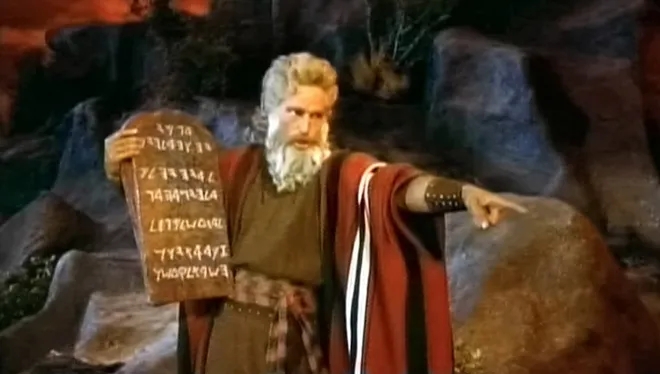
  1. It’s that time again! The Cecil B. DeMille classic “The Ten Commandments” airs at 7 p.m. tonight on ABC. I recommend renting it for a few bucks on Amazon Prime: commercials now add a full hour to the movie, which is already one of the longest U.S. films ever made. I watch the 1956 jaw-dropper at least once every year. No movie ever blew my mind like that one did when I saw it as a child, and, I noted with amazement last week when I watched it again, certain scenes still blow my mind now, like the Exodus, easily the greatest crowd scene that ever had been or ever will be. My top ethics notes:
  • The screenplay’s direct condemnation of slavery in Moses’ early speech is remarkable for the period, and gutsy for the most expensive movie ever made (to that point) that needed big audiences from the old Confederate states during the middle of a growing civil rights movement.
  • Like Ted Williams’ home run in his last at bat, DeMille bet everything on his biggest challenge at the end of his career when he had already made Hollywood history and was a living legend….and he succeeded. I admit, I’m a sucker for that. The movie killed him, essentially: CB suffered a heart attack while directing the huge scene where Moses leads the Jews out of Egypt, and never recovered. I’m sure he’d say it was still worth it.
  • As a director, I have learned that the greatest and most frightening challenge is trying to top yourself. I admire the artists who attempt it, and especially those who succeed. DeMille had already made a silent movie version of the story that stood as the top-grossing film of all time until his own talkies broke its record.
  • I cannot think of a better example of the ethical principle that if you are going to do something that matters, do it right and don’t cut corners. Like David O. Selznick’s “Gone With The Wind,” TTC is filled with astounding grace notes and details that are the mark of a perfectionist. On this week’s viewing, I noticed for the first time that when we see Egyptian princess Nefertiri primping in a mirror, her image is dark and indistinct. That’s because glass mirrors were unknown in ancient Egypt: the mirror is polished metal.
  • The 1957 Oscars , which largely snubbed De Mille’s masterpiece, show how bias makes you stupid, and how little the movie community understands its own medium. “The Ten Commandments” was the movie of the year and everyone knew it: it was the top grossing film and had scenes that were immediately recognizable as likely to become legendary (like the parting of the Red Sea.) But most of the Oscars, including Best Picture, went to “Around the World in 80 Days,” the over-stuffed “spectacular”—unwatchable now— made by industry darling Mike Todd. DeMille didn’t even rate a Best Director nomination. He was considered a conservative pariah and a dinosaur, and the “new Hollywood” wouldn’t bring itself to recognize an old pro doing his best work.

2. And now, speaking for the arrogant, biased, not as smart as they think they are people who lie to you daily, Lester Holt! At the 45th Edward R. Murrow Symposium at Washington State University, Holt received the Lifetime Achievement Award from the Edward R. Murrow College of Communication, presumably because they had to find a black journalist to give the thing to. Among his comments, which generally proved the stunning lack of self-awareness of himself and his industry, he said, .

Continue reading

From The Archives: “Ethics Quote of the Week: Moses (Charlton Heston) in ‘The Ten Commandments'”

Seven years ago, while  watching the annual showing of “The Ten Commandments ” on ABC, I realized how advanced its civil rights message was for its time, and what an interesting and instructive ethics movie the epic was. This post was the result. I’ve edited it a bit.

The movie hasn’t been shown yet in 2020 ; it’s scheduled for the weekend before Easter, which is late this year.  I never miss it, and if you watch the film with your ethics alarms primed, you might see it in a whole new dimension.

_______________________________

“That evil that men should turn their brothers into beasts of burden, to be stripped of spirit, and hope, and strength – only because they are of another race, another creed. If there is a god, he did not mean this to be so!”

—-Moses, as played by Charlton Heston and scripted by seven writers, in Cecil B. DeMille’s “The Ten Commandments,” answering the Pharoah Seti’s question, “Then why are you forcing me to destroy you? What evil has done this to you?”

“The Ten Commandments” is so extravagantly fun and entertaining that, I must confess, I never watched it as an ethics film until tonight, as ABC once again broadcast the Biblical epic on an Easter weekend. This quote especially struck me as remarkable for a film made by an infamously rigid conservative, DeMille, in 1956.

Less that a year earlier, on Dec. 1, 1955, Rosa Parks was arrested for refusing to give up her seat on a Montgomery, Alabama city bus. The next twelve months were tense, difficult days in which the entire U.S. population was undergoing a wrenching cultural debate regarding human rights.  On Dec. 6, 1955, the civil rights boycott of Montgomery city buses, led by Rev. Martin Luther King , began. January 1956 saw Autherine Lucy, a black woman, accepted for classes at the University of Alabama in Tuscaloosa, the first African-American ever allowed to enroll.  On Jan. 30, the Montgomery home of Martin Luther King, Jr. was bombed. February 4 saw rioting and violence on the campus of the University of Alabama and in the streets of Tuscaloosa. Lucy had to flee the campus, and the university’s Board of Trustees barred her from returning. On the 22nd of that month, warrants were  issued for the arrest of the 115 leaders of the Montgomery bus boycott. A week later, courts ordered Lucy readmitted, but the school expelled her. Continue reading

The Alabama U.S. Senate Republican Run-Off: The Worst Choice Ever [UPDATED]

And you thought having to choose between Hillary and Donald Trump was bad!

The upcoming Republican run-off for the special election to choose a successor to Alabama previous GOP Senator Jeff Sessions, now U.S. Attorney General, is as bad as it gets. Whoever wins is certain to be elected in super-red Alabama over Democrat Doug Jones, but one GOP candidate is corrupt and absurd, and the other is absurd, a fanatic and a habitual scofflaw. Both can be counted upon to immediately lower the ethical and intellectual level of the U.S. Senate, and normally I would assume that only electing a horseshoe crab or some other lower species could do the latter, while nothing short of sending Hillary Clinton back there could accomplish the former. That Alabama voters would allow their state’s seat in the U.S. Senate to depend on a run-off between these two examples of the worst of the U.S. politics bestiary doesn’t merely show that the state is backwards, it shows that its voters deserve one of these jerks. The rest of us, however, do not.

Let’s look at the two contestants, shall we? First current Senator Luther Strange, whose best feature is his name. Allow me to save you a click by re-posting a substantial section from February’s post about him:

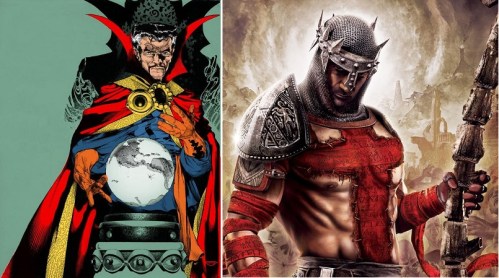
When the Senate confirmed Jeff Sessions as U.S. Attorney General in hearings that may be best remembered as the time Elizabeth Warren earned the fawning admiration of feminists by behaving like a mean-spirited jerk, it meant that Alabama’s Republican governor got to appoint his successor. There wasn’t much discussion in the news media about who this might be, because it’s hard for journalists to inform the public properly when it is concentrating on bringing down the President, per the orders of their Eldritch Progressive Masters—sorry, I’ve got Dr. Strange stuff rattling around in my brain now—but there was some interesting speculation in Alabama.

You see,  Republican Governor Robert Bentley is fighting to avoid  impeachment as the result of a sex scandal, and one that called his honesty into question as well.

An official fired by Bentley alleged that the Governor had engaged in an extramarital affair with his senior political adviser, Rebekah Caldwell Mason. An audio recording surfaced in which Bentley told a woman named “Rebekah” that he “worr[ied] about loving you so much” and that “[w]hen I stand behind you, and I put my arms around you, and I put my hands on your breasts […] and just pull you real close. I love that, too.” At a press conference, Bentley apologized for the comments but denied having an affair and stated that his relationship with Mason was purely platonic.

Sure.

Bentley invaded the Ethics Alarms Rationalizations List, saying that  he “had made a mistake” by saying “inappropriate things” to his aide, and apologized to Mason , her family and to the people of Alabama. On April 5, 2016, an impeachment resolution against Bentley was filed in the State Legislature, which appointed a special counsel to lead an investigation into the impeachment charges. Then, in November, Alabama Attorney General Luther Strange asked that the investigation be halted pending “related work” by his office. This was widely interpreted to mean that Strange, also a Republican but not an ally of Bentley’s, was overseeing his own investigation of whether charges should be brought against Bentley.

Trump was elected President on November 8, and ten days later he announced his intention to nominate Alabama Senator Jeff Sessions as U.S. Attorney General. On December 6, 2016, Strange announced that he was a candidate for the soon to be vacant seat, meaning that he would run in the 2018 election, if he wasn’t appointed to fill the vacancy by Bentley.

With the wolves gathering at  his door, however, that’s exactly what Gov. Bentley did. He appointed the man who was overseeing his current impeachment investigation to the U.S. Senate, thus creating a vacancy in the Attorney General’s post. Then he appointed a new AG named Steve Marshall (no relation), who many doubt will vigorously pursue an indictment against the governor.

Can you say, “Appearance of impropriety”?

I can’t imagine a better example of how the law can’t anticipate everything, making ethics indispensable.   There is an Alabama law prohibiting a governor from appointing himself to fill a U.S. Senate vacancy, but nobody foresaw a situation where a governor facing impeachment would interfere with the investigation by appointing a political adversary and the Attorney General overseeing the investigation to fill the slot. This is entirely legal, and spectacularly unethical.

Some in the state wonder if Strange’s request to the legislature wasn’t part of a deal with the Governor, in anticipation of a Sessions departure.  “He definitely slowed down the impeachment process, which put the governor in a place to actually appoint him. That’s the problem we have,” said Ed Henry, the legislator who brought the original  impeachment motion to a vote.  “He stopped an impeachment process and then in turn accepted the nomination to the Senate. I believe the damage is already done.”

For this to have been a pre-arranged  quid pro quo would have required that Strange and Bentley both believe that Trump would win, however. Hmmmm. Maybe they were in league with the Russians too…?

Yet it requires no conspiracy theory to conclude that for Strange to accept Bentley’s appointment makes him complicit in a sequence of events  that appears corrupt. It is too redolent of the Roland Burris affair, when now jailed former Illinois governor Rod Blagojavich was caught selling a Senate appointment. Burris swore in an affidavit  that he had no contact with the governor prior to his appointment to a Senate seat he had no qualifications for, and then as soon as he was safely on office, suddenly remembered that he had met with “Blago.”

The newly minted Senator Strange, had he been an ethics hero—and shouldn’t we be able to expect our elected officials to be ethics heroes?—could have foiled Bentley, inspired Alabamans, and proved that he would be a worthy Senator when he ran in 2018, if he had simply turned down the appointment, saying,

‘I am grateful and honored that Governor Bentley felt that I was qualified to represent the citizen of Alabama in the U.S. Senate. However, I feel I would betray the trust of those same citizens if I were to accept the post under these circumstances. As the lawyer for the people, I am obligated to undertake and oversee a fair and objective investigation of serious allegations against the Governor, and this raised a conflict of interest for me, pitting my personal political ambition against my duties in my current position. Moreover, should I accept the Governor’s offer, it would raise doubts regarding the functioning of the legal system as well as my personal integrity. Therefore I must decline the appointment.’

Nah.

Now, however, the Senator has proven himself unworthy of his new job by accepting it.

Strange!

Now normally I would say that anyone—Kathy Griffin, Jimmy Kimmel, Dormammu—is a preferable U.S. Senate choice than this shameless, ambitious hack. Roy Moore, however, is a piece of work. The one-time kickboxer and full time fundamentalist Christian fanatic first warranted Ethics Alarms notice as an Incompetent Elected Official in 2014, and his recognition came that late only because I viewed his stand-off over displaying the Ten Commandments in his court room and trying to turn Alabama justice into a theocracy too ridiculous to write about (and Ethics Alarms didn’t exist then.) Continue reading

Ethics Quote of the Week: Moses (Charlton Heston) in “The Ten Commandments”

The evil that men should turn their brothers into beasts of burden, to be stripped of spirit, and hope, and strength – only because they are of another race, another creed. If there is a god, he did not mean this to be so.

—-Moses, as played by Charlton Heston and scripted by seven writers, in Cecil B. DeMille’s “The Ten Commandments.” answering to the Pharoah Seti’s question, “Then why are you forcing me to destroy you? What evil has done this to you?”

The Ten Commandments“The Ten Commandments” is so extravagantly fun and entertaining that, I must confess, I never watched it as an ethics film until tonight, as ABC once again broadcast the Biblical epic on an Easter weekend. This quote especially struck me as remarkable for a film made by an infamously rigid conservative, DeMille, in 1956.

On Dec. 1, 1955, Rosa Parks was arrested for refusing to give up her seat on a Montgomery city bus. The next twelve months were tense, difficult days in which the entire U.S. population was undergoing a wrenching cultural debate regarding human rights.  On Dec. 6, 1955, the civil rights boycott, led by Marin Luther King, of Montgomery city buses began. January 1956 saw Autherine Lucy, a black woman, accepted for classes at the University of Alabama in Tuscaloosa, the first African-American ever allowed to enroll.  On Jan. 30, the home of Martin Luther King, Jr. was bombed in Montgomery. February 4 saw rioting and violence on the campus of the University of Alabama and in the streets of Tuscaloosa. Lucy had to flee the campus, and the university’s Board of Trustees barred her from returning. On the 22nd of that month, warrants were  issued for the arrest of the 115 leaders of the Montgomery bus boycott. A week later, courts ordered Lucy readmitted, but the school expelled her. Continue reading

A Shocking Farewell Confession From “The Ethicist”

In Randy Cohen’s farewell column for “The Ethicist” today—he was sacked by the new editor of The New York Times despite providing an entertaining, well-written and provocative column for many years— he makes a statement that I find shocking, and one that challenges the core assumption of this blog and indeed my occupation.

Writing the column has not made me even slightly more virtuous. And I didn’t have to be: it was in my contract. O.K., it wasn’t. But it should have been. I wasn’t hired to personify virtue, to be a role model for the kids, but to write about virtue in a way readers might find engaging. Consider sports writers: not 2 in 20 can hit the curveball, and why should they? They’re meant to report on athletes, not be athletes. And that’s the self-serving rationalization I’d have clung to had the cops hauled me off in handcuffs.
What spending my workday thinking about ethics did do was make me acutely conscious of my own transgressions, of the times I fell short. It is deeply demoralizing.

Amazing. Randy, we hardly knew ye, and we sure didn’t understand ye, either. How can someone possibly spend one’s working day “thinking about ethics” and not become more virtuous in his daily conduct? Continue reading

Provocative Links for Ethical Weekend Reading

Here is a diverse selection of five ethics-related posts from cyberspace for your weekend reading pleasure:

  • Christopher Hitchens analyzes, critiques and updates the Ten Commandments—and does an excellent job of all three, here.
  • Finally, a former Bush Justice Department official takes aim at the Republican attacks on the so-called “Al Qaeda Seven,” a despicable moniker apparently invented by Mary Cheney. There really is no debate here: the suggestion that attorneys who previously represented accused terrorists cannot be trusted to work in Justice is legally, ethically and logically ignorant. Still, it is good to have a Republican lawyer say so.

Ben Franklin’s Ethics Alarms

Why do good people do bad things? Usually it’s because they aren’t thinking about good and bad at all. They are thinking about more immediate issues, like getting through the day, keeping a job, making a child happy, paying the bills, enduring a crisis. When good people—most of us, I believe–actually focus on doing the right thing, doing good, they tend to do it. The trick is  focusing, when emotions and basic human needs are so powerful. Continue reading