
Comment Of The Day: “The Quest For The Perfect IIPTDXTTNMIAFB…”

Ethics Alarms is proud to present as Extradimensional Cephalopod‘s. Comment of the Day to the post, The Quest For The Perfect IIPTDXTTNMIAFB Continues, And Joe May Have Given Us A Winner!

I am always thrilled to have a lot of comment to one of my posts, but there is a definite downside to that: once the number gets much beyond 20, the chances of a comment being read diminishes sharply. The following superb entry on the subject of the relationship between values and bias, in the context of comparing the relative character traits of the current President and the previous one, is as though-provoking and worth reading as anything I have ever written here, and false modesty is not in my tool box.

***

Identifying our values takes place in a vacuum. Ideas first. Judging people comes later, if necessary. All of us here seem to agree that Trump and Biden are pretty bad people, but we’re arguing about what ways they’re bad, and which one is worse? And moreover, we’re judging each other based on differences of interpretation and risk tolerance which we’re treating as objective fact? We can do better than that.

(I’m not a postmodernist; I do believe we can arrive at judgments we all agree on. It’s just that this isn’t the way to do it.)

Trump and Biden represent different collections of risks. Which one we think is the lesser of two evils depends on what risks we think we and the rest of the world are prepared to deal with. The risks we’re comfortable dealing with depend in turn on our experiences and skills, and how we have come to think of society in general. It’s entirely possible that somebody’s risk assessment is more accurate than someone else’s, or they could be equally good or bad.

However, when we need to hash out a choice between two bad options, we’d better bring to the table some plans for how we’re going to handle the consequences of the option we want to pick. That’ll go a long way towards getting people on board. Continue reading
Morning Ethics Warm-Up, 10/29/2018: Codes, Cars, Carter And The Caravan

Boy, this really IS a good morning!

(The warm-up may rely a bit more on links and quotes than usual…as Bob Cratchit tells Scrooge, “I was making rather merry yesterday.”)

1. Breaking News: Jimmy Carter is right! Former President Jimmy Carter, now 94, has injected himself into the Georgia governor’s race by asking Republican candidate Brian Kemp to resign as secretary of state. Carter’s argument is that there is an appearance of impropriety in his being officially responsible for an election in which he is a candidate, and that his resignation is essential  to preserve public confidence in the outcome of Kemp’s race against Democrat Stacey Abrams. Carter’s made the request in an Oct. 22 letter .

“One of the key requirements for a fair and trusted process is that there be a nonbiased supervision of the electoral process,” Carter wrote, explaining that stepping aside “would be a sign that you recognize the importance of this key democratic principle and want to ensure the confidence of our citizens in the outcome.”

When he’s right, he’s right. Kemp should resign, and his lamer than lame rationalization for not doing so, that it isn’t really he who supervises the election but his staff, would be sufficient reason not to vote for him in the gubernatorial election.

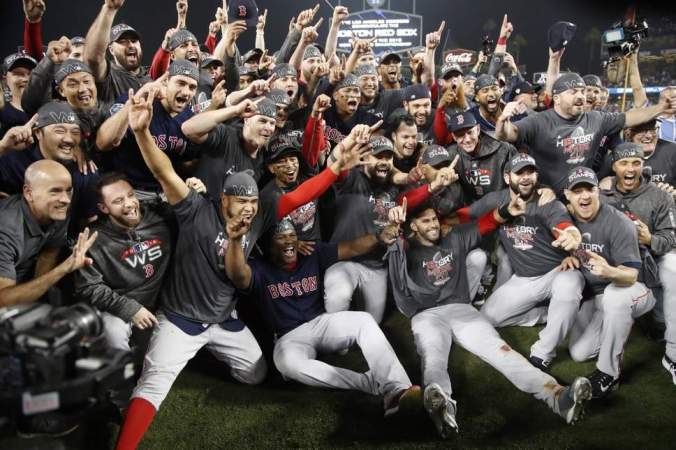
2. Ethics Dunce: Red Sox owner John Henry. You would think the progressive owner of the Boston Globe could restrain himself from blatant virtue-signaling while his team was celebrating its historic season and World Series victory, but no. Henry saluted his team for being “diverse” in his post-game remarks. Nobody sane cares how diverse, whatever that means (Where were the women, John? Where were the Asians? The differently-abled? Muslims? LGBT representatives?), a pro sports team is as long as it wins, and if it doesn’t win, its check-offs on an EEOC form won’t make it any better or its losing more palatable. The 2018 Red Sox were assembled according to the skills and talents of its personnel, with race and ethnicity a non-factor. What mattered is that the team’s manager (he’s Puerto Rican, and I don’t care) proved himself a natural leader who created a selfless, courageous, professional culture on his team, none of whom mentioned race, religion or creed all season, and properly so.

The compulsion to spurt progressive cant at every opportunity is pathological. Continue reading

Self-Driving Car Ethics: Who Do They Decide To Kill? You?

av-choice

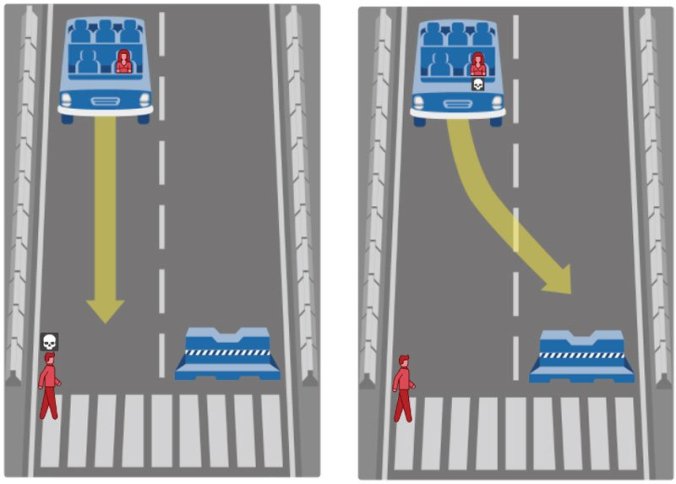
CBS’s “Bull,” a drama about a jury consultant (played by “NCIS” alum Michael Weatherly) is an ethics mess…but then, so is the former jury consultant Weatherly’s  character is loosely  based on: “Dr.” Phil McGraw. The show does find some interesting ethics issues, however. A couple of weeks ago the story involved the programming in an experimental self-driving car. The issue: is it ethical for such a car to be programmed to kill its passenger if it has to make a life or death choice?

The ethical conflict involved is the so-called “trolley problem,” which is, as the name suggests, over a hundred years old. British philosopher Philippa Foot developed it into series of hypotheticals in 1967. In 1985, American philosopher Judith Jarvis Thomson scrutinized and expanded on Foot’s ideas in The Yale Law Journal. Here is one of Thompson’s scenarios:

“Suppose you are the driver of a trolley. The trolley rounds a bend, and there come into view ahead five track workmen, who have been repairing the track. The track goes through a bit of a valley at that point, and the sides are steep, so you must stop the trolley if you are to avoid running the five men down. You step on the brakes, but alas they don’t work. Now you suddenly see a spur of track leading off to the right. You can turn the trolley onto it, and thus save the five men on the straight track ahead. Unfortunately,…there is one track workman on that spur of track. He can no more get off the track in time than the five can, so you will kill him if you turn the trolley onto him.”

The problem: Now what, and why?

A. Throw the switch in order to maximize well-being (five people surviving is greater than one).
B. Throw the switch because you are a virtuous person, and saving five lives is the type of charitable and compassionate act a virtuous person performs.
C. Do not throw the switch because that would be a form of killing, and killing is inherently wrong.
D. Do not throw the switch because you are a Christian, and the Ten Commandments teach that killing is against the will of God.
E. Do not throw the switch because you feel aiding in a person’s death would be culturally inappropriate and illegal. Continue reading