Demanding Blindfolds

From the New York Times:

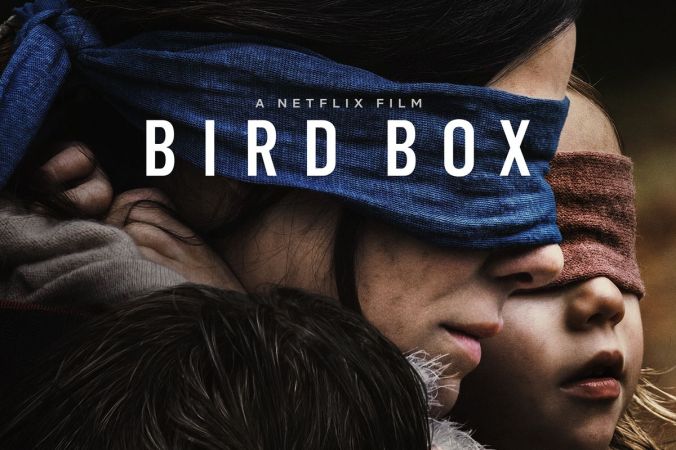
“Netflix said on Thursday that it would not edit its movie “Bird Box” to remove footage of a disaster that killed 47 people in a Canadian town, rebuffing calls from town leaders who called the use of the video insensitive.”

Good.

This has got to stop somewhere, and “Bird Box,” the sensationally popular sci-fi horror film about Sandra Bullock and her children wandering around a forest blidfolded so they won’t see whatever it is that is driving everyone crazy and making them kill themselves, is a good a place to make a stand as anywhere.

In the movie, some things, or demons, or vibes cause insanity if they are seen: people really aren’t safe if they see them. Images that raise unpleasent thoughst and memories in real life are different, but somehow the idea was pawned that people have the right to expect to be “safe” from thoughts, memories, sights, symbols and ideas that might bother them. Thus “woke” college instructors felt compelled to give students “trigger warnings.” This principle, a really bad one that mistakes censorship for sensitivity, quickly metastasized into historical and artistic airbrushing. The National Park Service banned Confederate flags and their images from battlefield  gift shops—might remind some people of the Dylan Roof church shooting. Or slavery. Or racism.  Then the statues started coming down, because, as Carol Folt, blessedly outgoing chancellor of the University of North Carolina at Chapel Hill explained about why the terrifying pedestal of now toppled “Silent Sam,” a campus statue of a fictional Confederate soldier, must be destroyed:

“The presence of the remaining parts of the monument on campus poses a continuing threat both to the personal safety and well-being of our community and to our ability to provide a stable, productive educational environment. No one learns at their best when they feel unsafe.”

Unsafe! Continue reading

A Trigger Warning About A Trigger Warning: Audiences Should Walk Out Of The Movie Theater When This Appears

This is not a joke. This is not The Onion. This is real. And frightening.

At the beginning of “Darkest Hour,” the new film about the wartime heroism and brilliance of  Winston Churchill, this warning appears on the screen:

“The depictions of tobacco smoking contained in this film are based solely on artistic consideration and are not intended to promote tobacco consumption. The surgeon general has determined that there are serious health risks associated with smoking and with secondhand smoke.”

Winston Churchill, you see, smoked cigars. Actually he chain-smoked them, and inhaled. They were among his trademarks. Any adult who doesn’t know that should not have graduated from high school. Interestingly, shooting and bombing people are also serious health risks, so I don’t know why it wasn’t noted that the depictions of warfare contained in this film are based solely on artistic consideration.”

Whatever “based solely on artistic consideration” is supposed to mean…

Of course, showing Churchill smoking cigars is not an “artistic consideration,” but one of historical accuracy and integrity. Does this mean that there was really a debate in the studio about whether or not Churchill should be shown smoking, so as not to trigger good little progressive totalitarians, who believe in changing the past for the greater good of the present? I wonder if they considered making Winston, who was fat, appear slim and ripped, since the surgeon general has determined that there are serious health risks associated with obesity and over-eating. I don’t see why they wouldn’t, if they felt that showing people smoking in the 1930s, when almost everyone smoked,  might be interpreted as promoting smoking today.  Churchill also drank like Bluto in “Animal House.” Why no warning about that? Uh-oh—does this mean that the film, for artistic considerations, only shows Winston sipping soda water and prune juice? Continue reading

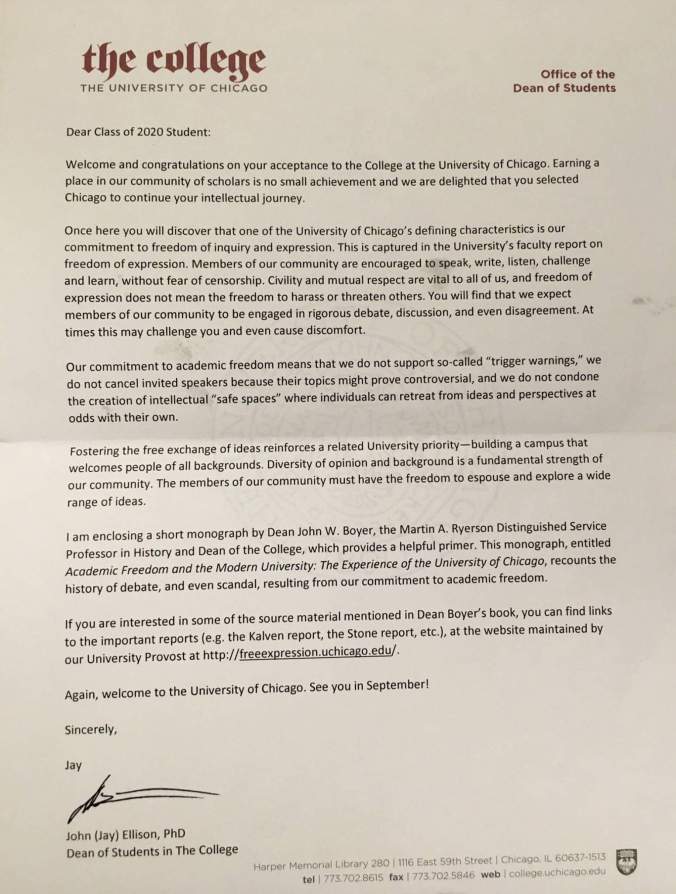
Ethical Quote Of The Month, And Ethical Acceptance Letter Of The Decade: The University of Chicago

acceptance_letter

This is all over the web, but as an ethics site, Ethics Alarms can hardly not join the throng.

The tragedy is that we have to regard anything in this letter as the least bit remarkable. I now eagerly await the wave criticism of the message, condemning it  as insensitive and racist.They have already started. Grand View University professor Kevin Gannon argued in a blog post,

Students ought to be challenged, even made uncomfortable, in order to learn in deep and meaningful ways. And, of course, collegiate education is where students must encounter perspectives different from their own… and that’s what this Dean and the anti-trigger-warnings, no-safe-spaces crowd are counting on-that the surface veneer of reasonableness in these admonitions to the Class of 2020 will obscure the rotten pedagogy and logical fallacies that infest this entire screed…Displaying empathy for the different experiences our students bring to the classroom is not a threat to our academic freedom. Allowing for a diversity of perspectives to flourish, even when that diversity might challenge the very structure of our course and its material, is not a threat but an opportunity.

Slate calls the letter “strange” and notes..

[T]he letter’s author, John Ellison, betrays a common misunderstanding of “trigger warnings” and “safe spaces”—both of which exist for the exact purpose of “building a campus that welcomes people of all backgrounds.” Trigger warnings are not intended to shield students from controversial material; they’re intended to warn students about disturbing content so that they won’t be shocked by it.

You know, like what happens in real life: we get an early warning before anything happens that might upset or “shock” us. Ellison understands perfectly: trigger warnings and safe spaces are part of a strategy to marginzlize individuals, groups and ideas by stigmatizing them as “controversial,” “disturbing,” and “shocking.”

I’ll also be watching to see if the university administrators will stand behind their bold words.

Maybe this will serve as a splash of ice water in the faces of Dean Ellison’s spineless and feckless colleagues around the country, like those in the University of Missouri, whose capitulation to campus race-baiters and grievance bullies has cost the school over 2,000 students. It may also be the final gasp of truly liberal higher education in the U.S.

We shall see….

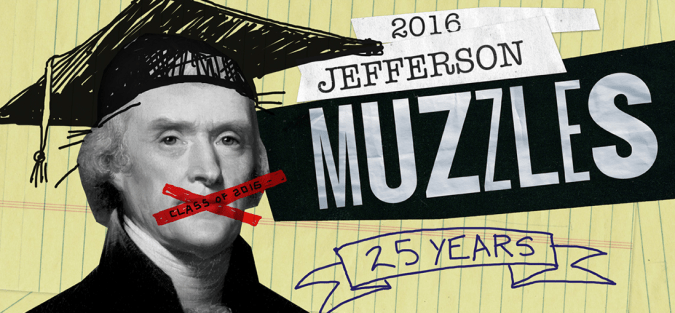
Read ‘Em And Weep: The Jefferson Muzzle Awards

muzzle-banner

 Thomas Jefferson Center for the Protection of Free Expression (TJC) hands out yearly “awards” to  government agencies that show themselves hostile to free speech.  This year, however, the Jefferson Muzzle Awards were reserved for various colleges, as the increasingly radical left institutions of higher learning, spurred by such groups as Black Lives Matters and the craven administrators who quiver in fear of them, have scarred freedom of expression over the past year in a multitude of ways.

Fifty schools got their ceremonial muzzles—the Muzzies?—in five categories:

1. Censorship of Students
2. Censorship by Students
3. Efforts to Limit Press Access
4. Threats to Academic Freedom, and
5. Censorship of Outside Speakers

Here they are.

And it’s not funny.

_______________________

Pointer: Instapundit

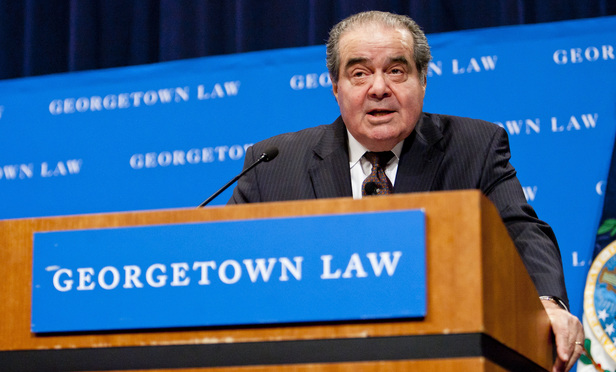
Ethics Observations On Georgetown Law Center’s Scalia Foofarah

Scalia-Georgetown

I am a Georgetown University Law Center grad, as well as a former administrator there. I also know and have personal relationships with several members of the faculty. None of this especially informs my ethical analysis of the community argument there that arose from a rather innocuous official expression of respect and mourning in the wake of Justice Scalia’s death, but if anyone wonders why I’m posting about this rather than many other ethics issues nipping at my heels, that’s part of the reason. The other reason is that this academic dust-up raises interesting ethics issues, and has received national publicity.

Observations on the tale as it has unfolded:

1.  Georgetown Law Center issued a press release mourning the death of Antonin Scalia, including a statement from Dean William M. Treanor that read:

Scalia was a giant in the history of the law, a brilliant jurist whose opinions and scholarship profoundly transformed the law. Like countless academics, I learned a great deal from his opinions and his scholarship. In the history of the Court, few Justices have had such influence on the way in which the law is understood. On a personal level, I am deeply grateful for his remarkably generous involvement with our community, including his frequent appearances in classes and his memorable lecture to our first year students this past November. The justice offered first-year students his insights and guidance, and he stayed with the students long after the lecture was over. He cared passionately about the profession, about the law and about the future, and the students who were fortunate enough to hear him will never forget the experience. We will all miss him.”

[Note: In the original post, I missed the first line, and kept missing it. Don’t ask me why. The text has been finally, after a couple botched attempts, been revised to include it.]

Is there anything inappropriate about the dean’s statement? Not in my view. This is nothing but a traditional expression of professional respect on behalf a prominent institutional member of the legal community. There is nothing in the statement, save for the last sentence, that anyone could argue is untrue. Countless academics, as well as Scalia’s more liberal colleagues, did learn “a great deal from his opinions and his scholarship.” He was an influential and significant figure on the Court. Scalia was generous with his time and passion as a teacher, and by all accounts he was a good one.

The opening statement,  “Scalia was a giant in the history of the law, a brilliant jurist whose opinions and scholarship profoundly transformed the law,”  seems to be what rankled Scalia critics. It shouldn’t have. At worst it is standard memorial puffery. But calling Scalia a giant “ in the history of the law” seems fair whether you agree with his jurisprudence or not: he is certainly among the 20 or so most quoted, most debated, and most provocative justices. The rest shouldn’t be troubling to anyone who isn’t suffering from Scalia-phobia. A Justice can be brilliant and transformational while being wrong.

None of the reports of the controversy ignited by this standard issue sentiment mention it, but Georgetown Law Center isn’t on the Georgetown campus. It has its own campus that is a 15 minute walk from the Supreme Court. Law students regularly attend oral arguments; I did: it was one of the great advantages of studying law there. More than any law school, the Law Center has good reason to feel a special affinity to the Court and all its justices.

2.  What about the last sentence? Is it appropriate for Treaner to speak for the law school community and say that “We will all miss him”? He was reasonable and fair to assume that.  Unfortunately, in today’s vicious partisan divide where opinions and sincere positions reached after thought and research are too often treated as proof of consort with Satan, and ion which even lawyers, who are trained not to take legal arguments personally, are frequently unable to respect a colleague for a well-reasoned argument that they may still think is completely wrong, it was not a safe assumption. Pillory the dean, then, for giving all members of his community the benefit of the doubt, and assuming they are capable of grace, compassion, fairness, professional respect and civility.

It’s still not unethical to assume one’s colleagues have some class.

3. They all don’t, unfortunately. Law Center professors Gary Peller and Mike Seidman (I know Mike, never met Gary) then used the Campus Broadcast system, usually used for event announcements, invitations and policy changes, to send a message  to all members of the student body titled, “Responses to Dean Treanor’s Press Release Regarding Justice Scalia.”  Peller’s statement reads,

Like Mike Seidman, I also was put-off by the invocation of the “Georgetown Community” in the press release that Dean Treanor issued Saturday. I imagine many other faculty, students and staff, particularly people of color, women and sexual minorities, cringed at headline and at the unmitigated praise with which the press release described a jurist that many of us believe was a defender of privilege, oppression and bigotry, one whose intellectual positions were not brilliant but simplistic and formalistic….That ‘community’ would never have claimed that our entire community mourns the loss of J. Scalia, nor contributed to his mystification without regard for the harm and hurt he inflicted.”

This was partisan grandstanding of the worst kind. The professors, of course, have a right to proclaim their opinions to the student body any time they want to, but their complaint here was petty and mean-spirited. It also models behavior that is poisonous both to the legal profession and the culture as a whole. The are saying, in essence,We don’t mourn him, we won’t miss him, and we’re glad to be rid of him, because his legal theories aren’t our legal theories, and we are on the side of the angels while he was an uncaring villain.” Such a message accomplishes nothing positive, and much that is destructive. The professors engaged in demonizing, when their profession and their duty is not to denigrate but reason. If they really think they can prove that Scalia was a defender of privilege, oppression and bigotry, they can make that case in a scholarly paper: I doubt that they can. Scalia often defended the rights to engage in conduct that he did not personally support, as well as some he did: the sloppy rhetoric of Seidman and Peller echoes the legally ignorant who accuse criminal defense attorneys of defending robbery and murder. Continue reading

The Mizzou Meltdown: Unethical Quote, Perfect Answer

Anyone who believes this doesn't understand the concept of "free speech." Fortunately, one of the purposes of a liberal arts education is to teach students what...oh. Right.

Anyone who believes this doesn’t understand the concept of “free speech.” Fortunately, one of the purposes of a liberal arts education is to teach students what…oh. Right.

There is no way, I have suggested, that the actions and rhetoric from the protesters at the University at Missouri clamoring for “safety” and an end to incidents of upsetting speech have any place to go except campus censorship by force. To the extent that the African- American students’ conduct has wider aspirations that extend beyond the campus to U.S. society, they threaten free speech, communication and thought in our society as well. Of course, it must have these aspirations: college is supposed to prepare one for the real world, not to render you more vulnerable to its challenges.

Since the defining character of progressive rhetoric in 2015 is double-talk and ambiguity (for example, “immigration reform,” which really means “no illegal immigration enforcement,” or “mass incarceration,” which means “blaming criminal activity on laws and law enforcement rather than too many people choosing to break laws”), it has been hard to get an explicit statement out of sympathizers that confirm my conclusion. Their intent has been clear, as in the episodes where journalists have been muscled away from “safe” places. Others have interpreted the students’ complaints and demands to require censorship by threat of sanctions, as shown by the Mizzou police e-mail telling students to report “hateful or hurtful speech or actions” and their perpetrators, laying the foundation for an elite, racially-based group of campus inquisitors who have the power to define the hate and haters and send them to a metaphorical stake. The students’ words, however, have remained oblique.

Fortunately, here comes Mizzou student body VP Brenda Smith-Lezama to clarify. She was talking to MSNBC about the declared “safe spaces”—which means, for those who need another translation, this means “places on campus where the Bill of Rights doesn’t apply”—and spat out this:

“I personally am tired of hearing that First Amendment rights protect students when they are creating a hostile and unsafe learning environment for myself and for other students here. I think that it’s important for us to create that distinction and create a space where we can all learn from one another and start to create a place of healing rather than a place where we are experiencing a lot of hate like we have in the past.”

Fortunately, Brookings Institute (That’s the liberal one, remember) Senior Fellow Jonathan Rauch, and the author of “Kindly Inquisitors: The New Attacks on Free Thought”,  had just offered the rebuttal to Smith-Lezama confused view of education in an op-ed the day before. He wrote in part… Continue reading

The Greensboro College “It Stops Here” Ethics Train Wreck

Everybody’s unethical here.

As usual, however, it starts at the top.

It Stops HereGreensboro College in North Carolina  adopted a new policy on student sexual misconduct, and it requires all first year students to attend a performance of  a one hour play, “It Stops Here,” written and directed by student Michaela Richards, based upon “accounts of sexual assault submitted by survivors.”

Ethics Foul 1 (Greensboro): A female-authored play based on “survivors” accounts is a one-sided, biased and ideological work by its very nature. Do we know that the real incidents are being fairly represented, or would the claims of a “Mattress Girl” be included? Presumably proof of “sexual assault” is being validated by the infamous “Dear Colleague” letter from the Obama Administration that has led to multiple examples of male students being harshly punished in violation of basic due process principles.  It is entirely written from a woman’s/alleged victim’s point of view, and thus certain to be received as hostile and unfair by male students.

Ethics principles violated: Responsibility, honesty, fairness, competence.

Ethics Foul II (Greensboro): Using a work of fiction to inform students about a policy is incompetent. Fiction is always infused with the viewpoint, agendas and biases of the playwright; in this case, such a work is bound to be political. A sincere effort to instruct students on policy should have no political content at all.

Ethics principles violated: Abuse of power, responsibility, respect, competence.

Ethics Foul III: Forced viewing of a work of art isn’t instruction, but indoctrination. In a play, any audience member should have the option of walking out. This is especially true of a play written and performed by amateurs. “The student actors on stage are telling stories of an extremely sensitive nature that should be viewed in a respectful manner,” the president of the college said. “We expect no less of our students, who should know better than to make light of an extremely serious subject that affects us all.” WRONG. Forcing students to watch a play consisting of a slanted view of the sexual assault issue on campus is not respectful. It is, in fact, an insult and a provocation.

Ethics principles violated (Greensboro): Abuse of power, respect, fairness, prudence, regard for personal autonomy.

When people, especially young people and especially American young people who, thank heaven, are still imbued by the culture with a natural detestation of arrogant authority and the courage to defy it, are commanded to do something they shouldn’t be, like to watch an agitprop play, they tend to resist. They did, too:

Members of the audience frequently heckled the cast and shouted sexually explicit remarks.“Many of the boys started calling out ‘She wanted it, it’s not rape,’ and making masturbation noises,” stage manager Claire Sellers told a local news station. Sellers said the remarks were so excessive that cast members “became physically ill and vomited after the show because they were so vulgar.”

Continue reading

Ethics Quiz: The Looney Tunes Cartoon Disclaimer

Warner Brothers Warning

Above is the disclaimer shown at the beginning of each DVD in the Looney Tunes Golden Collection: Volume 4, Volume 5, and Volume 6 sets, as well as the Daffy Duck and Foghorn Leghorn Looney Tunes Super Stars sets and the Warner Bros. Home Entertainment Academy Awards Animation Collection:

Your Ethics Alarms Ethics Quiz of the Day:

Is the warning that introduces the Warner Brothers classic cartoon videos fair and responsible?

Continue reading

“Everyday Feminism,” Trigger Warnings, And The Duty Not To Be Stupid

TRIGGER WARNING!!!

TRIGGER WARNING!!!

I have long posited the idea that we have a duty to be competent in the act of living, since incompetent members of society make the rest of us miserable. This means not rising beyond your own ability to be competent: an idiot who aspires to be Senator and who achieves his goal is not inspiring, but unethical.

Of course, people who don’t know they are stupid should be exempt from an unethical label: ironically, you can’t be an ethics dunce if you are truly a dunce. We also have a duty not to make our children, family members, friends, associates, fellow citizens and the culture dumber by reckless dissemination of idiocy.

Which brings us to this, from the earnest, apparently certifiably insane blog, Everyday Feminism. Trigger warnings, the recent progressive invention designed to shield overly sensitive members of our species from any idea, word, concept, thought, memory or theory that troubles them in any way lies right on the cusp of unethical, as it is at the threshold to censorship and thought control, as well as to stupidity itself. Everyday Feminism, however, charges over that line with hilarious excess. This could have easily been published by The Onion, but Everyday Feminism apparently means it.

The article was about triggering, so it had to have this warning:

This article discusses triggering in detail and mentions common topics of triggering (sexual assault, anxiety, health anxiety, depression, death, non-specific fears and phobias).

But the blog felt warning itself needed a trigger warning, and so it began with this:

Like this phenomenal article, Everyday Feminism definitely believes in giving people a heads up about material that might provoke our reader’s trauma. However, we use the phrase “content warning” instead of “trigger warning,” as the word “trigger” relies on and evokes violent weaponry imagery. This could be re-traumatizing for folks who have suffered military, police, and other forms of violence. So, while warnings are so necessary and the points in this article are right on, we strongly encourage the term “content warning” instead of “trigger warning.”

Continue reading

When “Oh, Grow Up!”, “That’s Ridiculous” and “You Need Help” Are Appropriate Responses

Oops...I forgot the trigger warning...

Oops…I forgot the trigger warning…

Columbia University’s descent into madness continues.

Columbia University’s student newspaper recently featured four members of the school’s student Multicultural Affairs Advisory Board demanding that professors consider their students’ delicate sensibilites when teaching intense, violent or otherwise provocative material. This will give you a flavor of what the students advocate:

“Ovid’s “Metamorphoses” is a fixture of Lit Hum, but like so many texts in the Western canon, it contains triggering and offensive material that marginalizes student identities in the classroom. These texts, wrought with histories and narratives of exclusion and oppression, can be difficult to read and discuss as a survivor, a person of color, or a student from a low-income background…Students need to feel safe in the classroom, and that requires a learning environment that recognizes the multiplicity of their identities. The MAAB has been meeting with administration and faculty in the Center for the Core Curriculum to determine how to create such a space. The Board has recommended three measures: First, we proposed that the center issue a letter to faculty about potential trigger warnings and suggestions for how to support triggered students. Next, we noted that there should be a mechanism for students to communicate their concerns to professors anonymously, as well as a mediation mechanism for students who have identity-based disagreements with professors. Finally, the center should create a training program for all professors, including faculty and graduate instructors, which will enable them to constructively facilitate conversations that embrace all identities, share best practices, and think critically about how the Core Curriculum is framed for their students.”

I take a lot of criticism on the blog for not expressing false respect when someone espouses a position that is cultural cyanide, or, in some cases, just plain stupid. This argument by the Columbia students would qualify. Some affirmatively bad ideas should not be pampered, mollycoddled or treated as if they deserve sustained attention and debate. It just encourages them. Long ago I feared that the multi-culturalism and diversity movements would run amuck, and indeed they have. Being literate,respectful and tolerant, as well as open-minded, toward other cultures is healthy and essentially American. Nevertheless, nations, societies and communities require a consistent culture, as well as the cultural values that a dominant culture contains. Ethics, among other critical features of a healthy society, is impossible without this, and chaos is inevitable. Continue reading