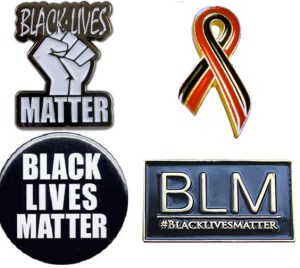
Wearing Black Lives Matter Pins In The Courtroom Matters To This Judge

Q: Which of these can a judge ban from a courtroom? A: All of them.

Q: Which of these can a judge ban from a courtroom? A: All of them.

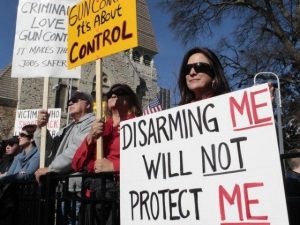
Youngstown (Ohio) Municipal Court Judge Robert Milich ordered NAACP attorney Andrea Burton to remove the Black Lives Matters pin she was wearing. The attorney refused, and was declared in contempt of court.

Good.

She was.

Judge Milich  sentenced the grandstanding lawyer to five days in jail, though the sentence has been stayed while she appeals the decision, as   as long as she obeys Milich’s order not to wear items that make a political statement in court. When she loses her appeal, and she will, she will have to serve the five days in jail.

Milich is on firm ethical and constitutional ground, not that this episode won’t subject him to being called a racist. It is well-established that judges can ban political expressions in the courtroom, and in 1998, the Supreme Court let stand the rulings of a federal district court and the 1st Circuit Court of Appeals, in Berner v. Delahanty, that a the judge’s prohibition of political buttons was a reasonable method of “maintaining proper order and decorum” in a courtroom. In that case, the judge prohibited lawyer Seth Berner from wearing  a button saying “No on 1—Maine Won’t Discriminate,” a declaration against an upcoming state referendum.

As long as a judge doesn’t allow one form of political advocacy while banning others, there is no free speech issue. Judges have gotten themselves involved in controversy when they have allowed buttons, as in the 2006 Supreme Court case of Carey v Musladin, in which Court ruled  unanimously that murder trial spectators were free to wear buttons with a picture of the victim in front of the jury that convicted the defendant. The justices agreed with California prosecutors who said the buttons were a harmless expression of grief by family members at Mathew Musladin’s trial.

I really don’t like that decision. A wise judge will avoid the issue by prohibiting any advocacy in court of of any political, social or case-related opinion. Continue reading

Four Supreme Court Decisions: Abortion, Guns, Affirmative Action, Corruption…And Ethics. Part 2: McDonnell v. United States

Virginia Governor McDonnell shows off the luxury watch he got as a gift from a businessman he barely knew who expected expected nothing in return...

Virginia Governor McDonnell shows off the luxury watch he got as a gift from a businessman he barely knew who expected expected nothing in return…

Governor Bob McDonnell, Virginia’s Republican governor from 2010 to 2014, was charged with using his office to assist businessman Jonnie R. Williams Sr., who, often with Mrs. McDonnell as a conduit, gave his family wedding receptions, loans, vacations and jewelry worth more than $175,000. I wrote about this scandal here, here, and here. The gifts were legal, thanks to absurdly lenient Virginia ethics laws, just as they were obviously unethical, except perhaps to the clueless McDonnells.

Governor McDonnell arranged meetings for Williams and attended events with him. My favorite part of the criminal trial was when McDonnell claimed that he never dreamed that Williams expected anything in exchange for all of his gifts, and then Williams said that of course he expected some favors in return. The jury found that McDonnell’s actions amounted to corruption and a quid pro quo exchange amounting to bribery. A federal appeals court upheld the conviction.

The Supreme Court’s 8-0 decision this week to vacate the conviction upholds the principle that even if someone has done something obviously bad, there has to be a law against what was done before the act occurred in order to convict him. It’s a rather narrow decision. The Court points out that the law McDonnell was convicted of breaking requires “official acts” to be bought and sold for the law to be breached, but that all McDonnell did was hand out political favors to his “friend”: setting up meetings, communicating his favor, greasing the wheels, essentially. (Much is made of the fact that Williams didn’t benefit very much from any of this, which is just moral luck. It doesn’t make what the governor did any less sleazy.)

Wrote Chief Justice Roberts in his opinion for the unanimous Court: Continue reading

Ethics Dunce: U.S. Supreme Court Justice Sonia Sotomayor

"Hey, when you leave, will you ask the bar rep with the gun outside my office what a good job I did for you? I can get bonus credit!"

“Hey, when you leave, will you tell the bar rep with the gun outside my office what a good job I did for you? I can get bonus credit!”

Speaking before an audience at the American Law Institute, U.S. Supreme Court Justice Sonya Sotomayor said that she advocated mandatory pro bono service ( that is, for no compensation) to poor citizens by all lawyers. “If I had my way, I would make pro bono service a requirement,” she said.

“I believe in forced labor.”

This is the quality of thought that we get on the highest court in the land, that must decided our most difficult, controversial and society-molding legal. This is what we end up with when a Justice is appointed in order to check off group identify boxes for “diversity” rather than on the basis of ability.

Sotomayor made the comment at the American Law Institute’s annual meeting in Washington, in response to a question from institute director Richard Revesz about the problem of improving access to low-cost and effective legal services for low-income individuals. I’m pretty sure the “forced labor” comment was delivered as a joke, but it looks terrible in print, and immediately drew a predictable response from conservative pundits. “YOU BELONG TO THE STATE” quipped Instapundit’s Glenn Reynolds.
Continue reading

Comment of the Day: “Comment of the Day (1): ‘Unethical Quote Of The Week: Chelsea Clinton’”

Hysterics, obviously...

Hysterics, obviously…

The gun-banning deceit is revving up again, so to pace the blog on this topic, which already had been discussed in a recent post and a Comment of the Day on it, I held out this excellent post by lively Ethic Alarms regular Steve-O-in-NJ for a few days.

By deceit, I mean statements like White House spokesman Josh Earnest yesterday regarding so-called “smart gun” technology, on which the White House is preparing a legislative push. He said in part:

“I think what is true is that I couldn’t think of another industry off the top of my head that isn’t interested in looking at new technology that could make their product safer. Just about every other industry that I can think of, that’s what people do. That’s what manufacturers do. That is a source of innovation in a variety of fields. I think the best example of this is in the auto industry. Auto manufacturers actually market the degree to which they use new technology to make their products safer, to make cars and trucks safer. It is surprising to me that so many gun manufacturers shirk that responsibility.”

It is amusing that Earnest—is he the worst of the three professional liars the Obama White House has employed to mislead the press, deny the truth and spin misconduct?—prefaced his remarks by dismissing “wild conspiracy theories” that the new initiative was designed to make guns less accessible, then uttered this whopper. Guns aren’t supposed to be safe, or what anti-gun zealots regard as safe, which would mean that they would have to be made out of foam rubber. They are designed to kill things, including, when necessary, people. Cars are not supposed to kill  anyone: making safe cars is nothing at all like making safe guns.

You know, Josh, I can’t think of any another industry off the top of my head–which is apparently quite a bit more well-furnished than yours–that makes killing tools and machines and does look for technology to make them “safer” by the anti-gun lobby’s definition. Hunting knives? Baseball bats? Have you ever seen a safe hammer? A safe bomb? Safe poison? Of course “smart gun” requirements would make guns less accessible (meeting regulations costs money and adds to purchase price, “smart” features that don’t work right engender lawsuits, guns that are more cumbersome to use are less desirable to people who want guns…) by making them more expensive and difficult to use. And that’s just what the President, Hillary, Chelsae and the rest want.

You’re a liar who treats the press and public as if they were idiots, Josh. Just off the top of my head. Yes, I know: I don’t care that you are just channeling your boss. The line about gun-makers “shirking responsibility” is a transparent effort to grease the skids for product liability lawsuits that would make it impossible to make guns, which is exactly the agenda being pursued here. Gun rights supporters know it, and are derided as conspiracy nuts. Anti-gun advocates also know it, and think it’s just fine.

Here is Steve-O-in-NJ‘s Comment of the Day on the Ethics Alarms post “Comment of the Day (1): ‘Unethical Quote Of The Week: Chelsea Clinton’”: Continue reading

Comment of the Day (1): “Unethical Quote Of The Week: Chelsea Clinton”

guns4

Over the weekend, J. E. Houghton contributed this excellent comment, spurred by Chelsea Clinton’s semi-incoherent declaration that seemed to admit that her mother was determined to reduce the Second Amendment right to bear arms to a nullity.

I apologize to J.E. for posting it as a main post later than I intended, though I am now glad I did. Chelsea’s inartful utterance confirmed what anyone paying attention already knows, but that is still a small minority of the public: the only way  anti-gun politicians can achieve the progressive nirvana alluded to by their rhetoric where there is no gun violence except when the government inflicts it is to make self-defense unavailable to the average American. It is important to emphasize what is wrong—as in unethical, undemocratic, unconstitutional, anti-autonomy and totalitarian—about this seductive and sinister position, and as attention on topics here tends to be fleeting, it’s good to have the topic exposed for another week.

Here is J. E. Houghton’s Comment of the Day on the post, Unethical Quote Of The Week: Chelsea Clinton.

 I have been interested in the 2nd Amendment debate for over a quarter of a century. In the early days, I honestly believed that there were good points on both sides of a reasonable debate both consistent with the idea that the 2nd Amendment is a fundamental individual civil liberty.

At some point in time, I concluded that there was a certain faction of political thinking that had no interest in an honest debate at all. But rather, this political faction was in fact a political elite that feared the political power of the American people and especially their potential “last ditch” power of armed insurrection if things got too far gone.

Continue reading

Unethical Quote Of The Week: Chelsea Clinton

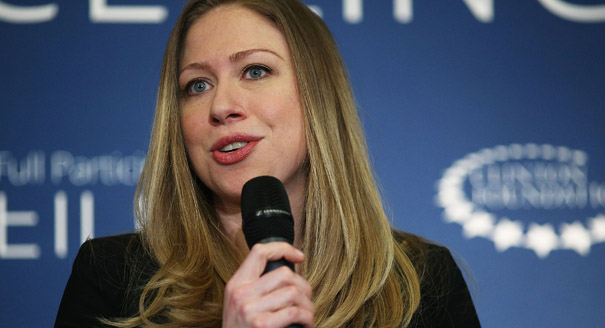
NEW YORK, NY - APRIL 17: Chelsea Clinton speaks at the Clinton Foundation's No Ceilings: The Full Participation Project at the Lower Eastside Girls Club on April 17, 2014 in New York City. Sharing the stage with her mother Secretary Hillary Rodham Clinton, the project is the first in a series of live and virtual dialogues designed to hear directly from girls and women, men and boys about their hopes  and fears for the future. The event, which took live questions from schools around the country, is working to advance progress for women and girls around the world.  (Photo by Spencer Platt/Getty Images)

(Of note: The Clintons are now the first family with three members having one or more “Unethical Quotes” on Ethics Alarms)

“It matters to me that my mom also recognizes the role the Supreme Court has when it comes to gun control. With Justice Scalia on the bench, one of the few areas where the Court actually had an inconsistent record relates to gun control. Sometimes the court upheld local and state gun control measures as being compliant with the Second Amendment and sometimes the court struck them down.  So if you listen to Moms Demand Action and the Brady Campaign and the major efforts pushing for smart, sensible and enforceable gun control across our country — in disclosure, have endorsed my mom — they say they believe the next time the Court rules on gun control, it will make a definitive ruling.  So it matters to me that my mom’s the only person running for President who not only makes that connection but also has a strong record on gun control and standing up to the NRA. This is one of those issues I didn’t know I could care more about until I became a mother. And I think every day about the Sandy Hook families whose children every day, don’t come home from school. And I can’t even imagine that living horror and tragedy.”

—-Chelsea Clinton, semi-incoherently campaigning for Mom this week.

Law professor Ann Althouse was really irritated by this speech, and posted twice about it. She points out that the Supreme Court in fact does not have an “inconsistent record” on gun control, so this statement is either ignorant or untrue—a tough call, since it’s Chelsea, and there is no reason to believe that she knows what she’s talking about, and she’s also a Clinton, which means that lying is in her DNA.

Althouse notes that the assertion about the Court sometimes upholding local and state gun control measures as Second Amendment compliant  and sometimes striking them down is “flat-out false.” Incompetent, irresponsible, or dishonest? Only Chelsea knows for sure, but “unethical” covers all three. Writes Althouse:

“She’s saying the cases are in disarray and the time is ripe for clearing up the confusion, getting to something “definitive,” but that’s not true. She’s really promoting changing the law that got settled in 2 very high profile, extensively briefed and argued cases that produced carefully thought out opinions. The Second Amendment does require application in particular cases (such as the case from last month, Caetano v. Massachusetts, which said the right included stun guns). So there are details to work out, but things have not been left in a state of confusion or in need of “a definitive ruling.”

Continue reading

The Costs Of Civic Ignorance: We Now Have A Frontrunning Candidate For President Who Wants To Gut Freedom Of The Press

SullivanYesterday, flushed with the fact that polls said he “won’ this week’s debate despite outrageous lying, posturing, and incoherence, Donald Trump said that if elected, he will muzzle journalists with fear of libel suits:

“One of the things I’m going to do if I win… I’m going to open up our libel laws so when they write purposely negative and horrible and false articles, we can sue them and win lots of money.We’re going to open up those libel laws so when The New York Times writes a hit piece, which is a total disgrace, or when the Washington Post, which is there for other reasons, writes a hit piece, we can sue them and win money instead of having no chance of winning because they’re totally protected. We’re going to open up libel laws and we’re going to have people sue you like you’ve never got sued before.”

It’s hard to say what is the dumbest or most alarming thing Trump has said this campaign season, but this is close. To begin with, journalism cannot function under the constant threat of libel suits. This device is already used to bully websites, a form of journalism, and blogs like mine, which don’t have the resources to fight censorious and frivolous suits. Second, the statement proves that Trump is ignorant about the Constitution, ignorant about the law, ignorant about American values—Can you make America great again when you don’t comprehend the culture, traditions or history in the first place? Of course not—and ignorant about the powers of the Presidency, which is fairly shocking for someone running for the office. Luckily for Trump, and unluckily for the country, a lot of Americans are even more ignorant than he is.

Third: this can’t be done unless Trump intends to declare himself Emperor, or something similar. The Supreme Court dealt very emphatically with this issue in the 1964 case of New York Times v. Sullivan, which ruled that win a defamation case against a newspaper (and now, by extension, any journalist), a plaintiff must show four things: 1) a false statement purporting to be fact; 2) publication or communication of that statement to a third person; 3) fault; and 4) some tangible harm  to the person or entity who is the subject of the statement. Public officials and public figures–celebrities, people in the news, reality stars, Bozo the Clown— must show that alleged libelous statements were made with actual malice—that is , they were maliciously intended to harm the subjects and the writer and publisher knew they were false, or were reckless is determining if the were false or not-to recover in an action for defamation.

The standard of proof is also high for libel against the press, and this is to protect the press. A plaintiff must show actual malice by “clear and convincing” evidence rather than the lesser burden of proof in most civil cases, preponderance of the evidence.

Sullivan is a bulwark of First Amendment jurisprudence. It isn’t going anywhere. Conservative justices wouldn’t overturn it; liberal justices wouldn’t touch it. Justice Scalia, brought back from the dead, would declare it untouchable. If there is a single legal scholar who has advocated overturning the case in whole or in part, he or she is an outlier or a crackpot. It was a 9-0 decision. Justice Brennan, writing for the Court, wrote… Continue reading

Ethics Review Of “Supreme Court Vacancy Theater”

Court vacancy

The short review would be “Yecchh.”

The reason that the earlier Ethics Alarms post about the death of Justice Scalia expressed the wish that President Obama on his own declare that he would defer the almost certainly futile appointment of a successor to the tender care of the next President was precisely because it was obvious that any other course was just going to create more ugly partisan name-calling and hypocrisy, accomplishing nothing positive and wasting a lot of energy and time. I also knew that this most divisive of POTUS’s would no more do that than he would deliver his next speech in a duck voice. Thus we have the theater, with people who should know better acting like the Republican Senate’s announcement that it would not be voting on President Obama’s nominee, should he make one, is some  kind of gross breach of duty and ethics, and people who don’t know better acting as if being one Justice short is some kind of Armageddon. Neither is true.

Nor is there any reasonably similar set of circumstances and conditions that makes the GOP’s entirely political decision, and Obama’s entirely political decision to test it, some kind of breach of precedent. There is no precedent—not with these factors in play:

A Democratic President with both Houses controlled by the Republicans

An ideologically and evenly divided Court, with the new Justice potentially having a momentous and nation-changing effect on the determination of many looming cases

An unusually partisan and ideological President who has proven unwilling and unable to seek legitimate input from the opposing party, and who, in fact, has been personally and bitterly insulting toward it

A rebellion against the “establishment” in both parties, from the extreme reaches of both parties, on the grounds that neither is extreme or combative enough

A lame duck, not especially popular President and an approaching national election that is currently being molded by unpredictable personalities and events, and is likely to be hotly contested..

The Supreme Court unusually central to the government of the country.

The vacancy on the Court being created by the death of one of the Court’s most influential, ideological and powerful members.

A degree of political division in the public not experienced since the Civil War.

These are all material factors, made more material in some cases because of the other factors. Thus accusations that the Republican have engaged in some kind of grand, historical crime against democracy is, to the extent the accusers believe it, crap, and to the extent that they don’t, ignorant. Continue reading

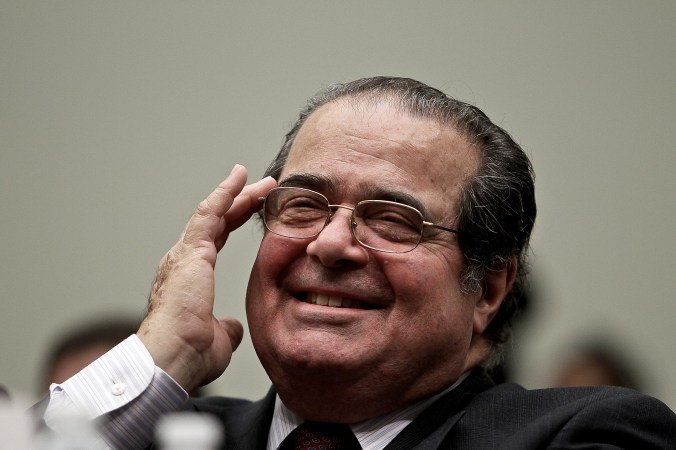
Ethical Quote Of The Month: Supreme Court Justice Antonin Scalia

Antonin_Scalia_2010

“I have no illusions that your man will nominate someone who shares my orientation, but I hope he sends us someone smart. Let me put a finer point on it. I hope he sends us Elena Kagan.”

—The recently departed Antonin Scalia, speaking to Obama advisor David Axelrod seven years ago, as President Obama was faced with making his first Supreme Court nomination upon the retirement  of Justice Souter.

Kagan, of course, was finally chosen to fill the second SCOTUS vacancy. Axelrod treats this conversation as somehow shocking, which I guess it would be to a political operative like him, to whom partisan warfare is everything,. Yet Scalia, who was known to be good friends with several of the more liberal members of the court, including Kagan, displayed with that private statement to Axelrod the professional attitude I have heard from many lawyers, and that perfectly describes my own. What is important to have on the Supreme Court are the best and most competent legal minds available. Assuming such judges also possess integrity, the third branch of the government will be in good hands. Continue reading

Thoughts On The Death Of Supreme Court Justice Antonin Scalia

chapman.0830 - 08/29/05 - A Supreme Court headed by Supreme Court Justice Antonin Scalia has questions for Chapman University Law School professor John Eastman as he and California Attorney General Bill Lockyer argue the 1905 ''Lochner v. State of New York'' case during a re-enactment Monday afternoon at Chapman University. (Credit: Mark Avery/Orange County Register/ZUMA Press)

Supreme Court Justice Antonin Scalia, the Supreme Court’s most adamant, eloquent, controversial and influential conservative jurist and one of the most important theorists in the institution’s history,  died today, unexpectedly, on a ranch near San Antonio while on a hunting holiday. He was 79.

Reflections:

1.  I had a beer with the Justice at a bar function a long, long time ago, after entertaining the assembled legal heavyweights. He was friendly, funny, and gregarious, and when I asked him if he would be on the Supreme Court for the rest of his life, he said, “God, I hope not!”

2. While everyone will be saying that this ups the ante in the Presidential race, that’s impossible. The importance of the election couldn’t be  greater. The vacancy Scalia’s death creates, unfortunately,will  increase the level of demagoguery from both parties, with the appointment of Scalia’s replacement being elevated to the equivalent of a life and death matter obliterating all other considerations. Anyone who argues that will be exposing their true status as a hack, appealing to hysterics, ignoring te ethical value of proportion. The composition of the Court is important, but it is not that important.

3. What is most important to the Court, and has been lost since Robert Bork became the first qualified judge to be blocked by pure partisan considerations despite undeniably outstanding qualifications, is to have smart, able, proven justices. Scalia was such a jurist.

4 .One of the traits of a qualified jurist is a refusal to pre-judge any issue or case before hearing arguments and knowing all the facts. Several of the current justices, including Scalia, have been sucked into the bitter partisan battles of this era and have made comments that called this trait into question. Continue reading