“Who Are You Calling A Nut?” And Other Ethics Issues In The Community College Shooting Aftermath (Parts I-VI)

mr__peanut_s_cane_gun_I. A good friend, who is a nice man so I chose not to upset him by explaining why he sounds like an idiot, announced on Facebook that he wasn’t reading any more “gun nut” posts. Hmmmm. I wonder what he thinks a “gun nut” is? Is a gun nut a teacher who punishes a student for pointing his finger like a gun, or who prevents a deaf child from signing his name, Gunner? Or is it someone who believes that the Second Amendment, which wasn’t second by accident, should be followed? Is it someone who keeps saying that laws need to be passed that will stop shootings like the one in Oregon, but who either has no realistic proposals to suggest or who suggest measures that wouldn’t have affected that shooting at all? Isn’t it nutty to engage in magical thinking? I think so.

II. I also think it’s nutty, not to mention hypocritical, to decry the lack of “civil debate” regarding gun policy and then call anyone who doesn’t want guns melted down by government order “nuts.”  Actually it’s worse than that: pundits, politicians and anti-gun advocates are increasingly equating  opposition to gun regulations advanced using false arguments, dubious logic, ad hominem attacks and deceitful statistics with insanity and intractable evil. Frankly, I resent it. I’m not opposed to sensible gun regulations, but my job is to oppose false arguments, dubious logic, ad hominem attacks and deceitful statistics, as well as to make sure that they don’t succeed lest “the ends justify the means” become a social norm.

III. Speaking of hypocritical, Mike Huckabee and others have been quite properly criticized (by me, for example) by claiming that since the Supreme Court ruling on gay marriage is “wrong,” it shouldn’t be followed. Yet the most vociferous defenders of that SCOTUS decision simultaneously advocate anti-gun measures that are forbidden by the Court’s decisions interpreting the Second Amendment….because, you see, “it’s wrong.” Continue reading

KABOOM! Justice Sonia Sotomayor Is A Supreme Ethics Dunce

HeadExplode3

Sonia Sotomayor is far from my favorite Supreme Court Justice, as she is the court’s most vocal advocate for pro-minority discrimination and a practitioner of touchy-feely law. Still, I assumed she had integrity, or at least my skull did,  because it exploded all over the place when it learned the truth.

Federal employment law forbids employers from having unpaid positions unless they meet stringent requirements of providing genuine educational experience to such workers while not personally (as opposed to professionally) benefiting from their services. Nevertheless, Sotomayor has used  unpaid interns as her servants —not law clerks or researchers, but servants—since 2010. Continue reading

If Anyone Starts Paying Attention To What Bernie Sanders Is Saying, He’s In Trouble

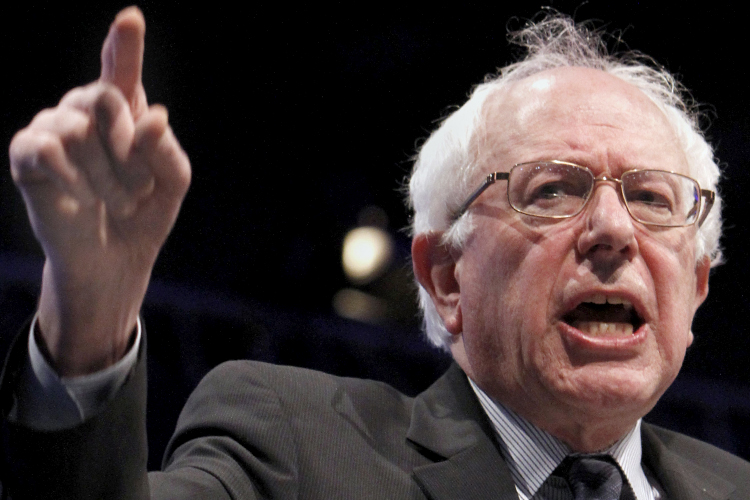
U.S. Sen. Bernie Sanders, I-VT, gestures as he speaks at the Californi Democrats State Convention in Sacramento, Calif., Saturday, April 30, 2011. Sanders called on Democrats to work together to stop what he calls the GOP's attack on the middle class.(AP Photo/Rich Pedroncelli)

So far, Bernie Sanders’ major function in the Democratic presidential nomination race is as a gauge of how badly Hillary Clinton is doing. The same function could be served by a wooden spoon or an Elmo doll, but Bernie will do: as Hillary’s machinations and lies about them sloooowly convince even Democrats that she should not be allowed near any office that includes a button labeled “Power,” he rises in the polls. So far, this had not required anyone actually thinking about Sanders himself, but the contents of a recent speech to a throng in Portland, Oregon should be cause for alarm. Sanders managed to announce his willingness to rig the Separation of Powers and eliminate judicial independence as well as his contempt for judicial ethics and his ignorance of how the Supreme Court works, all at once. All of this indicates that Sanders really isn’t qualified to be a U.S. Senator, much less President.

In his speech, to the sounds of cheers, Bernie shouted, “My nominees to the U.S. Supreme Court will in fact, have a litmus test and that test will be that they will have to tell the American people that their first order of business on the Supreme Court will be to overturn Citizens United.” Those cheers are interesting. My guess would be that not a single member of the audience, and quite possibly not even Bernie himself, has read the decision. Most people who turn red in the face and twitch when one mentions Citizens United do so because they think that it stands for the proposition that “corporations are people.”

It actually stands for the rather reasonable principle that the First Amendment protects the rights of people who band together for common purposes, and who wish to use such organizations to express their opinions regarding elections. The decision forbade the government from restricting independent political expenditures by a nonprofit corporation, and by extension to for-profit corporations, labor unions and other associations. Among other things, the law that was struck down in the case allowed the Federal Government to ban books and films based on content. Continue reading

Ethics Quote Of The Week: The Washington Post

“The court’s legal analysis in Arizona State Legislature v. Arizona Independent Redistricting Commission was something of a reach. But the ruling’s practical implications are unequivocally positive.”

—–The Washington Post in an editorial praising the Supreme Court’s approval of Arizon’s unconstitutional solution to the persistent problem of gerrymandering abuse.

"IGNORE WHEN INCONVENIENT" Really?

“IGNORE WHEN INCONVENIENT” Really?

The Post’s quote means nothing more nor less than “the ends justify the means.” “Something of a reach” is a shameless equivocation: John Roberts’ dissent to the 5-4 majority’s “legal analysis” —there really is none—resembles Mike Tyson slapping around Honey Boo-Boo. The decision’s argument approving the Arizona end-around the Constitution’s Elections Clause that reads, “The Times, Places and Manner of holding Elections for Senators and Representatives, shall be prescribed in each State by the Legislature thereof” can be fairly summarized as “this will work, so the Constitution be damned.” It’s not a “reach.” It’s  obvious defiance of what the document says.

It that so bad? It depends on what you think is more important, integrity or solving a problem. All of the big Supreme Court decisions in the past week have essentially raised this ethics conflict, and it is clear that the liberals on the Court is on the side of solving problems—at least as they see them— even when it means compromising what the Constitution says and what the Founders intended who drafted it, with the libertarian Justice Kennedy, who tends to lean away from laws constraining citizens anyway, often joining the  colleagues to his left. This issue is as stark an example as there can be,

Gerrymandering is unethical and anti-democratic. It was not foreseen by the authors of the Constitution, who can’t be expected to have predicted every devious political maneuver their successors would come up with to pollute their ideals. Unfortunately, the Constitution doesn’t provide a way for the public to stop the practice, other than electing less corrupt legislators, and legislators use gerrymandering to make that exceedingly difficult. A tweak of the wording in the Constitution could carve out an exception, but the Founders also made amending the Constitution in any way at all an almost impossible chore, including amending it to allow easier amending.

What’s a country to do? Well, sometimes the ends really do justify the means: that’s what utilitarianism means. If the Court can kill or limit gerrymandering by, as John Roberts felicitously put it in his dissent, gerrymandering the Constitution, it might be a good choice on balance. It benefits democracy. The conservatives argue, however, and legitimately so, that such a decision also creates a dangerous, even sinister precedent despite its good intentions (none of the Justices seem to think that gerrymandering is anything but unhealthy for democracy). What other laws that violate the plain words of the Constitution will the Court approve because its “practical implications are unequivocally positive,” to the cheers of partisans?  How many times can the Court do this before the Constitution is a dead letter, and any executive–or despot— can claim that government action, regardless of what Constitutional guarantees oppose it, is to be rubber stamped because it solves a real problem? Continue reading

Let’s Take The “Deranged And Unethical Ideologues” Test!

keep-calm-it-s-only-a-test-2

Recognizing insanity shouldn’t be that difficult, or impeded by political orientation. Yet as the Rachel Dolezal fiasco proves, it can be. (Now that we know that she previously claimed to be discriminated against because she was white, and heard her tell Matt Lauer that a black man was her father because she thought of him as her father, will all the loyal left culture warriors who chose to die on that silly hill after I warned them that they would regret it learn anything? I doubt it.)

Now, in the interest of improving everyone’s non-partisan wacko-detection and rejection skills, I offer these two examples, one from the left, and one from the right. If either seems reasonable to you, you flunk.

First, from the right, we have… Continue reading

SPECTACULARLY Unethical Quote Of The Week: President Obama

“Don’t blame us for all the mistakes in the law—look at how long it is!”

…on the Affordable Care Act and King v.Burwell, at his news conference. When President Obama was asked about the soon to be announced Supreme Court decision in King v. Burwell, he launched in an epic of unethical assertions and rhetorical games. I’ll highlight the unethical—not merely dishonest in some cases—statements and elaborate afterwards.

THE PRESIDENT: What I can tell state leaders is, is that under well-established precedent, there is no reason why the existing exchanges should be overturned through a court case. (1) It has been well documented that those who passed this legislation never intended for folks who were going through the federal exchange not to have their citizens get subsidies. (2)That’s not just the opinion of me; that’s not just the opinion of Democrats; that’s the opinion of the Republicans who worked on the legislation. The record makes it clear. (3)

And under well-established statutory interpretation, approaches that have been repeatedly employed — not just by liberal, Democratic judges, but by conservative judges like some on the current Supreme Court — you interpret a statute based on what the intent and meaning and the overall structure of the statute provides for. (4)

And so this should be an easy case. Frankly, it probably shouldn’t even have been taken up. (5)And since we’re going to get a ruling pretty quick, I think it’s important for us to go ahead and assume that the Supreme Court is going to do what most legal scholars who’ve looked at this would expect them to do. (6)

But, look, I’ve said before and I will repeat again: If, in fact, you have a contorted reading of the statute that says federal-run exchanges don’t provide subsidies for folks who are participating in those exchanges, then that throws off how that exchange operates. (7)It means that millions of people who are obtaining insurance currently with subsidies suddenly aren’t getting those subsidies; many of them can’t afford it; they pull out; and the assumptions that the insurance companies made when they priced their insurance suddenly gets thrown out the window. And it would be disruptive — not just, by the way, for folks in the exchanges, but for those insurance markets in those states, generally.

So it’s a bad idea. (8)It’s not something that should be done based on a twisted interpretation of four words in — as we were reminded repeatedly — a couple-thousand-page piece of legislation. (9)

What’s more, the thing is working. (10)I mean, part of what’s bizarre about this whole thing is we haven’t had a lot of conversation about the horrors of Obamacare because none of them come to pass. (11)You got 16 million people who’ve gotten health insurance. The overwhelming majority of them are satisfied with the health insurance. It hasn’t had an adverse effect on people who already had health insurance. (12)The only effect it’s had on people who already had health insurance is they now have an assurance that they won’t be prevented from getting health insurance if they’ve got a preexisting condition, (13)and they get additional protections with the health insurance that they do have.

The costs have come in substantially lower than even our estimates about how much it would cost. Health care inflation overall has continued to be at some of the lowest levels in 50 years. (14)None of the predictions about how this wouldn’t work have come to pass.(15)

And so I’m — A, I’m optimistic that the Supreme Court will play it straight when it comes to the interpretation. (16)And, B, I should mention that if it didn’t, Congress could fix this whole thing with a one-sentence provision. (17)

Wow, that’s even worse that I thought. Have there been more dishonest, deceptive, irresponsible statements by a President of the United States? Maybe. I don’t see how there could have been one that was much worse, though.

I’ll try to be brief, or else this will be a book. The numbers correspond to the bolded sections above… Continue reading

If You Are Going To Make Citizens United A Campaign Issue, You Are Ethically Obligated To Know What The Decision Actually Says

straw man

Here: read the damn thing.

There may have been other Supreme Court decisions that have been more shamefully misrepresented by pundits, activists and demagogues, but I can’t think of one.

The case is back in the news because Hillary Clinton, who  will try for a world record in cynical pandering to the least informed voters if she gets the Democratic nomination, told a group of her top fundraisers this week that if she is elected president, her nominees to the Supreme Court must share her belief that the Court’s 2010 Citizens United decision should be overturned, according to people who heard her remarks. In this she is echoing socialist candidate Bernie Sanders, who has said…

“If elected president, I will have a litmus test in terms of my nominee to be a Supreme Court justice. And that nominee will say that we are all going to overturn this disastrous Supreme Court decision on Citizens United because that decision is undermining American democracy. I do not believe that billionaires should be able to buy politicians.”*

The decision does not say that, or hold that, nor are the implications of the decision intended to allow that. Never mind. Bernie’s ideological leftist supporters don’t care what the decision really is about any more than Clinton does. It’s just a rallying cry against “the rich” and “big corporations.” The slogan is a positive litmus test result for ignorance, or, in Bernie’s case, the willingness to deceive. In Hillary’s case, it is just Hillary being Hillary, trying to keep Sanders from flanking her on the left. Do any of those who cheered her fatuous remarks about the decision know what the decision says? I’m dubious. I don’t even think that’s what they were cheering. They were cheering the symbolic use of the case as class warfare rather than the case itself. In fact, Hillary must be banking on nobody paying attention to the case for a very simple reason. Citizens United was about whether that government could ban a documentary that was critical of…Hillary Clinton!

That’s right, a presidential candidate is going to be on record that the films, books and other communications that criticize her should be illegal. Continue reading

Death Throes Of The Death Penalty: Dumb Expert, Dumb Advocates, Dumb Debate

“Next!”

As I recently concluded, the death penalty is beyond saving, not because it can’t be defended ethically and morally, but because the issues are tangled beyond repair.

The controversy over the legality of the so-called drug cocktails that somehow became our execution method of choice is a perfect example. The battles over capital punishment trapped policy-makers into this kinder, gentler, ridiculously complicated method of execution that has suffered snafus ranging from unavailable drugs to ugly extended deaths. The problem is the floating definition of “cruel and unusual punishment,” prohibited by the Constitution, but almost entirely subjective. Many judges think killing a killer is itself cruel by definition, and the more reluctant Western Europe becomes to execute the worst of the worst, the easier it is to make the argument that the death penalty is also unusual.

I don’t get it. I never have. India once executed condemned criminals by having the subject place his head on a stump under the raised foot of  trained elephant, which on a command would smash the head like a grape. Quick, painless–messy!—but virtually fool-proof. A pile-driver would be an acceptable equivalent.  Ah, but ick! In this stupid, stupid, intellectually dishonest debate, ick always equals “cruel and unusual,” because to opponents of the death penalty, killing people, even horrible, dangerous people, is inherently icky.

(Oddly, ripping unborn babies out of the womb is not, but I digress.)

I’ve admitted it, and I will again. (This lost Ethics Alarms Luke G., one of its best commenters the last time.*) It is obviously wrong to intentionally prolong an execution or deliberately cause pain, but if the occasional execution is botched and the condemned suffers, that should be cause for great rending of garments, nor should it be used to discredit capital punishment. As I wrote here about Clayton Lockett’s execution in Oklahoma

“There was no question of Lockett’s guilt, and his crime was inhuman. Such wanton cruelty and disregard for innocent life warrants society’s most emphatic rebuke, and the most emphatic rebuke is death. It is essential that any healthy society make it clear to all that some crimes forfeit the continued right to not just liberty, but also life. Anyone who weeps because this sadistic murderer experienced a few extra minutes of agony in the process of being sent to his just rewards has seriously misaligned values. No method of execution will work every time, and to make perfection the standard is a dishonest way to rig the debate. If the death penalty is justified, and it is, then we should expect and accept the rare “botch.” Meanwhile, if the concern really is efficiency, reliability, speed of death and minimal pain, there are literally dozens, maybe hundreds of methods of swift execution that would accomplish this. They just won’t pass the standards of death penalty opponents, because no method will.”

Today the Supreme Court heard oral arguments on the question of whether Oklahoma’s use of the common surgical sedative midazolam did not reliably make prisoners unconscious during lethal injections, thus violating the Eighth Amendment’s protection against “cruel and unusual punishment.” It’s a ridiculous case, which arises out of the botched April 2014 execution of Lockett that sparked the post I just quoted. It is a ridiculous case because the method of execution isn’t worth arguing over. Elephant. Head. Problem solved. Why is Oklahoma fighting about which cocktail to use? This is the anti-capital punishment team’s game, and sooner or later, the result is preordained.  Continue reading

Ethical! Funny! But Stupid: Kentucky’s Risible Same-Sex Marriage Ban Defense.

laughing Scotus

Supreme Court justices deserve to have a good laugh now and then.

Michigan, Ohio, Kentucky, and Tennessee are all defending their legislative bans on gay marriage in briefs before the U. S. Supreme Court. Only one of their legal teams came up with—-or had the guts to include—the novel argument contained in the Bluegrass State’s brief, which explains why a ban on gay marriage does not “discriminate on the basis of sexual orientation”:

Kentucky’s marriage laws treat homosexuals and heterosexuals the same and are facially neutral. Men and women, whether heterosexual or homosexual, are free to marry persons of the opposite sex under Kentucky law, and men and women, whether heterosexual or homosexual, cannot marry persons of the same sex under Kentucky law.

This is in the amusing category of arguments that make technical sense in legal terms—well yes, come to think of it, if you look at it that way, you’ve defined discrimination right out of the case!— but no sense whatever in the real world. Gays can’t marry their intended life partner but heterosexuals can; that’s obviously unequal treatment and constitutes discrimination. The defense deceitfully pretends that the whole reason for the emotional controversy doesn’t exist: “Love? What’s that? We know nothing of this thing you call love!”

These come up all the time when legal teams are brainstorming which theories to pursue in an appellate brief, and are virtually always discarded after some general amusement and admiration for the Clintonian who devised it. There is nothing unethical about including a dubious argument along with better ones in a brief, even a Supreme Court brief: consider the position that carried the day in the Obamacare case, when Chief Justice Roberts adopted a rationale for the individual mandate that the Obama Administration had repeatedly rejected and denied. The problem is that such an off-the-wall argument is risky:

1. It pulls time, attention and consideration from more promising arguments.

2. It makes the client look foolish or unserious to the public.

3.  Worse, it might make the client look foolish to the justices.

4. Some justice might react to it as an insult to his or her intelligence.

More than all of that, however,the argument is not going to work. Can you imagine what the reaction would be if the Supreme Court endorsed gay marriage bans relying on that logic? The argument is a non-starter, so including it in the brief sends a loud and clear message that no appellate lawyer ever wants a judge to hear:

“We got nothin’.”


Ethics Observations On The Selma Celebration “Gotcha’s!”

Selma redux

1. The big controversy as of this morning involved the New York Times front page photo, which managed to be cropped exactly at the point where former President Bush could have been seen. Given the Times’ proclivities, conservative blogs and Fox News presumed the snub was intentional. If it had been intentional, that would have indeed been disrespectful and unethical photojournalism. The Times explanation, however, seems reasonable. It tells us something, though, that nobody at the Times saw this coming. I think it’s incompetence born of bias. “Where’s Bush?” “He was too far down the line, so the photo looks lousy if he’s included.” “Damn. Well, put a note in explaining that.” Bias makes us stupid, and the fact that no Times editor had this conversation is, in fact, stupid.

2. If the NAACP was setting the place cards, and I assume they were, then Bush should have been second row center, and not an MSNBC demagogue and race-hustler who owes the U.S. back taxes. Talk about biased and stupid. The NAACP claims it wants to be a unifying force in the country, but it doesn’t. It promotes divisiveness,and intentionally. It’s good for business.

3. A graceful, fair, respectful and competent President of the United States would have insisted that his immediate predecessor be in a position of prominence, as part of the message that this event was an important part of the history of America and all Americans. It would have been the right thing to do. Bush would have done the same for him. But we do not have a graceful, fair, respectful and competent President. We have an arrogant, petty, self-absorbed and divisive one.

4. …who can, on occasion, rise to give an excellent speech, which he did. Continue reading