The Connecticut Senate this week approved a probably unconstitutional bill requiring all Connecticut colleges and universities to adopt the “yes, means yes” policy when it comes to sexual consent, similar to California’s cypto-fascist law. The bill dictates a completely unenforceable standard for sexual consent It was bi-partisan fascism, and passed 34-1. Sen. Joe Markley, R-Southington, was the lone vote against it.
According to the bill’s champion, Sen. Mae Flexer, D-Killingly, it is “is redefining the definition of consent.” She explains that under the law, college students would be required to “say yes” or indicate nonverbally through “physical cues” that they are willing to have sex with another college student. And what “physical cues” would qualify? How about eye contact, and the kind of communications that we celebrate in the arts and literature? What about the “look of love” that Dusty Springfield sang about? Enough, Mae? How would schools enforce such a law? Cameras in every room? A panel of “physical cues” experts, watching every possible sexual encounter? Continue reading →
It is true that watching, rooting for, betting on and generally contributing to the perpetuation of the NCAA Division I men’s basketball tournament, March Madness, and thus big time college basketball generally, is not as unethical as supporting pro football…after all, as Rationalization #22 reminds us, at least we aren’t killing anyone. Still, the whole system is rotten to the core: it warps higher education priorities, it instills toxic values in students, it has nothing to do with student athletics, and it rewards deceit, bribery, and cheating. FACT: Colleges would be better and the culture would be healthier without it.
Unfortunately, that would require people like the President of the United States to show some restraint for the good of society and the education of our children, and say, “Nope. College is for education, and spending millions to create teams of mercenaries who are only interested in making the NBA is a disgraceful misapplication of resources as well as inherently corrupting.”
You doubt that description? Look at the University of Massachusetts, which announced that it will retire a jersey in honor of John Calipari to commemorate the 20th anniversary of the university’s 1996 appearance in the men’s basketball Final Four, when he was the coach. Calipari, the university noted in the announcement, “catapulted” the university to “national prominence.” Well, that’s one description. Because the N.C.A.A. eventually found out that Calipari’s star player, Marcus Camby, had accepted riches and, ah, “services” (prostitution services, for example), from sports agents, the university had to pay $151,000 in fines—how many indigent students’ tuition might that have paid for? At least one—and the Final Four appearance that Calipari is being honored for was wiped from the record books. Continue reading →
There are times when I feel like the ultra-conservative Senator Keeley played by Gene Hackman in “The Bird Cage,” when he’s just learned that his daughter’s future in-laws are a gay couple, that his future son-in-law has two mothers, and the middle-aged woman he had been flirting with all evening is a gay man. Literally nothing makes sense to him any more, and he says, plaintively, “I feel like I’m insane.”
“After a review of records and roughly 70 interviews,” the story said, “Police Chief Timothy J. Longo Sr. said at a crowded news conference here, his investigators found “no evidence” that a party even took place at the Phi Kappa Psi fraternity on Sept. 28, 2012, when the rape was said to have occurred. Instead, he said, there was a formal that night at the house’s sister sorority, making it highly unlikely that the fraternity would have had a party on the same night.Despite “numerous attempts,” he said, his officers were unable to track down the man Jackie had identified as her date that night. And several interviews contradicted her version of events.”
But wait, there’s more:
During the course of the ensuing police investigation, the chief said, investigators interviewed nine of the 14 members who were living at the Phi Kappa Psi fraternity house in September 2012; none said they knew Jackie. The authorities also sent questionnaires to other fraternity members; 19 were returned, and none of the respondents said they knew Jackie or had any knowledge of an assault having occurred at the fraternity house. A review of bank records for the fraternity revealed no expenditures for a party. The police also found a photograph time-stamped Sept. 28, 2012. It showed two men in an otherwise empty entrance hall, the chief said.Investigators also interviewed two of Jackie’s friends, both men, whom Jackie had said met with her after the assault occurred. But both contradicted her version of events, the chief said, adding, “They don’t recall any physical injuries.” And while both said they were told by Jackie that she had gone out on the night of Sept. 28, 2012, with a person named Haven Monahan — identified in the Rolling Stone article as “Drew” — the police were unable to track Mr. Monahan down.
Meanwhile, we are told, “Jackie” refuses to cooperate with the investigation in any way. Continue reading →
TU suspended student George “Trey” Barnett last October for three Facebook posts [ It’s unethical and probably illegal to punish Barnett for his own Facebook posts…] published by his husband that criticized another student and two TU faculty members. […but it is beyond belief for the school to punish him for what someone else, regardless of who, posts to his page.] None of the Facebook posts came from Barnett’s account; the statements were posted by his husband, who either tagged Barnett or posted them directly to Barnett’s Facebook page.Barnett’s husband later submitted a sworn affidavit attesting to his sole authorship of the posts. Nevertheless, shortly after TU professor Susan Barrett filed a complaint against Barnett arguing that Barnett could not “avoid responsibility” because someone else was responsible for the posts. [This is Kafaesque. Do these even people know how Facebook works? ] TU Senior Vice Provost Winona Tanaka imposed eight restrictive interim measures against Barnett. The sanctions included suspending his participation in certain courses and activities and even barring him from speaking about certain individuals. [University administrators can not bar whom a citizen may speak to; only judges can do things like that, and only rarely.]
Without affording him the hearing he was entitled to under TU’s University Student Conduct Policies & Procedures, and despite his husband’s affidavit, Tanaka found Barnett responsible for “harassment.” Tanaka also found Barnett guilty of retaliation and violating confidentiality requirements for speaking about the disciplinary charges with his husband—who was also his exculpatory witness. [ What??? WHAT??? Due Process? Rights of the accused? Procedures? Policies? ]
Less than two months before Barnett was set to graduate, Tanaka not only suspended him until at least 2016 but also permanently banned him from receiving a degree in his major even upon his re-enrollment. Barnett was forced to wait two months for TU to respond to his appeal, which the university summarily denied on January 9 without explanation—leaving Barnett unable to earn his theater degree as planned. [ All of this for what someone else wrote on the student’s Facebook page! My key question in ethics scenarios is “What’s going on here?” What’s going on here? I have no idea. An illicit relationship between the apparently fat faculty member Barrett and Tanaka? Insanity?]
…TU has also threatened … its independent student newspaper, The Collegian, which this week reported on Barnett’s suspension and criticized his treatment. TheCollegian reports that after contacting TU administrators for comment, student reporters were told by TU’s director of marketing and communications that if “anything that the university deems to be confidential” is “published or shared, (that) could violate university policies.” The university refused to explain what might constitute “confidential” information and, come press time, the journalists were unsure what action the university might take against them. [ OK, let’s just stipulate that the University of Tulsa doesn’t accept the principles underlying the First Amendment. I will await its next abuse of power being aimed at impending worship requirements and a ban on assembly.]
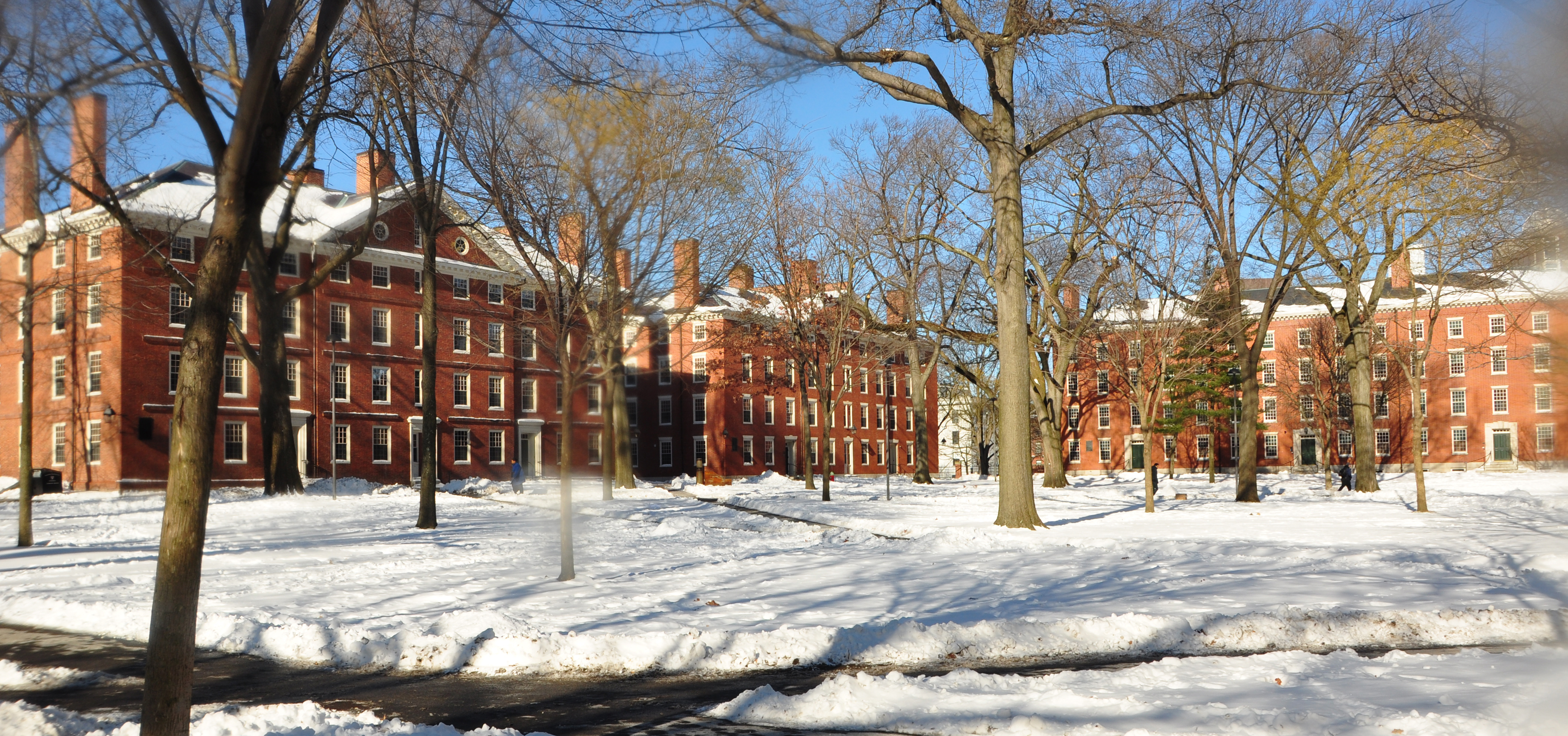
Harvard used to just say “it’s wrong,” but left it up to the faculty’s ethics in the school’s infinite faith in its own superior virtue. My Freshman Humanities professor, poet William Alfred, was married to a former student. As is usually the case in this matter, ethics alone often wasn’t enough to restrain the lust of many aging, prestigious, powerful professors facing a veritable cornucopia of luscious, young, ambitious co-eds they could court using brains, worldly wiles, charm and the promise of good grades. Now the profs have more to bolster their self-control…from the New York Times:
Harvard University has adopted a ban on professors having sexual or romantic relationships with undergraduate students, joining a small but growing number of universities prohibiting such relationships. The move comes as the Obama administration investigates the handling of accusations of sexual assault at dozens of colleges, including Harvard.
The ban clarifies an earlier policy that labeled sexual and romantic relationships between professors and the students they teach as inappropriate, but did not explicitly prohibit professors from having relationships with students they did not teach.
Harvard said in a statement released Thursday that the change was made after a panel reviewing the institution’s policy on Title IX, the federal law prohibiting sex discrimination in education, determined that the university’s existing policy language on “relationships of unequal status did not explicitly reflect the faculty’s expectations of what constituted an appropriate relationship between undergraduate students and faculty members.” It said the committee revised the policy “to include a clear prohibition to better accord with these expectations…Besides banning sexual and romantic relationships between professors and all undergraduates, the policy also bans such relationships between teaching staff, such as graduate students, and the students who fall under their supervision or evaluation.
Good. Long overdue.
This is also an excellent use of Harvard’s status and leadership, as the oldest and most famous institution of higher learning. Other universities will now suddenly be responsible as well.
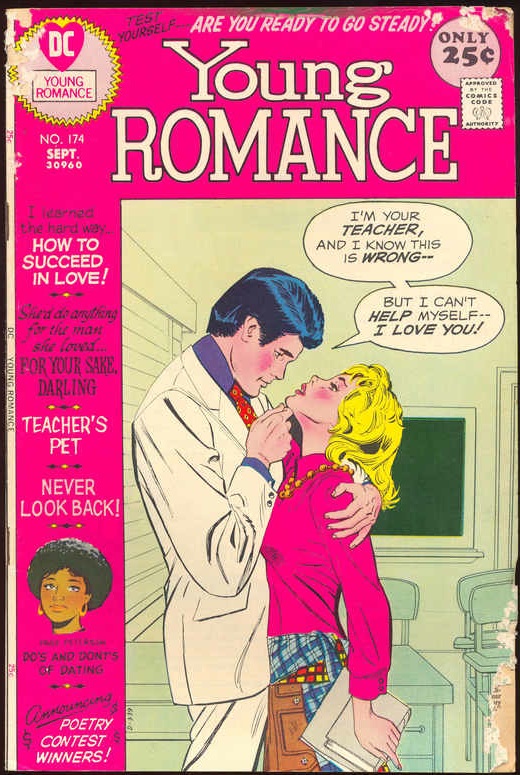
ProfsBlog asks the question regarding law professors and law students, but the question doesn’t change by narrowing the definition. The question is really, and only, “Is it ethical for teachers to have romantic relationships with students?” The answer is, has been, and forever shall be, “No.”
The answer to an ethics question sometimes becomes obvious when it is apparent that every argument on one side is either a logical fallacy, an unethical rationalization, or the application of an invalid ethics principle. Such is the case here, and thus I somewhat question the motives of the author of the post, Kelly Anders. Wishful thinking, perhaps? Asking the question creates the illusion that there is a real controversy. In this case, there isn’t.
I addressed this question a long time ago, in an early post here barely seen at the time but among the most frequently visited since. I wrote:
[P]rofessors [are] obligated to maintain a position of authority, objectivity and judgment as mentors and teachers of the whole student body, and [have] a duty to their schools not to allow their trustworthiness to be undermined by having intimate relationships among the same group that they [are] supposed to be supervising and advising. Dating a student is a professional breach of trust, and one that adversely effects the integrity of the entire educational institution…. The appearance created when a supervisor/manager/leader indulges in intimate relations with someone over whom they have authority, status and power—and every professor has authority over every student, in class or out— undermines the institution and the profession, by sending the false message that such relationships are standard, approved, and implicitly desirable in the culture where they occur…A professor has a potential teacher-student relationship with all students at a university, not just those in his or her classes.
Dating a student who happens not to be in one of those classes is what lawyers call “a distinction without a difference.” Many students and professors will reasonably assume that the pairing arose out of the student-teacher relationship, and in some ways it almost certainly did. A teacher always has superior power over any student by virtue of his or her position of authority, and it is an abuse of that power to use it to entice students into dates or bed…
[It] is naive to ignore the extended conflicts such relationships create. Might the professor’s best friends on the faculty be more generous when grading their friend’s significant other if he or she is one of their students? Will the professor consciously or subconsciously be easier on the friends of his student lover if they are in his class? The fact that the question can be asked shows that the situation should not occur where it can be asked.
Students, all students, must be off-limits as romantic partners for professors and administrators in universities, regardless of what rules are in place.Professors who date students risk their jobs because a student body is not their sexual smorgasbord, and it is a breach of trust and duty to treat it like one.
I wouldn’t change a word, except that typo I just noticed, and just fixed in the original. Nor is anything I wrote then revolutionary or new. These are the realities of authority, professionalism, leadership and power. It’s just that sometimes people really, really wish they were not. Continue reading →
Melissa McEwan’s profile photo. I’m not going to say a thing. No, really. Not a thing.
“I can’t state this more emphatically: If Jackie’s story is partially or wholly untrue, it doesn’t validate the reasons for disbelieving her.”
— Melissa McEwan, feminist proprietor of @Shakestweetz, an-all tweet blog, responding to the meltdown of the Rolling Stone story accusing a University of Virginia fraternity of gang rape.
Look, I’m not going to insult you by explaining what’s wrong with the assertion that those accusing others of horrific crimes shouldn’t be held to strict standards of credibility.
What is more significant than McEwan or her tweet is that this frightening and dangerous state of denial is moving from the status of self-evidently insane to acceptable. As I suggested in the previous post about the Rolling Stone retraction of its explosive story by Sabrina Rubin Erdely, the Ferguson demonstrators, the “Hands up!” protestors, the Congressional Black Caucus, and pundits like Eugene Robinosn who are still arguing that Officer Wilson should be indicted are doing essentially the same thing. Having decided that the Ferguson narrative pressed by civil rights activists communicated a deep truth about America, they refuse to accept that it was false even in the face of overwhelming evidence because they are intellectually and emotionally committed to that “truth.”
The tweet also forces me to upgrade the Rolling Stone fiasco to Ethics Train Wreck status. Continue reading →
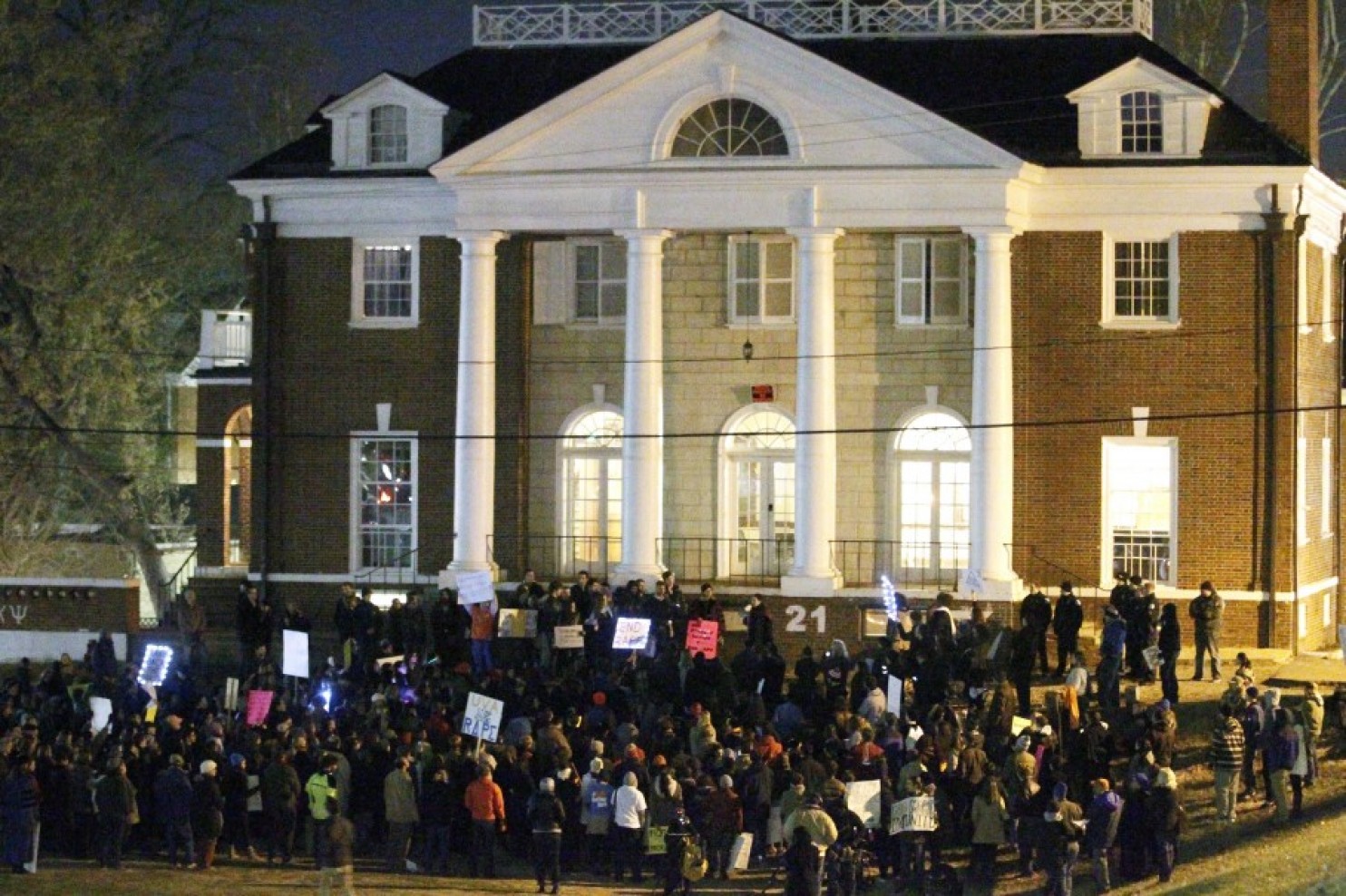
Student protest against campus rape at UVA. And if the rape didn’t happen? Take a cue from the “Hands up!” crowd: keep protesting! The news media won’t notice.
On Nov. 19, Rolling Stone published a sensational report—sensational, mind you—by reporter Sabrina Rubin Erdely, telling the tale of a vicious gang rape at the Phi Kappa Psi fraternity at the University of Virginia. The victim and the source of the story, a young woman called “Jackie,” said that in 2012 she was forced into a room in the fraternity and raped by seven men, as her date and another man cheered her assailants on.
In response to the uproar triggered by the story, the university, which was loathe to be a target of investigations and sanctions by the Obama administration if they did not act with appropriate haste and severity, suspended all the campus fraternities until January as the media went into a feeding frenzy. Meanwhile, the alleged crime is under investigation by local police. [UPDATE: Here is a call to suspend the UVA President Teresa A. Sullivan: “Her decision was arbitrary, rash and wrong. Even Delta House got some semblance of a trial in the movie, ‘Animal House.'” I do not disagree.]
Several journalists diplomatically raised questions about the account, especially the fact that the story was often phrased in terms that left no hint that these were allegations only. In an environment where the party in control of the White House maintains that any hesitation to regard a rape accusation as inherently reliable is proof of a “war on women,” one unnamed woman’s unconfirmed accusation presented as truth by a female reporter was sufficient to trigger adverse consequences for male UVA students with remarkably little reflection: this was unfair, an example of punishing all the horses because someone said that one of them left the barn.
It should be no surprise that the other shoe has dropped. Continue reading →
It probably isn’t the winner in the Ethics Alarms quest to identify the most unethical pop songs, but the 1949 ditty “Why Do They Always Say No?” is one of the most instructive nominations. The fascinating and essential feature of ethics is that our understanding of right and wrong evolves, changing and advancing with wisdom, cultural debate and reflection. This song is a tuneful reminder, arriving at our attention just as the culture, especially on campus, is struggling over exactly the dilemma the song celebrated. In 1949, however, literally no one thought about romantic or sexual gamesmanship as an ethical issue, or at least not a momentous one.
Have a listen (It’s on the B side of the record pictured, and starts playing at the halfway mark):
The lyrics are credited to Harry Pease, Frank Davis, Ed G. Nelson and Billy Glason. Only the latter has much of a footprint on Google, and none of them rate a Wikipedia entry. I doubt that it took four guys to write this song: It’s not exactly “A Day in the Life.” Glason (b. 1904) was probably the author. He shows up in the Encyclopedia of Vaudeville as a “singing comedian,” known for devising new punchlines for ancient jokes, such as
Q: “Who was that lady I saw you with last night at that sidewalk cafe?”
A: “That was no sidewalk cafe! That was our furniture!”
Pease, Davis, and Nelson were all musicians, though it’s also hard to imagine that the elemental tune required three collaborators. The lyrics are more disturbing read than heard:
Why do they always say no When they know they mean yes all the time You ask a girlie for a kiss or two She’ll let you know that’s something I don’t do How can they tell such a lie And still look you straight in the eye Whenever they say no to you go right ahead Cause it’s 10 to 1 that they mean yes instead Oh, why do they always say no When you know they mean yes all the time
Why do they always say no When you know they mean yes all the time You start to love them and they pout and fret Down in their hearts they want all they can get What keeps them acting that way They don’t mean a word that they say A girl that said she’d never marry me She’s the mother of my happy family Why do they always say no You know they mean yes all the time
Why do they always say no When you know they mean yes all the time You ask your girlie for a kiss or two She’s lets you know that’s something I don’t do How can they tell such a lie And still look you straight in the eye Whenever they say no to you go right ahead Cause it’s 10 to 1 that they mean yes instead Oh, why do they always say no When you know they mean yes all the time
You know they mean yes all the time.
“You know they mean yes all the time.”
Sure you do.
_________________________
Special thanks to my volunteer scout Fred, whose wife found this piece of musical ethics archeology.
In 2011, the Obama Administration threatened universities with a loss of funding if they did not adopt a new “preponderance of the evidence” standard in evaluating alleged student sexual assault and sexual harassment. This was, few doubt, a sop thrown to the combative feminists among the Democratic base, those who detect a culture-wide “war on women” and who seek to cast co-eds as imperiled naifs even as the proclaim themselves the equals of men. Within three years this really bad idea has metastasized into the Campus Sexual Assault Witch Hunt Ethics Train Wreck, which would be getting more media attention but for the fact that the world is falling apart in chunks. Among its weirder effects is the proliferation of new “yes means yes” regulations, effectively taking all spontaneity, romance and fun out of sex, all in the service of dubious and cynically employed campus rape statistics. Take this, for example:
“Consider the sexual consent policy of California’s Claremont McKenna College, shared almost verbatim with other schools such as Occidental College in Los Angeles. Paragraphs long, consisting of multiple sections and subsections, and embedded within an even wordier 44-page document on harassment and sexual misconduct, Claremont’s sexual consent rules resemble nothing so much as a multilawyer-drafted contract for the sale and delivery of widgets, complete with definitions, the obligations of “all” (as opposed to “both”) parties, and the preconditions for default. “Effective consent consists of an affirmative, conscious decision by each participant to engage in mutually agreed upon (and the conditions of) sexual activity,” the authorities declare awkwardly. The policy goes on to elaborate at great length upon each of the “essential elements of Consent”—“Informed and reciprocal,” “Freely and actively given,” “Mutually understandable,” “Not indefinite,” “Not unlimited.” “All parties must demonstrate a clear and mutual understanding of the nature and scope of the act to which they are consenting”—think: signing a mortgage—“and a willingness to do the same thing, at the same time, in the same way,” declare Claremont’s sex bureaucrats.”
Cheers, then, are due to 28 Harvard Law professors, who authored and signed a letter protesting Harvard University’s capitulation to the Obama Administration’s blackmail and urging the University to reject the new standards:




 Ethics Alarms