Unethical Website of the Month: Opinion-NYTimes.Com

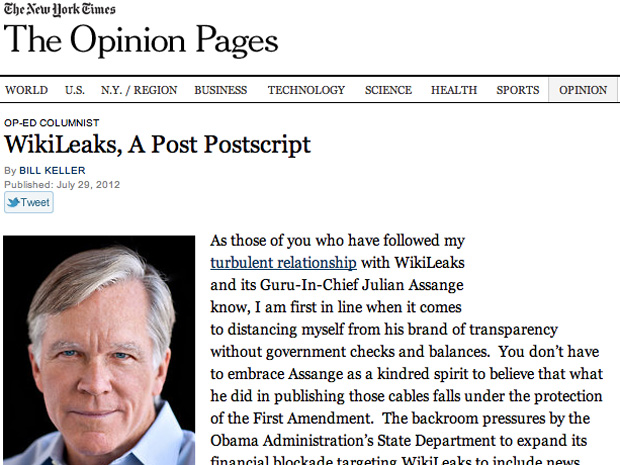
Yes, it is also an extremely well-done unethical website, a clone of the New York Times editorial pages, even featuring links to the real Times.

It is, however, a web hoax that presents a defense of Wikileaks, itself an unethical position, under the by-line of a real person, former Times editor Bill Keller, who didn’t write it, in order to mislead and fool people. One of those fooled was Times technology editor Nick Bilton, who passed on the link on Twitter. Keller eventually used a tweet to expose the hoax.

What a riot.

Hoaxes like this are constitutionally protected, but they are the news and commentary equivalent of the scene in “The Naked Gun” in which Leslie Nielsen throws  ten baseballs into the air as a catcher is trying to catch a foul pop-fly. They are information vandalism, and until the media and the public stops regarding them as newsworthy or funny, they will proliferate, and some will cause tangible harm

The technical term for the purveyors of web hoaxes like this is “assholes.” Once that is agreed upon, unequivocal and clear, we might have a chance of discouraging them.

Update: I had just finished writing the post when I  learned that Wikileaks itself has taken responsibility for the hoax. You see? The technical term was accurate.

_______________________________________________

Facts: Yahoo!

Source and Graphic: Care 2 Make a Difference


Web Hoaxes: Not Funny, Always Unethical

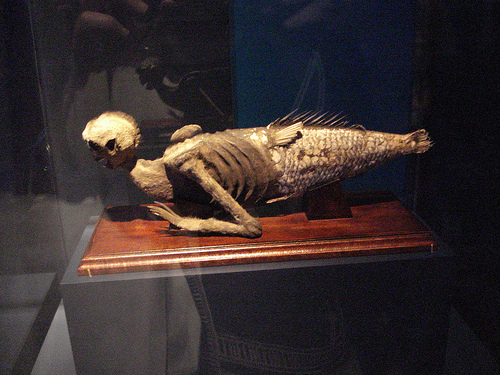
P.T. Barnum’s “Fiji Mermaid:. At least in 1842,. it wasn’t on the web.

Ethics Alarms is swearing off “angry ex-boyfriend/girlfriend takes cruel outrageous revenge” stories, no matter how juicy the ethics lesson may be. First it was the tattoo artist who defaced his ex’s back with a huge and ugly drawing of steaming dog excrement that was fantasy masquerading as news, and now it’s the Polish dentist scorned…remember? The one who pulled out her cheating boyfriend’s teeth? Yes, it seems that horror story was a hoax too.

A lot of people who should know better think that web hoaxes are funny and hoaxers are clever. I regard them as the ethical equivalent of  chefs and waiters who spit in restaurant customers’ food. The web creates—a web!—of information and communication across nations and cultures, and poisoning that web with bogus stories creates a chain of unpredictable harm. At very least, hoaxes make every trusting source that passes along the lie an unwitting accomplice in a despicable act. It harms long-nurtured relationships of mutual trust between those who post on blogs and websites and those who read them. Continue reading

Chevron, Environmentalists, Hoaxes, and the Ethics of Dialogue

Chevron, the oil giant, rolled out a new ad campaign this week. It announced that Chevron agrees with critics and environmentally concerned Americans that it has critical responsibilities, such as reinvesting profits into socially responsible projects, seeking renewable energy sources, and taking extra steps to protect the environment. “We hear what people say about oil companies – that they should develop renewables, support communities, create jobs and protect the environment – and the fact is, we agree,” says Rhonda Zygocki, Chevron’s vice president of Policy, Government and Public Affairs, in the company’s press release. “This campaign demonstrates our values as a company and the greater value we provide in meeting the world’s demand for energy.  There is a lot of common ground on energy issues if we take the time to find it.” Continue reading

Web Hoaxes: Would You Trust This Lawyer?

In an earlier post this month, I related the story of Ethan Haines, an unemployed, newly-graduated lawyer who was staging a hunger strike, he said, to protest the fact that law schools misled their recruits about the employment prospects of their graduates. I was not sympathetic, and concluded:

“Law degrees still are valuable credentials, as is a good legal education, and if Haines got a good legal education, he received everything a law school is obligated to provide. Turning the degree into a career is his responsibility, and it is wrong for him to claim that anyone but himself is accountable for his present unemployed state.”

His stunt was more than an avoidance of responsibility and accountability, however it was a lie. Continue reading

Doritos, Web Hoaxes, and the Need For An Ethical Consensus

AOL reports:

“A fake coupon for a free bag of Doritos has gone viral, leaving consumers angry when they can’t cash it in, retailers holding the bag if they do redeem it and Frito-Lay dealing with damage to its image. The scam problem has increased in the past few weeks as more and more people e-mailed the coupon to one another. And though a $5 bag of chips may not sound like a big problem, Frito-Lay spokeswoman Aurora Gonzalez said the losses could end up in the multimillions: The dollar value of fake coupons submitted in recent weeks equaled 5 percent of Frito-Lay’s real coupon offerings for all of 2009, she said.”

Pretty funny, huh? Continue reading

April Fool’s Day Ethics

What should be the standards of ethical conduct on April Fool’s Day? Research indicates that the tradition is a long one, and versions of Spring foolishness celebrations have been around for centuries. One source says, “April Fools’ Day is observed throughout the Western world. Practices include sending someone on a ‘fool’s errand,’ looking for things that don’t exist; playing pranks; and trying to get people to believe ridiculous things.”

Continue reading

Web Ethics, Due Diligence, and the Happy Maxi-Pad

There is no denying it any more. It is per se unethical to pass along information discovered on the web to anyone, much less to put it on a blog or in an e-mail, until you have performed due diligence and determined with reasonable certainty that it is accurate and true.

All the more reason, then, to praise the Snopes “urban legends” website, which does a superb job tracking down and clarifying web hoaxes, rumors and other misinformation. A lot of the latter isn’t even intentional, but the consequences of not checking the facts can still be significant and harmful,

I thought about this after encountering an amusing bit of web lore that many of you may have already seen, on aan old blog post that introduced the piece like this: Continue reading

TMZ’s JFK: Fake Photo, Same Ethics Questions

I love this, I really do. Yes, the JFK photo found by TMZ and trumpeted elsewhere, including here, is a hoax.

Since the photo conveys no new or false  information about JFK’s proclivities, its main significance is that TMZ was sloppy, and since it is well established that it traffics in gossip and rumor anyway, this means Ethics Alarms and others were gullible and careless.

I apologize.

A few points:

  • All the questions raised in the post stand.
  • This reaffirms my conviction that postng a hoax of any kind on the web, whether photo or otherwise, without clearly designating it as such, is unethical.
  • Let us all give thanks  for “The Smoking Gun.”

JFK the Philanderer: What Does It Mean?

Honest, I’m not picking on the Kennedy’s. That this surfaced today is a coincidence. But if you cross Ted Kennedy and Tiger Woods, you get Jack Kennedy, and what should appear on the web this morning but a surprising photograph:

TMZ, the celebrity trash website that likes to publish paparazzi photos of supermodels with spinach between their teeth, has a genuine scoop: it has gotten its cyber-hands on a photograph that appears to show a bevy of naked women frolicking on a yacht as a young Senator Jack Kennedy lounges nearby.  [UPDATE: As explained by The Smoking Gun here, and discussed in a later Ethics Alarms post here, the photo was a hoax. The ethical issues raised by it and discussed below are still valid, however.] Continue reading