I am trying hard to write about something other than the Charley Kirk Ethics Train Wreck despite the din making even thinking about other ethics issues difficult. Naturally, my default solution is the Great American Ethics Genre: the American Western.
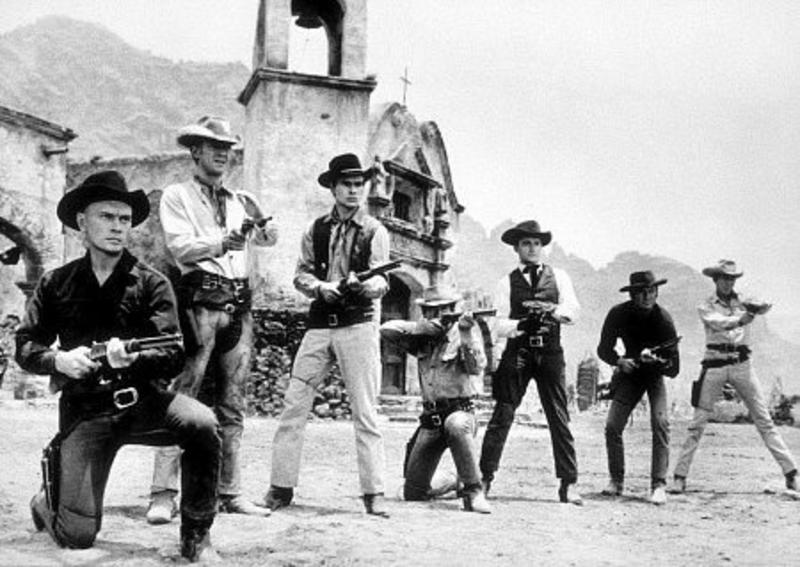
I have been bringing a younger friend up to speed in his cultural literacy pursuits, and recently had him view the original John Sturgis-directed version of “The Magnificent Seven,” a great ethics movie and one of the ten best Hollywood Westerns ever made, a tough field. I have written about the movie several times on EA, but I am abashed to say that it never quite sunk in what the film was really about until that last viewing.
The film is about professionalism. Once that bell rang, I couldn’t believe that I hadn’t realized it before. It is a filmed course in professionalism—the quality of justifying the trust a particular practitioner of an occupation dedicated to public service must maintain to be considered a professional. I would love to teach a professionalism course using the movie as the centerpiece.
Years ago, retired EA commenter Bob Stone-–I hope he isn’t Trump-Deranged now—wrote a piece for his own blog about how the film illustrated the difference between law and ethics. He wrote in part,
I recently perked some interest here in a comment when I mentioned how my dad, who taught various forms of weapon use while a trainer in the Infantry, railed at every example of a “Mexican stand-off” represented in a movie or TV show. “First one to shoot wins, or both quickly realize that there’s a mistake, and put down the guns,” he said. I was inspired by the Netflix Western “The Ballad of Lefty Brown,” which is very good, but the writer really liked Mexican stand-offs.
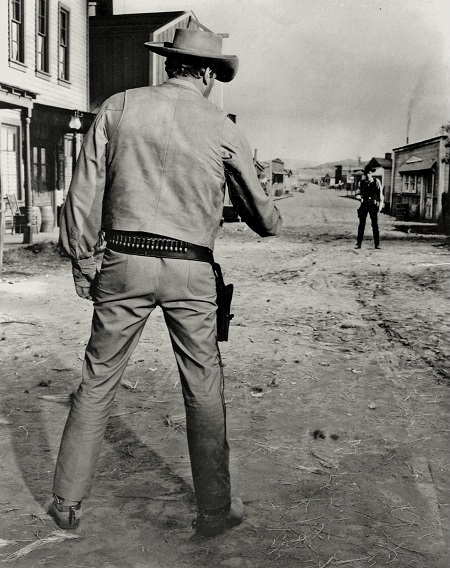
Another example is the old, dusty street showdowns Westerns have featured for a hundred years. They just didn’t happen, except for a few anomalies. One of them occurred this date in 1865, when Wild Bill Hickok faced off in the Springfield, Missouri city square against a former Confederate soldier named Davis Tutt in a dispute over a watch. Wild Bill won—his skill with a pistol was no myth—but the dime novel writers used the episode and Hickok’s colorful persona to create the impression back East that Wild West gun fighters were having quick draw showdowns daily. In fact, the Hickok-Tuttle affair was the first one documented.
The classic western showdown, also called a walkdown, was far rarer than drunken men shooting at each other spontaneously, ambushes and sneak attacks. The showdowns aren’t even as common in the movies as some people think who should know better. One article on the History Channel site talks about showdowns “like in ‘High Noon.'” Despite the title, there is no classic showdown in “High Noon.” And once he stopped making two-reelers as a B-movie star, John Wayne’s characters were never in any “middle of the street” duels either. Continue reading →
Extradimensional Cephalopod lassoed itself a Comment of the Day (I love the image of a cepalopod using a lasso!) with his musings on why races were designated “black” and “white,” since the white/black dichotomy is so frequently used to describe good/evil.
I’ll be back at the end with a rather lengthy discourse of my own on this subject, because it’s a favorite of mine.
I actually find it annoying that on the one hand, human races (groups of humans who share some similarities in appearance) have historically been identified by colors associated with their skin, while on the other hand, completely independently and before meeting humans from other continents on a regular basis, Europeans started to use colors to indicate whether things are good or bad.
This etymology likely came about because when things rot they often turn black, and because blackness implies darkness (the absence of light), which most humans use to evoke ignorance, fear, or bad luck because they can’t see in the dark. (I use the metaphor of darkness in a much more neutral/benevolent sense, but that’s quite rare.) Interestingly, the color white is associated with death and mourning in many Asian cultures.
With the exception of finance (black ink marking positive numbers and red ink marking negative numbers), most historical evocations of the color black indicate evil, corruption, morbidity, or otherwise something negative. “Black heart,” “blackguard,” “black magic,” “black hat,” “black market,” “blackball,” “blacklist,” “black mark,” “black day,” “black comedy/humor”… Continue reading →
I am so, so far behind, both here on Ethics Alarms, and elsewhere, like prepping for some upcoming seminars, writing new programs, and trying to get the business and home budgets to work. Last week involved the car dying, getting a new one, enduring a six hour, 17 inning loss by the Red Sox, some lingering new computer glitches, and a major video shoot for which I had to write and refine the script, acquire the props and costumes, and rehearse the actors, then assist the team of seven who handled the shoot itself, all while being sick, and progressively exhausted. (This project would not have all happened without the brilliant and tireless work of my business partner and love of my life, Grace.)
Ethics Alarms was lower on the priority list this week than I would have liked it to have been. I’m sorry.
1. “The Rifleman” Ethics: As I have mentioned here before, “The Rifleman,” the 30 minute TV Western drama, starring Chuck Connors as Lucas McCain that ran from 1959-1962, was all about ethics, with almost every episode teaching an ethics lesson to the Rifleman’s son Mark, played by the charming juvenile actor Johnny Crawford. I just watched an episode from the show’s final season that I hadn’t seen before. Guest-starring Mark Goddard (best known as the hot-headed young co-pilot in the original “Lost in Space” on ABC), the story involved a charismatic young huckster whom Mark admires but his father distrusts. This causes rare friction between father and son. Eventually, Lucas is proven right: the young man is a liar and a crook who was taking advantage of Mark’s guilelessness.
Mark shamefully but manfully tells his father, “I apologize for being wrong.”
NO! One shouldn’t apologize for being wrong. One has an obligation to apologize for doing wrong, which includes making a bad decision because of laziness, carelessness, poor reasoning, inadequate analysis, or through some other failing. There is no shame or blame in being wrong in the kind of situation laid out in the episode, however.
Until the final moments, the audience couldn’t tell whether this would be one of the episodes where Chuck screws up, with the lesson to Mark being, “Jumping to conclusions and judging strangers harshly before you know anything about them is unfair, Mark. You were right. I’m proud of you.”
In fact, after Mark apologized, I expected his father to come back with exactly what I just wrote. This was moral luck: Mark had nothing to apologize for.
Boy, I’m never going to catch up if I let issues jump in line like that…Continue reading →
All right: not exactly lost, but certainly almost forgotten. Released in 1960, “Sergeant Rutledge” was a daring Western with a racial justice theme well before Jim Crow had breathed its last. The iconic film version of “To Kill A Mockingbird” was two years from being made, and master director John Ford told the story of a black “buffalo soldier” wrongly accused of raping and killing a white woman and shooting an officer. The film was the first to feature the Buffalo Soldiers, the all-black cavalry units that continued through World War II, and was the first Western to feature a black protagonist. Sergeant Rutledge, played by the perfectly cast Woody Strode. Rutledge is innocent, but because he is black and a white girl was one of the victims, he is presumed guilty. The prosecution in his military trial has blatant racist overtones, and Ford unsparingly focuses on the indignities imposed on African Americans in the unsettled frontier culture following the Civil War. In Strode, Ford had an almost too ideal star: everything about him is perfect. He’s brave, well-respected, professional, trusted and gorgeous: Strode was a magnificent former athlete who projected virtue quiet dignity in every film appeared in. I don’t think he ever played a villain.
The movie has some problems, including a Perry Mason-style resolution that is either over-acted, badly-acted, or badly-written: I couldn’t decide. It was also a flop, perhaps because the nation was more ready for the theme two years later, perhaps because Ford’s star was fading fast by 1960, but more likely because it had no major star like Gregory Peck (or John Wayne, who was busy making “The Alamo”) to persuade audiences take a chance on an unusual film. It is Strode’s only starring role, and Hollywood was just beginning to cast Sidney Poitier in leads—Poitier was a far more versatile actor—in 1960. The other star is Jeffrey Hunter, best remembered today for making the original pilot for “Star Trek” as “Captain Pike.” Hunter never was a box office draw, though he was a strong second lead in Ford’s “The Searchers.”
Somehow the myth has grown that this was a film in which Ford, nearing the end, was “apologizing” for his previous racially insensitivity in other films. That’s revisionism. Ford made Westerns about cowboys and the West, and both were undeniably dominated by whites, with blacks in subservient positions. It’s not insensitive to be faithful to history. Ford was, by the standards of his time, a progressive liberal, and the kind, apparently now extinct, who could still have close friendships and working relationships with conservatives, like Ward Bond, Walter Brennan, James Stewart and John Wayne. For example, Ford memorably stared down arch-Right director Cecil B. DeMille when DeMille was trying to get the Screen Director’s Guild to install a loyalty oath. Continue reading →
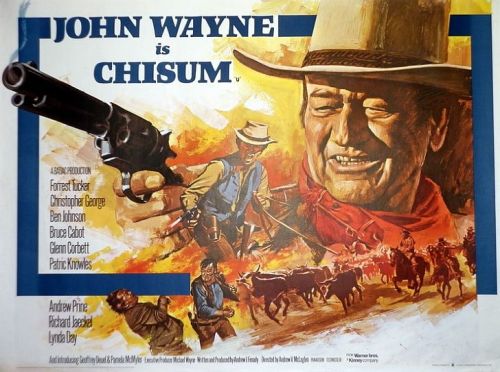
“Chisum” is a lesser effort by the Duke for sure; I saw the Western when it came out in 1970, and it made no impression on me at all, apparently. When I watched it again two days ago, almost nothing seemed familiar. There was one scene, however, that raised my eyebrows.
The story is very loosely based on John Chisum (of Chisum Trail fame) and his involvement in the Lincoln County War of 1878 in the New Mexico Territory. At one point in the story, British rancher and Chisum’s neighbor Henry Tunstall rides to Santa Fe to seek help from Territorial Governor Sam Axtell in the increasingly tense range war. Henry does not know that he has been framed for cattle rustling, and when he is intercepted by two deputies (they are in on the plot, but he doesn’t know that) who accuse him and tell him he is under arrest, he objects strenuously. Saying he is late, Tunstall starts to reach into a pocket. One of the deputies shoots him dead. The two then plant a gun on Tunstall to back the story that the deputy fired in self defense.
A post yesterday described the outrageous conduct of the management at the Six Flags Over Texas theme park, which declared a local man named Jerry Henderson person non grata and kicked him out of the park because he “looked too much like Santa Claus” (they want him to shave his white beard to resume his park privileges). He also gave candy canes to children after their mom asked him to pose with her kids for a photo.
A regular Ethics Alarms commenter related this 180 degree variation on the story:
My kids take swimming classes at our local park authority pool, and last week, while we were signing in, one of the managers came out of the back office dressed as Santa. However, he was doing it as a gag for the other employees, not for the kids. (About 80%+ of the people there were children.) My kids went running up to him shouting, “Santa, Santa!” He did not acknowledge them or the other kids, didn’t even say hi, and just walked into one of the workout rooms.
I thought my kids were going to cry. I had to tell them that Santa was busy right now, but not to worry, we would go see him tomorrow when he had time to talk to them.
Your “Bad Santa”-themed Ethics Alarms Ethics Quiz of the Day:
If you look like Santa Claus, are you ethically obligated to act like Santa Claus?
I have noted more than once what an excellent ethics movie the original 1960 Western classic “The Magnificent Seven” is. Occasional Ethics Alarms contributor and apparently retired ethics blogger Bob Stone made an excellent case for what he calls his favorite ethics movie here, but the screenplay makes its own case with exchanges like this one:
Harry (Brad Dexter): “There comes a time to turn mother’s picture to the wall and get out. The village will be no worse off than it was before we came.”
Chris (Yul Brenner): “You forget one thing — we took a contract.”
Vin (Steve McQueen): “It’s not the kind any court would enforce.”
Chris: “That’s just the kind you’ve got to keep.”
or the very first scene, where gunslinger Chris volunteers to drive a horse-drawn hearse to Boot Hill where a group of armed bigots are threatening to shoot anyone who tries to bury a recently deceased Indian, who lived in the town, in the town’s cemetery along with “decent white folks.” Steve McQueen (Vin) goes along as Chris’s wing-man, and the first two of the seven team up for an act of pure altruism.
The remake of the film opened over the weekend, and in part because I’m doing a program for the Smithsonian about the lore surrounding the movie, I saw it. And took notes.
It’s not bad. I enjoyed it. It is yet another example of how Hollywood no longer trusts the Western genre or its traditional trappings: the heroes in this and the heroes in most modern Westerns are now portrayed as super-heroes, ridiculously fast on the draw, absurdly accurate with every shot, and able to ride like circus performers. At a certain point, this silliness leads to a damaging loss of suspension of disbelief. The intrusion of gratuitous diversity was also annoying: the end features three heroes riding into the sunset, and they consist of an African-American, a Native American, and a Mexican. How they missed including a handicapped gay woman is mystifying, and somebody should organize a protest. Well, at least all the whites and the Asian guy were killed. That’s something. Continue reading →
I’m late to the blog today, because I spent it giving a special program for the Smithsonian Associates called “From Stagecoach to Django Unchained: The Hollywood Western and Its Influence on American Values, Aspirations and Culture.” It consisted of me talking, a terrific Powerpoint presentation by the gifted Grace Marshall, and almost three hours of clips from classic Westerns—the whole session was five hours. My primary message is that anyone who is not literate regarding the Hollywood Western really doesn’t understand the myths and archetypes that powerfully influence U.S. culture to this day. Within that “anyone” are the majority of pundits and journalists, a large percentage of citizens under 50, and the vast majority of women and minorities. This is a problem.
For example, no one can consider the vast influence of the Western genre on American culture and be the least bit surprised that gun control has an uphill battle with the American public. No other culture has as its primary source of heroes, legends and lore figures and events so dependent on firearms as a means to right wrongs, protect the innocent, and punish evil. Frankly, if a pundit doesn’t understand why John Wayne (who died in 1979) just set a Harris poll record by being included in its annual list of top ten most popular movie actors for twenty consecutive years, from 1994 to 2014, I don’t think they can comprehend the nation sufficiently to opine on it.
Joe Biden, however, understands. I have been critical of Joe, as he is frequently an embarrassment, and there was a lot wrong with his comments today as he was honored with the “Voice of Solidarity” award by Vital Voices, a women’s rights charity, at their event celebrating “men who combat violence against women.” Still, Biden proved that whether he knows it or not, he is more atuned to U.S. culture than most of his colleagues. He deserves credit for that, if nothing else.
You see, Biden told a fascinating personal anecdote from his childhood. He related:
“I remember coming back from Mass on Sunday Always the big treat was, we’d stop at the donut shop…We’d get donuts, and my dad would wait in the car. As I was coming out, my sister tugged on me and said, ‘That’s the boy who kicked me off my bicycle.’ So I went home—we only lived about a quarter mile away—and I got on my bicycle and rode back, and he was in the donut shop.”
Biden said the the boy was in a physically vulnerable position,“leaning down on one of those slanted counters,” so he took immediate advantage:
“I walked up behind him and smashed his head next to the counter.His father grabbed me, and I looked at his son and said, ‘If you ever touch my sister again, I’ll come back here again and I’ll kill your son.’ Now, that was a euphemism. I thought I was really, really in trouble… My father never once raised his hand to any one of his children—never once—and I thought I was in trouble. He pulled me aside and said, ‘Joey, you shouldn’t do that, but I’m proud of you, son.’”
The lesson, Biden said, was that one should to “speak up and speak out” to correct wrongdoings. Like much of what come out of Biden’s mouth, this was nonsense in the context of his own story, and was not what the lesson was at all. The lesson was that force, punishment, violence and intimidation is sometimes necessary to stop bullying, discourage misconduct, protect the innocent and vulnerable, set standards, and give more than lip service to core values. Little Joey Biden didn’t “speak up”: he bashed a bully’s head and threatened to kill him. Apparently it worked, too. America, Americans, the culture and our history—as well as the Duke–have long believed that sometimes violence is necessary to stop violence, and send important messages, and can therefore be virtuous and ethical. Biden understood that when he was ten, and somewhere deep in that mess of mush he calls a mind, he understands that now. Continue reading →
If you want to ground your child in basic values and ethics, buying the new DVDs (available next month) with all 168 half-hour episodes of “The Rifleman,” the classic Western TV series, is a good way to start. I’ve been watching episodes recently (they are currently showing on both AMC and Starz), and am struck by how virtually every one has a strong ethics lesson to teach, and teaches it well without interfering with the drama. Most of the TV westerns from the genre’s Golden Age (which had already ended before the demise of “Bonanza,” the last of the great ones) had strong ethical values embedded in their plots, but few made ethics as thematic as the show starring Chuck Connors as a single father, living on the prairie in the 1880s, who used his Winchester rifle the way other cowboys used a pistol, but faster and with more accuracy. Because Lucas McCain was trying to survive while teaching his young son (played by original Mousekateer Johnny Crawford) how to be a good man and citizen, he was always striving to be a role model while solving the difficult and often dangerous problems that came his way. Unlike many Western heroes, McCain didn’t always get it right, sometimes letting his emotions get the better of him or being unfair or impetuous, and had to undergo an ethical course correction by the end of an episode.
A repeated theme in the show was redemption and trust, as McCain often became the champion of a fallen woman or reformed criminal, or had to rely on an ally with a less than sterling past. Villains in “The Rifleman” sometimes saw the error of their ways at the last second, committing a noble act before dying or going to jail. And sometimes they didn’t, and got shot with the Winchester. I’m sure that “The Rifleman,” with its gun-happy opening sequence (it presents the rifle as the star of the show as much as Connors) will seem like an unlikely source of ethics to the gun-queasy parents out there, and that is a shame. There is much to learn from “The Rifleman.”
You can watch some episodes of the show here, here and here. The catchy theme music is here; I was surprised to discover that it had lyrics, which by the standards of the generally terrible lyrics of westerns that had songs that were actually sung on a show, aren’t too bad. The best of its endless verses:
THERE IS A MORAL TO HIS EXPLOITS
AND HE’S TAUGHT IT TO HIS SON
SPEAK SOFTLY TO YOUR ENEMY
BUT LET HIM SEE YOUR GUN!
Chorus:
THEY CALL HIM THE RIFLEMAN
THE STRONG, COURAGEOUS RIFLEMAN
A GREAT BIG MOUNTAIN OF A MAN!

 Ethics Alarms