My segment on an NPR panel yesterday regarding the sexual harassment issue was cut short because “All Things Considered” had to wedge in a report on the terror attack in Egypt. I get it: it’s live radio, and its a news show. Still, one can question whether dealing with such a difficult and complex issue in so little time—three of us plus ace moderator Michel Martin ended up splitting less than 10 minutes among us–does more harm than good. Farajii Muhammad, who was in the studio with me and whom I had a chance to chat with at length, said that he was interested in having me on his own show to discuss the issue. We shall see.
This is the response that the widow of writer Roald Dahl to a reporter’s suggestion that Charlie, the hero of Dahl’s “Charlie and the Chocolate Factory” (aka “Willy Wonka and the Chocolate Factory:) should be made black in a future “reworking” of the book. Recently Mrs. Dahl has claimed that Charlie was originally supposed to be black, but that her husband changed the character before the book was published. She blames his agent, who was, she says (none of this is more than hearsay) afraid that the book wouldn’t sell as well in American with a black hero. She blames “American sensibility.”
No, it wouldn’t be wonderful to start changing the races (and inevitably, genders and sexual orientations) in “reworkings” of literary classics. It would be unethical and irresponsible, as well as a defilement of the author’s visions and creations. Whatever the reason was, and we cannot know it regardless of what Mrs. Dahl now claims, Charlie was white in Dahl’s book. If he had wanted his book to be about a black child, or a little girl, or a Muslim transsexual, the author would have made it so. If someone obsessed with tribal identity politics wants to write a new adaptation under their own name so we can jeer and mock him or her, swell. But it isn’t any more “wonderful” to “rework” Dahl’s own story this way than it is to make Bob Cratchit black, or Captain Ahab black, or Bigger Thomas in “Native Son” Asian-American.
Of course, a stage or film adaptation of the book can cast it any way it chooses.
2 The major business ethics story this past week has been that data security breach by credit giant Equifax. An estimated 143 million Americans now face identity theft for the rest of their lives because the company wasn’t competent to be in the business it was in. It’s that simple. The ways in which Equifax blundered into allowing all this data to be hacked are legion, with more revelations almost daily. My personal favorite is that it neglected to install a patch that would have made its files more secure, delaying for months for no good reason.
Business analysts point out that despite this massive demonstration of ineptitude, the company is not likely to suffer more than the cost and inconvenience of a class action lawsuit or five. The companies that pay Equifax weren’t harmed by the breach, just the lives of the credit-seekers who they use Equifax to check. Nobody seems to think that even this massive misconduct will put Equifax out of business.
The company has dumped some executives, and will probably dump some more, reorganize, and padlock that barn door securely now that the horse has fled. Too…Late. The company is untrustworthy, and more than that, companies like Equifax that gather personal information about innocent citizens need to be scared sick about what will happen to them if they can’t keep the information from falling into malign hands. Equifax needs to be put out of business. Its leaders and management need to be imprisoned, fined so severely that they are reduced to eating cat food, or blacklisted so their future employment is limited to bait shops and traveling carnivals. Continue reading →
1. No, there is nothing “ironic” about Rep. Steve Scalise being shot. I finally lost my restraint and pointed out to a gaggle of left-wing Facebook friends that their writing that Scalise’s shooting was “ironic” because he opposes gun control, or because one of his rescuers was gay (because he opposes gay marriage) was as much a of a hateful comment as saying that it was “karma” (another popular sentiment from progressive friends) or that he “reaped what he sowed” (yet another). They protested loudly and angrily that this was an unfair rebuke on my part, that they were not cheering the crime, just observing that the shooting was “ironic” which, they insisted, it was.
Disingenuous and evasive.
The seriousness, criminal, hateful and absolutely inexcusable nature of Scalise’s shooting had absolutely nothing to do with his political beliefs unless you agree with the shooter, who used those beliefs as his motive. Karma, “reaped what he sowed” and irony (which implies an amusing or humorous nature) all signal and are intended to signal the same sentiment in the Facebook echo chamber—“It’s a shame that he got shot, but in a way he asked for it.” Oh, how those who sought to signal their virtue and their dislike of Scalise just hated to be called on the ugly impulses behind their words, and how they wriggled and spun to deny it.
What made the shooting ironic? Why, Scalise opposes gay marriage, I was informed. That’s neither a logical nor a justified answer. Although gays find it satisfying and expedient to automatically attach the label of homophobia to those who haven’t yet adapted to one of the fastest cultural paradigm shifts in U.S. history, there is no evidence that Rep. Scalise believes that LGBT individuals cannot or should not be medical or law enforcement professionals. Scalise’s position on gay marriage is irrelevant to his shooting, unless that position—the same position Barack Obama and Hillary Clinton held for a very long time—makes you think his shooting and the subsequent assistance of gay citizens is somehow deserved and funny. Similarly, the fact that Scalise was shot does not undermine the justification for his support of the Second Amendment, except in the closed minds of Second Amendment opponents. Nor does that make his shooting “ironic,” except to those whose gut reaction was “He was shot? Serves him right. Let’s see how he likes it.”
So many progressives have become so instinctively hateful and bitterly partisan that they are incapable of realizing it.
2. Are there any ethics takeaways from last night’s Republican victory in Georgia’s 6th District? Pundit Charles Glasser wrote that “Ossoff raised $23.6 million to make a symbolic run against President Trump, most of it from Marin County, California and Martha’s Vineyard in Massachusetts. Running the numbers, Democrats might have been better off considering that same amount would have bought 855,072 school lunches (at $2.76 each); 236,000 elementary school textbooks (at $100 each) or even 956 Priuses (at $24,685 each). Max Weber said that the purpose of a bureaucracy is to maintain or expand its own power. Who cares about children, education or the environment when there’s power to be grabbed?”
As a rule I object to the “spending money on A is unethical because you could have spent it on B” line of reasoning, since it can be applied to almost any purchase. Nonetheless, that’s a lot of money to be used by outsiders to influence a local election, particularly when the donors also decry the effect of money in politics. And as with Hillary Clinton’s defeat, this result suggest that money isn’t nearly as decisive as those who want to constrain political speech think it is. Continue reading →
Like Title IX, like Obamacare, like so many well-intentioned laws and regulations designed to assist and protect vulnerable citizens or traditionally oppressed groups, the Americans with Disabilities Act (ADA) opened the door for abuse, absurd taxpayer costs, and unanticipated consequences. The ADA was rammed into law by activists compassion bullies who proclaimed that any attention to proportion and cost-benefit analysis was mean and heartless. Here is an example of what else came in that open door:
ADA lawsuits are now as common as sex-discrimination lawsuits, with more than 26,000 new claims filed against employers each year. The latest litigants have their sights on the most innovative segment of our domestic economy: e-commerce.In this trend, people sue businesses because their websites aren’t sufficiently accessible to the disabled — because the websites lack assistive technologies for the blind or hearing-impaired, say. It began in 2000, when Bank of America became the first entity to settle a web-accessibility lawsuit. Safeway and Charles Schwab soon followed suit. In 2008, Target paid $6 million to settle a class-action suit brought by the National Federation of the Blind, and nearly $4 million more to cover the plaintiffs’ attorney fees and other costs. More than 240 businesses across the country have been sued in federal court over website accessibility since the beginning of 2015. Similar litigation has been brought against universities on the grounds that the free online courses they offer aren’t captioned for deaf users, and against ride-sharing services because their smartphone apps lack text-to-speech capability for blind users.
…According to the demands of disabled users, in order for a website to be accessible, it must use fewer pictures, present text in a format that is compatible with text-reading software and employ design that allows for easy navigation. But the features that make a website more accessible for one disabled group are bound to be objectionable to another.
They may also conflict with other needs. Consider bank websites, which often employ timers that will shut down an online session for security reasons after a particular time period is exceeded. Such “timeouts” could present problems for some disabled users, but eliminating them in the interest of accessibility could impair security for all.
In the process of making a website accessible, questions invariably proliferate. Do certain color combinations violate the ADA because they confound the colorblind? Are certain layouts inaccessible if they’re confusing to users with a limited field of vision? Do the accessibility requirements apply only to the websites themselves, or do they also apply to Web content, such as advertising on a third party’s website? Will website hosts be responsible for the compliance of third-party sites? Must archived Web content be revised to comply? What about mobile apps? Do temporary technical bugs in an otherwise compliant website constitute a violation? What physical and mental conditions will require accommodation? So far, Web accessibility lawsuits have concerned the vision- and hearing-impaired, but future cases could be brought on behalf of plaintiffs diagnosed with dyslexia, ADD/ADHD, narcolepsy, cognitive impairments, paralysis and many other conditions.
The game is to sue deep pockets website owners and extort settlement pay-offs. That’s fine for the Bank of America, but not for, say, Ethics Alarms. This blog could be put out of business by such a lawsuit, and so could hundreds of thousands of others. Continue reading →
Harley Branham, 21, a manager at the Dairy Queen in Fayette, Missouri, has been charged with second degree felony manslaughter following the suicide of 17-year-old Kenneth Suttner, whom she supervised. At an inquest called by the Howard County coroner, witnesses testified that Branham mistreated the teen. She made Suttner lie on the restaurant floor as he cleaned it by hand, and once threw a cheeseburger at him. Other witnesses said the boy also had been bullied for years at his school, where students mocked his weight and a speech impediment.
The coroner’s jury blamed both the Dairy Queen and the Glasgow School District for failures in training and prevention of harassment, concluding that Branham “was the principal in the cause of death,” and also that Dairy Queen negligently failed to properly train employees about harassment prevention and resolution, according to the inquest’s verdict form. Jurors also found that the Glasgow Public School system was negligent in failing to prevent his bullying.
All of those factors, the inquest concluded, caused the boy “to take his own life.”
Suttner shot himself on December 21, 2015.
Howard County Coroner Frank Flaspohler explained the inquest and the verdict, saying, “I felt there was bullying going on and things weren’t getting corrected. Hopefully this makes the school pay attention to what’s going on. And it’s not just in that school. We all need to wake up and say this exists and we need to take care of it.”
Yyyyyyup! The American public school system continues to impress. As they used to say, “Get a load of this!“
In 2012 Gonja Wolf was an art teacher at Patrick Henry High School in the San Diego Unified School District. She was monitoring a 25-minute study hall. Administrators at the school had told teachers that frequent bathroom breaks for students would undermine the study hall’s purpose, which was uninterrupted study. They also told teachers to use their common sense. Unfortunately, Ms. Wolf had no common sense.
When a young woman in the class, a freshman, asked to go to the restroom, Wolf ordered her to urinate in a bucket in an adjacent supply room rather than use the bathroom during class. The bucket was there because Wolf, a think-ahead type of person, purchased the bucket, she said, to serve as a toilet in case of a security lockdown, and had even used the bucket for emergency peeing herself. (I should have put this story in the “I Can’t Believe I’m Writing This” file.) She said she misunderstood the school’s instructions about bathroom breaks, but thought it was a good idea. To have students pee in a bucket. She actually said this under oath.
From this day on, “Trump of the Month” will recognize those individuals who are accorded the benefits of celebrity, public attention, trust and credibility despite demonstrating beyond any shadow of a doubt their lack of the character, judgment or acumen to justify such status.
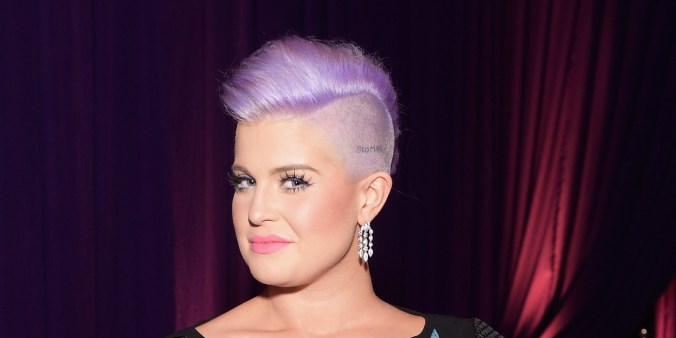
With that important announcement, Ethics Alarms now designates its first Trump of the Month, the daughter of elderly British rock star Ozzie Osbourne, Kelly Osbourne. She is described these days as a “television personality,” the rocking-chair career also occupied, at a slightly higher level, by Osbourne’s opinionated wife, Sharon. Both Osbournes owe their millions in dollars and fans to the fact that they are related to Ozzie, and nothing else—and Ozzie was a drug-addled, half-forgotten has-been when some bright TV executive, inspired by his name and the idea of doing a reality show parody of “The Adventures of Ozzie and Harriet,” the sine qua non of unfunny whitebread Fifties family sitcoms, gave him a second bite at fame.
Kelly’s got nothing, and I am being generous. She is not especially attractive, has no talent, has never uttered a perceptive comment in her life, and should fall down on her knees and thank providence that she is not living in a two room apartment in Gary trying to make ends meet as a temp. Because, however, she acquired that most important of all assets, at least to star-struck Americans, fame, by appearing weekly in a long-past reality show about the dysfunctional family of a mumbling boob with a lot of money (that would be Ozzie), she has been tapped to deliver verdicts on everything from fashion (Kelly herself likes to dye her hair lavender) to the administration of Barack Obama. Why are so many citizens ill-informed and eagerly embracing the dubious leadership abilities of Trump, Clinton or Sanders? Paying attention to “authorities” like Kelly are part of the reason. Compared to Kelly Osbourne, the Kardashians look like the Algonquin Roundtable.
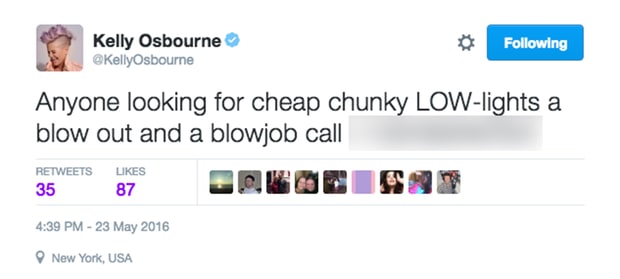
Kelly Osbourne earned the initial Trump of the Month by engaging in the kind of slimy conduct that in a sane culture would ensure permanent obscurity and antipathy. Her parents recently announced that they were getting a divorce because Sharon found incriminating e-mails that proved Ozzie had been fooling around with Sharon’s hairdresser. In response, pundit Kelly tweeted this classy tweet to her FOUR MILLION followers on Twitter:
The British cartoon above give me the willies the first time I saw years ago it, and it does still. I tracked it down after reading legal commentary on a nightmarish incident in Canada.
Canadian couple Angela Collins and Elizabeth Hanson chose a sperm donor for their planned child who claimed a 160 IQ, a neuroscience PhD, and a perfect medical history. After their child was born, they learned the surrogate father’s name though an error by the sperm bank, and discovered that Dad had lied: he never graduated from college, was a convicted felon, and had a history of schizophrenia. His sperm bank profile picture was also a fake; I’m guessing he really looked like the guy in the cartoon.
The last ethics quiz posed the questions of whether a financially struggling (that is, like most people) brother [NOTE: In the earlier version, I incorrectly said they were twins. Why, I don’t know, except that it makes the set up more perfect. I apologize for the error. It didn’t change the issues any, or the commentary.] in his Sixties should suggest to his lottery-winning brother, now 50 million dollars richer, that he could use some of that excess cash…and whether the brother would be unethical to refuse.
The more I think about it, the more I am sure that Slate advice columnist Emily Yoffe was answering a fictional hypothetical carefully devised to coax out the answer it did. I write these things for a living, and the brothers element is suspicious. The idea was to emphasize the perception of unfairness: here we have two genetically similar human beings raised with the same advantages and disadvantages, not just metaphorically “created equal” but equal in fact. How cruel and unfair that, in “Dear Prudence’s” words, “your brother-in-law, through no effort of his own—save the purchase of a quick pick—was smiled on by fate and now enjoys luxuriant leisure. Especially since the two brothers suffered from a start in life that would have crushed many, it’s disturbing that the lottery winner hasn’t been moved to share a small percentage of his good fortune so that his brother doesn’t spend his last years scrambling to meet his basic needs.”
I didn’t exactly give my preferred answer to the quiz, but I did suggest that Yoff’e’s answer and the orientation of the questioner were redolent of the prevailing ethos of the political left. This was met with some complaining in the comments, but come on: “it’s disturbing that the lottery winner hasn’t been moved to share a small percentage of his good fortune so that his brother doesn’t spend his last years scrambling to meet his basic needs” would be a great Occupy Wall Street poster if it wasn’t so long, and it perfectly states the ethically dubious mantra we can expect from Bernie, Hillary or Elizabeth and probably any other Democrat who is selected to be called “a lightweight” and “a loser” by Republican nominee Trump. In fact, I think this hypothetical would be a great debate question….and better yet if we explore some of the variables.






 Ethics Alarms