Ethics Quiz: The Fake Inspirational Story

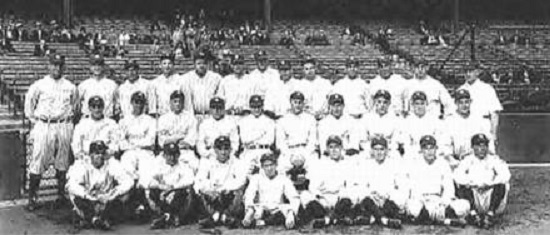
1927NYYankees5

Ethics Alarms touched on this area here, when I related the example of a defense lawyer who won over the jury in the sensational Richard Scrushy fraud case with a vivid but made-up anecdote:

My favorite ethics moment is when Scrushy’s main trial lawyer, Jim Parkman, is asked about his headline-making anecdote in his opening statement, in which he quoted his grandmother as always telling him”every pancake, no matter how thin, has two sides.” “Did your grandmother really say that?” Parkman’s asked on camera. “No,” he admits after a long pause. “But she could have!”

Lying to a jury would seem to be a serious ethical violation for a lawyer, and by the wording of the rules, it should be. But every lawyer I’ve discussed Parkman’s tactic with agrees that such non-substantive lies would never result in professional discipline. (I think they should be.)

But what about inspirational stories and anecdotes that aren’t true? Does the end justify the means? Brian Childers’ story about Tommy Lasorda reminded me of another Lasorda story. Managing in the minors before becoming the third-longest tenured manager with a single team in baseball history, the ever-ebullient leader of the Spokane AAA team was faced with a dispirited squad that has lost nine straight games. Tommy bucked them up by reminding the players that the 1927 Yankees of “Murderer’s Row” fame, then and now the consensus choice as the greatest baseball team of all-time, also lost nine games straight. His team was cheered, and not only broke out of their slump, but went on a winning streak.

Asked later if it was true that the team of the Babe, the “Iron Horse” and the rest ever lost nine in a row, Lasorda answered, “Hell, I don’t know. But it turned my team around when they thought so!!”


Continue reading

The 60 Minutes/Vanity Fair Lying Poll, For What It’s Worth, and That’s Not Much

"Ummmm..."The Princess Bride"?

“Ummmm…”The Princess Bride”?

CBS and Vanity Fair—now there’s a pair—is out with a so-called poll on lying, which I offer for your amusement, and perhaps irritation. Among its “findings”:

  • Only 57% of those polled said they have never preferred to be lied to.
  • COMMENT: This makes no sense in light of the 2012 Presidential election.
  • Only 48% of the public knew which film “You can’t handle the truth!” comes from, and 29% couldn’t even hazard a guess. COMMENT: It’s comforting to know that the public isn’t any more educated in relevant popular culture than it is in more important matters.
  • More of those polled said they lie to their mother (17%) than lie to their boss (12%). COMMENT:  So much for “the Mom Test” ethics alarm, in which you test a considered action’s ethics  against your willingness to tell your mother about it. If you just lie to Mom about it, problem solved! Continue reading

Be Very Afraid: Why Fake Statistics Become “True”

"Those nachos were COLD!!!"

“Those nachos were COLD!!!”

Last week, I wrote about how fake statistics become “true,” after Gabriella Giffords’ husband Mark Kelly asserted as fact that “85% of all children killed by gunfire worldwide die in the U.S.” while ABC’s Diane Sawyer tut-tutted approvingly. Credible advocate, shocking statistic, passive, lazy and biased journalist, politically correct objective—all the elements were in place. We will hear this lie for decades now, probably in a future Presidential debate.

Now the perceptive and watchful James Taranto of the Wall Street Journal has found a smoky gun that tells us much about why we get so many bad statistics, and why the media supports them. A U.S. World and News Report article combined the recent passage of  the Violence Against Women Act with the upcoming Super Bowl, to get this:

“Urban myths rarely have a useful purpose other than to confound, outrage, and frighten people into passing them along. But there’s a silver lining to this one—the idea that Super Bowl Sunday is linked to the highest incidences of domestic abuse in the country. While experts in the field dismiss that theory, they value the increased attention paid to domestic violence on the occasion.

“‘The Super Bowl does not cause domestic violence, and it doesn’t increase domestic violence, but it does increase the public’s awareness of the issue, which will help victims learn about help and resources,” says Cindy Southworth, vice president of development and innovation at the National Network to End Domestic Violence.'”

Oh. Well then the lie is all right then! Continue reading

Ethics Dunce: Glenn Beck

No, it wasn’t a big lie, a harmful lie, or a malicious lie that Glenn Beck told at his recent rally. Beck had claimed that he held George Washington’s handwritten first Inaugural Address “in his hands” at the National Archives, but a spokeswoman at the institution denied it: they don’t allow that. After Keith Olbermann and other full-time Beck-bashers kept pressing the issue, Beck admitted that he had fabricated the story to cut through the extraneous details of the real process:

“…Yesterday I went to the National Archives, and they opened up the vault, and they put on their gloves and then they put [the document] on a tray. They wheeled it over and it’s all in this hard plastic and you’re sitting down at a table…you can’t actually touch any of the documents, these are very very rare. So … they have it in this plastic thing and they hold them right in front of you; you can’t touch them, but then you can say ‘can you turn it over,’ and then they turn it over for you and then you look at it.”

“I thought it was a little clumsy to explain it that way,” Beck told his cable audience, shrugging off the controversy. No, as lies go, it was about as harmless as it gets.

Except. Continue reading

Ethics Notes on a Busy Week

  • Sen. John McCain, who had well-earned credibility on military matters,  released a statement after the State of the Union address saying that “it would be a mistake” to repeal “Don’t ask, don’t tell” as President Obama pledged, and added…

“This successful policy has been in effect for over 15 years, and it is well understood and predominantly supported by our military at all levels. At a time when our Armed Forces are fighting and sacrificing on the battlefield, now is not the time to abandon the policy.”

John, John, John. You have, in other interviews, stated that you served with many gay soldiers who performed their duties with distinction, so the current policy continues a form of bias and discrimination without any  justification. The fact that it may be “successful” is not sufficient reason to continue a practice that is unethical, unfair, and a violation of the principles of civil rights. Success is no excuse for violating core ethical principles; one of the primary justifications for the U.S. allowing torture, an outright violation of the Declaration of Independence, was that it was “successful,” an argument you properly rejected. Continue reading