Further Ethics Observations On The Kevin Spacey Scandal [Part 1 of 2]

The comments regarding yesterday’s ethics quiz have been varied and vigorous. As to the quiz question itself,

Is [Anthony] Rapp’s public accusation [against actor Kevin Spacey alleging that Spacey sexually assaulted him 30 years ago when Rapp was only 14] fair, responsible, and ethical?

I have arrived at my answer, and am abashed that I didn’t see it immediately.

No, the accusation was not fair, and it was unethical. It fails all ethical systems. It is a Golden Rule breach: What Rapp did to Spacey is not how he, or anyone would want to be treated. The fair and decent thing would have been to confront Spacey privately.  Maybe Rapp has distorted the incident over time; maybe Spacey is as remorseful and embarrassed by the incident as Rapp has been traumatized by it. All of us would want at least a chance to explain or make amends before being exposed…in Buzzfeed(!?).

Other observations, as Spacey is being metaphorically disemboweled by an angry mob…

  • Rapp also stomped on Kantian ethics, which forbids using human beings as a means to an end. Rapp says his goal was “to try to shine another light on the decades of behavior that have been allowed to continue because many people, including myself, being silent.” Wait: is there a shred of evidence that Spacey engaged in such conduct over “decades”? Is there any indication that Rapp is protecting future teens from his assaults? No, he’s just jumping on a train, joining a virtue-signalling mob engaged on what appears to be a scalp-hunting expedition. His late hit on Spacey didn’t stop a predator (as with Weinstein), didn’t report a crime to authorities (the statute of limitations is long past), didn’t accomplish anything postive and productive involing Spacey at all. I was just symbolic, and Kant, correctly, holds that it is unethical to destroy real human beings to make a political, social or culotural point, in this case the point being, “Don’t stay silent for 30 years if you have been abused, harassed or molested!”

This also fails any Millsian or Benthamist test of utilitarianism. The ends accomplished by Rapp’s accusation consist almost entirely of destroying Kevin Spacey. What else? I suppose its a warning too: anything you did that society will regard as worthy of making you a pariah can be revealed by an angry, vindictive or politically motivated alleged victim at any time, and you will have no recourse. Call it the Anita Hill Principle. That’s not enough of a “benefit” to society to destroy someone’s life. We have the Weinstein example, and the Bill Cosby saga. They were–are?—both serial offenders. Taking out Kevin Spacey based on one very old incident is not a means justified by any end.

  • Upon examination, Spacey’s response was a mistake and an ethics botch on multiple levels. Here it is again:
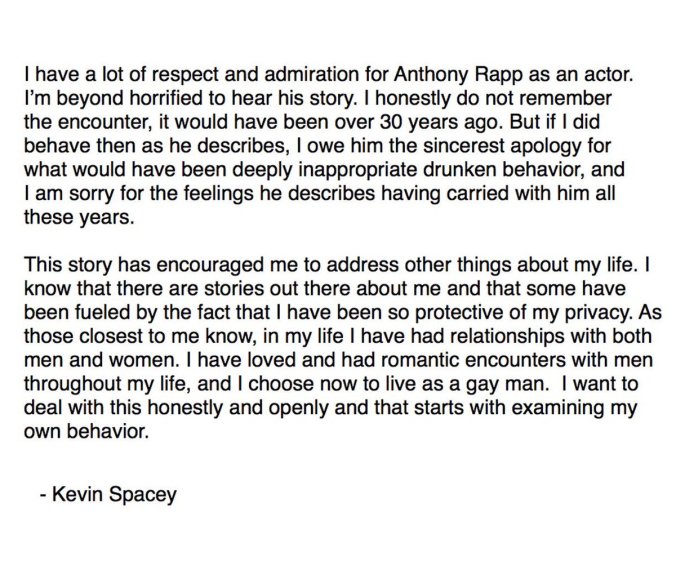
First, here we have another example of why Twitter is dangerous. Spacey is a smart guy, yet he foolishly, in his rush to deal with this crisis, authored his own rapid response on social media. In the old days, as my late friend Bob McElwaine, Hollywood publicist for Danny Kaye, Dean Martin, Robert Mitchum and many other stars, told me, he job was to make sure nothing attributed to his Hollywood clients was authored by them. Continue reading


Ethics Quiz: The Weinsteining Of Kevin Spacey

This latest boxcar on the Harvey Weinstein Ethics Train Wreck contains an ethics quiz because I have such mixed feelings about it.

Yesterday, actor and former child performer Anthony Rapp told Buzzfeed that in 1986, when Kevin Spacey was 26,  Rapp was 14, and both were appearing in Broadway plays, Spacey invited Rapp over to his apartment for a party. At the end of the evening, Rapp says, Spacey picked Rapp up, put him on his bed, and climbed on top of him. Rapp says he managed to squirm away and locked himself in the bathroom. Eventually he left Spacey’s residence, and never had any further contact with him.

Rapp is now 46. He says that before talking to Buzzfeed, he never told anyone about the traumatic  experience. However, Spacey’s success in his career constantly reminded Rapp of the incident.  “My stomach churns,” Rapp said. “I still to this day can’t wrap my head around so many aspects of it. It’s just deeply confusing to me.”

Rapp said he felt obligated to finally tell his story in the wake of the new awareness of the sexual harassment and sexual abuse culture in  the entertainment industry, sparked by Harvey Weinstein’s fall.

“And not to simply air a grievance, but to try to shine another light on the decades of behavior that have been allowed to continue because many people, including myself, being silent. … I’m feeling really awake to the moment that we’re living in, and I’m hopeful that this can make a difference.”

Spacey immediately tweeted an apology, and more:

Your Ethics Alarms Ethics Quiz of the Day:

Is Rapp’s public accusation fair, responsible, and ethical?

Continue reading

Morning Ethics Warm-Up, 10/26/2017: Witch Hunts, A Missing Witch Message, A Too-Gleeful Dodger, Racially Offensive Breakfast Cereal…[UPDATED]

Good Morning!

1 Sigh. Driving home from Maryland via the Capital Beltway for the first time in many years, I saw the white and gold spires of the D. C. Mormon Temple (above), a local landmark, rising in the distance, and remembered that an an upcoming overpass had long been famous for the inspired bit of graffiti scrawled on it decades ago, perfectly placed to compliment the fantastic structure. It read SURRENDER DOROTHY!,” in script, for decades.  I don’t know when it was painted over, but it’s gone now.

Why would they do that? It was a part of area lore, it was clever, and it was always good for a smile. Some humorless bureaucrat decided to make the world a little less fun for no good reason. Of such small, heartless gestures is life drained of joy, drop by drop.

2.  Last night, in the 11th inning of a memorable, back and forth World Series Game Two between the Astros and the Dodgers,  Charlie Culberson of Los Angeles hit a two out home run to narrow the score from 7-5 Astros to 7-6. Nonetheless, Culberson’s team was one out away from losing a game they appeared to have in the bag when they were leading 3-1 in the 9th. (Indeed, the Dodgers did lose after the next batter struck out.) Despite his team’s plight, Culberson celebrated his home run like he had just won the game, or at least tied it. He screamed, he raised his hands, he high-fived everyone in sight. Joe Buck on the Fox broadcast speculated that Culberson might have had the score wrong, and believed that his home run tied the game.

No, said Culberson. He knew the score. “I never would have imagined hitting a home run in the World Series, and I did that. I pointed to my parents in the stands and pointing to my wife,” Culberson explained. “I was just having fun out there, nothing more than that.”

Except you’re not supposed to be having fun when your team is facing a devastating loss, Joe. That was bad form, bad taste, selfish, and obnoxious. The Fox cameras even caught a Dodger coach in the dugout turning around, disgusted , and saying to the still ebullient Culberson, “Come on!”

3. 

That’s Ellen Degeneris ogling Katy Perry’s breasts.  Ellen is gay, as we all know. Explain to me why this conduct is funny, acceptable and harmless, but a male heterosexual behaving similarly, for exactly the same reason, would be sexual harassment. You have 30 seconds…

Time! What’s your answer!

Continue reading

Now THIS Is A Witch Hunt…The Bitter Actress’s Old Score


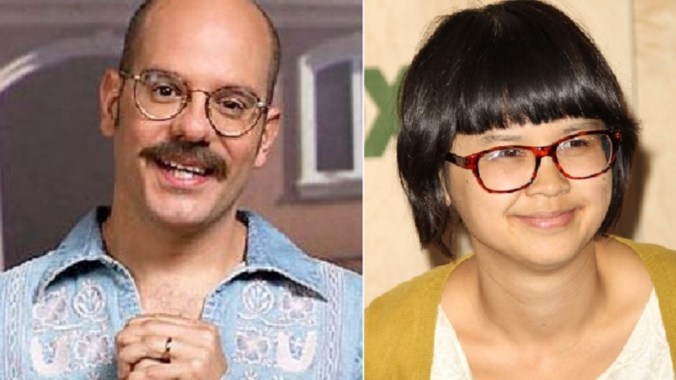
Cross and Yi

Actress Charlyne Yi ( you may remember her on “House”—well, maybe not)  tweeted last week :

“I think about the first time I met David Cross 10 years ago & he made fun of my pants (that were tattered because I was poor). Dumbfounded I stared at him speechless and he said to me ‘what’s a matter? You don’t speak English?? Ching-chong-ching-chong.’

“I will say this: I can tell the difference between this man making a joke vs condescending me,” Yi wrote later. “This happened 10 years ago and I sure as hell hope he’s changed (or at the very least, he’s scared enough to not be his racist self).”

Now Cross, a very funny improvisational comic and actor best known for “Arrested Development” (he was also in the first two “Men in Black” films) is being attacked on social media as a a racist. He purports to be flummoxed.

“I don’t remember this at all!” he said in a tweet this week. Cross later tweeted to Yi,

“Charlene, i dont remember this at all! It’s bonkers to me and WAY, way out of character. DM me so I can understand all of this.”

Mark this down as one more way social media allows people to be worse human beings, and makes the world a meaner, nastier place.

Yi, who has obviously held a grudge for a long, long time (Career just didn’t work out the way you hoped, eh?) exploited social media to get some media buzz by accusing a colleague of being a jerk ten years ago. This, in turn, calls down on Cross’s head the Web Furies, harms his reputation, and there isn’t a thing he can do to defend himself, whether he said what she claims, or not.

This is a blinding Golden Rule breach by Yi. Who among us would like to have this happen—a bad moment in a single personal interaction suddenly made public just to cause us humiliation and embarrassment? It seems as if Yi, lacking a salacious story of being propositioned, assaulted or raped by Harvey Weinstein, decided to see if recounting the time David Cross was a jerk to her could get some cheap publicity. And it worked! Continue reading

Now THIS Is A Witch Hunt! The Northwestern-Laura Kipnis Ethics Train Wreck

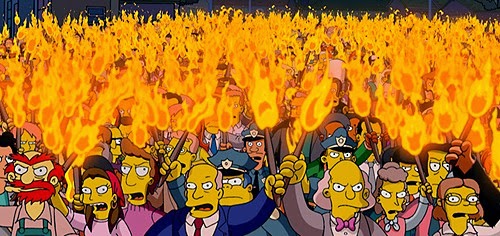
Springfiled mob

I really tried to ignore this ridiculous story. Campus political correctness battles, like examples of public school teacher incompetence ( my head just exploded yesterday, so I refuse to write about THIS), are so common and so self-evidently whacked that the blog could easily be over-run by them. The lower education episodes are more important, I’ve concluded, because the victims are children who still might be saved from indoctrination and a life-wrecking warped concept of how authority should be wielded, and children must be protected from the kind of child abuse a lot of these episodes represent. In the college campus fiascos, much of the time, it is the students who are the initial culprits (remember, they are adults, supposedly), and the administrators are mostly the craven enablers. Initially, I thought this episode was just another example of runaway progressive fascism feeding on itself. And it is, but there is more to it than that.

To briefly summarize…Laura Kipnis is a Professor of Radio, TV and Film at Northwestern University. She wrote an entertaining article in the Chronicle of Higher Education about what she termed the ‘sexual paranoia’ on college campuses, including hers, and delivered observations about how these attitudes were strangling discourse and sane human interaction in society at large.

I wasn’t crazy about the article, because Kipnis, as I might expect from a theater prof, appears to know nothing about ethics at all. Her over-arching position is Old Sixties Berkeley: if it involves sex, chill out. I will bet my head that Kipnis was one of Bill Clinton’s defenders on the grounds that lying about sex isn’t lying, even when it’s under oath, even when it’s on TV, even when it’s to the American people’s face, even when you use your power and high office to support it. It’s sex, and sex is groovy. Who knows, she might also have defended John Edwards, and no, I have not had any respect for people like this since the Nineties. Continue reading

The Campus Sexual Assault Witch Hunt Ethics Train Wreck, Complicated By The Fact That The Witches Are Real

"Wait...are you raping me, or am I raping you?"

“Wait…are you raping me, or am I raping you?”

There is no question that there are sexual predators on college campuses, or that some colleges let them get away with raps on the knuckles for sexual assault or worse. There is also little question, though various parties and activists deny it, that what constitutes genuine sexual assault and even rape has been so thoroughly politicized and muddled by irresponsible rhetoric, dubious statistics and cynical political maneuvering that addressing the problem of actual campus sexual assault is becoming impossible without harming, indeed destroying, the innocent in some cases.

At Stanford, women are rallying for a more stringent process and harsher punishment after student Leah Francis protested in an e-mail to the campus that she had been “forcibly raped” by a fellow student and he was permitted to graduate. Of course, Stanford didn’t find the she had been raped: her assailant was found guilty of sexual assault. The loose use of “rape” to describe sexual assault for political purposes is one of the reasons universities seem incapable of finding a satisfactory balance in handling such cases. At the risk of getting ahead of the post, I would say this: if it is alleged to be rape, then turn the matter over to the police and the justice system. Schools are not allowed to use internal procedures to investigate and punish murder; it makes no sense to permit them to do so with the serious crime of rape. The fact that the standards of proof and the requirements of due process are less stringent in a campus procedure is what simultaneously leads to inadequate sanctions for the guilty and railroading of the innocent. The solution to this problem has always been available: treat allegations of campus rape like any other kind of rape.

Unfortunately, colleges are often in thrall to the political agendas of feminists and their allies, so “rape” can mean many things, as can “sexual assault.” In the casual, morality-free sexual atmosphere now not merely tolerated but nurtured on college campuses, lines of consent are blurred, and missteps are inevitable. At the same time, the permissive sexual environment is a playground for predators, exploiters and manipulators. How are the genuinely culpable sexual assailants to be distinguished from the clumsy, the confused, the misled, or the drunk and overly aroused? Continue reading

Ethics Dunces: The Petraeus Defenders

I know I have touched on this before regarding the Petraeus scandal (and elsewhere), but it bears emphasizing—especially since so many seem to be unable to process the concept. Leaders cannot be seen as willing to violate their own rules, principles and those of the organizations they represent. Arguing that the rules violated are foolish, or outdated, or too restrictive does not rebut this fact of leadership in any way, but making that argument does show beyond question that the pundit making it doesn’t comprehend the most basic facts of leadership and the building of ethical cultures.

Today’s Sunday papers are awash in editorials and op-ed pieces by former intelligence personnel, lawyers, social scientists and other pundits blaming the widening Petraeus scandal ( now focusing on Gen. John Allen, the U.S. commander in Kabul, and the significance of his exchanging thousands of inappropriate emails with Jill Kelley, the Tampa socialite who is apparently the military equivalent of a rock-and-roll groupie, only older) on antiquated morals and political opportunism. There are too many of these bewildered commentators to count, but their views all ooze from the same basic, shockingly facile, and in some cases intentionally misleading theory, which is that Petraeus’s and Allen’s conduct are irrelevant to their ability to do their jobs. The Washington Post’s David Ignatius, usually one of the more rational and objective of that paper’s leftward chorus, actually reprints verbatim an e-mail he received from an Arab diplomatic source as if it contains illumination rather than naiveté:

“He needs to resign cause he has an affair? What da hell??? He is brilliant!!!! Why like this????” Continue reading

Buzz Bissinger’s Primer on Unethical Reasoning

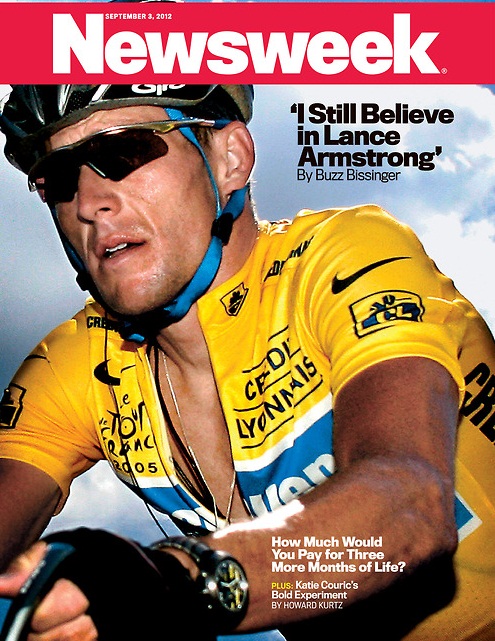
Sportswriter Buzz Bissinger, already an Ethics Dunce in good standing, has contributed something immensely valuable to the world of ethics: a cover story for Newsweek that can serve as a teaching aid in college ethics classes.

Titled “I Still Believe in Lance Armstrong,” Bissinger lurches from one rationalization to another, contradicting himself repeatedly along the way. This is a professional journalist, writing in his field, for what once was a respected news commentary magazine. Why is so much of the public unable to tell right from wrong? Because they spend a lifetime reading junk like this: Bissinger’s essay could be Exhibit A.

Bissinger begins by talking about the reactions of his son, a cycling enthusiast who worshiped Armstrong, to the recent news that the tarnished athlete would no longer challenge the U.S. Anti-Doping Agency’s efforts to strip him of his titles:

“Caleb is not blind. He said it was hard not to read the statement and conclude that when Armstrong said, ‘There comes a point in every man’s life when he has to say ‘Enough is enough’ ” and that he was finished fighting the United States Anti-Doping Agency’s fanatical attempt to strip him of his victories, what lay below the outrage was an admission that he may well have cheated with performance enhancers in order to win. That bothers my son. It is why he called the stunning announcement a ‘sad day.’ But it is also why he called it a ‘weird day’ emotionally because of the constant effort to make Armstrong into a villain.” Continue reading