Celebrating the 110th Anniversary of the Strange But Ethical “Christmas Truce”

One of the weirdest events in world history took place on Christmas 1914, at the very beginning of the five year, pointless and stunningly destructive carnage of The Great War, what President Woodrow Wilson, right as usual, called “The War to End All Wars.”

World War I, as it was later called after the world war it caused succeeded it,  led to the deaths of more than 25 million people, and if anything was accomplished by this carnage, I have yet to read about it.

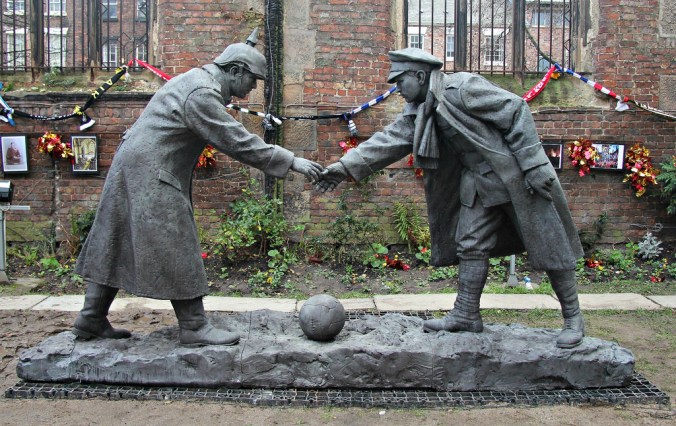
The much sentimentalized event was a spontaneous Christmas truce, as soldiers on opposing sides on the Western Front, defying orders from superiors, pretended the war didn’t exist and left their trenches, put their weapons and animus aside, sang carols,  shared food, buried their dead, and even played soccer against each other, as “The Christmas Truce” statue memorializes above.

The brass on both sides—this was a British and German phenomenon only—took steps to ensure that this would never happen again, and it never did.

It all began on Christmas Eve, when at 8:30 p.m. an officer of the Royal Irish Rifles reported to headquarters that “The Germans have illuminated their trenches, are singing songs and wishing us a Happy Xmas. Compliments are being exchanged but am nevertheless taking all military precautions.” The two sides progressed to serenading each other with Christmas carols, with the German combatants crooning  “Silent Night,” and the British adversaries responding with “The First Noel.“ The war diary of the Scots Guards reported that a private  “met a German Patrol and was given a glass of whisky and some cigars, and a message was sent back saying that if we didn’t fire at them, they would not fire at us.”

The same deal was struck spontaneously at other locales across the battlefield. Another British soldier reported that as Christmas Eve wound down into Christmas morning,  “all down our line of trenches there came to our ears a greeting unique in war: ‘English soldier, English soldier, a merry Christmas, a merry Christmas!’” He wrote in a letter home that he heard,
Continue reading

Museum Ethics: The Draft-Dodging Playboy and the Wright Bros. Plane

The old TV show “Naked City” used to intone at the end of every episode, “There are eight million stories in the naked city. This has been one of them.” There are far more than eight million ethics stories in our country’s rich and surprising history. This is one of those, and I pass it along to you.

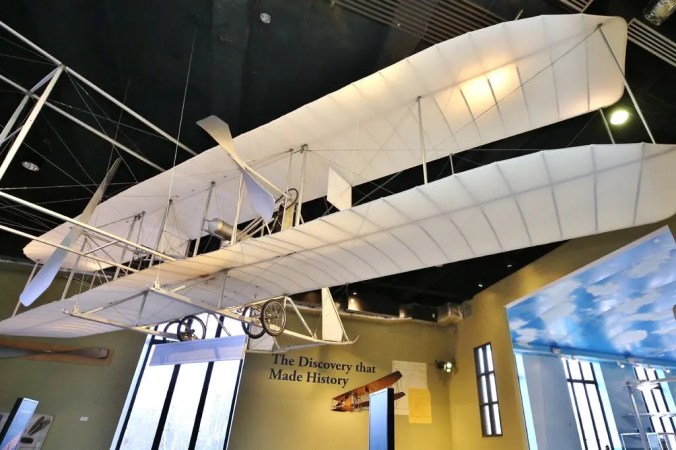
The Franklin Institute, a museum in Philadelphia inspired by the work of Ben Franklin and dedicated to the study of science, exhibits a plane built in 1911 by the Wright brothers. It was, they say, a gift from Grover C. Bergdoll, a strange man with a strange history who was once an infamous national figure but who is now forgotten.

He was a wealthy playboy who was heir to  a Philadelphia beer brewing fortune. He dodged the Great War draft in 1917, failing to report for military service. He was already known for his irresponsible conduct, taking flying lessons from Orville Wright and buying a plane from the Wright brothers that he used to buzz buildings among other stunts. He had  multiple accidents and traffic violations in automobile as a teenager, and served two months in jail after a head-on crash in 1913. Since he was rich and well known, the government decided to an example of him to discourage draft-dodgers, It  distributing wanted posters with his face and name, and when the soldier who supposedly was drafted to take Bergdoll’s place died in combat,  the New York had a front page headline, “Died Hero in Battle in Bergdoll’s Place.”

The story gets stranger. Bergdoll was finally captured in 1920 after an ongoing manhunt, and sentenced to prison for five years. He escaped after less than a year. He convinced authorities to temporarily release him from prison to  help them find a “pot of gold” that he claimed to have buried. Bergdahl escaped while his two U.S. Army escorts became distracted (they were playing pool at his family mansion), fleeing in his chauffeur-driven car to Canada, from which he travelled to Germany. He married there, but often returned secretly to the United States. Reported sightings of Grover were headlines news.

Continue reading

Comment Of The Week #2: Morning Ethics Warm-Up, 11/11/2022: The Ethics Post To End All Ethics Posts Edition

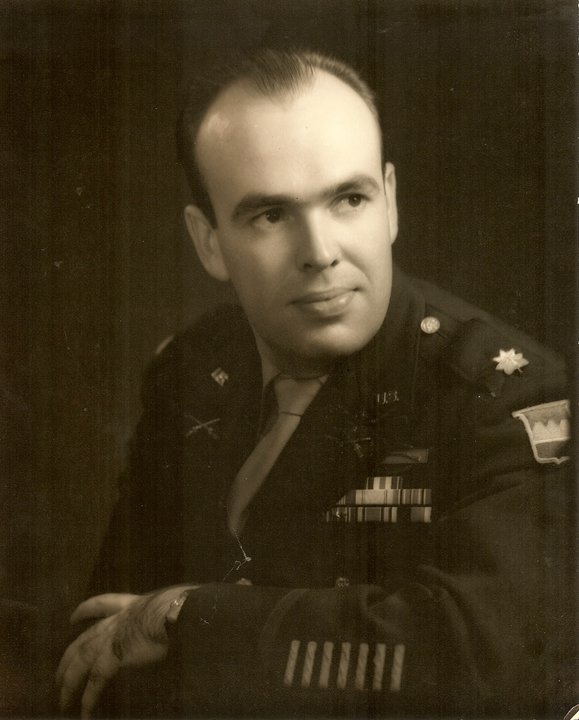
My father, now in Arlington National Cemetery, would have really liked Steve-O-in NJ’s post. the second of this weekends’s Comment of the Week. The great irony of his life was, as he once mentioned, that he hated war, but had a natural aptitude for it. Jack Sr. never boasted about his many war exploits, forcing us to drag them (definitely not all, though) out of him over nearly 6 decades. Nevertheless, he was more proud of fighting the Nazis in Africa and Europe than of anything else in his life, except, perhaps, of being a good father, unlike his own father.

Dad used to imitate FDR’s famous “I …hate… war!” speech (“My wife Eleanor hates war…”) , which he felt was ponderous and insincere—The Roosevelts all liked war, he believed—and said more than once that anyone who didn’t hate war was a lunatic. (This was just one of the many reasons he detested General Patton). But my father never hesitated to display reminders of his participation in the victory over Hitler and his minions.

We had beautiful, brilliant red curtains separating our play room from the laundry area in our basement in Arlington, Mass.when my sister and I were kids; it wasn’t until long after I had moved to the Washington, D.C. area that I learned that my mother had cut them out of the giant Nazi flag my father had brought home as a trophy. He felt that using the red portion of the menacing flag as a cheerful decoration in the most humble part of his all-American home was a nice, final, private “Bite me!” to the evil losers.

Here are Steve-O’s reflections on Armistice Day, prompted by the introduction to this post…

***

103 years ago, the guns finally fell silent at the eleventh hour of the eleventh day of the eleventh month, ending the greatest conflict to date, known as the Great War in Europe, as World War One here. The war that was supposed to end by Christmas 1914 had dragged on for more than four years, shaken civilization to its core, and thrown down no fewer than four empires, leaving chaos in their place. It had also killed six million and badly damaged a generation.

The world thought another war like this must not, could not ever happen again. In memory of what had happened, the allied nations proclaimed Armistice Day a year later, including the red poppy as the symbol of the fallen, the two minutes silence, and the continued hope for world peace.

Here’s the dirty little secret, though, the allied nations, weary of war and afraid of another one, turned their back on the problems left unresolved at the end of World War One. They made a few half-hearted attempts to deal with them, like the poorly organized Allied intervention in Russia to stop Communism before it took root, which accomplished nothing. For the most part, however, they either just looked the other way or threw up their hands. Turkey mopped up what was left of the Armenians and forced Greece into a population exchange that destroyed thousands more lives, and the allies just nodded. The Soviets attempted to conquer Poland, but they found themselves thrown back by a nation not inclined to give up the freedom it had just won under the leadership of the military and political genius Josef Pilsudski. France and the UK didn’t do or say anything. Ireland erupted in violence, and the UK all too quickly concluded a peace that left it embarrassed and Ireland bankrupt. Let’s also not forget the abandonment of the Finns, the Ethiopians, and the Austrians to tyrannical aggression. The major nations were too busy trying to come up with lofty promises and ways to prevent there from ever being a war again: the Washington Naval Treaty, signed with a smile by the Japanese and promptly violated, the Locarno Treaties, which were quickly ignored, and the Kellogg-Briand Pact, which supposedly outlawed war, and is still technically in effect, but which was ignored from its inception, and actually reads like a bad joke in hindsight.

Continue reading

Remembering, Again, The 1914 Christmas Truce

Truce

I’ve posted on this a couple of times, and as it is one of the more unusual ethics events in history to occur on Christmas, here it is again. Of course, as an America, I am joyful about another, more consequential military event that happened on Christmas. Washington crossed the Delaware river on this date. His resulting victory over the Hessians at Trenton was, in the end, less than consequential militarily, but it was important nonetheless . It bolstered the rebelling colonies’ morale, at a point where there were serious doubts that the nascent democracy had any chance to prevail.

One of the weirdest events in world history took place on Christmas 1914, at the very beginning of the five year, pointless and stunningly destructive carnage of The Great War, what President Woodrow Wilson, right as usual, called “The War to End All Wars.”

World War I, as it was later called after the world war it caused succeeded it,  led to the deaths of more than 25 million people, and if anything was accomplished by them, I have yet to read about it.

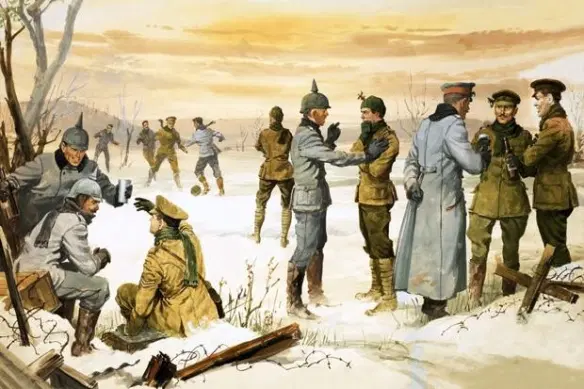
The much sentimentalized event was a spontaneous Christmas truce, as soldiers on opposing sides on the Western Front, defying orders from superiors, pretended the war didn’t exist and left their trenches, put their weapons and animus aside, sang carols,  shared food, buried their dead, and perhaps, depending on which source you choose to believe, even played soccer against each other.

The brass on both sides—this was a British and German phenomenon only—took steps to ensure that  this would never happen again, and it never did.

It all began on Christmas Eve, when at 8:30 p.m. an officer of the Royal Irish Rifles reported to headquarters that “The Germans have illuminated their trenches, are singing songs and wishing us a Happy Xmas. Compliments are being exchanged but am nevertheless taking all military precautions.” The two sides progressed to serenading each other with Christmas carols, with the German combatants crooning  “Silent Night,” and the British adversaries responding with “The First Noel.“ The war diary of the Scots Guards reported that a private  “met a German Patrol and was given a glass of whisky and some cigars, and a message was sent back saying that if we didn’t fire at them, they would not fire at us.”

The same deal was struck spontaneously at other locales across the battlefield. Another British soldier reported that as Christmas Eve wound down into Christmas morning,  “all down our line of trenches there came to our ears a greeting unique in war: ‘English soldier, English soldier, a merry Christmas, a merry Christmas!’” He wrote in a letter home that he heard,
Continue reading

The 105th Anniversary Of “The Christmas Truce”

One hundred and five years ago today, one of the weirdest events in world history took place at the very beginning of the five year, pointless and stunningly destructive carnage of The Great War, what President Woodrow Wilson, right as usual, called “The War to End All Wars.”

World War I, as it was later called after the world war it caused succeeded it,  led to the deaths of more than 25 million people, and if anything was accomplished by them, I have yet to read about it.

The much sentimentalized event was a spontaneous Christmas truce, as soldiers on opposing sides on the Western Front, defying orders from superiors, pretended the war didn’t exist and left their trenches, put their weapons and animus aside, sang carols,  shared food, buried their dead, and perhaps, depending on which source you choose to believe, even played soccer against each other.

The brass on both sides—this was a British and German phenomenon only—took steps to ensure that  this would never happen again, and it never did.

It all began on Christmas Eve, when at 8:30 p.m. an officer of the Royal Irish Rifles reported to headquarters that “The Germans have illuminated their trenches, are singing songs and wishing us a Happy Xmas. Compliments are being exchanged but am nevertheless taking all military precautions.” The two sides progressed to serenading each other with Christmas carols, with the German combatants crooning  “Silent Night,” and the British adversaries responding with “The First Noel.“ The war diary of the Scots Guards reported that a private  “met a German Patrol and was given a glass of whisky and some cigars, and a message was sent back saying that if we didn’t fire at them, they would not fire at us.”

The same deal was struck spontaneously at other locales across the battlefield. Another British soldier reported that as Christmas Eve wound down into Christmas morning,  “all down our line of trenches there came to our ears a greeting unique in war: ‘English soldier, English soldier, a merry Christmas, a merry Christmas!’” He wrote in a letter home that he heard,
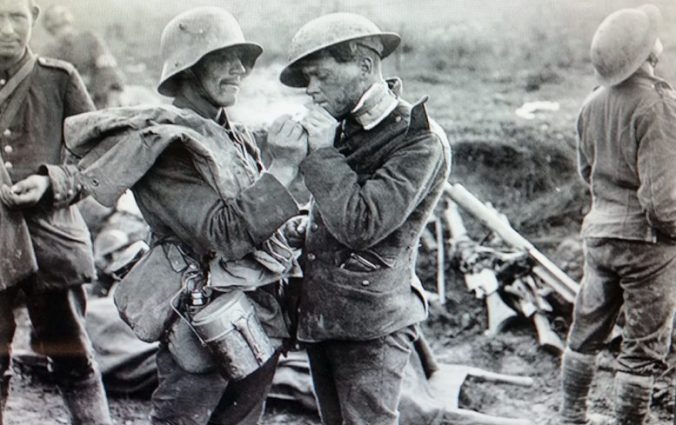
‘Come out, English soldier; come out here to us.’ For some little time we were cautious, and did not even answer. Officers, fearing treachery, ordered the men to be silent. But up and down our line one heard the men answering that Christmas greeting from the enemy. How could we resist wishing each other a Merry Christmas, even though we might be at each other’s throats immediately afterwards? So we kept up a running conversation with the Germans, all the while our hands ready on our rifles. Blood and peace, enmity and fraternity—war’s most amazing paradox. The night wore on to dawn—a night made easier by songs from the Germantrenches, the pipings of piccolos and from our broad lines, laughter…

Continue reading

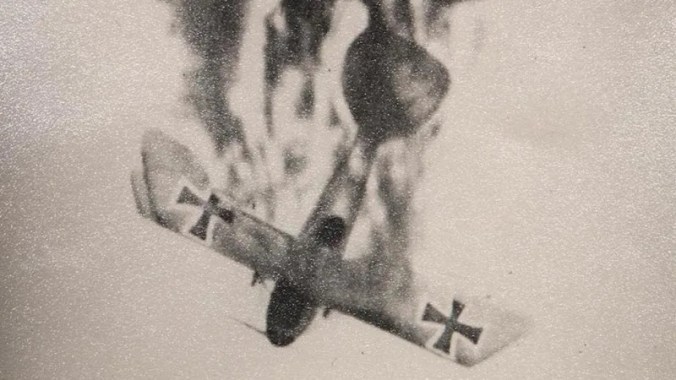
The Great World War I Dogfight Photo Hoax

You are probably familiar with the famous Cottingley fairy photography hoax (there’s even a movie about it starring Peter O’Toole) in which two young British girls fooled much of the world—and credulous believer in the supernatural Sir Arthur Conan Doyle—into thinking that they had captured photographic proof that the fairy folk of legend existed. That hoax, however, was a mere bagatelle compared to this one.

In the early 1930s, a Mrs. Gladys Maud Cockburne-Lange said she was the widow of a Royal Flying Corps pilot. She presented  stunning photographs of scenes of aerial combat during World War I, apparently taken in the air from a combat biplane. Her late husband, she said, had defied the RFC’s regulations and mounted a camera on his plane, tying its shutter action to his machine gun. The resulting photos were the first  visual representation of British and German planes fighting each other taken from the air. They showed  bi-panes crashing into each other, being shot to pieces, catching on fire, and even pilots falling from the sky.

All previous photos of  WWI aerial “dogfights” had been taken from the ground, so this unexpected  trove of photographs caused a sensation.  The images were rapidly sold to newspapers, galleries, and publishers. Mrs. Cockburne-Langes sold 34 of the photos to one  publisher for  $20,000, a huge sum during the Great Depression, and they were later published in a popular book, “Death in the Air: The War Diary and Photographs of a Flying Corps Pilot.” by an anonymous author.

Unlike the fairy photo hoax, however, the truth about these photos took hald a century to uncover.  In 1984, the Smithsonian Institute received a donation of materials from Wesley David Archer, an American pilot who had served with the RFC and then…wait for it… became a special-effects technician in Hollywood.  Air and Space Museum curator Karl S. Schneide and Peter M. Grosz, an aviation expert, investigated the materials, and discovered  that in  some of the photographs, the wires holding up the model airplanes used to create the illusion of mid-air dogfights had yet to be airbrushed out. The materials also contained a diary entry that revealed the entire scheme. Continue reading

Morning Ethics Warm-Up, 12/21/2018: Getting The Tree Lights On In One Day Victory Lap Edition, Featuring Sports, Movies, Jerks And “Bambi”

Happy Holidays!

Seven hours, one serious needle wound, and 1300 lights later, victory! I’ll finish the decorations when I get back home, IF I get back home…

1. Itinerary…I’m heading to New Jersey via train to hook up with the brilliant Mike Messer, what we call “the talent,” in an encore rendition of the musical legal ethics seminar, “Ethics Rock Extreme,” lyrics by yours truly, musical stylings by Mike, on the guitar. Then it’s back to D.C. by air on Saturday, if I’m lucky. If I’m not lucky, I’ll be taking the New Jersey bar exam in the Spring…

I have no idea how or whether I’ll be able to keep Ethics Alarms on track once I board the train this afternoon. I’m not going to launch a second Open Forum in leas than a week, so please keep working on the current one here, now at 130 entries and counting. I will be reviewing those on the road, and I’m sure there will be some Comments of the Day to post, eventually.

2. In case I am trapped in New Jersey…Let me alert everyone that Peter Jackson’s apparently terrific (based on the reviews) WWI documentary “They Shall Not Grow Old” will be playing in theaters on December 27, and after that, who knows? The American public’s ignorance about that war, perhaps the greatest human catastrophe in modern history, is a failure of education, perspective and culture. If you have kids, take them. Here is the trailer:

3. Speaking of cultural literacy and movies, TCM is offering a limited engagement in theaters for “The Wizard of Oz,” on January 27, 29, and 30.

Is there another film that so many people purport to know and love so well without actually having seen it as it was intended to be seen? When I finally saw the movie in a theater—no breaks or commercials, big screen—I was shocked at how different and, obviously, better, the experience was. It’s an artistic masterpiece and sui generis: we will never see its like again, nor talents like Judy, Ray and Burt, among others. Continue reading

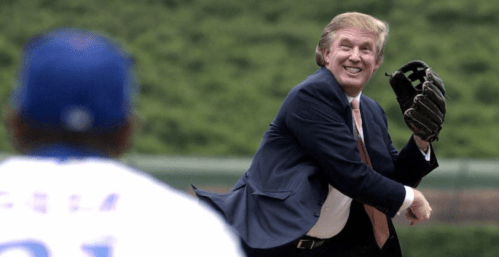
Comment Of The Day: “President Trump Will Not Throw Out The First Ball Of The Baseball Season”

The post about how the Democratic hate-mongering campaign against President Trump has stopped him from continuing the century old tradition of POTUS symbolically signalling the beginning of the baseball season with a ceremonial first pitch inspired another Comment of the Day from Steve-O-in NJ, on the related topic of jerks.

Part of his commentary below evokes TV comics, who, as he notes, have become entirely one-party, partisan shills, and if that leaves humor in the dust, so be it.

Last night, reacting to news that Ivanka Trump would be an unpaid but official advisor to her father, Daily Show host Trevor Noah  played a clip of an old interview with Ivanka by Leslie Stahl, in which the First Daughter answered a question about whether she would be active in the administration, saying,

“Um no, I’m going to be a daughter.”

“And a liar!” quipped Noah. HAHAHAHAHA! Isn’t that funny? HAHAHAHAHA! He’s a vile, unfunny,  dumb partisan hack. What she said wasn’t a promise, and it wasn’t a pledge. Even if it was uttered by Ivanka under oath, it couldn’t be called a lie, or even hypocrisy, unless there is reason to believe that she said this knowing it wouldn’t be true. Proof, please, Mr, Noah, you asshole.

That’s what she thought was the case then; now conditions have changed, and she decided to do something else.  If a woman, say, Ivanka Trump, said on TV, “I’m going to marry Trevor Noah,” and then, having seen what a miserable jerk he is on TV, decided not to marry him, would that mean she was lying when she said she would? Do these relentless leftist hit-comics —Bee, Oliver, Maher, Colbert, Kimmel, et al, or the right-oriented…wait, there are no right-oriented comics—have any integrity at all? Decency? Or a dictionary?  The people who find Noah’s attack on Ivanka hilarious are the same people who were glad she was harassed on an airplane, and who organized a boycott of her products. You know. Jerks.

Mega Jerk Noah then detoured into news that former South Korea President Park Geun-hye would be jailed for corruption. “Wow, a president impeached, removed from office and thrown in jail. Imagine that,” said Noah, “No, no, seriously, let’s all close our eyes and imagine that.”

I have Facebook friends who issue bile like this every day. It is simply, clearly, hate-mongering, citizens wishing ill on their nation’s leader, making two party government impossible, and fanning the flames of social unrest while proclaiming their own bias and ignorance. They want to jail the President of the United States because he beat their corrupt, incompetent candidate. Stalin would be so proud.

These are friends of mine, but their conduct is detestable and loathsome.

But I digress. Here is Steve-O-in NJ’s Comment of the Day on the post, President Trump Will Not Throw Out The First Ball Of The Baseball Season:

Someone compared me to Mr. Hyde or a werewolf, so I have to make sure I’ve taken my potion before I respond. Unfortunately, the jerks win a lot more than a lot of us would like to admit, as every kid who took the long way home to avoid the class bully, every girl who didn’t attend dances because she was marginalized by the queen bees, and three quarters of people who quit jobs (75% of resignations are due to not getting along with one’s immediate supervisor) can testify to. In the past the grown-up culture of this country had moved past jerkiness, now it thrives on it.

Part of it is the ease with which now anyone can say anything about anyone and have it cross cyberspace in the blink of an eye. Not only that, but now anyone with a couple of apps or Photoshop (if you spring for it) can easily make anyone look bad or create an image that can’t be unseen (I just got Photoshop, and a friend who serves me in the same role as Jiminy Cricket warned me to use it wisely and NOT to combine my photographic and rhetorical skills to cook up tasty, quickly digestible morsels of hate, bias, or disdain) . However, just because you can do something doesn’t mean you should.

Continue reading

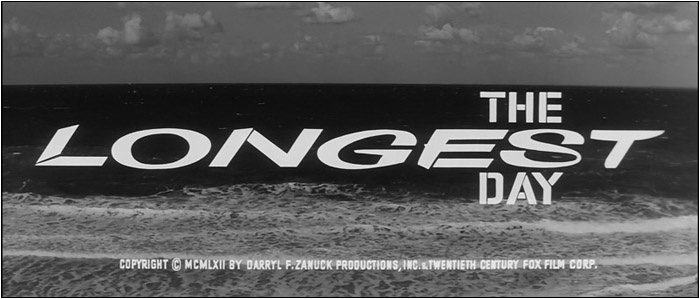
“The Longest Day,” Darryl F. Zanuck, D-Day, And Us

title_longest_day_bluray

Today is June 6, the anniversary of the Allies’ invasion of Normandy, the audacious military strike that changed the course of history. I’ll be interested in seeing how it’s commemorated this year, 71 years later, especially by the news media. A lot of Americans under the age of 40 know almost nothing about it, or worse, the values it represents to the United States.

Fortunately, there is an easy and entertaining way to teach a young American about what happened on this day 71 years ago. That is to have him or her watch “The Longest Day,” producer Darryl F. Zanuck’s epic film based closely on historian (and sole credited screenwriter) Cornelius Ryan’s 1959 book. (You can get it at Amazon, here.)I usually find understanding military battles nearly impossible; written accounts completely confound me, and few movies about any battle make a serious effort to explain the tactics and strategy without reducing the facts to pablum. (I remember how much my father, who fought in the Battle of the Bulge, detested the big budget movie of the same name, which he found outrageously sloppy, and which he summarized as “Henry Fonda won the war.”)

Not “The Longest Day,” however. Since seeing the movie with my father as a kid, I have learned a lot about what was left out, but the movie is remarkably clear and accurate about what happened and why without being either too detailed or too simplistic. It’s also just a great, inspiring movie.

That we have “The Longest Day” is entirely due to the courage of one of Hollywood’s most dynamic, flamboyant and successful studio moguls, Darryl F. Zanuck. The original producer of the adaptation of Ryan’s book (which is terrific ) gave up on the project when 20th Century Fox refused to allow him an adequate budget. Zanuck, who was still producing films but no longer ran the studio he had built,  bought the rights, and was determined to do the story, the event, and the men who fought the battle justice by mounting a production almost as ambitious as the invasion itself. Continue reading

Memorial Day Ethics Hero Emeritus: Theodore Roosevelt, Jr., 1887–1944

Teddy Jr

The latest inductee into the Ethics Alarms Heroes Hall of Honor has a familiar name that burdened him with exorbitant expectations his entire life. Yet against all odds, he managed to add to its prestige.

With some notable exceptions that you can probably name, being the son of a President of the United States has proven to be a burden and often a curse. Being the oldest son of our most flamboyant President was particularly hard on Teddy Roosevelt’s boy who shared his name, and through young adulthood, Theodore Roosevelt, Jr.  experienced migraine headaches and other symptoms of anxiety and stress. The President was even cautioned by a family friend and physician that his constant badgering was ruining his son’s health.

Young Ted still followed his father’s path to fame by enrolling at Harvard, then became a partner in a Philadelphia investment banking firm. With the U.S. entry into the Great War, Roosevelt enlisted in the army, fought in Europe, rose to the rank of lieutenant colonel, and was gassed and shot in the kneecap in 1918.  Roosevelt received the Distinguished Service Cross. He was renowned for his courage under fire as well as his unusual concern for the men under his command: at one point, he personally purchased new boots for his entire battalion. After the war, Roosevelt was instrumental in the founding the American Legion in 1919. Continue reading