[Warning: I’m sure there are typos below; I’ll be fixing them, but I’m a bit swamped, and I want to get this post up. It’s a utilitarian decision. Update: I think I’ve fixed them all.]
I have been consciously avoiding wading into this issue, first, because its components are beyond my expertise in two fields, second, because to do a proper job would take a book rather than a blog post, and third, because to even do an inadequate job, I will have to quote extensively from the arguments of others, which I try to do as little as possible (believe it or not). I detest appeals to authority, which is basically all I get from my deranged Facebook friends all day long. Nonetheless, I can’t put this post off any longer, because this is an ethics issue encompassing several related ethics issues. I also can’t cover it in a post of reasonable length, so this will be Part I.
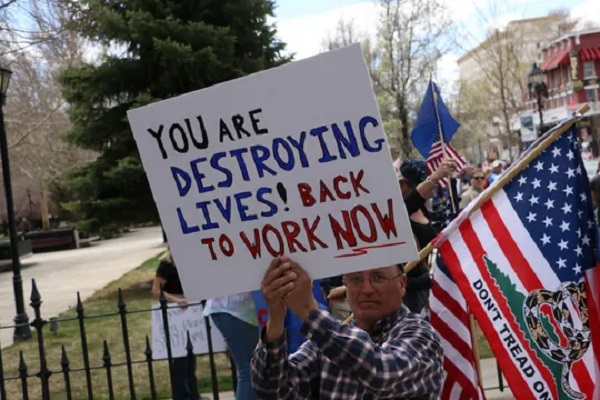
The grand ethics issue facing the nation, the public, the President and our future is when to begin re-opening the economy, allowing people to get on with their lives. Let’s begin with ten stipulations:
1. This is an ethics conflict, not an ethics dilemma. There are ethical considerations and values on both sides of the equation.
2. Many, too many, of those involved in the problem are going to approach it as an ethics dilemma, in which ethical values compete with non-ethical considerations. Unfortunately, that group includes almost all, and maybe all, politicians and elected officials, including the President.
3. It is a cruel trick of fate, or a bizarre joke by a sadistic Creator, that this crisis is occurring in an election year, and with a national leader with the personal characteristics, chaotic leadership, management style, and divided constituency of Donald Trump….but that’s the situation. It is particularly unfortunate that he does not have a reserve of public trust, because that, if not essential now, would sure help a lot as he makes some difficult decisions. He is significantly responsible for that trust deficit; the media and “the resistance” are even more responsible. That doesn’t matter right now. It is a different issue, though a related one.
4. We still do not have adequate information to make a fully informed decision, and will not have before a choice is unavoidable. That’s a fact. We still aren’t certain how the virus is transmitted, or the degree of infectiousness by the asymptomatic. We don’t know why some areas of the country are experiencing higher rates of infection than others. We cannot compare the U.S. statistics with other countries, because we can’t be sure of the accuracy of those foreign statistics. We aren’t even sure of the effectiveness of the supposedly essential precautions, like masks and social distancing. For example, I have articles on file from the last 30 days by credentialed medical professionals arguing that wearing masks may increase the likelihood of infection. I don’t care if this is a minority opinion; minority opinions are often right. Meanwhile, I just watched HLN interviewing a researcher who claims that social distancing should be 12 feet or more, after measuring how “droplets” from coughs spread. But a social distance requirement of much more than six feet is impractical, meaning that it’s not worth talking about.
5. Making important decisions without perfect information is what effective leaders have to do. Two recent weak Presidents, Barack Obama and Jimmy Carter, were marked by a habitual reluctance to make difficult and urgent choices without “all the facts,” and this resulted in multiple fiascos. The danger in making a premature decision, as defined by those two intelligent men, is that the decision will be subject to second guessing after the missing facts are known. President Trump has to be courageous and responsible and make any choice, knowing that whatever he does will be attacked whatever happens. He has to place his fate in the hands of moral luck, and the fate of the country as well. That’s a terrible situation to be in, but that’s the job. Continue reading →


 Ethics Alarms
The second Comment of the Day to come out of Part 1 of the pandemic analysis ethics conflict analysis, like the first, does a lot of the work I would otherwise have to do to complete Part 2. A couple more like these, and the issue might be thoroughly covered without any input from me at all!
Here is Michael R’s Comment of the Day on the post, “The Pandemic Creates A Classic And Difficult Ethics Conflict, But The Resolution Is Clear, Part I: Stipulations”: