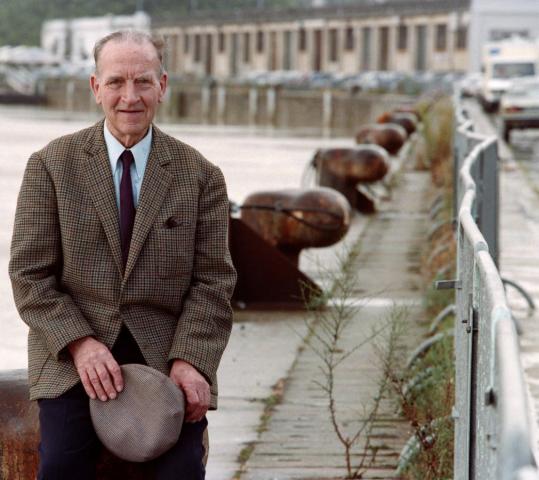
Henri Salmide by the port he saved, and came to love.
In the Nuremberg war crimes trials following World War II, the Allies took the high-minded position that “just following orders” was no defense to “crimes against humanity” committed during wartime. It is and has always been much easier to argue for defying military orders in the abstract, however, than in real combat situations. Conveniently, the victors in a war can take such a position, even knowing in their hearts, as most honest soldiers do, that they themselves might not be able to muster the courage and conviction to tell a commanding officer, “No!”
Henri Salmide, a former German soldier in World War II who died in France this week, would have been an appropriate judge for the trials, for he would not have been plagued by any such conflict or hypocrisy. For Salmide, back when he was called by his birth name of Heinz Stahlschmidt, was a rare and remarkable man who did defy an order he knew was wrong, and saved a city with his courageous, dangerous, and principled actions.
In 1944, Salmide was a German officer in the 159th Infantry Division of the German army occupying the French city of Bordeaux, the largest seaport on the west coast. It was August 19, and Allied Forces were spreading out from the beaches at Normandy and taking control of the war. An order came from Berlin calling on the Division to destroy the entire seven miles of port infrastructure before abandoning the city. The port’s destruction was scheduled to occur within a week.
“It fell to me,” Salmide recounted in an interview, because, as head of the bomb disposal unity, he had expertise with explosives. “I couldn’t do it. I knew the war was lost. What was the point of this, I asked myself. People would die and suffer, and the war would still be lost by Germany.”
On August 22, he filled a bunker at the docks with detonators, plungers, timers and other hardware needed for the planned demolition. But instead of using them to destroy Bordeaux, Salmide blew them up with dynamite, in a terrifying explosion. “It was all I could do,” he said later.
French historians estimate he saved 3,500 lives by refusing to carry out his orders. About fifty Nazi soldiers died in the blast instead. “I could not accept that the port of Bordeaux be wantonly destroyed when the war was clearly lost,” he explained in an interview. “I acted according to my Christian conscience.”
Salmide deserted, and was hunted by both the Gestapo and the French authorities. He hid with the French Resistance for the remainder of the war. Then Salmide adopted a French name, married a local woman, became citizen of France, and raised his family in the very city his conscience had rescued. The Germans regarded him as a traitor, and even the French were reluctant to give him the recognition he deserved, according to his wife.
“No one wanted to admit that he had done it,” Mrs. Salmide told the New York Times. “If he had been French, it would have been easier for him.” It was not until 2000 that the French government finally awarded him the French Legion of Honor,* and the Bordeaux City Hall said this week that it wants to erect a memorial to Salmide.
His best and most lasting memorial, however, would be for his story to be known around the world, and taught in every school, of every nation. For when any of us finds ourselves being required to act under authority to accomplish unjust and cruel ends, and we wonder if it is fair for us to be accountable for our actions when, in reality, we seem to have no choice, we should recall Henri Salmide. His moment of courage should remind us that we are always accountable, and we always have a choice, provided we also have the ethics and courage to take it.
* UPDATE (9/3/2013) Apparently the Legion of Honor was awarded to Salmide for his work as a civil servant, and made no mention of his World War II heroics at all. And that is absurd.
______________________
Facts: New York Times
Graphic: Boston.com
 Ethics Alarms

Solmide richly deserves his honor, but then so did General Dietlich von Choltitz, the military governor of Paris in the closing days of World War II. During his brief command, he disobeyed several direct orders from Adolf Hitler to destroy the city (as he had previously ordered the destruction of Guernica, Rotterdam, and Warsaw, all of which were in fact destroyed). Hitler’s order from 23 August said: “The city must not fall into the enemy’s hand except lying in complete debris.” A common account holds that Hitler phoned him in a rage, screaming, “Brennt Paris?” (“Is Paris burning?”) — whence the book and the movie.
He’s the obvious comparison, but his story is relatively well known, no? I’d also argue that a general in that situation has a somewhat less risky path to follow…who was going to discipline him? In fact, he never had to face Hitler and went straight to an Allid POW camp for officers.
Then there’s the little matter of his admitting (on tape) to liquidating Jews. All in all, I’d rather spend an evening with Henri.
Loving Bordeaux and knowing about Heinz Stahlschmidt I have to lay stress on the point, that Henri Salmide officially got his Legion of Honour for “23 years of civil service”. Not one single word about his heroic act in the war!
What a pity that the even the French President still plays the “only a Frenchman can be a hero” card…
Reinhard Gross, Eltville, Germany
I didn’t know that, and it was missed in the obituaries that I read. Thanks. And it is a pity, as you say. I would say it’s also disgraceful. How is Salmide regarded in Germany, I wonder?
Hello Jack,
thanks for your comment. I am afraid that still very few people know about him, but as a Bordeaux High School is caring about Henri Salmide’s memory I hope that at least the german exchange students will hear about him. If you walk the streets of Bordeaux, every bookshop sells the books written on him.
Fortunately the general opinion in Germany has changed and people who turned against Hitler and his hangmen are no longer considered as traitors or deserters but found their place in the memory of our people. Luckily the “old soldiers” who considered them as cowards are passing away.
This started in the 90s when the grandchildren started to ask questions. Now many war memorals carry an additional plate commemorating these people and the victims of prosecution. I was born in 1953 and when I started asking questions, it often happened that I upset people with my questions. Nobody wanted to talk about the war and the Nazis. At our cemetery there is a stone with the names of a dozen Ukrainian forced laborers, more or less tortured to death and they wrote on it ” deceased during WW II”. What a hypocrisy still today!
By the way: I share your opinion about von Choltitz. He saved Paris by doing simply nothing while Heinz Stahlschmidt put his life at risk. That is a big difference!
Yours sincerely
Reinhard
This is invaluable perspective, Reinhard, and I am going to post it as the Comment of the Day—both to remind readers here about Salmide, and also to focus a bit on the difficult cultural problem created in Germany by having such a nightmarish period where the culture and values of the nation were warped, and so many died as a result. There’s no template for this dilemma, and I am fascinated by it, as well as moved by the continuing efforts of the German people to find some kind of peace with the past..
This may appear pedantry, but it matters a great deal to naval men (and latterly, women). Other sources describe him as a sailor. Was he ever actually transferred to the army, or just on a detached secondment from the navy? If the latter, he would undoubtedly have been offended to be called a soldier (and it may have made a difference to his fellow feeling for the German soldiery, too).
More nearly pedantry: the German general couldn’t have been caught on tape that early, though wire and other recordings were already available. This may matter to someone who needs to get into technical details.
Heinz Stahlschmidt was sunk three times before he got the post in the port of Bordeaux. So I think he considered himself a sailor, especially as he is wearing the uniform of a navy chief petty officer. rank marks look like “Oberbootsmann”.
In German tradition, navy people are not that much insulted by being called “soldiers”. We sure know how to distinguish ourselves from the “hole diggers” of the infantry and the “after-shave soldiers” of the Air Force!
I want to add that all the bunkers (the French call them “Bockhaus” = log house) were administrated by the Navy, not by the Army. When you take a bicycle to go along the Atlantic coast, you will still find indicators “Chemin de la Kriegsmarine”, going fron one bunker to the other. If available, the bunkers were manned with Navy Infantry, as there are no “Marines” in Germany. In Lacanau near Bordeaux they had Indian (!) volunteers to man the bunkers. So it is possible that the unit of Heinz Stahlschmidt was Navy Infantry but under the command of the Army General who gave orders in Bordeaux.
Do you mean that the 50 nazi soldiers he blew up were likely Indian (from the subcontinent) sailors?
Hello,
in fact, men from India who served in the German army (Azad Hind) because Hitler had promised them to free India from British colonization, partly manned the bunkers of the “Atlantic Wall” near Lacanau. I do not know if they also were in the ammunicion bunker of the port of Bordeaux which was blown up by Stahlschmidt, but I do not think that he could have thought that the life of a german soldier born in India was less precious than the lif of a German born.
On my point of view he had to make up his decision: 50 German soldiers (wherever they come from) against thousands of french civilians. What a burden!