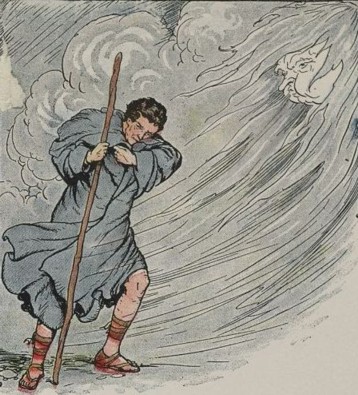
 Today, by happenstance, I heard an Aesop’s Fable that I had never encountered before recited on the radio. Like all Aesop’s Fables, this one had a moral, and it is also a statement of ethical values. Unlike most of the fables, however, it doesn’t make its case; it is, in fact, an intellectually dishonest, indeed an unethical, fable.
It is called “The North Wind and the Sun,” and in most sources reads like this:
“The North Wind and the Sun disputed as to which was the most powerful, and agreed that he should be declared the victor who could first strip a wayfaring man of his clothes. The North Wind first tried his power and blew with all his might, but the keener his blasts, the closer the Traveler wrapped his cloak around him, until at last, resigning all hope of victory, the Wind called upon the Sun to see what he could do. The Sun suddenly shone out with all his warmth. The Traveler no sooner felt his genial rays than he took off one garment after another, and at last, fairly overcome with heat, undressed and bathed in a stream that lay in his path.”
The moral of the fable is variously stated as “Persuasion is better than Force” , or “Gentleness and kind persuasion win where force and bluster fail.”
The fable proves neither. In reality, it is a vivid example of dishonest argument, using euphemisms and false characterizations to “prove” a proposition that an advocate is biased toward from the outset.
The first of the morals is vague and presumptuous. Why is persuasion “better” than force? Because it works? If the North Wind was successful in blowing off the man’s coat, would that then mean that persuasion and force were equally “good”? The fable with such a moral isn’t even making an ethical judgment; it is, instead, registering a vote for consequentialism: “If it works, it’s good; the end justifies the means.”
All the contest really proves is that the North Wind is an air-head, and the Sun rigged the competition by tricking the North Wind into an unfair test. What if the competition had been to determine who would be able to get the man to put on his coat? I don’t know about you, but I’m betting on the Wind. Windy wouldn’t have to blast, either: “The North Wind gently puffed, and the man shivered in the suddenly cool breeze. The Wind puffed colder and gustier, and soon the man hurried to don his coat.” Is that persuasion, or force? “Meanwhile, the Sun beat down ever harder with his withering rays, but the more sweat that appeared on the sweltering man’s brow, the less inclined he was to wear his heavy coat.” The fable decides from the outset that the Sun’s power is gentle and persuasive, and the Wind is, by definition, “Force.” If that is the assumption in my new, equally plausible adaptation, then the moral must be “Force is better than Persuasion.”
The alternate version of the fable’s moral, “Gentleness and kind persuasion win where force and bluster fail,” is worse. It arbitrarily assigns benign motives and virtues where none are in evidence. To begin with, the whole contest is unethical, violating basic principles of fairness, respect, autonomy, empathy, and caring, as well as the Categorical Imperative. A man is walking along the road, minding his own business, and these two bullies decide to use him as a prop to settle their argument, to torment him for their own amusement. Neither the Sun nor the Wind are ethical; their objective is wrongful, and their treatment of the man irresponsible. The fact that one of them may harass the victim more gently than the other is hardly reason for praise.
Even that characterization is false. The Sun’s heat is “gentle” and “kind” only because Aesop calls it so. If the man stubbornly refused to take off his coat (fearing, perhaps, that the North Wind would start gusting again), and the Sun burned ever hotter until the man dropped dead of heat stroke, would the Sun still be called “gentle” and “kind”? Was the man killed by “persuasion”? In truth, both the Wind’s gusts and the Sun’s heat are varieties of Force; the fable, like the Bush Administration calling waterboarding “enhanced interrogation” instead of torture, is a lesson in obfuscating reality and manipulating perceptions by using deceptive language.
If one is going to propose a fable to pass along wisdom to children and others, there is an obligation to actually be wise, and above all, to tell the truth. Here, Aesop is expressing a personal abstract preference as a universal truth, when it is no such thing. Sometimes persuasion is more effective than force, in which case persuasion is preferable, since it allows the one persuaded to exert free will without coercion. If both persuasion and force will have the same effect, force should yield to persuasion. But if persuasion is ineffective, and having a party do something or not do something will prevent great harm to others, force may be required, justifiable, and right. In such a case, persuasion is not “better;” in fact, it is useless.
Nor is gentle and kind persuasion necessarily superior to firm and relentless persuasion. It all depends on the circumstances; deciding whether to use force, which is sometimes necessary and unavoidable, is a complex issue, ill-served by disingenuous and bias-laden fables.
Well, they can’t all be winners, Aesop, but this fable really needs to be pulled from the collection. It’s nothing but hot air.
 Ethics Alarms
My word! I am taking a course in humanities and chose this fable to contrast and compare to other areas in humanities and came across this blog. I read all these comments. I just wanted to say everyone is entitled to their opinions and it was hysterical that a Aesops fable would be a cause of so much discord and conversation. just saying……….. and the Beatles said it right..”Love is all we need”.
Even the Beatles didn’t believe that.
A very cynical and literal reading. You ought to see the sun and wind as just metaphors not as exact representational symbols. The idea is good triumphs over evil and this metaphor of sun and wind is how Aesop manipulates us. Diplomacy over war, giving over taking etc.
It’s actually a profound fable and literal readings of it like yours do it a disservice.
People see what they want to see.