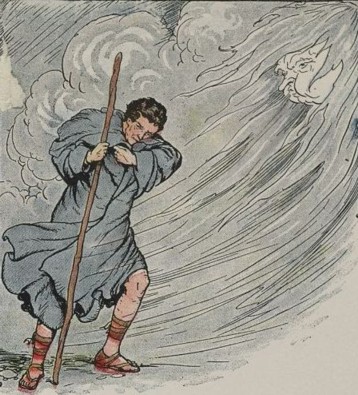
 Today, by happenstance, I heard an Aesop’s Fable that I had never encountered before recited on the radio. Like all Aesop’s Fables, this one had a moral, and it is also a statement of ethical values. Unlike most of the fables, however, it doesn’t make its case; it is, in fact, an intellectually dishonest, indeed an unethical, fable.
It is called “The North Wind and the Sun,” and in most sources reads like this:
“The North Wind and the Sun disputed as to which was the most powerful, and agreed that he should be declared the victor who could first strip a wayfaring man of his clothes. The North Wind first tried his power and blew with all his might, but the keener his blasts, the closer the Traveler wrapped his cloak around him, until at last, resigning all hope of victory, the Wind called upon the Sun to see what he could do. The Sun suddenly shone out with all his warmth. The Traveler no sooner felt his genial rays than he took off one garment after another, and at last, fairly overcome with heat, undressed and bathed in a stream that lay in his path.”
The moral of the fable is variously stated as “Persuasion is better than Force” , or “Gentleness and kind persuasion win where force and bluster fail.”
The fable proves neither. In reality, it is a vivid example of dishonest argument, using euphemisms and false characterizations to “prove” a proposition that an advocate is biased toward from the outset.
The first of the morals is vague and presumptuous. Why is persuasion “better” than force? Because it works? If the North Wind was successful in blowing off the man’s coat, would that then mean that persuasion and force were equally “good”? The fable with such a moral isn’t even making an ethical judgment; it is, instead, registering a vote for consequentialism: “If it works, it’s good; the end justifies the means.”
All the contest really proves is that the North Wind is an air-head, and the Sun rigged the competition by tricking the North Wind into an unfair test. What if the competition had been to determine who would be able to get the man to put on his coat? I don’t know about you, but I’m betting on the Wind. Windy wouldn’t have to blast, either: “The North Wind gently puffed, and the man shivered in the suddenly cool breeze. The Wind puffed colder and gustier, and soon the man hurried to don his coat.” Is that persuasion, or force? “Meanwhile, the Sun beat down ever harder with his withering rays, but the more sweat that appeared on the sweltering man’s brow, the less inclined he was to wear his heavy coat.” The fable decides from the outset that the Sun’s power is gentle and persuasive, and the Wind is, by definition, “Force.” If that is the assumption in my new, equally plausible adaptation, then the moral must be “Force is better than Persuasion.”
The alternate version of the fable’s moral, “Gentleness and kind persuasion win where force and bluster fail,” is worse. It arbitrarily assigns benign motives and virtues where none are in evidence. To begin with, the whole contest is unethical, violating basic principles of fairness, respect, autonomy, empathy, and caring, as well as the Categorical Imperative. A man is walking along the road, minding his own business, and these two bullies decide to use him as a prop to settle their argument, to torment him for their own amusement. Neither the Sun nor the Wind are ethical; their objective is wrongful, and their treatment of the man irresponsible. The fact that one of them may harass the victim more gently than the other is hardly reason for praise.
Even that characterization is false. The Sun’s heat is “gentle” and “kind” only because Aesop calls it so. If the man stubbornly refused to take off his coat (fearing, perhaps, that the North Wind would start gusting again), and the Sun burned ever hotter until the man dropped dead of heat stroke, would the Sun still be called “gentle” and “kind”? Was the man killed by “persuasion”? In truth, both the Wind’s gusts and the Sun’s heat are varieties of Force; the fable, like the Bush Administration calling waterboarding “enhanced interrogation” instead of torture, is a lesson in obfuscating reality and manipulating perceptions by using deceptive language.
If one is going to propose a fable to pass along wisdom to children and others, there is an obligation to actually be wise, and above all, to tell the truth. Here, Aesop is expressing a personal abstract preference as a universal truth, when it is no such thing. Sometimes persuasion is more effective than force, in which case persuasion is preferable, since it allows the one persuaded to exert free will without coercion. If both persuasion and force will have the same effect, force should yield to persuasion. But if persuasion is ineffective, and having a party do something or not do something will prevent great harm to others, force may be required, justifiable, and right. In such a case, persuasion is not “better;” in fact, it is useless.
Nor is gentle and kind persuasion necessarily superior to firm and relentless persuasion. It all depends on the circumstances; deciding whether to use force, which is sometimes necessary and unavoidable, is a complex issue, ill-served by disingenuous and bias-laden fables.
Well, they can’t all be winners, Aesop, but this fable really needs to be pulled from the collection. It’s nothing but hot air.
 Ethics Alarms
An interesting and persuasive argument. I am left pondering whether cultural context defines “right” and “wrong”. Is there such a thing as a moral imperative? My gut and college-era reading of Kant leave me inclined to say that yes, there are moral imperatives, there are absolute rights and wrongs, but they are few and must be closely examined for cultural bias.
There are moral imperatives, but absoluteness is an illusion. In the case of the fable, I’m inclined to think it was just a sloppy allegory from the start.
First, I like this post. We’re in agreement on this one (though, I probably would have kept the political example away from a completely apolitical piece).
Unfortunately, I disagree with the ability for moral imperatives to exist, but absoluteness not. If we assume the former, we must have the latter, otherwise we may be requiring actions that are immoral. Our imperatives may be morally disperative. (Is that a word? I’m keeping it.) The difficulty is that it’s exceedingly difficult to impossible to know the absolute answer. In the future it may be possible, but we (the human collective we) know enough at this point to know how much we do not know. Absoluteness is only an illusion in practice (that anyone cares about here), but if we’re already in the theory of moral imperatives and absoluteness, I think it deserves its fair shake.
On the other hand, if we assume absoluteness, imperatives do not necessarily follow. Imperatives require relative value judgment and a definable line. While I argue for moral imperatives, I can’t necessitate their existence. Mostly, I use relative harm, in agreeable terms, to support my positions, with only one major dip in to absolutism.
Edit. I would like to think I would keep the political example out of the apolitical piece. I actually bet I would have used one, and my example would likely have been an other-side transgression.
I find myself disagreeing. If I understand you correctly your main beef is with the morals, which I would give the benefit of a doubt. (Apart from the necessity to revisit the original Greek in order to find out what Aesop himself said: Translations can be quite tricky.):
The word “better” is in it self not necessarily a judgement about good and evil: Nadal is a better tennis player than Tiger Woods. It is better to win the lottery than to break a leg. “Because it works?” is a justifiable reason to use “better” in the non-moral sense.
“Gentleness and kind persuasion”, in turn, does not necessarily imply a motive, but could merely describe the method. There are plenty of people who use gentleness and kind persuasion despite being utter bastards—and there are many kind and gentle people who act differently.
Of course, if I had written the moral, it would have gone more along the lines of “We are more successful in making people do X if we make them want to do X than if we just force them to do so.” (or something more poetic to the same effect).
Michael, I could argue this point, but I’m so grateful someone actually read this post, which I like a lot, that I won’t. Just thanks for reading and commenting.
Well, I did think myself that this fable has a nice message to give to people – that in general in life it is better to be gentle and kind than forceful and mean. I would use fables as a starting point for discussion with my pupils, to then move on to real world examples, to acknowledge where this fable doesn’t cover all eventualities.
Your dissection of the fable above may appear correct on logical grounds, but I think you are missing the point. A fable is a succinct story illustrating a moral point (yes I used wikipedia to check). You seem to be writing it off as “hot air” because it isn’t a fully featured philosophical argument fit for a degree level course of reason and logic. Well, no – it’s a fable. It may be imperfect but I don’t think it deserved quite such a kicking.
A fable either conveys wisdom or it doesn’t. This one doesn’t, and cheats as well. There’s a reason why it isn’t one of Aesop’s Greatest Hits. As a fable, it’s “Why Don’t We Do It In The Road?”, not “Eleanor Rigby.”
Eleanor Rigby? That’s the one you pull out as one of the greatest Beatles songs? How about Yesterday or Strawberry Fields Forever? Is Eleanor Rigby even top 20 of Beatles songs?
According to Rolling Stone…. no. http://www.rollingstone.com/music/lists/100-greatest-beatles-songs-20110919/eleanor-rigby-19691231
Wait a minute—I didn’t say it was one of their Greatest Songs, just that it’s on the list of their greatest hits.
My personal top 20, since you ask…
1. A Day in the Life
2. I want to hold your hand.
3. We Can Work It Out
4. Strawberry Fields
5. In My Life
6. While My Guitar Gently Weeps
7. I Saw Here Standing There
8. Here, There, and Everywhere
9. I Am The Walrus
10. Run For Your Life
11. That Boy
12. Eight Days A Week
13. Octopus’s Garden
14. If I Fell
15. Penny Lane
16. Help!
17. You’ve Got To Hide Your Love Away
18. Can’t Buy Me Love
19. Here Comes The Sun
20 Any of about 40 others.
Holy wow. You really tore this fable apart and took it literally where I don’t think it was meant to be taken literally…
For instance, you view their game as an example of bullying an unsuspecting person. Well, OK. But it seems to me rather clear that it’s a metaphor for basic interaction and communication.
If you want somebody to understand your opinion, and you start screaming at them, they are likely to not listen. If you calmly explain it, they are more likely to listen. In fact, I recall some studies suggesting this — that when confronted with evidence that proves someone’s opinion wrong, they are more apt to believe it all the further. So if you want somebody to honestly see your side, you must present it in a different way, perhaps a way in which they don’t even realize they’re being disagreed with. I don’t think this is the same thing as bullies.
Also, come on. The sun and the wind are metaphors for different types of people. Duh that the sun and wind only have certain capabilities that just happen to work in this story — but the sun and wind aren’t actually sentient beings, you know? So it’s same to assume they’re metaphors, and therefore, your complaint about that just … doesn’t make sense.
I’m also unsure that there’s an ethical statement being made — just a methodical one. If you want to get someone to do or believe something, force and violence probably won’t work. Putting someone in a situation where they come to understand what you want them to on their own will be more successful. Right or wrong? Sun didn’t say a word about that. He was just proving his way worked.
I agree with Charlotte and would say she explains her point in the position of the wind here:)
Aesop almost certainly DID NOT write either of those morals. Most scholars conclude that the morals attached to the Aesop fables were tacked on by later writers who may have suspect views or incomplete analysis of the story. Find whatever truth you can in the story–that’s probably what Aesop wanted you to do.
I agree with charlotte above and I am thankful she elucidated concrete enough to disincline me to attempt, but for the blogger I do question anyone who fosters absolutist drives towards things while having lived in benefit of the opposite. We know from Wittgenstein that language has no deeper meaning than use, and is of origin piecemeal and arbitrary, excepting some divine allocation, yet we function off of it like it was solid proof from Heaven. Could we not say that in the manner of the above fable a leader promises and presupposes the ability to get a nation somewhere (not necessarily territorial, could be social/cultural) with no absolute guarantor of the capacity to do so (not even if stocked with a CV of precedent of successes). So existing in a society led by those who make potentially inaccurate (in fact often falling far short of the buy-in expectation of their member-incumbency) promises is as if presenting purity from the prospective of a hypocrite (as the Bible says: “Let he who is not without sin, cast the first stone”). To denounce immorality while reaping the profit (the tentative functionality of society, for one of a multitude of examples) is like a man whose family has stolen by robbing banks and sent him to the stratums of prestige who then moralizes why we should not do like his ancestors, although that it part and parcel the vehicle which fostered him the paltform to communicate this to us.
This sounds like the relatedness of Power vs. Force; Force leads to resistance whereas Power is a constant. The ‘moral’ of the story is a false assumption , as it has nothing to do with morals, and that is the point.
P.S. I found this post when searching on , “morals are like the wind, they come and go like the wind like fads and social norms but the sun riseth and falleth in a predictable fashion having nothing to do with what a person or society thinks”. It’s the equivalent of having a cold , hardened heart or a warm one of flesh.
Like Charlotte, I think you miss the whole point. To me, the fable is just a metaphor that helps people understand that persuasion works best when your argument leads the audience to conclude you are correct, rather than when your “argument” consists of shouting: “agree with me! agree with me!” It’s about rhetoric, nothing to do with ethics.
I don’t see that at all, at least, not in the version I used. All of these have different translations and interpretations, and I could see getting to where you are with some tweaking.
Erhm, certain aspects of this argument don’t sit right with me. “…..the Sun rigged the competition by tricking the North Wind into an unfair test.” Nothing in the piece seems to justify this claim other then the fact the Sun won the contest and like the Wind they both showed some level of hubris.
“Even that characterization is false. The Sun’s heat is “gentle” and “kind” only because Aesop calls it so. If the man stubbornly refused to take off his coat (fearing, perhaps, that the North Wind would start gusting again), and the Sun burned ever hotter until the man dropped dead of heat stroke, would the Sun still be called “gentle” and “kind”?”
This is a fair accusation to make but couldn’t the wind just as easily kept blowing harder and harder until the man was knocked to his death? Would he also be killed by persuasion? The fact that the wind placed a limit on “his” abilities leads me to believe the sun would have as well.
You say in their own ways that they both used force on the man to get him to remove his cloak, but the broadness you use of the term defeats the purpose of the piece. The wind tried to force the man out of his cloak by blowing it off him, but the sun used heat to make the man want to take the cloak off. Heat won’t force it off, but wind will. If anything the sun understands characteristics of a human more than the wind does. If the wind blows chillier and harder you’d want to keep it on for warmth, but if it gets too hot it’d be too uncomfortable to keep on.
The contest in itself may be unethical but to what extent is that relevant? It doesn’t reflect the moral or purpose of the piece so why should it matter? Little Red Riding Hood has wolf that wants to eat people yet it doesn’t reflect the purpose of the piece either. Certain aspects of a piece are just meant to progress the story along, they don’t necessarily have to reflect the meaning.
This analysis seems to have been undertaken while suffering the effects of an intellectual nocebo. This Aesops fable is a beautifully succinct and clear illustration of cause and effect in the context of freedom and compulsion. I first read it when I was about 8 years old and feel I understood the metaphor more clearly then, than does the above paranoid and confused analysis.
In any event while Aesop may have had greater insight than we think given while he not have realised the scale of the difference, the sun, at well over 300,000 times the mass of the earth, is indeed incomparably ‘stronger’ than the movement of gases around one of its relatively insignificant satellites.
You avoided enlightening us regarding your 8 year-old logic, undoubtedly because it doesn’t hold up.
Jack, you seem to go about this particular topic unusually aggressively. My advice would be to take a step backwards and try to look on this discussion as a third party.
In the end, it seems that you have a very different understanding of this fable than the other readers. (Cf. my original comment.)
Re-reading, I am also surprised by your statements along the lines of “greatest hits”: I would actually see this particular fable as one of Aesops most well-known and like “Ironbar Jim”, but apparently unlike you, I encountered it (repeatedly) as a child.
Never encountered it at all, and we even had an “Aesop’s Fables” book in my family that we consulted repeatedly.
My argument is correct on the facts: heat is as much “force” as wind is. Solar power vs wind power. Do you really want to maintain that one is “force” and the other isn’t? The sun is infinitely more powerful than wind.
People are defending the fable because of politics and ideology: they like the motto, which is in truth a value judgment, not “wisdom.” I don’t know what you mean by “understanding”—I correctly stated the “lesson,’ and it is a fact that the story doesn’t prove it, because the motto is false as stated. I know ideologues routinely state conclusions that are not supported by facts, and this is an example. The fact is that “Gentleness and kind persuasion win where force and bluster fail..and vice versa.”
A bit more analysis to point out where you from my POV go wrong:
> The first of the morals is vague and presumptuous. Why is persuasion “better” than force? Because it works?
Yes, because it works: The moral, as I have always interpreted it, has nothing
to do with what is the morally better but with what works. You can speculate
that Aesop had a hidden agenda of making the world a kinder place, but that
would be just that—speculation. (And, obviously, the moral of a fable is not
a statement about morals in the ethics sense.)
> If the North Wind was successful in blowing off the man’s coat, would that then mean that persuasion and force were equally “good”?
Persuasion and force can both be used to achieve certain ends. This story
illustrates the benefits of persuasion in a one-sided manner, but virtually all
fables are one-sided and should not be seen as giving the whole truth or a
direct instruction—but as “food for thought” to allows us to make better
decisions. Here, many people would tend just use force (including sanctions,
threat of violence or other consequences, whatnot) in order to enforce their
will, and the story suggest that there are other ways that might be better.
> The fable with such a moral isn’t even making an ethical judgment; it is, instead, registering a vote for consequentialism: “If it works, it’s good; the end justifies the means.”
The fable does indeed not make an ethical judgment; however, it also does not say that the end justifies the means: The end was already decided and the means came afterwords.
> All the contest really proves is that the North Wind is an air-head, and the Sun rigged the competition by tricking the North Wind into an unfair test.
The point of the story is not whether the wind or the sun are more powerful: They are used allegorically to illustrate the actual point.
> What if the competition had been to determine who would be able to get the man to put on his coat? I don’t know about you, but I’m betting on the Wind. Windy wouldn’t have to blast, either: “The North Wind gently puffed, and the man shivered in the suddenly cool breeze. The Wind puffed colder and gustier, and soon the man hurried to don his coat.” Is that persuasion, or force? “Meanwhile, the Sun beat down ever harder with his withering rays, but the more sweat that appeared on the sweltering man’s brow, the less inclined he was to wear his heavy coat.” The fable decides from the outset that the Sun’s power is gentle and persuasive, and the Wind is, by definition, “Force.” If that is the assumption in my new, equally plausible adaptation, then the moral must be “Force is better than Persuasion.”
See the two previous remarks.
> The alternate version of the fable’s moral, “Gentleness and kind persuasion win where force and bluster fail,” is worse.
Frankly, I am not certain that I see a difference in practical meaning (after correcting for your misconception that the first moral was an ethical statement).
> It arbitrarily assigns benign motives and virtues where none are in evidence.
It does not: “Gentleness and kind persuasion” are means, not a sign of the
underlying motives and virtues. Yes, kindness often comes from kind people. No,
it can come from evil-minded people too. Notably, one of the stereotypical
characteristics of a psychopath is having learnt how to manipulate people
through fake friendliness and similar. Or consider the stereotypical car
salesman…
> To begin with, the whole contest is unethical, violating basic principles of fairness, respect, autonomy, empathy, and caring, as well as the Categorical Imperative. A man is walking along the road, minding his own business, and these two bullies decide to use him as a prop to settle their argument, to torment him for their own amusement. Neither the Sun nor the Wind are ethical; their objective is wrongful, and their treatment of the man irresponsible. The fact that one of them may harass the victim more gently than the other is hardly reason for praise.
The contest is unethical. Here you do have a point, but this does not detract from the main moral of the story.
> Even that characterization is false. The Sun’s heat is “gentle” and “kind” only because Aesop calls it so.
He does not. There is, in fact, no characterisation along those lines.
If one reads a fable like this one merely as an exercise in inviting (or provoking) the reader to think, rather than as having an obvious bias or agenda – especially if we consider that the supposed ‘moral of the story’ was tacked on later – perhaps a different meaning emerges.
It is not stated who began the dispute, only that they chose the passing traveller as means of resolving it. Perhaps, in this metaphor, the Sun is merely more aware of his strengths and weaknesses in given circumstances, or put another way, is aware of how to fight each battle. He agreed to the contest knowing his own nature, and the nature of his adversary. And his tactics (choices, self-knowing, call it what you will) illustrate not that ‘persuasion is better than force’, but that ‘understanding is better than ignorance’. It strikes me that many of Aesop’s fables are far more concerned with the idea of thinking than they are with morality.
Political analogies? “SUNNY WAYS, my friends, sunny ways.” Justin Trudeau, Canada’s new prime minister was beginning his victory speech by quoting an old one – the highly successful Wilfrid Laurier (1841-1919). Trudeau’s “sunny ways” quip therefore, political shorthand for: “The frigid years of Mr North Wind, Stephen Harper, are over; and the years of Mr Sunshine, Justin Trudeau, are about to begin.” It illustrates the difference between democracy and dictatorship. I’ve always loved the fable as a humanist and a socialist and an egalitarian, and completely disagree with above comments.
This fable is neither unethical nor misleading. No need to make it more complicated. Its what each represent. Many believe strength only comes with force. A knife can be used to take a life or save one. What is the intention? What is the situation? Balance is key. Extremes are dangerous because they close you off from being open to seeing all sides of a situation.
Fables are short and simple to give a new perspective. We dont need to analyze or complicate them. Love and compassion are powerful. Life is cycles. Sun without rain is a desert, rain without sun is no good either. Each has a place and a purpose. Life is full of metaphors. Brilliant and beautiful. It would be wise to pay attention to how you feel when you read such things and ask yourself why because if you are offended, you are taking a mere fable too personally and it could mean you have inner work to do. Peace.
Peace.
Baloney.
Life isn’t simple, and the fable is neither fair nor true.
What situations have you come across in which this moral wasn’t true? I know that from working with the homeless for a year and from 15 years of working with small children, gentle persuasion absolutely works better than forcefulness.
You’re writing has a rather angry and obstinate tone and almost sounds a little bit like a retaliation against some advice somebody gave you.
Gee, I don’t know: Nazi Germany? Bullies? Iran? Russia?
Thanks for the amateur psychiatry. You’re nuts. How anyone could interpret this post as “retaliation” is beyond me.
I do not necessarily agree with Rivkah, but it is clear that you have unusually strong feelings concerning this particular story. My advice would be to take a step back and try to evaluate why most commenters have such a different take and if they might possibly have a point, even be it one resulting from different interpretations of the story or the terms discussed (i.e. a possible
disagreement on semantics, especially WRT “better”).
> Gee, I don’t know: Nazi Germany? Bullies? Iran? Russia?
Much can be reached with force, threats, and violence—no doubt. There may even be situations where this is the best (or only) choice. Certainly, the rules for dealing with a small group of children and an entire adult population could be different. However, look how often this has ended badly for the bullying party. If we impose our will on others against their own wishes, chances are that they will rise up to over-through and hang us, or that the
opposition simply grows so strong that we have to step aside (cf. Eastern Europe in the 1980s). Also consider how much greater the effort can be or that this approach can backfire disastrously if we are too weak.
As an aside, one possible interpretation of the fable is that rhetoric (a big deal in ancient Greece) is more effective and/or efficient than force, making it a form of hidden advertising. (I do consider rhetoric largely unethical:The art of making someone believe or do something regardless of the actual facts of the matter. Something very similar applies to much of advertising.)
Interesting analysis. My main problem with the fable is that it states in absolute terms what is, as you properly note, a solution to conflict very dependent on the situation. A good fable, and ethical, fair one that doesn’t mislead, is the messenger of a universal truth. This isn’t. It is an ideological position.In that regard, it is misleading.
As with the previous commenter,you leap to unwarranted conclusions. This is one of over 7000 ethics essays on this blog, and believe me when I say that the flaws of an obscure Aesop’s Fable is somewhere around 7,347 on the list of issues I care most about.I write all the posts here, with few exceptions, assertively and strongly. Anyone who reads here regularly knows that, and would never suggest that I feel “unusually” strongly about the stupid wind and sun. I don’t.
I thought the moral of the story was about bragging on who you are. The sun didn’t have to do all that huffing and puffing and blowing air, all the sun had to do was be who he was and people would know he was the sun…… The sun doesn’t have to say “I’m the sun”….. Meaning, just be yourself and people will notice what and who you are without all extra hoopla.
If the challenge in this fable was to get the man to put on his coat, the North Wind could have easily won with a gentle persuasion and the Sun would definitely have lost with forceful heat. Either way, kindness prevails. Society today, more than ever before, needs to hear this message. So sad that you choose to trample it.
I enjoyed this.
Thanks. I’m amazed how much criticism it has received. Don’t mess with Aesop.
You were still replying in 2017, so maybe someone will see this. I really thought nothing of this fable until one of my young students replaced the word “Traveler” with “cute girl”, then it sounded absolutely horrible. Now that I’m writing this, it seems the moral holds in a court case, but that more about which is worse rather then which is better. (Is a less wrong wrong “better” then a worse wrong?) As another commenter noted, the meaning of better is quite flexible in common use.