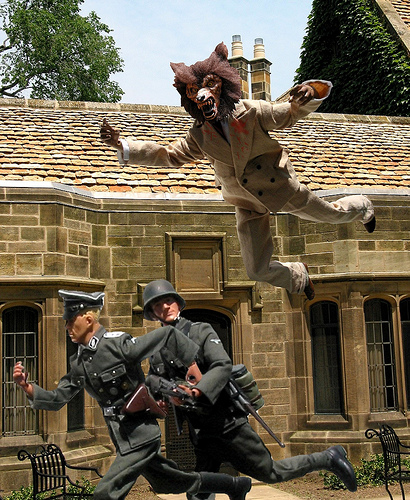
This werewolf attack on Nazi soldiers doesn't weaken the case that Sen. Kerry didn't deserve his medals.
Alternate title: “Smearing John Kerry”, Part II. The quote:
“The Swift Boat Veterans for Truth disputed whether John Kerry deserved some of his five medals. A large part of Kerry’s defense was an appeal to the authority of veterans who supported him–one of whom has now been revealed to have received a medal he doesn’t deserve. This doesn’t prove the Kerry detractors were right, but it certainly doesn’t weaken their case.”
–—James Taranto, the usually astute and witty author of the conservative Wall Street Journal blog, “Best of the Web.” He is referring to the child porn conviction and retraction of the Silver Star of Wade Sanders, who rose to Sen. Kerry’s defense during his 2004 race against President Bush, when The Swiftboat Veterans for Truth claimed that Kerry had lied about his war record.
A pure slime-job, this…well beneath Taranto’s standards, though he does dip low now and then, and as reprehensible an example of attack by unfair innuendo as you are likely to find, from McCarthy to Olbermann to Beck.
“It certainly doesn’t weaken their case.” No, because it has absolutely nothing to do with their case (which was weak and unfair to begin with), and since Taranto is undoubtedly smart enough to know that, this sentence, and the post containing it, was only written to suggest otherwise. Let’s see…what else “doesn’t weaken” the case of those who claim that the honors bestowed on Kerry for wartime valor by the United States of America were undeserved? Hmmm. We have…
- The 1997Oxford Dictionary (Unabridged)
- The post-baseball career of Hall of Famer Brooks Robinson
- The grooming habits of President Franklin Pierce
- The disappearance of Natalie Holloway.
- The puzzling discovery at Göbekli Tepe
- This weird sore I’ve got on my eye
- Billions and billions of other things, as the late Carl Sagan liked to say. In fact, almost everything.
Of course, not one of these things have a damn thing to do with John Kerry, and as I wrote in the earlier post, neither does the life of Wade Sanders during the Vietnam war or after the 2004 campaign. There are few U.S. Senators I have less regard for than John Kerry, but there is a surplus of failings, positions, statements, and actions to attack him on without resorting to this kind of underhanded, unethical smear.
 Ethics Alarms
Kerry made an appeal to authority. I pointed out that one of the men to whose authority he appealed has been discredited. How is that a “slime job”? I don’t see what this post has to do with ethics.
Oh, sure you do. The first ethical principle breached here is fairness. The authority Kerry appealed to in 2004 was another Swiftboat commander who took a different view than the Swiftboat commanders attacking his record. It is unfair to use a subsequent criminal prosecution and conviction of such a tangential figure to cast aspersions on Kerry, and unfair to suggest any connection whatsoever between the disallowed Silver Star and Kerry’s. Unless there is a connection, and there isn’t, between the circumstances of the two medals, the latter should not even be mentioned. It was mentioned only to raise a suspicion that you, the writer, know is invalid.
You also know your statement was a completely intentional—and typically deft—example of doing precisely what you say you are not doing by how you say you aren’t doing it! This is a breach of honesty….another ethical value. It is rhetorical sleight of hand in the class of making it clear what the identity of a party who “shall not be named’ is, or the device you have often attacked, using the unethical journalistic trick of noting that “some say” a thing is true when there is no valid reason to raise the suggestion.
The recent problems of Kerry’s temporary ally in 2004 indeed don’t weaken or strengthen the accusations of his critics, because they are irrelevant to it. Writing that fact in the manner you did intentionally fed the suspicions your statement supposedly claimed should not be bolstered. You really don’t see what’s unethical about that?
This reminds me of a story I read in second-year German class. The first mate of a ship was normally steadfast and reliable, but one night went ashore and tied one on. The next morning he was dismayed to find a log record, written by the captain, saying “Last night the first mate was drunk.” The mate protested, citing his otherwise exemplary record, but the captain said that if had been properly entered in the log, and was true, it couldn’t be changed. Those were the rules.
The next morning the Captain opened the log and found that the first mate had written, “Last night the Captain was sober.”
I wonder if James Taranto understands what THAT story has to do with ethics?