A Tale of Two Heathers

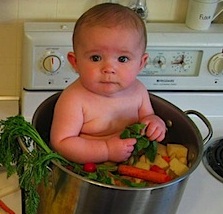
All right, cooking your child doesn't mean you're a bad person.

Heather #1: Ethics Hero Heather Elliott, who saw two small boys locked in a car parked outside a Kroger store in Indianapolis. The temperature was in the 90s and climbing, and the boys looked red-faced and hot. One was screaming and crying, and banging at the closed window. Elliott decided to take action, and began to try to find a way to open the car doors.

Heather #2: Ethics Dunce Heather Query, 21-year-old mother of the two cooking boys, who arrived on the scene just as Heather #1 was trying to rescue her children. “How long were you in that store?’ Heather #1 asked #2.  “It’s 100 degrees outside.” ‘What do you care?” said Ethics Dunce Heather. “Mind your own business” When Ethics Hero Heather responded, “I’m just concerned about your kids. I’m just thinking about the safety of your kids,” Heather #2 attacked her, punching her in the face.

There’s gratitude for you. Continue reading

Ethics, Stereotypes, and Holly Golightly

"Andy Hardy, the Asian Years"

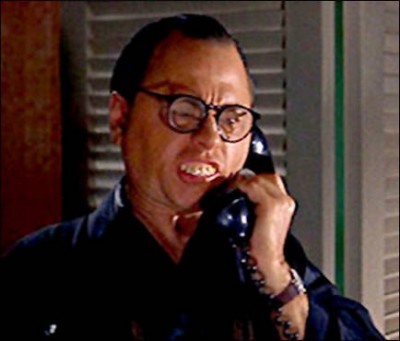
A Bronx woman, Ursula Liang, has started a petition against Brooklyn Bridge Park’s “Movies With A View” series showing “Breakfast at Tiffany’s,” the 1961 Audrey Hepburn classic that gave us “Moon River” and one of actress Hepburn’s most endearing performances. Why? Well, the movie, which has long been popular for summer screenings in New York City and elsewhere, also contains a pre-political correctness performance by Mickey Rooney as Holly Golightly’s comic Japanese neighbor, “Mr. Yunioshi.”

Rooney’s performance, in my opinion, was cringe-worthy even in 1961, one of director Blake Edwards’ not uncommon excesses in vaudeville humor, placed in a context where it didn’t belong. It is a scar on an otherwise marvelous film, but there is nothing inherently wrong with comic stereotypes. Stereotypes are a staple of comedy, and have been forever; the question is whether a particular stereotype is cruel, gratuitous, harmful, or funny. Some stereotypes are cruel and funny. Continue reading

Fact Checker Ethics, Part II: Validating Deceit, and Practicing It Too

Et tu, Fact Checker?

In its review of Washington Post “Fact Checker” Glenn Kessler’s shameful refusal to call the Democratic dissembling on Social Security, Ethics Alarms saved the best—which is to say, worst—for last.

Beginning with a statement typical of Obama Administration and Democratic leadership positioning on the subject, Rep. Xavier Becerra’s (D-Calif.) “Social Security has never contributed a dime to the nation’s $14.3 trillion debt…not one penny to our federal budget deficit this year or any year in our nation’s history,” Kessler gives a brief history of Social Security, why it has no more money, and concludes with this nonsense:

“Becerra is sincere in his convictions and his statement is true, so far as it goes. Yes, Social Security in the past has not contributed to the nation’s debt. But it’s basically a meaningless fact and actually distracts from the long-term fiscal problem posed by the retirement of the baby boom generation and the shrinking of the nation’s labor pool.” Continue reading

Fact Checker Ethics: Alibis For Obama, Part I

The Washington Post “Fact Checker,” Glenn Kessler, is among the most biased of the breed. On the issue of the Obama Administration’s outright dishonesty on Social Security, however, he is embarrassing his paper and the entire Fact-Check community.

Lately, his strategy has been to bury obvious dishonesty by the Obama Administration and Democrats regarding Social Security in technical details, excusing straightforward misrepresentation (how’s that for an oxymoron?) and encouraging readers to shrug, give up, and move on

How nice for the President to have political allies posing as objective truth-tellers. Continue reading

Barn Doors + Anger + Ignorance + Irresponsible Legislators = “Caylee’s Law”

When someone first mentioned the wave of support for “Caylee’s Law,” proposed legislation so far pending in four states making it a felony for a parent not to report a child’s death within an hour or a missing child within 24 hours, I responded that it “sounded like a good idea.”  Lots of dumb things sound good to me before I think about them. “Caylee’s Law,” is in fact a terrible idea, and about 10 minutes of quality thought illuminates why.

The law is the result of multiple factors more related to human nature than sound law enforcement. When something unpopular and frustrating happens, like the death of Caylee Anthony and her mother’s subsequent acquittal of murder charges, the response is often to try to fix the problem with a law. Such laws are often formulated in the heat of emotion and sentiment rather than careful reasoning and consideration, and the result is  bad laws that cause more problems that they solve.

These laws also embody the Barn Door Fallacy. Society passes broad-based measures to stop an unusual occurrence that has already done its damage, and that may be extremely unlikely to occur again. Nevertheless, society and the public saddle themselves with expensive, inconvenient, often inefficient measures designed to respond to the rare event. One shoe bomber, and millions of passengers have to remove their shoes to go through airport security. One adulterated bottle of Tylenol, and every over-the-counter drug bottle requires a razor blade and the manual dexterity of a piano virtuoso to open. Two sick boys shoot up Columbine, so third graders get suspended for bringing squirt–guns to school. Continue reading

The Shannon Stone Tragedy Ethics Quiz, Part II

Don't try this if you're not a firefighter

 Many commenters were upset with me for characterizing the tragic death of Shannon Stone, who fell to his death while trying to catch a ball during a Texas Rangers game, as the result of his own bad judgment, suggesting that I was impugning the character of a dead man. (I wasn’t.) That reaction sparks the second Ethics Alarms quiz question relating to the incident.

NBC baseball blogger (and lawyer) Craig Calcaterra put up a post this morning headlined “Idiot nearly falls from the stands chasing a ball at the Home Run Derby”:

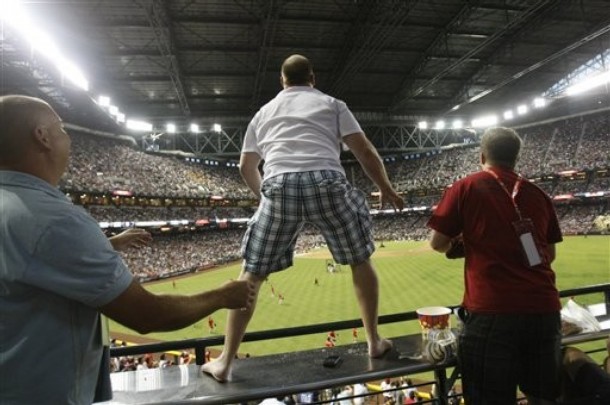
“Just days after Shannon Stone died from a fall while reaching for a baseball at a Texas Rangers game, a fan at last night’s Home Run Derby nearly fell out of the outfield stands while lunging for a home run ball hit by Prince Fielder.  He was spared serious injury or death only because his friends grabbed him by his feet, held him and then pulled him back as he dangled over the railing above a concrete deck 20 feet below…His name is Keith Carmickle, and common sense is not his forte. His fall came after he stepped up onto the narrow metal table which abutted the railing — the kind you stand in front of and set your drink on while watching the game — and then, while still standing on it, reached down low to catch the ball as it came in…He missed the ball, but his momentum carried him forward and he fell headfirst over the rail. If it wasn’t for his brother’s and his friends’ quick action, down he would have gone. Despite his idiocy, he (a) escaped this dangerous situation of his own making unscathed; and (b) was allowed to stay at the Derby by security. Both of these factors have been added to the “evidence that there is no God and/or that He is not just and fair” side of the big ledger I keep on my desk and in which I tally the wonder and folly of Humanity as I encounter it…”

Your questions to answer, if you dare: 1) Is it fair for Calcaterra to call Carmickle an idiot, and Stone just a random victim of circumstance? 2) Why or why not? Continue reading

The Case of the Excessively Flexible Lawyer

A Louisville lawyer named Keith Kamenish wants to defend Dion Neal, a drug dealer, against a murder-for-hire charge.  A police informant wearing a wire recorded a hit man as he said  that he was paid by Neal to kill a competitor for him. “I put 36 slugs in that nigger’s face and stood on his head,” the independent contractor boasted, according to a transcript of the conversation filed in court. “The whole head collapsed!”

Nice.

The government is trying to get Kamenish kicked off the case, and here is why: the guy whose head collapsed, LaJuante “B.B.” Jackson, was a Kamenish client at the time of his murder. Jackson was shot just four weeks after Kamenish got Jackson released on bond on a state drug charge; the lawyer’s blood- stained business card was found in Jackson’s wallet. Continue reading

Now THAT’s Bad Sportsmanship!

After a 16-year-old Florida boy lost a black belt taekwondo match, he bowed to his opponent, shook his hand ...and then kicked him in the face. The blow knocked his surprised adversary’s front teeth out.

The sore loser was booked on a felony assault charge. The sore winner ended up in the hospital.

National taekwondo organizers are reportedly considering serious sanctions, including banning the suspect from the sport for life.

I think that’s a reasonable response.

An Ethics Lesson From the All-Star Game

It really is one of the most enduring sports deja vus—every year, sportswriters and fans engage in thousands upon thousands of words of complaint regarding baseball’s annual All-Star Game, the 2011 edition of which will occur tomorrow night in Phoenix. This year was no exception, and as is always the case, no consensus or conclusions were reached, except that everyone agrees that the game is mishandled, mismanaged, unfair and illogical in every possible way.

I have been thinking of the game’s plight as an ethics case study that proves a core truth: you can’t do the right thing if you don’t know your objectives, stakeholders, and how to prioritize them. In the All-Star Game as it has evolved, there are competing interests and stakeholders with no clear agreement regarding which takes priority over the other. It is literally impossible to do be fair: somebody always will be disadvantaged, and because there is no single objective either, utilitarian balancing doesn’t work.

It was not always this way. When the All-Star game was first conceived in 1935, it was intended to raise money for the players’ pension fund, the players then being generally paid little more than grocery clerks.  Since the game had to draw as much of a paying crowd as possible to make money, the rosters and starting line-ups were constructed to include the biggest stars and most popular players. It didn’t matter whether Babe Ruth was off to a great start or not: it wouldn’t be an All-Star Game without him in the starting line-up, so he was the right-fielder. Managers picked the team that they thought would both be the “starriest” and that would give them the best chance to win the game. Continue reading

Wanted, Desperately Needed, and Lacking: Professionals, Adults and Values in the Media

What? Is there something wrong?

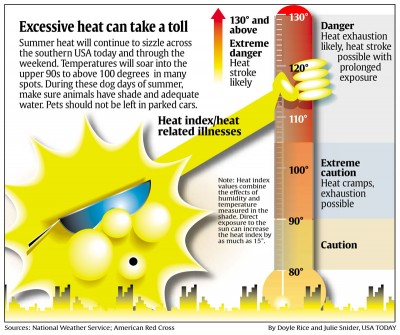
There is not a lot to say about the graphic above, other than:

  1. It is crude.
  2. It is funny.
  3. It is intentional.
  4. It is inappropriate for a general audience newspaper
  5. A competent editor should have caught it, and
  6. The graphic artist needs a warning and a reprimand.

The media, its staff, celebrities and assorted vulgarians and boors seem to be determined to make public square America as uncivil as a locker room, as crude as a peep show, and as juvenile as a junior high school farting contest. Professionals, including USA Today editors and publishers, can either do their duty and discourage this intentional rudeness in their products and services, or shrug it away. Similarly, our culture needs to decide if we are going to just define our deviancy down some more, and accept gratuitous sexual innuendo that will gradually make the whole population into a bunch of snickering Beavises. Continue reading