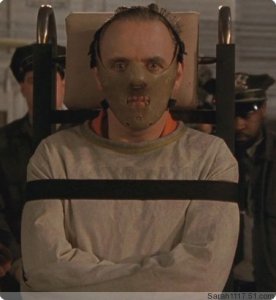
"Watch the pencil! WATCH THE PENCIL!!!"
Joshua Monson, standing trial in Washington State for drug charges and multiple criminal assaults, keeps stabbing his lawyers with pens and pencils mid-trial. He just stabbed his third—the others withdrew because of the conflict of interest created when you are afraid that your client wants to kill you—so the judge ruled that Monson had forfeited his right to counsel under the 6th Amendment in the Bill of Rights. Judge David Kurtz said Monson will have to defend himself without the assistance of counsel and will be strapped to a special chair for the rest of the trial. Kurtz advised jurors to ignore the incident, the restraints and the absence of a lawyer.
The right to counsel is a core feature of the right to a fair trial. Of course, there is no recognized right to stab counsel.
Your Ethics Quiz question: Assuming that Judge Monson’s ruling is legal, is it fair to take away a citizen’s Constitutional rights under extreme conditions—like a defendant repeatedly attacking his lawyers?
My guess, and it is only a guess, is that the judge’s decision will be grounds for an appeal and a reversal. I don’t think any action by a defendant, other than an explicit waiver, can justify taking away his right to counsel; the Sixth Amendment begins “In all criminal prosecutions,” not “In all criminal prosecutions where the defendant isn’t addicted to stabbing his lawyers with Bics and N0. 2 Mediums.” The theory, I suppose, is that the repeated stabbings are a waiver. I doubt it. I’m not a constitutional scholar (oh, shut up, Prof. Lewin!) but I’ve never heard of such a thing, and the case cited by the judge to support his decision doesn’t seem on point.
Even if it is legal, I don’t think it’s fair. The rights in the Bill of Rights are absolute. The Supreme Court has upheld the restraint, removal and even gagging of disruptive defendants in the past. If Monson is going to be in a “special chair,” why can’t he have his arms restrained and be represented by competent counsel in a safe, pencil-free environment? Since the judge has options that won’t rob Monson of a fair trial, he is obligated to use them. The legal system is only fair to a citizen, even a lawyer-stabbing citizen, when it gives him a fair trial. Making Monson defend himself guarantees that he won’t have one (“Ignore the incident, the restraints and the absence of a lawyer”—right. Anything you say, Judge!).
Besides—what if he stabs himself? Then what?
 Ethics Alarms
Never been stabbed by a client in 30+ years of defense work. Thought about stabbing a few to get them to shut up, though. Fancied putting a shock collar on a few as well. How would that be for a remedy? One motion toward the attorney and bzzzzt!
Couldn’t he just be restrained to protect his lawyer?
I was thinking about restraints as well. A much better option than taking away his right to counsel.
I agree. The defendant should be represented by counsel while restrained. Otherwise it’s a waste of time and taxpayer money, as an appeal is sure to follow.
Chuckles a bit. First the Judge should maybe ask if the defendant wants to be represented. Not simply make a ruling against the defendant.
“extreme conditions—like a defendant repeatedly attacking his lawyers?”
I not so sure repeatedly attacking a lawyer counts as being ‘extreme’ it could have just been his way of getting his lawyers attention.
Using restraints seems like a no brainer, they have been used before when a defendant shows to be a danger either to himself or others in the courtroom.
I may be going out on a limb here, but it sounds like this defendant is mentally ill. Surely, taking away a mentally ill person’s right to counsel is a violation of human rights? I don’t understand why he can’t be restrained during the trial, if his illness makes it impossible for him to behave otherwise?
” … advised the jurors to disregard the incident, the restraints, and the absence of a lawyer?” *Choke!*
But is it fair to force a lawyer to represent someone who poses a physical threat to them?
This may be a bit off-topic. One of the biggest ethical dilemmas for defense attorneys, at least in Virginia, is the defendant whose counsel suspects may be legaly incompetent to stand trial. The maximum punishment for a misdemeanors is twelve months in jail. A defendant who is found not comptetent to stand trial is frequently incarcerated for lonegr periods than that awaiting restoration to comptency. [The Commonwealth’s mental health system does not have enough beds for those who are determined incompetent to stand trial, resulting in their being held in local jails until a space is available.] So, as an attorney, do I go with my client’s desire to be free as soon as possible, even if it results in a connviction which might otherwise not occur, or do I raise the competency and sanity issues which might result in a “Not guilty by reason of insanity” verdict which may occur more than two years down the road?
Rule 1.14 says you defend him as if he’s competent. That means…his desire is your command.
The issue arises when the defendant is obviously incompetent. But going down that path leaves him incarcerated idefinitely, whereas, even if he got the maximum twelve months, he would only have to serve six. Waiting time to get to Central State Hospital in Petersburg is frequently that much or longer.
No, it doesn’t. The fact that a client is violent doesn’t mean he is incompetent, either. The lawyer’s job is to do what the client feels is in or her best interest.