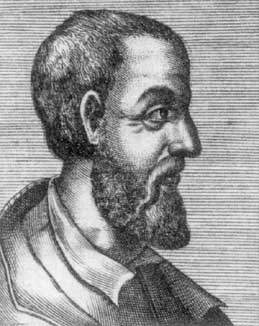
Remember his name?
A chance reference in a book I was perusing yesterday reminded me of a fascinating historical figure whom I hadn’t thought about in decades—which still gives me an edge over most people, who have never thought about him at all. He is Jerome Cardano, or, in the Italian version of his name, Gerolamo Cardano, an archetypical Renaissance man from Italy who walked the earth between 1501 and 1576. When I first learned about him those many years ago, his remarkable life didn’t give me any ethical insights because I wasn’t thinking about ethics then. Now, reviewing the facts of his remarkable life, I find that it carries at least five lessons with value for anyone who strives to live in a more ethical culture, and to have his or her own life contribute to making the world a better place.
Lesson 1 : Diligence—Play the hand you are dealt the best you can.
Cardano’s mother attempted to abort him by taking various poisons, but succeeded only in making him unhealthy. He stuttered; he was incapable of sexual relations, and had chronic insomnia, supposedly resulting in an “annual period” where he got little or no sleep for two to three months. He was afflicted at various times with the plague, cancer, dysentery, and many lesser ailments, yet he led a life full of extraordinary accomplishments and adventures, and continued to be active and breathing for 75 years, when most of his class and era died before they reached 45.
Lesson 2 : Enterprise—Don’t waste time.
I am always amazed at what some talented individuals were able to accomplish in eras when so much time had to be devoted to activities, like travel, health care, hygiene and food preparation, that today require a small fraction of the time and effort they once did. Cardano wrote a mind-boggling 230 books while becoming a renowned physician and mathematician as well as a gambler, magician, astrologer, master chess player and mystic. He is credited with identifying some of the basic principles of probability, making significant advances in algebra, and developing innovative cures for various maladies, including his own.
Lesson 3: Courage—Challenge conventional wisdom.
Cardano was, like many very intelligent and talented people, something of an arrogant jerk. He was not tolerant of fools or unduly impressed with majority opinion, and was not shy about expressing unpopular points of view in blunt and annoying ways. He suffered as a result, but was never dissuaded from making observations that opposed settled beliefs when he believed they advanced human knowledge and wisdom. One of his great contributions, for example, was making the first persuasive argument that the deaf were not mentally deficient, and could be taught to read, write and speak.
Lesson 4: Honesty and Integrity—Be as critical of yourself as you are of others.
Cardano’s autobiography “De Vita Propria” is unrelentingly candid about his character flaws and mistakes during his life, but in an analytical rather than apologetic or self-pitying fashion; he is equally straightforward about what he regards as his virtues and accomplishments. This is, perhaps, what is most instructive about Cardano. We cannot become better human beings if we deceive ourselves, or are afraid to identify our biases, flaws and weaknesses. It is unknown whether Cardano was so self-critical earlier in his life, but even being so at the end is an achievement. Significantly, he did not allow the recognition of his failings and mistakes to undermine his self-respect or send him down the path of self-loathing, and neither should we. Everyone has serious flaws, but all of us have virtues we can build upon. Critical and fearless self-analysis is itself a virtue, and one of the most useful.
Lesson 5: Truth-telling: The quote—
“Of all ends that man may attain, none seems more worthy or more pleasing than the recognition of truth.”
Last but not least, there is an ethics lesson that comes not from Cardano’s life, but from the fact of the widespread ignorance of it. Despite the American culture’s obsession with fame and celebrity, neither is a true accomplishment or something to be sought or admired. I always winced when I heard the anthem to the 70’s movie (and its TV spin-off) “Fame,” with its aspiring stars’ frenzied appeal to “Remember! Remember! Remember!” their names. Cardano led a full, astonishingly productive life that contributed in important ways to the development of the civilization we enjoy. We handicap ourselves by not being informed about his life, because there is much to learn there, but Cardano is not diminished in the least because we foolishly prefer to pay attention to Kim Kardashian and World of Warcraft than to make the effort to acquire some short-cuts to wisdom by considering the experiences of remarkable people from other lands, times and cultures. We should measure the value of our lives by the good we accomplish in them, not by the notoriety we receive.
 Ethics Alarms
I’m ashamed that I’d never heard of him. Thanks for this one, Jack.
Cardano was a pretty good guy. Apparently he couldn’t keep a secret, though. One mathematician told him how to solve the cubic equation on the condition that he promise not to publish them, but he later did. Actually, he saw that the person who told him was not the only discoverer, so he figured it would be okay to publish. Here’s an ethics question: Is it okay to reveal what you have promised to keep secret if you independently confirm it from another source?
I wouldn’t think so. The fact that another source has the same information doesn’t sufficiently alter conditions to make the promise moot. At very least, the recipient of the secret would have an obligation to check with the original secret-holder and inform him that the cat was out of the bag or about to be out.
The calculations are a little different in these times of intellectual property laws, but I would think the obligation to the one who shared the secret still applies.
Good answer. Good post, too. I didn’t know about this mathematical dispute until I looked up Cardano because of your post. I had heard of Cardano’s formula (i.e. the cubic root formula) before, but I didn’t know who he was or that he had such an interesting life. I had always thought that he was just the guy who discovered the formula (he wasn’t, but he properly attributed it, so the incorrect attribution is not his fault).
Pingback: Five Ethics Lessons from Jerome Cardano (“Who?”), and One More … « Ethics Find
Re his Lesson 4, Self-Honesty. I have to ask help here, as I’m not really qualified to discuss: I have never read St. Augustine’s “Apologia Pro Vita Sua”, though I’ve heard snippets discussed by others. In all my parochial schooling we were supposed to regard Augustine as the greatest.
My question: was Augustine’s autobiography as honest as Cardano’s? The impression I have from others is that Augustine’s was guilt-racked and full of self-blame…”mea culpa, mea culpa, mea maxima culpa”…e.g., the famous Pears of Augustine.
Is that an accurate approximation?
Oh wow, did I mess that up — memories of my Catholic upbringing are well over a half-century old, and not often revisited.
“Apologia Pro Vita Sua” was the autobiography of John Henry Cardinal Newman. Augustine’s life story is , of course, known as “The Confessiions of St. Augustine”, usually called simply “The Confessio”.