A Inconvenient Question About the Death of Walter Vance

"He's everywhere! He's everywhere!"

I have little to add to the tragedy of Walter Vance that can’t be found in the list of 15 Ethics Alarms about failures to rescue that I posted during the recent Penn State discussions. Vance was the shopper who collapsed in a South Charleston, West Virginia Target store during the Black Friday rush and was ignored by dozens of other shoppers, some of whom stepped over his body to seek more bargains. Vance later died.

I do have one little question, though.

I wonder how many of those shoppers who callously reacted to Vance’s peril with indifference told everyone who would listen earlier this month that had they witnessed Jerry Sandusky’s sexual assault on a child in the Penn State showers like Mike McQueary, they would have rushed to the rescue, even if it meant battling Sandusky.

My guess?

Every single one of them.

[More thanks to Rick Jones, who writes about the Vance episode here, and nudged me to comment on it too.]

Obamacare Recusal Wars: Right and Left Are Equally Deluded

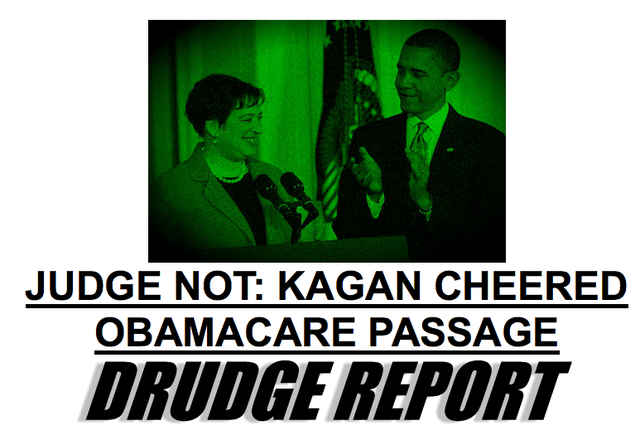
Note to Drudge: Cheering your boss's victories is not unethical. It's not unusual. It is not even meaningful. It's called "smart."

I hadn’t written about the dual efforts to knock Justice Kagan and Justice Thomas off the Supreme Court panel considering the constitutionality of Obamacare’s individual mandate, because it is so obviously politics masquerading as ethics. I also though they would stop soon, since there is no chance either Justice will recuse at this point, and neither should.

The controversy is still occupying newspapers, blogs and talking heads, however, so I suppose it is worth discussing, especially to make this point: what concerns those seeking recusal is that they know, or think they know, how each Justice will vote on the issue, and they want to rig the process by finding a technicality that will prevent one or the other from participating. Does anyone really think that Kagan’s previous work as Solicitor General under Obama will bias her already liberal leanings? No. Does anyone really believe that Clarence Thomas would vote for an interpretation of the Constitution that opens that door for Congress to demand that we buy whatever it tells us to, were he not trying to please his conservative wife? Tell me another. Both recusal arguments are intellectually dishonest attempts to interfere with full judicial consideration of a politically explosive matter. Continue reading

The SAT Cheating Scandal

Over at Curmudgeon Central, Rick Jones appropriately eviscerates the Educational Testing Service for its role—the role being negligent facilitator–in an unfolding scandal involving students cheating on their SATs by having surrogates take their tests. 20 people have been arrested thus far as either the fake test-taker of the fraudulent scholar paying for said test-taker, and Rick’s guess that there must be a hundred times the ETS’s estimate of 150 incidents of cheating on the SATs  is extremely conservative. The problem is that the SATs are taken under incredibly lax  security, and Rick reveals something I never would have suspected: if someone is caught cheating after the SAT service investigates, he or she is given a refund and allowed to take the test again—and no college is ever notified! Rick writes…

“…in a just universe, the cretinous yahoos at the CB/ETS who decided on this policy would lose their jobs, have “unethical moron” branded into their foreheads, and be publicly pilloried. Preferably literally.” Continue reading

The Emma Sullivan Affair: Not Just An Aberration

Time to double-down.

Yes, it's student-hating teacher Natalie Munroe, back again to remind us that the welfare of our children is no longer guranteed to be the #1 priority for your child's teacher, principal or school board member.

Over the weekend, I managed to ignite a controversy with one sentence I included in my discussion of the ridiculous incident which began when high school student Emma Sullivan tweeted that Kansas Governor Sam Brownback “sucks” and ended with her being called on the carpet for it by her principal. Noting that the incident should have been cut short by the school district administrator telling Brownback’s lackey to stop bullying kids, I wrote,

“But the school district administrator had neither the integrity, courage or common sense to do that, which permitted the fiasco to be passed on to the next spineless incompetent, and which also, I submit, tells us all we need to know about why public education in the U.S. is a disgrace.”

“I disagree with your statement and think it is an unfair generalization!” wrote Michael Boyd. Tim LeVier wrote, “…how many public schools are there in the U.S.? How many students are educated (enrolled) by those public schools in the U.S.? How many “social networking” fiascos have there been? Do the positive situations get the same amount of attention as the negative?”

Obviously, I was insufficiently precise, as both Michael and Tim are solid analysts and deft critics here. I was not suggesting that this one incident proves anything about the U.S. public education system. No one incident in a Kansas high school can prove anything about the system as a whole. I was, however, asserting that the deficits of character, warped priorities and lack of common sense displayed by the administrators in this incident are emblematic of the problems of the educational system as a whole. There are too many incompetents in high places, and too often the priorities of the system lie with staying on the right side of the political structure rather than being concerned about the welfare and development of students. To be broader still, my statement indicated that this is the kind of incident that shows why I believe that we can no longer trust the educational establishment, which has “jumped the shark,” “nuked the fridge”, or any other metaphor you  designate to describe when a profession has lost its moorings to professionalism and ethics. Continue reading

A Protest Code of Ethics

I began work on a protest code of ethics a decade ago, periodically putting it aside, then adding to it, subtracting from it, and refining it. I regard the current version as a work in progress still, but the discussion here regarding the “Occupy” movement prompted me to complete this initial final draft, at least. This is the first time it has been published.

It has been a source of continuing amazement to me that there was no such Code had been proposed previously, or none that I could locate. When an activity such as organized protesting, activity that is obviously rich with ethical dangers and the potential for excess, does not have  proposed or established ethical standards of conduct, the reason is usually that nobody wants to be limited by ethical considerations or to be held accountable for misconduct.  I strongly suspect that is the case here. Well, too bad. Now we have proposed standards with which to measure the ethical nature of protests. Whether these 25 principles are the first or the last, or just begin the discussion and inspire something better, is of no import. They open the discussion. It’s time.

The Protest Code of Ethics

A. Guiding principles

All participants in protests and demonstrations should recognize and respect the important role lawful assemblies for the purpose of airing grievances and advocating change and reform have played in the history of the nation and civilization, must strive to uphold the best of that tradition by upholding these ethical principles. A protest without leadership and objectives is only a mob, and a protest without discipline and respect for others is a riot.

B. Public protests
Any protest involving demonstrations or other public conduct… Continue reading

Five Ethics Lessons from Jerome Cardano (“Who?”), and One More

Remember his name?

A chance reference in a book I was perusing yesterday reminded me of a fascinating historical figure whom I hadn’t thought about in decades—which still gives me an edge over most people, who have never thought about him at all. He is Jerome Cardano, or, in the Italian version of his name, Gerolamo Cardano, an archetypical Renaissance man from Italy who walked the earth between 1501 and 1576. When I first learned about him those many years ago, his remarkable life didn’t give me any ethical insights because I wasn’t thinking about ethics then. Now, reviewing the facts of his remarkable life, I find that it carries at least five lessons with value for anyone who strives to live in a more ethical culture, and to have his or her own life contribute to making the world a better place.

Lesson 1 : DiligencePlay the hand you are dealt the best you can.

Cardano’s mother attempted to abort him by taking various poisons, but succeeded only in making him unhealthy. He stuttered; he was incapable of sexual relations, and had chronic insomnia, supposedly resulting in an “annual period” where he got little or no sleep for two to three months. He was afflicted at various times with the plague, cancer, dysentery, and many lesser ailments, yet he led a life full of extraordinary accomplishments and adventures, and continued to be active and breathing for 75 years, when most of his class and era died before they reached 45. Continue reading

Abuse of Government Power+ School Administrator Cowardice = Student Persecution

Enemy of the State.

Emma Sullivan, an 18-year-old high school senior at Fairway, Kansas’s Shawnee Mission East High School,  went with her class on a field trip to the Capitol and heard Gov. Sam Brownback speak. She tweeted her reactions to her Twitter followers, writing, “just made mean comments at gov brownback and told him he sucked, in person #heblowsalot”.

The part about making mean comments to the Governor was a lie, but on a scale of believability and damage done, not an especially momentous one. It was adults who turned this unremarkable student tweet into an ethics train wreck in three neat, unforgivable steps.

1. First, some over-zealous hack on the Brownback’s staff saw the tweet and complained to an administrator in the school district. This is a First Degree Ethics Foul. Nothing in Sullivan’s tweet brings it within his, the governor’s or the government’s legitimate concerns. For the staffer to complain was petty, vindictive and mean-spirited. Every second he spent on his vendetta was a waste of taxpayer dollars. Worst of all, he was bringing the power of the government to bear on a teenager for doing nothing more than expressing her opinion, which is that Governor Brownback sucks. I’m sure there have been foreign dictators who would punish a teen for doing no more than telling friends that she doesn’t like him, but I would have thought that someone who works in one of the United States governments would instinctively know that this kind of bullying mind-control isn’t allowed here. I was wrong. Brownback does suck, at least at picking staff. Continue reading

The Tattoo Artist’s Revenge: Funny! But Wrong.

She wanted something like this to decorate her back, but the artist had something more appropriate in mind….

UPDATE HERE!

It is not unethical to be entertained by the revenge schemes put into action by others, as long as we understand that revenge is unethical in a civilized society. A culture that embraces revenge as a norm will be a violent and unforgiving one. Because the perfect act of vengeance is viscerally indistinguishable from justice, it has the power to make us feel vicariously satisfied, and that should be taken as a warning. Revenge feels good, which is why revenge fantasies have been a popular genre from “The Odyssey” to “Kill Bill”…and also why revenge can easily expand from a guilty pleasure to a bad habit.

This tale of revenge from a trailer park in Dayton, Ohio, for example, makes me want to chuckle and tip my metaphorical hat to the avenger.
Rossie Brovent asked her boyfriend, tattoo artist Ryan L. Fitzjerald, to ink a large and lovely panorama from “The Chronicles of Narnia” on her back. Little did she suspect that Fitzjerald’s insistence that she sign a consent form agreeing to accept his “artistic discretion” was but the first step in a diabolical plan. Rossie also didn’t realize that her boyfriend was on to her secret infidelity: he had just learned that she had been cheating on him with one of his close friends. Continue reading

Post-Thanksgiving Ethics Quiz: Is This Ethical? (Giant Lips Edition)

Jessica also apparently has only one eye…

Look at the bright side: at least she didn’t have octuplets.

Kristina Rei, 22, of St. Petersburg, Russia, wants to look like Jessica Rabbit, so naturally she opted to get herself a pair of hugelips.She has undergone over 100 silicon-injection procedures, and considers it just the initial step in her quest to look like Roger Rabbit’s

Kristin’s hickies are deadly.

Toon wife from “Who Framed Roger Rabbit?”. “When I can afford it I want to enlarge my breasts from a C-cup to a DD, change the shape of my nose and I want to make my ears pointed like an elf,” she told reporters. “It’s good to be different.”

Well, she’s different, all right.

Your Post-Thanksgiving Ethics Quiz: Was it ethical for a plastic surgeon to give her the lips she wanted?

Plastic surgeons are subject to the Hippocratic Oath like other doctors, but in  cases of elective surgery the standards of what constitutes doing substantive harm to a patient are extremely elastic. None of the Codes of Ethics for plastic surgeons would clearly prohibit giving a patient lips that look like they belong on a Macy’s helium balloon, or similar exaggerated features. These lips make Kristina happy. Is she mentally ill? A doctor who suspected so would be wrong to submit to her wishes if they were based on clinically defective judgment, but the fact that a doctor thinks a patient will look like a freak if he does what she wants isn’t ethically dispositive. Continue reading

Ethics Dunces: The Nevada Ethics Commission, Which is Pretty Depressing.

An X-Ray of Caren Jenkin's head, ethics sector

Here at last may be the answer to the riddle of why state ethics commissions have so little effect on the persistent problem of unethical government.

The people who make up the membership of such commissions may not know the first thing about ethics. Take Nevada, for instance:

To celebrate the 35th anniversary of the Nevada Ethics Commission, its executive director, Caren Jenkins, organized a party at a Carson City restaurant.  She invited current and former commissioners and staff, and also the state’s top elected officials, whose conduct is reviewed by the commission, which can fine them substantially or even seek their removal from office and prosecution for violating state ethics laws.
The invitation included a request for $33 to pay for the event.

“It never even crossed my mind that this would be seen as questionable,” said Jenkins. Never crossed her mind. eh? The event has elected officials whom the commission has to objectively oversee socializing with their state-appointed watchdogs. The Ethics Commission chair solicited money from officials who must depend on the commission for discretionary ethics calls. Jenkins has apparently never heard of appearance of impropriety, conflicts of interest, or interference with independent judgment. The Chair of the Nevada Ethics Commission has ethics alarms about as well-maintained as those of Charlie Rangel or Marion Barry. And since none of her fellow members bothered to raise any objections over her plan, their ethics alarms are in similar disrepair.

Unbelievable.

Or all too believable, come to think of it.