A conundrum I have been asked to solve:
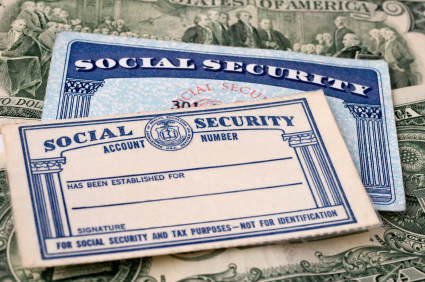 A mother is working to get her foreign adopted child a new copy of his Social Security card, which was lost. The child is a citizen since infancy, and a SS number has been assigned to him, but the process for a naturalized alien to get another is long and fraught with red tape, delays and frustration. So far, replacing the card has taken ten months, though it was supposed to take three. Now the son is waiting for the card to be issued. Social Security says it is waiting for final approval from Immigration, and Immigration says that there is a bottle neck, but not to worry.
Meanwhile, the boy has a standing job offer for a job that he is excited about and that would help family finances considerably. He cannot be processed without a Social Security card, however. And the job will not be held open forever.
For $250, a friend of the mother’s can get a counterfeit Social Security card with the son’s real number on it. He can have it in a week,
Your Question, in the last Ethics Quiz of 2011:
Granted that getting such a fake card is illegal, is it unethical?
None of the agencies involved dispute his citizenship, that he is enrolled in Social Security or that his number is valid. He has a document from Social Security that lists his number. The fake card would not assert anything that wasn’t true, except that he actually had the official card. He would be offering fake proof, but fake proof of something that is undisputed and true.
Is this one of the rare cases when conduct would be both illegal and ethical?
I’ll take your responses and update this with commentary later.
 Ethics Alarms
I say ethical, or at least justifiable. Sometimes the government, especially Immigration, is SO inattentive to human issues that it’s OK to take unilateral action. Social Security is usually pretty good, but Immigration has always had a terrible reputation. My ambition–my dream–when I worked at the WH was to be Immigration Commissioner and fix things.
The only ethical red flag that I can see in this situation is that paying the $250 presumably supports an illicit business. It seems unlikely that the friend’s knowledge of how to go about obtaining counterfeit documents is mere trivia. Nevertheless, that concern speaks to the ethical problems with counterfeiting in general, but not in this particular case. The possibility of material support for unethical behavior doesn’t strike me as sufficient grounds for avoidance of payment for something that is not in itself unethical. If it was, it could bar us from dealing with most anyone, since any money we spend could be put towards unethical means. That is up to the recipient.
The mother in this case would not be paying for anything that is unethical in itself. I expect everyone can agree that the illegality of counterfeiting is intended to protect against false representations of capital, status, etc.. It is an anomaly when counterfeiting would result in an indisputably true representation of the same, and it is an instance where the application of the law might conflict with simple common sense.
It is illegal AND unethical.
To obtain the card in this manner – even if the card bore the correct numbers, and his contributions to the Social Security Trust Fund (yeah, yeah, I know) were properly made in his name – requires engaging the services of someone who is knowingly breaking the law and charging a large fee for doing so. Obtaining the card in this manner is providing support for criminal activity (and I’d reckon this individual doesn’t do business exclusively with people who got hung up in the system..
Jack,I want to say go for the fake. No,I don’t think it’s unethical. He has the card coming,it’s not his fault he doesn’t have it,and the government is behaving unethically,not him.
Now we can see where competence and efficiency are a necessity if we don’t want corruption. We have people who have done everything right, but are being driven to buy a fake ID because of the incompetence and inefficiency of the government. This is the 21st century. All it takes is a quick check of the records to make sure they are who they say they are and a replacement card should be issued in days. Jobs are hard to come by and that simple, cheap piece of cardboard is required for a job. It is not in society’s best interest for people to be unemployed because of pointless red tape. The letter from Social Security listing his number and asserting that it is valid should obviously be an acceptable substitute for the card (the whole point of the card is to list the valid SSN), but common sense and government regulations don’t normally overlap in Ven diagrams.
Unethical: U.S. Government
Less Unethical: People driven to deal with counterfeiters to replace valid certificate due to government idiocy.
To answer: illegal but ethical. Just two words:
ROSA PARKS.
A family is being stepped on by the very government who’s laws, rules, and procedures they have worked hard to conform to and, in becoming citizens, sworn to uphold. This is a no-brainer, for me. The government has forgotten who it works for, here. We fought a revolution based on the premise that if the government won’t provide just governance for it’s people, those people have the right to go their own way. This case would be a much smaller act of rebellion, but it would still be a just one. Get the card, use it, and save it after the official one finally arrives, in case the official one is lost again.
Oops! Only the son became a citizen, the rest of the family having been born into that status. A small error of fact, and I apologize for it. The principle remains the same, however, and I stand by my original conclusion.
“A conundrum I have been asked to solve”
Easy solution/trick question – you don’t need a Social Security Card as a prerequisite for employment. Just review the government’s list of acceptable documents from the I9 form (http://www.uscis.gov/files/form/i-9.pdf)
Trick answer: if the employer insists on a Social Security card, you need it.
Not so fast. The very top line of the I9 reads as follows (not my emphasis):
“ANTI-DISCRIMINATION NOTICE: It is illegal to discriminate against work-authorized individuals. Employers CANNOT specify which document(s) they will accept from an employee.”
If you’ve done any amount of hiring and/or followed employment law it is pretty clear about this.
oops. jack, that should have been in reply to you
It was.
But the fact that the government gives you recourse still won’t save a job that the employer says you haven’t qualified for. You wave a law in their face, and you may get hired, but you’re doomed. It’s like whistleblowing—you can make them keep you around, but you are a dead man walking. The law can’t really solve the problem of human relations…and what kid wants his first job to start out with a legal dispute?
“…and what kid wants his first job to start out with a legal dispute?”
That’s exactly what you’re proposing with this hypothetical scenario. So considering this is a quiz (which probably means you have the “right” answer) it would have to follow that you believe it is both illegal and unethical.
But I disagree, I find it neither illegal nor unethical–especially in the case when the employer is violating employment law to begin with. I am not advocating that “two wrongs make a right.” Heck, skip the $250 and make one yourself. If the employer truly doubts the authenticity of the card then he can use the free Social Security Number Verification Service (SSNVS) an online tool created by the SSA to confirm eligibility.
If this employer is so hyper-focused on a SS card then it doesn’t sound like it would be a good work situation either.
No, my comment simply means that calling the law on a potential employer is impractical, not unethical. The legality of a forged document isn’t in question: it’s illegal no matter how you cut it.
A forged document is illegal? If I photocopy important documents to have backup copies in my possession in case the originals are lost. Are those considered forged?
Merriam-Webster says: “to make or imitate falsely especially with the intent to defraud.”
In the case of the lost SS card, it will not be imitated falsely (as in someone else’s signature) nor will the SS numbers be altered (intent to defraud). A facsimile will be generated that has an accurate SS number and valid signature. I think it only fulfills this antiquated requirement to furnish a card because the employer demands it. Even the SSA’s website says that the designs have changed 30 times since 1936 making it “difficult to recognize a valid card.” Hence, my recommendation to just use the online tool for immediate verification.
The government goes so far in the I9 as removing liability from the employer with the clause “they appear to be genuine.” I can’t even foresee how this situation could ever be flagged by a governmental agency. Thus, I don’t think it violates any laws.
But Gregory, isn’t the person here intending to defraud the employer? It is at minimum dishonest when we falsely present a fake government document in return for a job, especially when we are unfairly depriving other applicants who meet all the requirements for the position without a fraudulent representation.
You would not photocopy your driver’s license and present it to an officer of the law and claim it was the original license, would you? Of course not. You would represent it for what it was — a photocopy. You could have a notary certify that it is, in fact, a true copy, but that doesn’t make it an original.
The employer has asked for an original government document, and in fact, the subject can’t even provide a certified true copy. So of course, such a fake document would be a fraud, regardless of the truth of its representation.
Glenn, none of the other applicants are being unfairly deprived. The point I made in my original comment to this post was that an employer cannot stipulate which documents a candidate provides. That is black and white and follows anti-discrimination law. But Jack won’t let me argue that–calls it whistleblowing and something not advisable for an 18-year-old to due.
The employer never asked for an “original government document.” It may be implied but the law does not burden employers with inspecting and verifying the absolute legitimacy of said docs. In the case of SS#s they provide an online resource that can quickly bring closure to this matter and verify the name/# match.
I think that this employer is of far more concern than the issue that Jack originally raised. He is ignorant of the law regarding proper hiring practices. Who is to say that once the kid gets the job that he will be paid for all the hours worked or receive proper breaks? It opens a door to further abuse.
Gregory, I understand your argument, but you aren’t playing the game fairly. Jack has set up an example of an ethical dilemma, and you refuse to accept it because, in the real world, it would run afoul of the law. It also lacks common sense, in the real world.
This is not a test to see if we understand employment law, it is an attempt to provide an ethical dilemma to see how people resolve it.
Why don’t you just address the exercise as it’s intended? If this were about the employer, of course he would be a problem. Your point is well made. But it isn’t about that, it’s about the ethical dilemma faced by the boy.
Not to be difficult, but there are a number of documents that the US Department of Homeland Security has determined are qualified to “Establish Employment Authorization”. The Social Security card is listed as the #1 document, but also accepted are:
— Certification of Birth Abroad issued by the Department of State
— Certification of Report of Birth issued by the Department of State
— Original or certified copy of birth certificate issued by a State, county, municipal authority, or territory of the US bearing an official seal
— Native American tribal document
— US Citizen ID card
— Identification Card for Use of Resident Citizen in the US
— Employment authorization document issued by the DHS.
Of course, using the following negates the need for any other documentation:
— US Passport or US Passport Card
— Permanent Resident Card or Alien Registration Receipt Card
— Foreign passport that contains a temporary I-551 stamp or temporary I-551 printed notation on a machine-readable immigrant visa
— Employment Authorization Document that contains a photograph
— Foreign passport wtih Form I-94 or Form I-94A bearing the same name as the passport and containing an endorsement of the alient’s nonimmigrant status, as long as the period of endorsement has not yet expired and the proposed employment is not in conflict with any restrictions or limitations identified on the form.
— Passport from the Federated States of Micronesia (FSM) or the Republic of the Marshall Islands (RMI) with Form I-94 or Form I-94A indicating nonimmigrant admission under the Compact of Free Association Between the United States and FSM or RMI.
Also, as a recruiter I have been instructed that I am not permitted to require any one type of identification. So while it’s an interesting ethics question, it should be a moot one, if the hiring organization is operating per legal guidelines.
In the real world, though, it’s not moot. Let’s say the reason the job is being offered to you is because the owner knows you and likes you. But he had a hassle with the IRS that stemmed from a missing Social Security number, and isn’t taking any chances. So he insists on the Social Security card. You’re 18…do you argue with him? Tell him he’s breaking the law? Report him? Or just decide to somehow get what he wants?
If he liked him and wanted to hire him and he can do that within the law yet without the card… he would hire him. It seems an unlikely scenario behind the problem. To me, it seems more likely he doesn’t want to hire him and just told someone he did. Sounds more like an excuse to me. But… employer motivation aside, if I am the kid, I am moving on to another employer. If my first experience with this new employer is that he clearly thinks he can make up his own, discriminatory rules (knowing a new employee is not going to push that legally) then I would think it is very likely this employer has lots of other “rules” outside the law. I would wonder what the next compromise I would have to make would be… and how soon I would be required to make it.
A very difficult challenge, at least to me.
The first casualty is honor. The fake card is a lie. It depicts the truth, but it is a facsimile of the truth represented as the original, and therefore altogether dishonest.
The second casualty is fairness. Is it fair for this person to get a job for which others are presumably also qualified by falsifying a document that the employer has required of you as a condition of employment? I can’t see how.
With that said, this is of course an ethical dilemma, which, by it’s nature, requires one to consider sacrificing ethical principles, perhaps justifiably. A powerful non-ethical consideration, his families finances, as well as his desire to contribute to the family well-being, are driving the dilemma. The only question to be answered, it seems to me, is “Is it worth being dishonest, and unfair, in order to better provide for my family?”
I think the key here is the question, “What happens if I don’t do this?” Does the family starve, or do they merely do with less than the ideal? From the narrative, this is unclear, other than to say that the job would “help the family finances considerably.”
Based on the provided information, it is my judgment that buying the fake card would be unethical. There would be other jobs after he gets his card, perhaps not a lucrative but which won’t require injury to his honor, his family’s honor, and implicit unfairness to other qualified applicants.
You’ve established pretty articulately that the ethical thing to do just sucks sometimes. I would say that the ethically correct, or at least ethically heroic, thing to do is to follow the law, accept consequences you don’t deserve, and hope for the best. (I can’t fault the kid if he doesn’t, and I can’t promise you I’d hold the same position as anything other than a detached observer.)
It strikes me that sometimes—not always, but sometimes—ethics is on a continuum. There’s the truly ethical, the not unethical, and the unethical, with many finer distinctions to be made.
I don’t running screaming into the night at the idea of faking a card, under the circumstances. Still, the truly ethical thing to do in this situation is to tell the prospective employer the truth. And the availability of all those other possible means of identification is indeed relevant. Provide one of the non-Social Security card alternatives and whatever other documentation is available. Importantly, if the employer, for whatever reason, is unwilling to accept this legally sufficient documentation, you don’t want to work for this person, no matter how much you need a job.
The details here are different, but I give this kind of advice all the time to students looking for jobs, internships, or grad school admission. If someone in a “hiring” position, either literally or in the sense of admitting you into a competitive program, won’t work with you a little, you really don’t want to be there. Actual examples (in the second and third examples, the dates are made up; their relationships to each other are not):
• a grad school (in theatre) said they accepted only students with 3.8 GPAs. My student had a 3.798 because she got a B in Calculus IV (not exactly standard theatre major fare!) senior spring when she was also directing one production and costuming designing another.
• an internship required a complete application packet by February 1. My student submitted her application on time, and had two of the required three reference letters. One of her references (the most relevant one for the position), however, had complications from childbirth and wasn’t out of the hospital until the 3rd.
• a summer stock company started on May 15 with a company picnic (nothing else, just the picnic). My student graduated the day before (and his parents really expected him to walk), and he needed the 15th as a travel day. He’d be ready to go when the real work started on the 16th.
In all of these examples, my student got a good position… two of them at the place in question, one not. I have, of course, no idea whether the student in question might otherwise have been hired or accepted at the other place. But a colleague at a conference regaled me with horror stories a couple of years later about the horrible experiences of one of his former students who had gone to the place in question.
What I’m saying, I guess, is that whereas it’s often easy to see the negative relationship between the ethical and the practical, there’s often a positive connection we don’t think about. The most ethical thing to do is to tell the truth; then it’s on the employer to act ethically. If he doesn’t, then perhaps that job wasn’t such a godsend, after all.
This commentary is relevant, of course, only in the specific circumstances you describe. If the Social Security card really were a sine qua non, the ethics wouldn’t change, but the pragmatics might legitimately mitigate a minor ethical lapse borne out of frustration and desperation.
(Just noticed that Danielle had said pretty much the same thing. I’m with her.)
Is this about Obama’s birth certificate?
Illegal and unethical and everyone of you missed the obvious solution that prevented the illegal and unethical practice in the first place.
“He has a document from Social Security that lists his number”. this document serves as a valid SSN until his documents arrive. I have had several employees who lost a card and when they applied for the replacement the form that they are given at application grants temporary authority until the card is received.