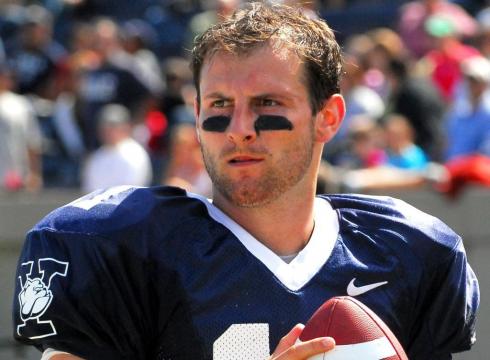
Patrick Witt, rapist. Well, accused rapist. OK, he was accused of something that might have been rape.All right, all right, we can't say what he is accused of or did, but he must be a bad guy, or we wouldn't be publishing this story about what some people say he did. Because the public has a right to know. Thank god for Freedom of the Press!
The jaw-dropping Patrick Witt story in Friday’s New York Times was heavy on my mind when I wrote yesterday’s post about the collapse of the news media’s ethical standards. I decided that it needed its own spotlight. When I read the piece about Yale’s former quarterback, what kept going through my mind was, “What does the Times think it’s doing?” I still can’t figure it out.
Reporter Richard Perez-Pena uses an anonymous complaint of sexual assault levied against Witt as justification for raising questions about a young man’s integrity and character and to undermine his reputation with innuendo, speculation and rumor. The article would be outrageous if it was written about a public figure. Publishing such a cruel and unfair attack on a relatively obscure student athlete defies all reason. Obviously, it is also bottom of the barrel journalism…from America’s premier newspaper.
Washington Post columnist Kathleen Parker summarized the deficiencies of the Times story in her op-ed column, writing:
“A New York Times story on Friday that essentially indicted and convicted a 22-year-old star football player on an alleged sexual assault charge by an anonymous accuser should have begun as follows: “We know absolutely nothing about this rumor except what six people told us anonymously about this guy who they say sexually assaulted this girl. We don’t know who she is or what she said, or really anything, but here’s HIS name and what ‘they’ say about him.”
She’s not exaggerating. There are no named sources, no details, not even an explanation of what the accuser meant by “sexual assault.” The Times is deliberately creating the impression that this young man is a rapist, though there hasn’t been a charge, a trial, or even an investigation. Yale will not confirm the existence of a complaint; there is no valid basis to conclude that it is genuine or has merit. Nonetheless, the Times reporter uses the alleged, unknown complaint as a wedge to explore every past incident in which Witt misbehaved, though none of these would have been independently newsworthy. I think, though I am still unsure, that the reporter’s point is that Witt’s endorsement by Yale as a Rhodes Scholar candidate was undeserved, and that perhaps strings were pulled for the team’s star quarterback. Now there’s a scoop. The wisdom of individual Rhodes Scholar choices is now newsworthy? This is so significant that it justifies the destruction of a young man’s reputation without named sources or facts? What janitor in the Times offices greenlighted this story? What kind of journalism standard permits something like this to see the light of day? What about fairness, responsibility and due process?
“This account of the accusation against Witt and how it affected his Rhodes candidacy is based on interviews with a half-dozen people with knowledge of all or part of the story; they all spoke on the condition of anonymity because they were discussing matters that the institutions treat as confidential,” Perez-Pena writes. Institutions treat such matters as confidential because that’s only fair. Any anonymous sources violating that confidentiality are presumptively up to no good. Why is the New York Times serving as their ally to foil reasonable privacy protections installed by Yale? Why does it consider it responsible journalism to undermine school policy? “Yale refused to confirm or deny the existence of the complaint,” he writes. Then there is no story, is there? At least, there is no story until we know that the invisible sources aren’t homeless people, Occupy New Haven trouble-makers, lunatics or the vengeful Yale second-string quarterback.
“Many aspects of the situation remain unknown, including some details of the allegation against Witt; how he responded; how it was resolved; and whether Yale officials who handle Rhodes applications — including Richard C. Levin, the university’s president, who signed Witt’s endorsement letter — knew of the complaint,” the reporter continues. Also unknown, he might have added, is why this was written at all…unless the objective is to smear Witt. Consider this:
“In September, according to people with knowledge of the situation, a female student went to Yale’s Sexual Assault Harassment and Response and Education Center, claiming Witt had assaulted her in her dormitory room. The woman later made a complaint to the University-Wide Committee on Sexual Misconduct, created last July as part of Yale’s new approach.
“Like many colleges and universities, Yale offers accusers a choice between making a formal complaint and an informal one. This student chose the informal process. In that process, an individual or a few members of the committee are charged with resolving the issue, without a full investigation or a finding of guilt or innocence. The most significant outcome might be an agreement to move the accused to a different dorm.
“Connecticut law does not require colleges to report suspected sex offenses, and experts say the vast majority of campus sexual assaults are not reported, either to college authorities or to the police.
“The Rhodes scholarship, perhaps the highest prize for young American scholars, finances postgraduate study at Oxford University for 32 students a year who, in the words of the Rhodes Trust, embody “excellence in qualities of mind and qualities of person.”
Do you see the tricky progression? A student made an informal complaint, about which we know nothing. Well, I guess there’s no more to..What’s that? The college doesn’t have to report suspected sex offenses—OH! I get it now!…he must have been accused of a sex offense! And the Rhodes scholarship is awarded…wait, that doesn’t seem to have anything to do with…OH! Right! It is awarded based on good character, and Witt obviously doesn’t have that, being informally charged but clearly guilty, based on what these people we don’t know say, of a heinous sex offense of some kind that Yale doesn’t have to report but that must prove this kid is a bad apple and should never have been up for a Rhodes anyway….or else why would the best newspaper in America, an award-winning publication which we trust and revere, be printing it?
What?
I don’t care if Witt is the reincarnation of Jack the Ripper. The New York Times had no story here, and its inexplicable attack on Patrick Witt without having anything concrete that it could reveal to justify it shows the press abusing its rights and power to a shocking degree.
“All the news that’s fit to print.”
Ah, those were the days.
 Ethics Alarms
“What janitor in the Times offices greenlighted this story? ”
This is really unfair of you, Jack. What did the NYT custodial staff ever do to deserve this?
There’s a back-story on that line. My favorite comic novel is Philip Roth’s riff on baseball lore, the Red Scare, and America, “the Great American Novel.” (if you haven’t read it, do. It makes me laugh out loud every time.) In the book, a hapless major league baseball team is constantly weakened by ridiculous trades, and the players joke that the office janitor is responsible. Later, it turns out that in fact he IS the one making the trades.
I had high hopes, in the wake of the incident involving the Duke lacrosse team, that the media would have learned a few salutary lessons about how restraint and confirmation should precede actually going with a story, but alas….
That’s the first analogy that crossed my mind, Karl. Unsurprisingly! Those young men at Duke will bear the scars of that year long ordeal of trial-by-media for the rest of their lives. At least, in this case, a racial element (and, thus, the inevitable presence of Reverend Al Sharpton) is absent. But that’s not much of a consolation for this young man. This sort of accusation, no matter how vague and when forwarded by the “reputable” NYT, is alone a reputation killer.
Now… where is the State Attorney General to intervene and put the wheels of justice back on track? Probably where Roy Cooper of North Carolina always was when cases like Duke LaCrosse and the making of the child pornographic movie “Hounddog” erupted on his extended watch. Not available. It’s inexpedient to an AG’s career to get involved in tricky cases unless it makes waves large enough to rock his office. It works, too. He’s STILL in office.
Patrick Witt needs to start making those waves. Otherwise, he’ll be raked over the coals for as long as the Times think they can sell papers on the weight of their likely manufactured scandal. If he doesn’t, he runs the real risk of incurring public suspicion that the oft repeated allegations have validity.
In some ways, this is worse than the Duke episode. At least in that case there was a criminal complaint, and a prosecutor, however wrongly, going forward.
I’d point out that Mike Nifong’s case against the Duke lacrosse players- while (to give him the barest benefit of a doubt) it might have began with a reasonable suspicion- extended itself only because it acquired political momentum. Nifong wound up with a tiger by the tail and was too inept and corrupt to do the right th8ing and let go. When it had long since passed the point of absurdity and public condemnation- only then did Roy Cooper step in… and only THEN because the heat was being felt in his own office. By then, it was also necessary to throw Nifong to the dogs; not just for his own failings, but to protect Cooper.
Similarly, during the “Hounddog” fiasco, Cooper hunkered down and let the two responsible DA’s handle the public outrage. This time, it was not only to protect himself, but Governor Easley’s administration- because Easley had personal and political ties to Screen Gems Studios in Wilmington, where the film had been made. Again and again in such cases as those, common justice has been set aside by legal authorities- sworn to uphold justice first and foremost- for the sake of political viability.
It’s not just North Carolina or the Great Northeast, either. It’s not even just Democrats! I’ve still got a big bone to pick with Utah’s then and current AG- Republican Mark Shurtleff- who compounded and exceeded Cooper’s crime over the “Hounddog” affair at Sundance 2007.
I’m not sure I’d defend the story, but I am sure that your description of it isn’t fair, Jack.
The theme of the story is clearly that this athlete managed to give the impression — in national media, including a glowing puff piece about him on NBC nightly news — that he had nobly chosen loyalty to his team over a valuable Rhodes scholarship. Witt himself clearly emphasized that picture in interviews:
So a sports star who has been lionized in national news because he nobly gave up a likely chance at a big scholarship out of loyalty to his team, seemingly actually gave up the scholarship because of a sexual assault accusation scuttling his chances. And by the way, this is the same scholarship that his coach ALSO famously lied about having given up nobly.
That’s a sensational story, concerning someone who used nationwide news media to give the public a false impression, for his own benefit. How is that not news?
One big question is why do we allow anonymous complaints in the first place? Should not the accuser’s public information be published, if the accused’s public information is published?
After what happened regarding Grant Snowden, Gerald Amiraut, Duke University, and Timothy Cole, all rape and sex abuse accusers should be publicly identified, with photographs.
Michael, that would lead to actual rape victims being afraid to report their rape to the police because they don’t want their face and names in the paper.
In my ideal society, neither accusers nor defendants would have their names or faces involuntarily publicized under ordinary circumstances. (Although either one should be allowed to go public if they choose to.)
That will reduce the odds of something happening similar to what happened concerning Grant Snowden, Gerald Amirault, Timothy Cole, and Duke University.
I agree.
Only in extremely rare circumstances, and with plenty of documented proof – with editors knowing who the source is and why they need to remain anonymous – should anonymous sources be used in a story. The fact that this one has several, and there is no documented evidence. The NYT is a disgrace for running the story.
Jackk, you are right on target here. I am appalled that the Times would make a story out of this when no criminal charges were filed, and when the Times does not know exactly what the complaint was or how it was resolved.