If someone sends you an obnoxious, arrogant, idiotic or otherwise embarrassing e-mail, the ethical thing to do is to tell the individual what’s wrong with it, and perhaps save them from future embarrassment. The principle is simple: The Golden Rule. When you send a private message to someone and pour out your heart, empty your skull, vent your spleen, or otherwise express things you probably should have slept on and moderated in the clear light of day, you don’t want your correspondent to use the internet as a weapon against you and introduce you to millions at your worst. It is a terrible, cruel, indefensible thing to do…to anyone.
In 2010, I wrote about an incident at Harvard University Law School, in which a student’s e-mail to a supposed friend expressing a willingness to accept the possibility that there were genetic differences in intelligence among the races was maliciously forwarded to other students, resulting in the author of the e-mail becoming a campus pariah and unfairly branded a racist. I wrote at the time:
“The ethical issue is the same with all examples of embarrassing e-mails (and sometimes voice mail messages) broadcast to the world in malicious efforts to embarrass and damage the reputation of a careless or impolitic writer. Sometimes it has been a graceless e-mail break-up note; sometimes a stupidly worded admission of dishonesty; sometimes a political opinion. But in all these situations self-righteous avengers decide to do to someone else what they would never want done to them: have strangers “meet” the writer and form negative opinions about him or her based on unguarded comments intended to be read by only a trusted few.”
It doesn’t matter how bad, silly or dumb the content of the e-mail is. There can be no justification for betraying any individual’s trust in this way. “People do it all the time”? The Golden Rationalization. “They deserve it”? Who says they deserve it? If someone embarrasses himself with one person, he deserves to be embarrassed to that one, not before a million strangers. “That’s the way the internet is”? No, that’s the way some of the more despicable people who use the internet are. Don’t be one of them.
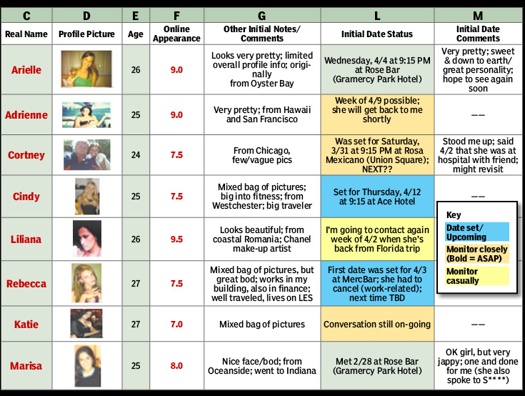
This brings us to the victim of the latest Internet Avenger, an investment banker, 28, named David Murker. His comprehension of romantic relationships would fit right into a mediocre Farrelly Brothers comedy, for he ranks and compares his dates on an Excel spreadsheet (above), and worse, has no idea how inherently distasteful this is, or what it says about his maturity level. The spreadsheet isn’t obscene; he doesn’t compare bra sizes or discuss sexual habits. It just marks him as a cross between Eddie Haskell and the Nutty Professor. And a caring, sensible, ethical woman who discovered his dumb record-keeping should be able to explain to him just what’s wrong with it.
Unfortunately, Murkur’s bad taste extends to his judgment of character. He met a lovely young woman named Arielle, and after their initial date —Murkur described her in his spreadsheet as “very pretty, sweet & down to earth” with a “great personality”—he decided to demonstrate his trust and fondness for her by sending Arielle his spreadsheet. She, in turn, sent it to a list of her friends, who in turn sent it on its viral way.
It was an act of betrayal and gratuitous cruelty. Murkur may be a dork, but his silly spreadsheet wasn’t hurting anyone but his own emotional development. Arielle, however—I wish I knew her last name, because she is a menace—not only set out to hurt someone, but someone who liked and trusted her.
Publishing private communications of any kind without the permission of the author is unethical, unless it is done to prevent a crime. Somehow, some way, we have to discover how to trust each other. Vile and mean-spirited people like Arielle, often disguised in attractive faces and bodies, make that even more difficult than it already is.
 Ethics Alarms
You would be surprised on how many men do this.
I had a good friend who basically did the same thing 15 years ago. He was single and wanted to find someone who he could eventually marry. He , with the advice and assistance of his best friend who had less knowledge of women and relationships then my friend did, devised a rating system that my friend kep on 3 x 5 cards. When I was told about it I advised my friend to stop doing it, that his best friend who suggested it was an idiot who married the first woman who slept with him and while the system may help him find a wife if she ever found out about it it would help him lose her also.
Perfect. The right think to do, and what I would want someone to do for me.Of course, I never had enough encounters with women to MAKE a spreadsheet…
Great commentary, Jack. I have seen this done so many times, and always cringed at the complete failure of the person’s ethics who did the forwarding.
We know it’s wrong to do that. We wouldn’t want anyone to forward our email faux pas to the world. Why don’t we just listen to ourselves?
Publishing private communications of any kind without the permission of the author is unethical, unless it is done to prevent a crime.
I’d throw some more caveats in there. Private communications that go directly to the character/trustworthiness of politicians or that expose misinformation/bad faith can be ethically exposed.
you don’t want your correspondent to use the internet as a weapon against you and introduce you to millions at your worst. It is a terrible, cruel, indefensible thing to do…to anyone.
Jack, isn’t this exactly what Gregory did to Guillen when he misrepresented his quote and hid most of it behind the Time.com paywall?
Well, no—because when you talk to a reporter, you know what you say isn’t private. And Ozzie is hardly a naif at dealing with the press–he knows how it works.
You seem to think “I love Fidel Castro!” would have played differently in Little Cuba had Ozzie’s whole context been immediately apparent. I doubt it.
So, if Jack is talking to a reporter he has no expectations that he’ll be quoted accurately? Because, I can image that you would pen a rather verbose response calling out a journalist for his unethical actions.
I think it absolutely would have played out differently if it had been presented to readers as he said it. This journalist reworked it to demonstrate how it would appear as it should have. Let people form their own opinions. But hand selecting those few words as the story lead-in fall under the adjectives that you used in this post: terrible, cruel, and indefensible. It’s wrong. Whether between private citizens or if done by journalists. Period.
“So, if Jack is talking to a reporter he has no expectations that he’ll be quoted accurately?” Absolutely!!! In particular, I have no idea which part of an interview will be used. In 1977 I was interviewed by the Washington Post about Strat-O-Matic baseball. I was an attorney and an an administrator at a law school. I spoke to the reporter for over an hour about baseball history and the game, and the statistical appeal of the board game simulation. The sole quote used, with my title? “The game is really neat!” Made me sound like I was 8.
If I am talking to a reporter, I make sure I say nothing that can misrepresent my views if it is taken out of context. If I do, it’s my own fault. Reporters are untrustworthy; it’s a given. If you talk to them, and your image or company is at stake, it is your obligation to give them nothing to distort. If you can’t do that, don’t do the interview. They aren’t friends. They are perfectly happy to make you look terrible if it helps the story.
Wow, you’ve had an infatuation with baseball for a long time! But honestly, with a name like Strat-O-Matic I think neat is an appropriate adjective. They had their own marketing problems to overcome–namely a stupid name. Ironically, your interview came on the heels of this timeless classic.
But if it is a given that reporters are untrustworthy I don’t think they deserve a get out of jail free card on an ethics blog. Because what happened in the Guillen case is that the journalist played to readers’ emotions knowing full well what he was doing and created a heightened state of awareness that wasn’t valid.
It’ going to take awhile before most folks learn that there is NO privacy in our Brave New (electronic) World. Even before the advent of the I-Net and social networking, my maternal grandfather (1850-1930), a pretty good lawyer, had this bit of wisdom for his four daughters (including my mother, who passed it on to me):
“Never put anything in writing that you would not want to see posted in the town square.”
Well, sure—and don’t put your dates into spreadsheets, and if you do, don’t show it to a date. That doesn’t excuse the betrayal.
No, it certainly does NOT excuse the betrayal. On the other hand, has one a “reasonable expectation of privacy” on today’s electronic media? I like that thing in the Judaeo-Christian scriptures that advises to be “…as wise as serpents, as innocent as doves…” (I’m not a student of their book, so I may not have that exact.).
One should not leave the keys in the ignition and the car unlocked, and then be very surprised when the vehicle disappears.
The internet is dangerous, which is all the more reason for us to look out for each other, not make it more perilous by tolerating treachery.