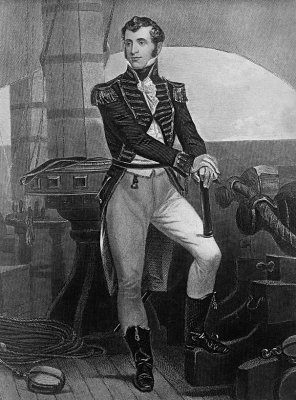
Stephen Decatur
I admit that I am often ambushed by the hypocrisy of both political parties and their followers. The ability of both conservatives and progressives to completely reverse positions and advocate exactly what they had passionately opposed mere months, weeks, or even minutes before is breathtaking, and I never seem ready for it. For example, after the Democrats had tried to pin the shooting of Rep. Giffords on the harsh rhetoric of Sarah Palin, Rush Limbaugh and others in the conservative camp, I really wasn’t ready for them to ratchet up the metaphorically violent metaphors themselves within a few weeks, but they did. Similarly, after conservatives had mocked and condemned the discouraged liberals who had fled the U.S. in dismay after George W. Bush was re-elected, I was unprepared for the unseemly applause emanating from the Right when Facebook co-founder Eduardo Saverin decided to become an ex-American to save mega-millions on his tax bill.
Lock-step ideology is damaging enough, but lock-step ideology without consistent values, principles and priorities is dangerous, and that, I fear, is what we have on both ends of the political spectrum in America today.
Stephen Decatur (1779-1820) was a genuine American hero, once featured in grade school history lessons but now, like so many others, the victim of cultural oblivion. One of the greatest naval commanders in U.S. history, Decatur had his meteoric career was cut short by a duel, and as his exploits on the waves have faded from memory, the one feature of his remarkable life that is best remembered is his legendary toast, made in April 1816, that became an iconic, if often misunderstood, expression of American patriotism:
“Our Country! In her intercourse with foreign nations may she always be in the right; but our country, right or wrong.”
Decatur was not, as is often claimed, espousing mindless dedication to whatever course this nation embarks upon, but rather that America’s missteps and poor choices never relieve a citizen of the obligation to be loyal to the United States and to continue to strive to serve the best interests of the country, its mission and its public. It means, at very least, sticking around, enduring policies that are personally objectionable or disadvantageous and working within the system to change them. Carl Schurz, a Civil War general, U.S. Senator and social reformer, understood, and clarified Decatur’s sentiment when he said, “My country, right or wrong; if right, to be kept right; and if wrong, to be set right.”
I wrote about this after the 2004 election, when an unusual number of Bush-hating Democrats abandoned the U.S. for Canada after the votes didn’t go their way, saying in part...
“Democracy is based on belief in the wisdom of the people when those people constitute an informed electorate. Interestingly, recent research has begun to show that such a belief is based on more than ideological optimism. In James Surowiecki’s fascinating book, “The Wisdom of Crowds,” the author describes many case studies that strongly suggest that large groups are often capable of making better decisions than any one member of the group alone. Why? The primary reason seems to be that when each member of a group views a choice or a problem from a slightly different perspective, the cumulative effect of their judgements, though each by itself may be inadequate or flawed, is deep and perceptive. That conclusion is consistent with the history of democracy in this country, which in two centuries of being guided by majority vote has reached levels of achievement that no other system has matched.
“But democracy requires that each citizen taking part in the process believe in and respect it.…This is critical to the strength of our institutions, as America always must balance its celebration of individualism with its recognition that even the most independent among us must make concessions to the welfare of the community… just as your political opponents take part in an election agreeing to abide by the wisdom of the majority, so must you. To expect them to abide by your will if it prevails while being unwilling to reciprocate in kind is both unfair and dishonest, and is evidence of an unwillingness to commit to democracy as either a concept or as a governing tool. Now, after absorbing all of America’s benefits in relative safety, we have come to a time when we each need to take a more active part in the support of American principles…We owe our country that much, and more.”
This was true of the sore-loser Democrats who lit out for Toronto, and it is true of the tax-dodging, Singapore-bound Facebook tycoon. I have heard sneering conservative radio hosts braying that Saverin is reacting reasonably to the confiscatory tax policies of the Obama Administration, and read Right wing pundits making the same claim. Their attitude undermines the social contract that binds America together, and their solidarity with the greedy millionaire shows that all of their supposed fealty to the Constitution and the Declaration of Independence is a self-serving sham.
Real Americans stick around, and real Americans don’t advocate abandoning ship the second they don’t agree with the charted course. Stephen Decatur knew all about not abandoning ships, having won sea battles in some that were flaming wrecks. He also knew that for real Americans, it is our country, and when and if the United States is wrong, it is our duty, all of ours, to try to change the course.
_________________________________________
Graphic: Padre Steve’s World
Ethics Alarms attempts to give proper attribution and credit to all sources of facts, analysis and other assistance that go into its blog posts. If you are aware of one I missed, or believe your own work was used in any way without proper attribution, please contact me, Jack Marshall, at jamproethics@verizon.net.
 Ethics Alarms
I could not disagree with your conclusion more though I agree with most of your logic leading up to it. However, when more than one half of the electorate live as parasites off of the minority then there is little left to do other than what this gentlemen says he is going to do. He owes no absolute fealty to a nation that has abandoned the founding principals and is on it’s way to the status of a third world country because of the elites that believe they know better than the ‘crowd’ you speak of. If 50 plus per cent are being bribed to vote against the best interests of the crowed how can that every be called a better way to make decisions.
If any of us had the courage of Jefferson or Paine or any of those that pledged their lives, their fortunes and their sacred honor then we would like be taking up arms against the current political classes.
He is the only one abandoning anything. May his children enjoy being caned.
Well, frankly his children will be better of being caned than being cowed by an out of control central government that is bound and determined to make tax slaves out of all productive people.
Hysteria.
You are not making enough money yet to be targeted. It is not hysteria when you have worked hard all your life and come from very modest means and then have the government take it. You are mistaken if you think the amount you have determines whether or not it can be taken by force from you. That is unethical whether you make $10,000.00 or $1,000,000,000,000.00. If the rate were the same for everyone that would be ethical if there were no loopholes and deductions. As it is we are being conned by the people we elect who have used money taken from us by force and then used to buy votes and reward their friends.
By the way calling someone hysterical is both sexist and in my view a typical liberal tactic.
They have taxes in Singapore too. Governments have to pay their expenditures somehow.
I am not talking about whether or not governments have to pay for things but rather what they are spending money on, who they are spending money, why they are spending money, how much money they are spending, and finally and most importantly who is paying and how is that effected. I personally would like to see taxes on personal income but especially on capital gains, dividends and interest eliminated (like Singapore does I believe) and all personal and real property taxes eliminated and return to what this country was like for much of it’s history. I don’t have as much trouble with excise and sales taxes (as long as it is not in the form of VAT).
What kind of Brave New World do we live in when the ‘Earned Income Tax Credit’ is actually a payment to those that have not worked? More Orwellian doublespeak of which our current President, the democratic party members and much of the republicans are masters of.
Sounds like you don’t want any kind of taxes? Where do you plan on living, Fantasyland?
No you live in fantasy land, not me. If you think you can continue to tax the productive member of society indefinitely and have them stick around you are wrong. Excise and sales taxes are perfectly acceptable methods of taxation and those that spend the most pay the most so it is actually progressive rather redistributionist as our current system is. These snide little shots at people say much more about you than the people you are attempting so crudely to criticize.
Obviously, there is a point at which taxation is abusive and confiscatory as well as unjust. However, the argument that it is inherently so is an extreme one, and one that has been, properly I think, rejected by the courts and the culture. And the fact is that relatively few of even the richest Americans have gone so far as to flee the country.
I am sure you realize that this is all relative and you have compare more than taxes to determine the best place to live. However, this country managed for more than 100 years to live without an income tax. Since you are learned man of the law I think you can follow the logic train that makes property taxes confiscatory and in fact destroys the basic concept of private property since you have to pay the government every year or it will take the land away from you.
I think all taxes should be kept to an absolute minimum but especially federal taxes as they are corrosive to the smooth functioning of the society. Taking money from people that live in one state and giving to people that live in another state just begs for misfeasance on the part of the state.
The Federal government has absolutely no business being involved in Education, Energy, Commerce, Housing and just about everything it is involved in. The complete and utter abuse of the commerce clause is beyond comprehension though hopefully we will see a decision soon that will say it is not completely elastic and capable of eroding all our other rights.
The cuts people talk about now are not even cuts, they are reductions in the rate of growth of the government. It is simply a sorry state of affairs that if not addressed will eventually make us France without the benefits of their cuisine.
I’m in complete agreement that the federal government has gone far beyond its constitutional limits as envisioned by the Framers. The incredible judicial expansion of the commerce clause’s use- well beyond any exercise of logic that wasn’t based on political motives- has gone far in allowing this. The 16th (and 17th!) Amendments- the products of the sorrowful Wilson Era- gave the progressives a further tool in the movement to make an all-powerful central government a reality. I don’t know for sure how much of the present federal government is functionally unconstitutional, but I’d estimate at least 75%.
So you can be a snide little short fat fuck but when people get snide back with you dont like it?
I am not little or short!
Martin: I understand your outrage and share it for the same reasons. But we also need to approach this situation with a cool head. We’re fast coming to a head-to-head showdown with the very forces you cite. When that happens, we can count on their using every foul word and deed they can get away with in order to continue their bid for power over this country. We’ll need to stay focused, resolute and on message to defeat them.
Agreed!
For some reason I couldnt respond to your post where you replied.
“I am not little or short!”
Very well played!! lol
Making a trillion dollars?
What did Jack say again? Hysteria? That sounds about right.
This issue has been litigated, debated, and settled. There is, in fact, no way to pay down 17 trillion in debt without taxing the public, and the rich have to be taxed the heaviest of all, for the same reason Willy Sutton robbed banks—that’s where the money is. The death and taxes line has it right. You might as well shake your fist at the sea. Maybe you do. Trust me: there are better uses for your time and energy.
But FAIR taxation, Jack, that does not penalize success and rob from the capital base needed to expand economic growth in the private sector. That, plus a return to limited, constitutional government minus massive entitlements.
“Fair” is debatable, and it should be debated. But nobody has the right to proclaim their concept of fair as the right one without engaging in the debate.
Well, there’s been plenty of that, hasn’t there? And the battle lines are pretty well drawn. Some believe in the utter supremacy of the State and some hold for the citizens in a free republic. At the heart of it all is Jefferson’s great maxim: “A government big enough to give you everything you want is strong enough to take everything you have,”
Sure, and snappy maxims are easier than the messy realities of governing. Honesty begets fairness. First I want to hear Obama stop calling the US “the richest nation in the world” when we are 17 trillion in debt. Then I want to hear millionaires stop poor-mouthing. Finally, I want to hear the people without jobs and money accept some responsibility for their own dilemma, unless they were born in abject poverty, had no support network, stuck out high school and graduated, never used drugs, never got arrested, never had a kid without a legal spouse and never had one that they couldn’t provide for when they had him, and still were foiled by bad luck, illness, disaster and proven conspiracies.
Jefferson never said that, that was said by President Ford.
Which, you have to admit, is a big comedown. What’s the next level down, I wonder? “Ford never said that, that was said by Pauly Shore”?
You mean proclaiming your concept as right and then calling people that disagree with you hysterical as you are doing?
No. There are plenty of reasonable, rational, supportable, persuasive arguments to support the ethics of a tax fugitive giving up his citizen to hoard his gold. Talking about “tax slaves” just doesn’t happen to be one. Because it’s hysterical.
Jack, since you are from Tassachusetts you may have been vaccinated against even recognizing tax slavery. What would you call it when a person that has made a very modest amount every year for his whole adult life (including 11 years in the US military) and then when he finally makes some money the US government steps in and takes it by threat of force? The US government as embodied by our current tax laws in essence owns the fruit of your labor – you don’t. That is a very reasonable definition of tax slave wouldn’t you say? It doesn’t even stop at the border as they want a piece of everything you make wherever you make it and even when you make it illegally.
You should remember what Margaret Thatcher once said – “The problem with socialism is that sooner or later you run out of other peoples money”.
I was tempted before to use Lady Maggie’s quote! It goes in line with Churchill’s observation: “The inherent vice of capitalism is the unequal sharing of blessings. The inherent virtue of socialism is the equal sharing of miseries.”
I thought about the Churchill quote as well but it seemed a bit complicated for someone from Harvard. Unfortunately we have the worst aspects of both in that we have crony capitalism (read corruption on a massive scale) and the nanny state both funded by money ‘stolen’ from productive Americans at most every level. I have some news for Obama and his friends like Buffett – when you take money at the point of a gun it is never your fair share.
Another snide slander on the Ivy League! I can dig it.
Oh, yes. I agree absolutely with your observations on “crony capitalism”. I’ve often referred to this as an attempt by faux capitalists to “freeze the game” in their favor once they’re ahead by throwing in their lot with a socialist movement that has the upper hand. I’ve also called this the “New Feudalism”. Guys like Buffet and Soros realize that social mobility- a key ingredient in a free and prosperous society- can work both ways. They’re up… and they want to stay up, even if it means betraying the system that allowed them their wealth and stifling those opportunities for others. Massive taxation- against which they are prearmored- is one means of achieving this.
I am glad you didn’t go into economics. This is the typical East coast liberal view that the richest have to be taxed the most of all. That is simply not true as a matter of fact. It is another shibboleth used to engage in wealth distribution. The real money is in the masses that make less than $250,000 each year and people that argue with facts and not emotion know this.
I understand that this ‘soak the rich’ thing feels good but is not economically sound. I lived in the England when the rate above a modest level was 99% incrementally. What did that accomplish? Actual government takings went down, productive people left the country (a lot went to Ireland), and whole place got so bad that only Margaret Thatcher very difficult reforms many years later managed to bring back prosperity.
Jeff calling me hysterical is no more attractive coming from you than Obama’s ‘war on women’ attack is from him. I tell you again that people with weak argument, especially liberals, revert to name calling whenever their argument doesn’t hold up.
What Jack seems to be promoting here is moral relativism based on economics. Is it acceptable to rob someone if they have enough money? Is it OK to steal from an insurance company but not the pan handling on the street? If you think the answer to that is yes, as, apparently Jack does he has fallen into the trap set by those that try to use your emotions to justify wrongful acts.
I can somewhat see Jack’s reasoning from an ethical point of view. Regardless of ethics however, with so much coverage here and in the mainstream media about taxing the rich, I’m more curious about what the government will do with the extra cash. Virtually no-one is covering or talking about reduced spending. Upping the tax rate of the rich alone will never work in our situation.
What??? There is this little thing called an unsustainable current debt. What do you mean, what will the government do with the extra cash? It’s fairly obvious what it SHOULD do, isn’t it?
What the government should do does not coincide what it will do.
You show the same naivete as those religious leaders who want to increase taxes on the rich in order to help the poor. That is not what happens when taxes are increased on the rich- unless by “poor” you mean billionaire bankers who lost money due to poor judgment.
Hysteria is hysteria…diagnosis, not name-calling. This just a rant, and fairly incoherent at that. Taxation is not “stealing.” It’s a means-based fee for services. Nobody’s arguing for a 99% rate. Again—debt has to be eliminated with money. What’s your solution? Magic? Everyone, but everyone, should have to contribute something, and those with more should have to contribute more.I take no issue with accumulating wealth and designating all of it, untaxed, to children. I think the cororate tax should be as low as it can be. I have never advocated soaking the rich, but when bills come due, the ones who have the money need to sacrifice.
Your ignorance of my views articulated here are staggering, beginning with the risible labeling of me as an “East Coast liberal.”
You could not have made my point any better than your post did. Another pseudo intellectual who believes he has all the answers and anyone that disagrees is actually ill. My ignorance of your views? My goodness don’t we have an ego?
Unfortunately, your views as articulated here don’t stand up to any argument and are indistinguishable from those of Obama and his ilk except in degree. Using terms like means-based gives your game away. You are just another big government proponent hiding under a fig leaf of ethical behavior that becomes more transparent the more you write.
You are certainly no Charles Krauthammer and no one has designated you the diagnostician in chief unless it was the Oder (sic) of the Coif where you went to law school. Calling someone sick that you disagree with is, I say again, a typical East coast liberal tactic. I think, to mix a metaphor, that you can’t stand the heat in your self built kitchen.
Sexist? really? your reaching pretty far to play that card dont you think?.
He played the system, but i dont think they.will let this loop hole.stay open. It would not suprise me if the government found away to get their taxes from him anyway.
You probably think entomology and etymology are the same thing my little cucaracha!
Nope I was unsure of the explainin of either word. Dont much undertand no mexican speaking either.
But i would still like to be learnin how hysterical is sexist by modern usein of the word.
hysterectomy? Get it?
So it was a.joke?
Hysteria was in the past always used to describe women because of their reproductive organs. It was thought that when they went a bit nuts the cause was their sexual anxiety was high. So when one is accused of being hysterical the root of the word should be considered as it should be applied to women and not men. Ergo, to even use the word is to be sexist given it’s past history. End of lesson one.
Owch!
So let me see if understand this. Your using the greek root of the word and a definition of the word that has not been used in nearly a hundred years to make the.claim that use of wo today is.sexist? that my.friend is again a far.reach. The use has changed sure you can still find women suffering from hyserical depression, but it has.nothing to.do with a wandering uterus.
Nowadays the word typicaly means a big emotional reaction or over reaction.
For at least two thousand years of European history until the late nineteenth century hysteria referred to a medical condition thought to be particular to women and caused by disturbances of the uterus (from the Greek ὑστέρα “hystera” = uterus), such as when a neonate emerges from the female birth canal. The origin of the term hysteria is commonly attributed to Hippocrates, even though the term isn’t used in the writings that are collectively known as the Hippocratic corpus.[1]
Which is why i thought you were making a joke about it being a sexist comment. Since no one in their right mind could consider sexist by today’s definition of the word. I mean you would have to be a *lunatic to think that.
*i mean the modern crazy term not.the archaic full moon crazy.:-)
Let’s just say it was just a ‘smart ass’ little reference.
As I see it, this is not so much a case of someone leaving the country in order to forgo “paying his fair share” (as Obama would put it) but that of a productive citizen who was forced to flee from the threat of confiscatory taxation based on his crime of BEING productive… and therefore being targeted by a rogue administration that, 1) despises rich individuals who aren’t Democrats and, 2) needs his money to prop up their own failures. The crime and the failure is Obama’s, not Saverin’s. So is the tragedy. We’re not only driving away our own citizens and their resources with them, we’re likewise disincentivizing ingenuity and productivity.
In the Brave New World that the socialists advocate, this is all fine. Such things ARE to be discouraged beyond the ranks of the ruling elite. In a free republic, however, this is the kiss of death. Jefferson likely would not have done what Saverin did, even though he was richer than he by the standards of his time. Not for his wealth, but for the sake of the nation he founded, Jefferson would have taken up arms in America’s defense. I’m sorry that Saverin didn’t have more faith that his country would free itself from the chains that the Chicago Cabal has attempted to lay upon it. He should have stayed and seen it out. But I can’t fault him for wanting to keep his fortune out of the hands of the true anti-patriots in their criminal quest for power.
I agree. He should have stayed.
I guess he just lacked the faith that America would return to being a land that rewards industry. Already, we have the highest corporate taxes in the industrialized world. They would already be worse but for a GOP House of Representatives. On the state level… well, Facebook is based in California! Of course, if he had moved to Texas, we’d be on his tail to clean up Facebook from the scourge of child porn. I guess he saw Singapore as the best compromise!
Does it make sense to have loyalty to a nation that embraces moral relativism?
Given that America is a nation that was initially populated by immigrants, many of whom left their countries in search of a better life, how can one criticize someone who leaves America in search of a better life? Mr. Savarin’s reasons for leaving America are probably unsavory (it is hard to admire the desire to evade taxes once one has “made it”, so to speak), but leaving for a better life is not wrong.
By the way, it is interesting that you brought up Decatur. He is most famous (in Canada, at least), for fighting in a war that was started partly to defend someone’s right to leave one’s country, even in “its hour of need”. During the Napoleonic Wars, Britain needed all of its able-bodied sailors to fight Napoleon, so she forced once-British sailors from America to join the Royal Navy. America was fighting, in part, for those sailors’ right to be a naturalized Americans, rather than Britons.
I can’t fault Saverin for wanting to evade taxation that threatens (or actually is) confiscatory. And it’s his right and privilege to seek greener pastures elsewhere. The argument can be made that it was here in America that he made that fortune to begin with, which is true. In that, his story departs from those of Britons and other Europeans who immigrated here to (as Saverin did) initially seek their fortunes in a free nation. That WAS a vital principle over which the War of 1812 was fought. But what happens if that nation to which you have come becomes or threatens to become just as bad as the one from which you fled? I don’t think, though, that Saverin will find a true haven in Singapore. The world has gotten too small. The only way left to preserve freedom and decency in the world is to stand your ground and defend it. “… our lives, our fortunes and our sacred honor”.
The question of whether to stay and try to make changes or to leave is one that must face every would be immigrant. Even Cromwell almost left England for Connecticut (the government prevented him from doing so).
True enough. I never knew that about Oliver Cromwell. If that had happened, we’d be the United States of Connecticut right now!
It would have led to quite the change in history.
One leaves in a situation where the system does not permit input or change, or to save one’s life or the lives of family members. That individuals influence the system and can effect change is proven literally every day. Savern doesn’t care about change, and he doesn’t care about his countrymen. He cares about himself. He embodies the kinds of stereotyped rich Occupy Wall Street thinks rail against. Luckily, they are as wrong as he is.
One also leaves when one just wants a better life. People move from one democracy to another democracy all the time. People leave India, Canada, the UK, Korea, etc. for the United States all the time because they believe that they will have more economic opportunities in the USA or because the lifestyle in the USA is closer to the way they would like to live. It follows that Americans should be able to leave the USA for Canada, India, the UK and, yes, even Singapore, if they see economic opportunity there or would prefer the lifestyle in the other countries.
By the way, what sort of system does not permit “input or change”? In 2010, you might have said that a Tunisian leaving Tunisia would be justified under your criteria, given the regime then in place. The Tunisians that did stay showed that this was not so.
Input or change depends on individual circumstances. The Jews leaving Russia in the teens didn’t have lot of choice. Nobody, certainly not me, is saying one shouldn’t be able to leave any nation. I think it’s unethical here, that’s all: it fails the universality test. Your Tunisia example is good on that score. Somebody has to stay and tough it out. I have no respect for those who do not, just as I had no respect for draft-dodgers who fled to Canada during the bad old Vietnam days. The idea and ideals of America are worth staying and fighting for, and if you aren’t willing to do that, you probably didn’t belong here in the first place.
People justify robbery “to have a better life” too. It’s also my least favorite rationalization for illegal immigration.
What if one prefers Canadian ideals or Singaporean ideals to American ideals? Evidently emigrants do not feel that they “belong” in a country otherwise they would stay.
Does emigration violate the universality test? If everyone decided to leave a country, it is likely that the country is not a very good place to live and that it deserves to be abandoned. This would force the decision-makers in the country to make changes to prevent such a migration, so that such a mass emigration would never occur.
Also, you don’t admire draft-dodgers, but you speak admiringly of Decatur. Was he not fighting in part so that former British sailors who no longer wished to have allegiance to Britain did not have to serve in the Royal Navy (indeed, some of the sailors on the Chesapeake during the Chesapeake-Leopard affair were Royal Navy deserters)?
THAT’S a stretch! Dragooning US citizens onto British vessels is hardly a draft, and by no facts can anyone call Decatur a draft dodger.
US citizens, yes, but some of them were also recent deserters from the Royal Navy. Jenkin Ratford, for example, was a British sailor, born in London. He deserted from the Royal Navy on March 7, 1807 made it to Norfolk, Virginia and was recruited for the Chesapeake. As commander of the Norfolk naval yard, Decatur had no interest in sending Ratford back to the British. Ratford was captured by the Leopard on June 22, 1807. Ratford may have been a naturalized US citizen (it apparently took a lot less time back then), but it is hard to argue that he didn’t owe his services to the Royal Navy any less than a Vietnam war draft-dodger owed his services to the US military.
Anyway, sorry to get sort of sidetracked but, as a Canadian, I have strong opinions about the War of 1812 and draft-dodgers.
There was a difference there, Eric. First of all, prior to the War of 1812, America was considered little better than a collection of breakaway British colonies who might yet be reincorporated into the Empire. But most of all was the status of the British sailor of the time. There was no system of national service for the Royal Navy. And it was (of necessity) so huge a fleet that no enticements were nearly enough to bring in sufficient numbers of volunteers. Thus, the Navy relied largely on either conscripted convicts, captured foreigners, Irish rebels or (to a good part) common men who were literally kidnapped by press gangs. Until the Great Mutiny, a sailor was liable to be grabbed off the streets, hustled aboard a warship, subjected to brutal on the job training, no contact with his family or shore leave and death or mutilation in many ways. The American naval or merchant service was a dream in comparison. And in America, you could start off fresh. It’s a testament to the endurance and loyalty of Jack Tar that half the Royal Navy didn’t mutiny and sail their ships to Baltimore!
Yes, impressment was pretty terrible. I can’t blame the people who left to avoid it, but, as a corollary, I can’t blame draft-dodgers who left to avoid the draft. If someone is so averse to fighting in their country’s war that they are willing to give up their rights as a citizen of that country, then their decision should be respected. I was just trying to point out what a felt to be an inconsistency in Jack’s reasoning. By honouring Decatur, it seemed to me that he was supporting sailors’ rights to leave Britain for America in Britain’s hour of need, while criticizing Americans who leave America in her hour of need.
By the way, I agree that boarding American ships looking for deserters was wrong (it was a violation of American sovereignty). It was a pity that it led to war though, because Britain eventually agreed, and stopped the policy just before war broke out.
Also, to address your last point, robbery is bad because it makes other people worse off. When a country is healthy, free migration should not make it worse off because the loss from emigration should be balanced out by the gain from immigration into the country.
Poor, less stable and/or less free countries might lose from emigration (although remittances to families back in the old country by the diaspora might make up for or even negate this loss). I agree that there is something sad about people with skills and talents leaving a country that could use them. However, just as you say that it is wrong for UNICEF to prevent international adoptions for nationalist reasons, thereby preventing the children from getting “better lives”, I think it is wrong to look down upon qualified immigrants who wish to seek “better lives” for themselves and their families.
What I’m thinking of here is a similar occurrance in Britain during the 1950’s and 60’s. They called it the “brain drain”. Seeking better opportunities and relief from the onerous socialistic taxation of that time, many of Britain’s (and Europe’s) best and brightest came to America. This was a key factor in America’s dominance over that period. It also marked Europe’s decline from once having being the center of the world. Today, America is going down the same road to socialist malaise. In Europe, this long seated malaise is reaching its terminal phase into self-destruction. There’s still time for America to avoid their fate but, in the Saverin case, we’re seeing the symptoms of that dissolution at work. When before in our history have men of means and ability fled FROM America instead of TO? This is what disturbs me the most from this affair.
I understand what you mean, but I don’t know whether I would be too worried. I would bet that the number of people of means who want to move to America still far outweighs the number of people of means who want to get out of America.
True… but only because the bulk of the world’s counties are still much further down the road to ruin than we are. Before, too, the people who came here did so because they were industrious and/or had skills that would pay off. Now we see an ever increasing share of migrants who come to milk the social entitlement system… just as has happened in Europe. This is another consequence of the welfare state.
I don’t think I would choose this particular person for this argument. He was only in this country because he was less likely to be kidnapped here than in his native Brazil. He probably still has Brazilian citizenship and has lived in Singapore for several years. US citizenship was probably always a business decision for him, with his real citizenship as Brazilian. Dual citizenship lets you have it both ways; you can have the citizenship of your culture and loyalty (which you can always fall back on) and a secondary ‘business’ citizenship that you can shift with the economic winds. It is likely he never thought of himself as an American. The man with two citizenship should not be expected to be loyal to both.
I would look at those who have been renouncing their citizenship because the money they have hidden in Swiss bank accounts will soon be discovered. They are quite despicable. I hope that their newfound European citizenship is met by the type of 75% tax bracket being proposed in France.
Good points, Michael. And, as we all know, “No man can serve two masters”.
How far can one drill down the ‘owed loyalty’ position? Was I wrong to abandon the State of my birth, (California), and take my money, and my family elsewhere? How about a crappy school district? A bad marriage? A subpar softball team? Did I abandon my civic responsibility to stick it out in these cases? When do I get to abandon ship?
Don’t we hold people to a standard that requires them, at times, to disassociate themselves from governments and organisations, despite life long involvement? For example: The German People a time or two, or a mafia member.
I didn’t suggesting drilling down at all. The loyalty to the state theory pretty much lost credibility inn the Civil War. There should be no fealty at all for an American to his or her country of origin. The American experiment is one for the betterment of the human race and liberty, and being lucky enough to be part of it, we are obligated to do our part to make it succeed. Which, by the way, includes showing California the error of its ways.
There’s still such a thing as state loyalty. Jack. In some states (notably Virginia and Texas) it’s stronger than in others. It’s also true that the Union was deliberately made loose enough so that individual states could establish different internal systems and policies that might work better than those of others. California was, well within living memory, the economic powerhouse of the nation, once rating 10th in the world among NATIONAL economies. But, in a fit of insane self-indulgence and moral corruption, they turned from their successful system and destroyed it all. Now they’re to America what Italy is to Europe… stumbling along on past momentum like a car run out of gas. And, like Europe, they’ve lost the moral courage to tighten their belts and rebuild.
Let’s use “state pride.” I’m all for it, and I’m plenty proud of my home state, Massachusetts, the cradle of liberty, home of the Adamses, Hancock, Thoreau, Harvard, and the Boston Red Sox. I’m not taking its side when it decides to secede, however.
Secede to what, Jack? What you call state, most REAL states would call a county! Heh-heh-heh…