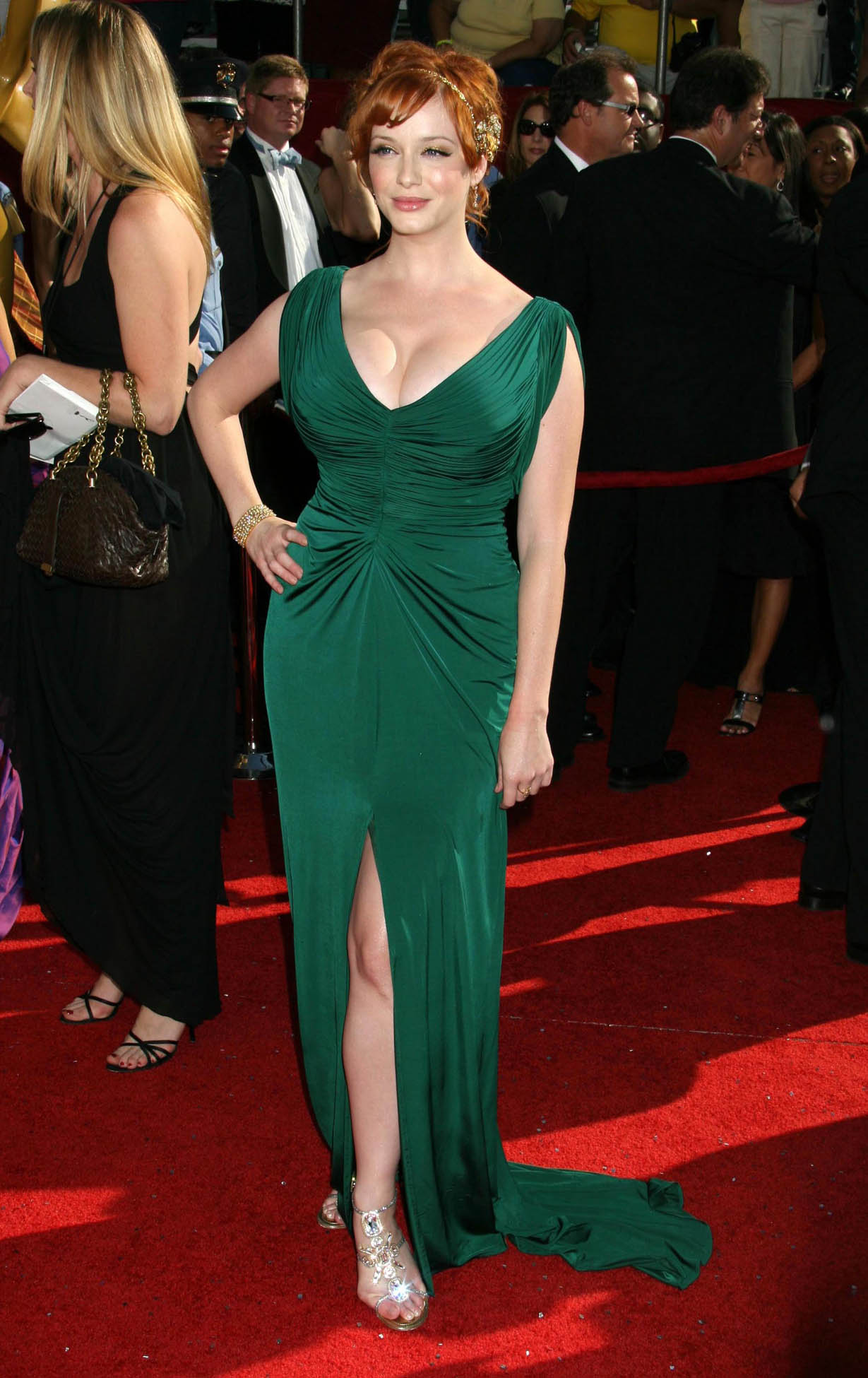
“Me? ‘Full-figured?’ How DARE you?”
Christina Hendricks, the voluptuous actress who is one of the stars of the AMC cable drama “Mad Men,” reportedly stopped an interview on Australian TV when an interviewer referred to her as “full-figured.”
Christina earns millions of dollars with her figure, and exhibits it regularly and enthusiastically. If her figure isn’t accurately described as full, I don’t know what “full” is.What was the term she was expecting? “Spectacular?” “Eye-popping”?
“GwGahhhhmehenkRgh”?
Now that we have that definition straight, what is the proper description of her conduct toward the interviewer? Unfair? Dishonest? Unkind? Isn’t it a bait and switch? To me, it seems like a less debatable example of the conduct I criticized by Comic Con attendee Mandy Caruso. Mandy, however, was undeniably treated crudely and impolitely, and had every reason to end the interview.
There needs to be a specific name for this sort of thing—intentionally courting a particular kind of comment or treatment, and then punishing those who take the bait. Is there one? I can’t seem to think of it, if there is.
_______________________________________________
Facts: Daily Motion
Graphic: Share Your Wallpapers
 Ethics Alarms
Teasing
Yes, that’s almost it. Not quite specific enough. Deceptive teasing? “Loaded teasing”? Teasing implies holding out possibilities that one has no intention of allowing to be made real. But this adds the feature of punishment.
Sadism?
Methinks the lady doth protest too much.
I’m reminded of the Delbert McClinton lyric, “If you can’t lie no better than that, you might as well tell the truth.”
That was because the term “full figured” has become a polite euphemism for FAT! That interviewer would have done better to say, “Wow, whatta rack on you.” Miss Hendricks might have even enjoyed that. After all, it’s outrageously true… and the only source of her fame and fortune.
Steven said exactly what I would have said, only a tetch more politely.
I submit that there is a precedent here on Ethics Alarms for particularly annoying ethics violations: commemorating them by naming them after the person that made them famous here.
To that end, I suggest that this type of behavior hence be known as “a Christina.” Or “a Hendricks.” I kind of like Christina better.
I like it. “The Christina Trap”, perhaps.
She had to know what was meant—“full figured” only means fat when someone is in fact fat.
Perhaps she, like so many women, is fed up with the media’s need to categorize and comment on our bodies. Although she may be cast in certain roles because of her body, she’s a professional artist and probably wanted to talk about that, not her body, which is actually so uninteresting.
Oh, come on. Her career is, I would say, 95% a result of her genetic assets. As an actress, she is completely fungible. Your argument is the equivalent of suggesting that it would have been reasonable for Jayne Mansfield, Raquel Welch, Jane Russell, Mae West or Pamela Anderson to make the same complaint, or for Arnold Schwarzenegger to get angry when an interviewer asks about his muscles. She has no standing to be fed up with the same obsession that she has exploited from the beginning with great success. If Christina Hendricks had the figure of Meryl Streep, she’d be in dinner theater…at best.
For Jane Russell, I’d maintain it was a useful “augmentation”. Jane could act and took her obvious physical assets with good humor. Those others had little else to offer. It was just that what they had was spectacular enough to where little else was needed!
This is obviously wrong. But what IS it? Oh right, it’s sexist. Asking Arnold about his muscles is not equivalent to asking a woman, actress or not, about her large breasts. I’m sure you do not understand and think I’m being ridicluous, which is reasonable, since you do not have breasts.
It’s not sexist. If it’s taboo to mention breasts to a woman who makes her living with them, that is the double standard of the century. You’re right: I think it’s ridiculous.
But how do you know I don’t have breasts?
Well, actually, of course, you DO have breasts, Jack, as all mammals do. As we know, men can and do get breast cancer.
Following your argument it seems prudent to divide all women into two categories: those who make a living off their breasts vs. those who do not. (Per Jack Marshall’s opinion, of course).
There are a lot more categories that THAT. But it is still a category. Do you deny it?
No, I do not deny that they are categories. But I would like to point out that for the six actresses you mentioned whom you believe make a living off their bodies you only mentioned one whom does not as a counter example. This leads me to believe that you are more likely to assign female actresses to the latter category I mentioned, rather than the former.
If that leads you to that conclusion, you like leaping at conclusions. Why would I include more than one example of the largest category, since nobody would deny its existence? Female sex symbols are a rare category, though an increasing breed, thanks to the increasing obsession with plastic surgery and cartoon proportions.
Because people would deny it’s existence. Do you deny that?
If you think female sex symbols are rare and a new phenomena, then I can understand why you thought your original post was appropriate. I’m no historian, but sexualizing women with frequency has been going on for nearly a century.
Heather, you are new here, so let me point this out: I don’t appreciate snark, and I don’t like people putting words in my mouth. Popular culture and entertainment, including cinema and theatrical history is a field of mine: don’t talk down to me. “Sex symbol” is a term of art, and covers specific screen stars like Theda Bara, Mae West, Jean Harlow, Rita Hayworth, Marilyn Monroe, Jayne Mansfield, Rachel Welch, and so on. I did not say it was a “rare or new phenomenon,” nor do I believe that. Sexualizing women is a different topic than screen sex symbols. Don’t do that again.
I argue with Heather Cohen all the time. One thing you will discover is that she always, without justification, leaps to conclusions. Also, she is presumptuous, combative and downright snarky. She loves to throw-down with straw-men, too. Now, I regret ever introducing her to your site. Apologies, Jack.
Let me raise this question, of the thousands of aspiring actresses in the world, what separates those who are successful from those end up doing weekend plays at the local school auditorium? I can’t quantify it, but i bet it’s looks. The disparity between a great actress and good actress is probably nominal to the untrained thespian. However, we can all gauge aesthetic attributes like physical beauty (ceteris paribus eyesight). So, if this is one feature that is easily distinguishable, unlike acting, then doesn’t it seem probable that beauty is the reason some actresses are successful while others are not? if this is true, then asking an actress about her physical attributes is only fitting when talking about her career.
I think one of my main problems is the thought that Hendricks “makes her living” with her breasts. She isn’t a stripper. She happens to have breasts, and they, of a necessity, go wherever she goes. She doesn’t do nude scenes, and her clothes on the show are not particularly risque, consisting mostly of late 50s/early 60s dresses and suits suitable to be worn to the office. Almost all of the other actresses are dressed in a similiar manner, it’s just that her Hendrick’s breasts are so much bigger that they are just that much more obvious even when dressed in those outfits.
Michael Fassbender was in a movie called Shame recently where he did full frontal nudity. I’ve yet to hear an interviewer directly ask about his penis, it’s size, girth, what he does with it in it’s free time, or anything else. It would be considered uncouth and coarse. All Hendricks has done was put on period-style and formal dresses. That doesn’t give someone the right to ask about her breasts, and cause some sort of ethical lapse on Hendricks part to be insulted by that line of questioning.
Agreed.
And well put, deery.
Indelicate as it may be to say so, she doesn’t “happen to have breasts”, she is specifically cast because of them. I cast actors and actreeses all the time. If teh script calls for a tall guy, and my staff says, well, X is 6’8″ and is perfect, that actor is cast because of his height. If he wasn’t tall, he wouldn’t be cast at all. Hendricks, at this point in her career at least, is cast when a director wants a busty actress, otherwise, someone else gets the call. Now, that is making a living with your breasts as much as Gene Kelly made a living with his feet. It’s nothing to be embarrassed about—acting and performing is often based on physicality. But it is disingenuous to deny it.
Without knowing what the casting call was for the character of Joan Harris, we don’t know if they were specifically looking for a busty actress, or cast one who happened to be busty. You automatically assume that because her breasts are big, the casting directors were specifically looking for that trait (and no other). The role doesn’t even center around her breasts in general. Hendricks is no Pam Anderson bouncing around in bathing suits and doing nude Playboy pictorials.
Joan represents one of the points along the continuum between the traditional soft feminine power of Betty, and the hard masculine power that Peggy longs to have. She has power, but often uses her cleverness and feminine wiles to get what she wnts. But even that aspect mostly involves her looks in general, not her breasts in particular.
It’s funny how the men [or at least those I presume to be men (there I go leaping to conclusions again)] agree with you and the women (or at least those I presume to be women) disagree with you. We’re probably just being sensitive and overly dramatic.
It’s not so much funny as illuminating. Women identify with the woman in the scenario, and think about the issue as if they were in her place. But almost no normal woman can or should identify with Hendricks. While a typical woman in this society should never be focused on according to her appearance and sexual attributes, in Hendrick’s business, especially her practice of it, this is not only normal but expected, accepted by her and essential to her continuing success. Actresses and actors can be ordered to lose weight—try that in any other business, and your getting sued and prosecuted. As I pointed out, “full-figured” in Hollywood terms can be Kate Winslet—telling a normal woman that she looks like Kate Winslet is a tremendous compliment. In this case, and it is not typical, men are more able to find an objective vantage point than women.
Mansplaining at its best Jack. Hendricks experience is not exceptional. Every women has had experience with someone commenting on her physical appearance, given “helpful” suggestions, being graded (out loud, to her face), and generally having her personal boundaries invaded.
Just because some producer or agent might order Hendricks to lose weight doesn’t mean that some stranger or interviewer now has full rights to ask about her boobs, especially when she has made it very clear that she does not want to be asked about them. In contrast to your title of this post, it is far from an obvious wrong what Hendricks has done. If anything, the interviewer was being rude.
Stubbornness at its worst. Your comment makes sense only if one accepts that there is no difference between a Hollywood sex symbol doing a publicity interview and a Main Street professional woman having a conversation with a man in an elevator. Ergo, it makes no sense.
Jack, one of us is missing the mark on this one as normally I think most people overact to ill formed questions or statements and I am not generally known to have much sympathy for those who I would deem (the majority) to have received minor or imagined slights. Maybe it is because I can only base my opinion on your post and comments received as I can’t seem to view the outside link or other resources that covered this incident but it seems to me she is justified in reacting negatively to the question, especially as an opener. There are other questions and phrasing that should have been used that would have been less offensive and still got to the subject. You’re “in this case, and it is not typical, men are more able to find an objective vantage point than women.” I don’t believe is accurate as I understand what the women are saying and agree largely with their points and I would “typically” say suck it up, it is no big deal, but not in this case. I still think no big deal but to deem her reaction as inappropriate and not the interviewers question is missing the true unethical behavior.
I’ve been interviewed by smart people and dumb people, and my experience is nothing compared to the regular routine of stars like Hendricks. Who is she to demand exact precision of language from some Australian media flack? Such interviews are by nature intrusive. I don’t understand the resistance to the concept that this is show business, with a genetic freak being asked about her freakiness, and deeming it an insult. We have established that the term he used was, at worst, ambiguous. It seems unlikely that he meant any offense. Choosing a word that causes an actress to behave unprofessionally is not unethical, and calling it so is consequentialism. If she answered the question in the spirit in which it was asked—I once heard, of all people, Lindsay Lohan give a very graceful answer to a similar question that seemed rather icky to be asked of a then 17 year old girl—nobody would be accusing the interviewer of anything at all. Christina Hendricks’ stock in trade are her extravagant curves. When someone asks Christina Hendricks about being “full-figured,” it should be obvious to everyone—especially her—what was meant. (In “Back to the Future II”, Marty goes to an alternate future where his mother has breast implants. Paralleling the first film where Marty (Michael J.Fox) wakes up and sees his mother as a young girl and says…”You look…so young!”, here he wakes up, focuses on her new bustline, and says, in shock…”Mom! You look so…big!” Did anyone think that Marty meant “fat”? Hendricks was being willfully dense. Unreasonable, and unfair.
Jack, Skynet here is kicking my butt but I found a few related articles that have some quotes, maybe there are two incidents? At this time I think I have to throw a flag on this play, we can go to review on it as I am handicapped on the ability to back check this story.
1st Kate Waterhouse, a petite little thing was the interviewer, not “he”?
2nd “You have been an inspiration as a full-figured woman. What is the most inspiring story that you can remember where you’ve inspired someone?” This sounds like she is referring to her size, as in “fat” or larger then average. I don’t know how that translates to “You have been an inspiration as a BIG BREASTED woman. What is the most inspiring story that you can remember where you’ve inspired someone?” Someone? Someone with big breasts? Why would someone with big breast need inspiration?
3rd Waterhouse then rephrases her question but continues to call Hendricks “full-figured,” which prompts the actress to interrupt the interview, saying: “I mean, you’ve just said it again.” Couple that with Hendricks comments about the incident ““I think calling me full-figured is just rude.”
All this leads me at least to think the term was used more along the lines of implying she is fat then as a reference to her sex appeal and the success linked to it.
Well, the fact that a woman was giving the interview blows the sexism argument out the window, right?
Now that this is out of the way: NO!!! With all the tidal wave of articles about how women hate their curves, how fashion models are flat-chested, malnourished and concentration camp this, how the obsession with size ZERO in Hollywood has led to dysmorphia and eating disorders, with various actresses who have fought the standard as unhealthy making statements in the media about “loving my curves” (Scarlet Johansson, to name one particularly lovely example), this makes it crystal clear that the interviewer meant “curvy,” a description that a) is one of the definitions of “full-figured” and b) fits Hendricks to a “T”.
“Well, the fact that a woman was giving the interview blows the sexism argument out the window, right?”
On the part of the interviewer sure, but I thought your arguments had a bit of a sexism tone to them and if I thought that then I am sure others did, I will go back and reread this weekend.
“Now that this is out of the way: NO!!! With all the tidal wave of articles about how women hate their curves, how fashion models are flat-chested, malnourished and concentration camp this, how the obsession with size ZERO in Hollywood has led to dysmorphia and eating disorders, with various actresses who have fought the standard as unhealthy making statements in the media about “loving my curves” (Scarlet Johansson, to name one particularly lovely example), this makes it crystal clear that the interviewer meant “curvy,” a description that a) is one of the definitions of “full-figured” and b) fits Hendricks to a “T”.”
I would say Hendricks does fit that description, I would never have said otherwise and I didn’t consider the” inspiration” bit as you just framed it with all the talk that it concerned her breast size, as that does not fit the context of the question. But assuming the interpretation that you just laid out above is the correct one then I have no problem with it other than it being poorly worded and delivered. As for “crystal clear” I don’t think so and if you interpreted it that way then why didn’t you include it in the post from the start? I think based on her reaction it is clear that she took it as her being fat or larger than average thus being insulting.
Tell me—how should the woman have phrased her question delicately any better than what she said? “Big bazzooms” wouldn’t be quite right.
I never thought the interviewer meant “fat” and don’t. Why? Because the actress isn’t fat. She’s stacked. Why would she, or you, assume that the interviewer used an ambiguous term to mean one of its inapplicable definitions when one of the applicable ones—curvy—obviously applies and makes sense under the circumstances? And why should I have to make the obvious explicit? I must confess, I did not foresee commenters torturing common sense and logic to compare Hendricks to a typically proportioned woman being ogled by a letch in the grocery store. An actress who makes her living in part by displaying her bust, for which she is justly famous, is asked about that, by a woman struggling for a non-vulgar term, and throws a tantrum because she wants to pretend that she’s a star because she has pretty eyes and great Meisner technique. That makes Hendricks, on this occasion at least, not a victim, but a jerk. Pretty simple, in my view.
Correction-All this leads me to think the term was used more along the lines of implying she is fat then as a reference to her sex appeal and the success linked to it.
Oh no, it’s just plain funny.
I think she was insulted. Everyone (in the US at least) knows that calling someone full-figured is the same as calling them fat. She probably gets enough fat comments to be sick of it, let alone someone calling her fat to her face. Plus, exactly how is she supposed to respond to a comment on her body? “Yep, I am full-figured”, or “no, I’m not full-figured.” Where does the interview really go from there?
I actually think Hendricks as Joan Harris is a pretty good actress. Compare and contrast her character to January Jones as Betty. Night and day. Both are attractive women, but only one of them is a good actress.
Sure, it was stupid question. Most interviewers ask stupid questions. By Hollywood standards, when actresses are asked to lose weight if they wear a Size 4, she is full-figured, knows it, and can’t possibly have been shocked at the question. I heard Jennifewr Love Hewitt do a 20 minute interview that was almost entirely about her breasts. For buxom stars and starlets, this is old hat.
Yes, I think CH is a good actress. Hollywood, New York and regional theater are full of actresses just as good, living on food stamps. She is a star because she is “full-figured” in a spectacular way. She should count her blessings. She won’t have to count too high, either.
Yes, she has big breasts. And some people apparently want to ask her questions about them. And she sometimes dresses in ways that draw attention to her breasts (though it would be very difficult to hide them in most clothes). So then the question is, just because she has big breasts, is she then obliged to tolerate and answer questions about them, because some (men) are fascinated by her breasts?
You say yes, she is obligated to answer questions about her breasts, because they made her famous. Even as you acknowledge that she is a good actress, and that plenty of other famous actresses, even on the same show, do not possess large breasts, the only reason Hendricks herself would have been famous is because of her breasts. Therefore she must answer interview questions about them. You cite examples of other actresses who answered questions about their breasts in support.
I have to say that I feel that Hendricks is under no obligation to answer questions about her breasts. She has not presented any bait and switch or teasing by not answering any questions about her breasts or figure unless she agreed to answer the questions beforehand and is now generating faux outrage. It is very Mad Men era of you to think that women’s bodies should constantly be held up to public commentary, and that the woman in question should be obliged to bear it with a smile and no complaint. Some women do not enjoy their bodies being discussed like a slab of meat (other’s do, and that’s their choice). Hendricks boundaries are her own, I see no reason to castigate her for having them. Most people don’t enjoy discussing their sexualized body parts in public, even if they do show cleavage from time to time.
I think this is a trollish comment at best. Her breasts are her trademark, and she knows it. The role she is famous for makes a big deal out of them. Her dresses accentuate them, and that is by design. If she doesn’t feel comfortable discussing the entertainment asset that is responsible for her fame and career than she should change careers, get breast-reduction surgery (as, for example, Drew Barrymore and Christina Ricci did, both of whom did NOT base their career on their cup size) or stop giving interviews. I did not say, nor do I believe, that “women’s bodies should constantly be held up to public commentary, and that the woman in question should be obliged to bear it with a smile and no complaint.” Christina Hendricks is paid to display her figure, and again, has no standing to object when the most significant and distinguishing aspect of her performing persona is naturally the topic of conversation. The equivalent would be if the Hensel twins were offended by an interviewer asking, what’s it like having two heads and only one body? That’s the only reason they are being interviewed, and why they have a TV show. Hendricks is no different.
Hendricks is not a nude model. She isn’t paid to display her figure any more than any of the other actresses on the show, or in general. Just because she has large breasts does not mean that she is obliged to answer questions about them, or even more ridiculously, get a breast reduction to expect civil treatment.
Hendricks is on one of the most popular, and talked about shows on television. Her character went through a very great arc last season, and Hendricks herself has recently married. I think she would naturally be expecting to be asked about those things, rather than her boobs. Apparently, according to the video you linked above, she did not storm out the first tme she was asked the question, but asked if the interview could be restarted, and that the interviewer refrain from asking that particular question. Only when the interview was restarted again, and she was still asked about her boobs, when she made it perfectly clear that she did not want to be asked about them, did she leave the interview. Hendricks, at least, seems to think her boobs don’t define her. It’s normally called common courtesy to do the same.
With all due respect, Deery, if Miss Hendricks doesn’t think her body defines her, then she’s living in Lalaland. If she wants to become more than her physique, she’s going to have to display something beyond it. I agree that common courtesy needs to be practiced a lot more in the media and in all facets. However, given the plain reality, that interviewer had to have known that the viewers would be tuning in with only one grand thought in mind! Was he, perhaps, too much into the subject in his questions? Likely enough. Should he have backed off when Miss Hendricks started displaying discomfort on the trend of the questioning? I agree. But she was also likely taking herself too seriously. That body got her where she is. Fact of the matter. No one can blame her if she’d like for it to be toned down a little. But it’s not going away. If she can’t come to terms with that, her career will be a flash in the pan.
She’s an actress. In that sense, *every* famous actor or actresses body got them where they are. When Jonah Hill lost weight, people didn’t find him as funny. But why should only the full breasted be expected to tolerate comments about them? Most people agree that it would be rude to ask January Jones about her breasts from out of the blue, so why isn’t Hendricks allowed the same courtesy? Because her breasts are bigger, and people really, really, really like looking at them?
Again, I’m not justifying it. I’m one of those who rails against the tastlessness (at best!) that we now see in every sector of society- the entertainment industry in particular. This interviewer was, no doubt, a case in point. Not on the same level as, say, Howard Stern, but still playing on the vein that “sex sells”. However, is Miss Hendricks that much better than he? What has spurred her rise to fame? Gorgeous red hair, an outrageous figure and a leading role in a TV show not exactly known for moral uplift. Now, if she gave lectures in conduct on the Christian Broadcasting Network, she would likely be much offended with such questions, as they would be both crass and totally unrelated to her work. Unfortunately for her, those “assets” have everything to do with her career and she’s used them in establishing that career. As they say, she’s made her bed and must now lie in it. I’m sorry that careers CAN be made like that. I’m further sorry that sleazy shows like “Mad Men” and talk shows that capitalize on that sleaze are allowed on the air. But they are… and Christina Hendricks walked into that world with her eyes wide open. She can’t play the blushing maiden now.
Exactly. She cannot accept the benefits of her genetic gifts, exploit them, win parts from lesser endowed actresses because of them, cash 6 figure monthly paychecks as a result of them, leap over more gifted actresses assisted by them, and get huffy because interviewers don’t give proper respect to her “art” and ask instead about the only reason she is being interviewed at all. It’s hell being typecast, and maybe she’d be a great Media. But that’s not her career path.
The problem is that actors equate being “sucessful” with being “talented” and then take it a step further that being “talented” makes them an “artist” and that “artists” should treated with a certain amount of respect.
What they dont know is that just becuase you are successful doesnt mean you are some great talented artist or intellectual. All it means is that a certain time and place you had something, whether it be look, a sound, or a natural instinct for a role , that someone could use in their show or play. Thats it. Nothing more. There are very few great talented actors and most of them are not famous.
[A comment from an actor who is as talented, or more, as most of them.]
One of your best typos ever, Jack. I think you mean “Medea.” She’s already great Media.
A) As reported, the interviewer made reference to her being full figured, he did not make a comment specifically on her breasts, and he did want to talk about her full figure specifically. He worked ‘full figured’ into a question about her in general.
B) Her response was that is was rude to be called full-figured, not to have someone comment on her breasts.
Seems to me someone is a little touchy about her weight, not about having to discuss their sexualized body parts, which by the way is par for the course in sex symbols. You may not like that our society still has them, but we do, she is one, and her response was uncouth.
correction, ‘he did not want to talk about her full figure specifically.’
Oh sure, my first reply was about the full-figured. But then other people said he was basically talking about her breasts, which is when I talked about that. I noted that “full-figured” is used pretty interchangeably as a kinder synonym for fat over here in America, so Hendricks probably felt a little insulted about that. Others said the interviewer was referring specifically to her full breasts, which is still insulting, just in another direction. But for the record, I do think she has touchy about her weight, she has indicated in several interviews that she is actually very sensitive about it. Her reaction was probably in response to that rather than breasts specifically, but other people have argued otherwise.
Seems to me someone is a little touchy about her weight, not about having to discuss their sexualized body parts, which by the way is par for the course in sex symbols. You may not like that our society still has them, but we do, she is one, and her response was uncouth.
I don’t think she was uncouth. She indicated that she did not want to talk about her body. Hendricks has indicated for several years now that she would rather not have her body be a subject for discussion. This could not have come as a surprse to the even casually diligent interviewer, and even if she is some sort of sex symbol, I see no reason why she has an obligation to discuss sexualized body parts. It isn’t as if she signed some sort of contract for that. What can be possibly gained from such expectations? And it cheapens our culture to seriously expect a star to entertain a 20 minute interview about her breasts.
Nonsense. Just plain nonsense. I’m not going to write the same thing over and over, but really: she is, essentially, exactly like a stripper, in that her livelihood is linked directly to her unusual physical attractiveness. If John Goodman is interviewed, he is asked about his weight. (By the way, one question does not equal 20 minutes.) So are the stars of “Mike and Molly.” Gary Coleman was asked about his height; so is Mickey Rooney; so was Michael Clarke Duncan. Ahnold would be asked about his muscles; John Wayne about his walk; Betty Grable about her legs; Jimmy Durante about his nose; Joey Brown about his huge mouth, and ditto Martha Raye; Jackie Gleason about HIS weight (especially if he had lost some); Jay Leno get jokes about his chin, J-Lo her butt; Liz Taylor her violet eyes. These are or were all trademarks, and linked to a performer’s uniqueness. Hendricks is no different, except that she’s not as big a star as most of those people, yet all of these bigger stars recognized that it was likely and reasonable for interviewers to focus on the physical feature most identified with the star, and never walked out of an interview because a question was asked about them.
I focused on fairness, but the more I think about it, what Hendricks did was just unprofessional. If she’s going to do that, let her only accept parts that don’t play up her curves (she had one, in “Drive.” She was unrecognizable. She was competent, but there was nothing memorable about her or her performance. Hiring her to walk around in overcoats is like hiring Fred Astaire to sit in a wheelchair. ), and then she can insist that she only be asked about her “craft.” She will be working at WalMart in about 10 months.
When they start taking about “honing their craft”, it’s time to whack them over the head with the club of reality… and humility.
Damn! Something we agree on! Although I do see acting as a craft, you’d build a performance. I hate that damn expression.
I agree. It’s one of those infamously trite expressions that actors tend to use when they’ve enjoyed some early success and want to avoid being typecast in the future. That’s understandable to an extent, but their ambitions often outrun reality. “Honing my craft” is usually a term they pick up from their agent, who wants to boost their ego a little!
I’m of the Micheal Caine school of acting. I want to know how much I’m getting paid and where is the job .
Only a man, and an intellectual one at that, could possibly state what you just did. Any show biz interviewer calling an actress of any size “full figured” during an interview, unless the actress has called herself that, is a complete idiot and should be fired by whatever organization hired him/her. Show biz interviewer Rule #1: DO NOT INSULT YOUR GUESTS (unless, of course, your schtick is insulting your guests, in which case, anything goes).
“Full figured” is far from a compliment in current parlance, no matter how accurate it may be, how it may have been received by Jayne, Raquel, Jane, Mae, or Pamela, or how much Lane Bryant would like us all to think otherwise. Should that be the case? Perhaps not. But it is, and suggesting otherwise is utterly ridiculous.
No term needed for Hendricks’ conduct beyond “understandable.” She was insulted. While a more prepared/gracious person might have deflected the question and carried on, stopping the interview was far from unethical. The interviewer caused the problem. If he/she had brains and/or a thesaurus, then he/she could have used the term “voluptuous” (as you did), “va-va-voom,” “sexy,” or any other number of alternatives that did not involve a possible insult. Don’t blame Ms. Hendricks for a reasonable reaction.
I would suggest changing the focus of this piece to the conduct of the interviewer and classify it as “stupidity,” which, by the way, is a major factor in much of the appalling conduct discussed on this site and is completely absent from the “category” list on this blog. Just a thought.
NOTE: My comment was to Jack’s first response to Deery. Apparently, I took too long writing it.
From a blog discussing what “full-figured” means:
In the world of celebrities, the phrase “full figured” is applied to such women as Jennifer Lopez, Kate Winslet, and America Ferrera—a category of women who I’ve always viewed as “Hollywood fat.” The women who are called “full figured” are often treated as overweight by the media; we’ve seen it time and again. The problem escalates when regular, ordinary women start to interpret the data in the obvious way: larger than a size 6? Forget it. You are (or Eva Longoria is) “fat.” And thus, the pressure is on to adhere to this unrealistic standard.
Celebrities like Longoria, who apply the word “fat” to themselves when they are clearly no such thing, might be part of the problem. But how about Mariska Hargitay, who referred to herself as full figured in Self magazine? My first reaction: “Mariska Hargitay? Really?”
I would submit that if actresses like Kate Winslet, Mariska Hargitay, Eva Longoria and Jennifer Lopez are called “full figured,” Hendricks, who is more full-figured than any of them, wildly over-reacted. Checking the web, its rather obvious that there is no widespread agreement on what the word means, and I have no idea what it means in Australia. My guess would be that the poor interviewer was looking for a polite euphemism for “stacked.”
I don’t think her conduct was understandable at all…not for a celebrity, not for an actress, not for an actress accustomed to being called voluptuous (would she have walked out on “zafig”?), not for an actress who benefits tremendously by being full-figured in the right places, or as Nellie Forbush sang, “Broad where a broad should be broad.”
Heck, even just according to this one link, it can be a synonym for both relatively flattering terms like voluptuous and curvacious, and more genuinely faux-pas terms like chubby and plump: http://thesaurus.com/browse/full-figured
Personally I dont think she is full figured. I think she is normal. She should have taken the oppurtunity to point that out to the interviewer instead of getting all huffy about it.
She could never be called “normal,” but you i TAKE YOUR POINT. Hollywood bodies are abnormal.
I could live with that kind of “abnormality” in all women!
I meant normal in that she has curves and isn’t a stick.
Jack, I’m sorry (well, not really), but as a woman who can be described accurately as full-figured (i.e., fat), I am a bit appalled at your lack of empathy. I don’t care how Hollywood defines it or how some blogger defines it — full figured was coined as someone’s attempt at a marginally polite euphemism for fat. As you and others have noted, there are other terms (no less objectifying) that would describe Ms. Hendricks’ physical attributes more accurately. The “poor interviewer” (really, Jack?) is apparently either too immature to prepare adequately for the interview so that he had his verbiage set in his mind, or he’s just a hack who is too ignorant to know what the term really means. If the interviewer was just making a short-hand remark about her sexy body parts, he used the wrong term. Period.
And Jack, you are too smart to be ignorant about fat-bias and people in this world who harbor it. You and I worked with one such person back in the 80s. I have not forgotten. It exists and persists. Few if any are biased against sexy body parts.
And another thing, it has not escaped my attention (unless I’m actually still too sleepy to have read everything well enough) that the interviewer and the only commenters (yourself included) who think that she should just accept this objectification are men. Sorry, you know that I don’t usually play the feminism card, but this seems to be a gender thing — except that I would find it equally appalling if an interviewer (let’s say female) said to a legitimate actor something like “Well, Steve, as a well-hung actor, do you feel blah blah blah.” It’s all gratuitous, gutter, unprofessional media stupidity.
I stand with Christina Hendricks (and if I actually DID, SHE would NEVER be described as full figured, i.e., fat).
I think the bias is on the other side this time. First, the term is ambiguous–a simple survey of how it is applied shows that. Second, we owe it to our fellow human beings to give them the benefit of the doubt. Poor interviewer is right. Hendricks threw a hissy fit when she had to know she wasn’t being called “fat,” since she isn’t, and has lived on her curves long enough to know what the term means in her case, however it may be used in reference to others.
If an actor has made his living and reputation as being “well-hung,” say, John Holmes, damn right he has no business getting his tight panties in a bunch if he’s asked about it. The actresses I mentioned—Anderson, Welch, West, Russell, et al, would never be called “legitimate” actresses—they are specialty actresses. a.k.a. sex symbols or cheesecake, and for them to be asked about the qualities that make it so should be expected and handled gracefully. Imagine how Mae West would have dealt with that question. Hendricks simply showed that she has delusions of grandeur. She wants it both ways—to be respected as “an artist,” but to win parts over less-endowed competitors because of a lucky draw in the genetics lottery.
A second though on this, Patrice. Hendricks’ reaction also smacks of extreme vanity. She is drop-dead gorgeous, and I can’t imagine that anyone has ever suggested otherwise. So an Australian interviewer doesn’t feed her ego properly and she quits a an interview leaving him with nothing? Nobody but nobody thinks she is “fat,” and that is clearly not what he meant. She lives in a bubble; she is accustomed to being fawned over, and she is treated like a decoration on every red carpet she walks on. You stand with her, and stand with a spoiled pin-up girl who is offended at anything that falls short of the superlatives she is accustomed to. Her experience, environment, culture and value system is nothing like yours. Yes, you would have had every right to tell the interviewer to go to hell. That doesn’t mean she did.
I’m pretty sure that Hendricks has to deal with being called fat all the time. http://www.pajiba.com/celebrities_are_better_than_you/quit-fking-calling-christina-hendricks-fat-celebrities-are-better-than-you.php
She has mentioned before that she has been repeatedly requested to lose weight, and well, the internet is very cruel to all but the skinniest of women. So no doubt she has been called fat repeatedly, and that people meant it. She was probably sick of being called fat. I don’t think any special vanity is needed for that. We don’t what the interviewer meant. But clearly Hendricks made clear that she did not want to talk about her body, even going so far as to stop the interview, tell the interviewer explicitly this, and agree to restart it. So who can be surprised when if the very first question the interviewer asks after restarting the interview is the same question that made Hendricks stop the interview the first time, that Hendrixks walks off? No bait and switch, and certainly no teasing. She made her boundaries clear, as is her right, and even gave the interviewer another chance. Inept interviewer, not terrible star.
I’m intrigued that no one has mentioned the fact that this was an interview with Australian television. “Two nations divided by a common language,” and all that. I attended in English university for my Masters; I visit the UK not infrequently. I’ve been working fairly closely with British exchange students for a dozen years. There are still occasions when I say something that they misunderstand, or vice versa. I suspect the same phenomenon might well hold with respect to Australians.
It doesn’t matter what “full-figured” means in the U.S. It doesn’t even matter what it means in Australia. What matters is that it never occurred to someone who seeks international fame to consider that an obvious euphemism might have different connotations in different dialects. I have no idea what “full-figured” means to the interviewer, or to Hendricks. I don’t really care.
I put this down to roughly equal parts ignorance and parochialism on the part of both of the principal players, to inflexibility on the part of the interviewer, and to over-sensitivity and entitlement on the part of Hendricks.
Good take. I have been trying to find out what “full-figured” is taken to mean in Australia, but since it’s an ambiguous term here at best, and since nobody in their right mind would impugn Hendricks’ attractiveness, I think the assumption that it wasn’t meant as an insult is an easy call, for us and for her.
I, personally, have only ever heard the term “full figured” as a euphemism for a heavy but still attractive girl and almost always in a sarcastic or defensive context. But it might be a generational thing.
Titular tyranny.
Jack, I personally find Christina Hendricks stunning and the way she plays her part on Mad Men admirable, initially and currently as a sex symbol but evolving. I grant you your point on her fame being tied to her form but I think she deserves credit also to how she presents it and captures attention, basically I don’t think it is solely her body but also how she “works it”. I am far from knowledgeable in the field of acting so my evaluation of her abilities is probably of little use. With all that said I understand the interviewer wanted to talk a bit about her assets but she apparently didn’t like how it was being phrased, they reset and it appears that the interviewer was still off the mark. Because of Skynet I cannot watch or read the linked article myself but based on your post and some of the comments on here I have to wonder if you and some of the others aren’t rationalizing the unethical behavior (I will give a judgment pass on the first instance, but not the second) of the interviewer and ignoring civility that you normally champion. To take into account your evaluation that it is her body and not ability that makes her worthy of interviewing why couldn’t the question be phrased in those terms? Something to the effect of “what do you attribute your success too?” Follow up “do you think your physique attributes greatly to it?” If the interviewer uses the a line of questioning that opens the door to more pointed observations or questions based on her willingness to discuss specific characteristics then I think it perfectly acceptable. I think your evaluation on this one stands in stark contrast to your normally staunch defense against objectifying women based solely on their appearances and in general civility that should be shown. I believe your focus on defining “full figured” and your and others repeated reference to it and its correct meaning demonstrates there is enough of gray area with that term to appropriately deem it offensive, thus unethical.
What if he had used the term “big boned” ? Its another phrase that people use to describe fat people, but would it have offended her?
I think it’s a less flattering term, since it is pure euphemism. (Also it never meant sense to me. An Apatosuarus is “big boned.” Bones aren’t flesh. Big boned means tall, not zaftig. But you’re right—people use it like that.) Who knows? I think Christina was just having a touchy day.