 The gossip site TMZ often has horrible ideas, but for once it has come up with a horrible idea that is worth discussing seriously.
Several citizens provided information that led to renegade killer Chris Dorner being trapped and ultimately killed in a stand-off with police. This should put them in line for three rich rewards offered for information leading to the end of Dorner’s rampage, but TMZ identified catches in all three:
“The Mayor of L.A. announced a $1 million reward — funded by private groups — for information leading to the “capture and conviction” of Dorner. Big problem — technically speaking, Dorner must be both captured AND convicted to trigger the reward. The L.A. City Council offered a $100,000 reward for information leading to “the identification, apprehension, and conviction” of Dorner. Again … no conviction. City Council sources tell us there’s already a disagreement between the Legislative Analyst and the City Attorney over how to interpret the reward language. And finally … the L.A. County Board of Supervisors offered a $100,000 reward for information “leading to the capture of Christopher Dorner.” One source at the Board of Supervisors tells TMZ, “Dorner was cornered but not captured.”
Could TMZ possibly be correct? Would the offerers of these rewards weasel out of their obligations, citing the fact that Dorner burned to death before he could be captured and convicted?
Legally it’s possible, but barely. Ethically, it would be unfair and a breach of public trust. Pragmatically, it would be stupid beyond all imagining.
The citizens did everything required of them by passing on information to the authorities. Whether or not the information resulted in a capture, an arrest or a charred corpse was entirely outside the informants’ control, and the result of official action. This is moral luck. If officials attempted to avoid paying up on the theory that the exact terms weren’t met when their own police force’s actions were the reason they weren’t met, I would expect a judge to rule that allowing this would be contrary to public policy and welfare. Is it wise to give the LAPD a multi-million dollar reason to make sure their suspect dies before he can be formally arrested? Clearly not. Especially LAPD.
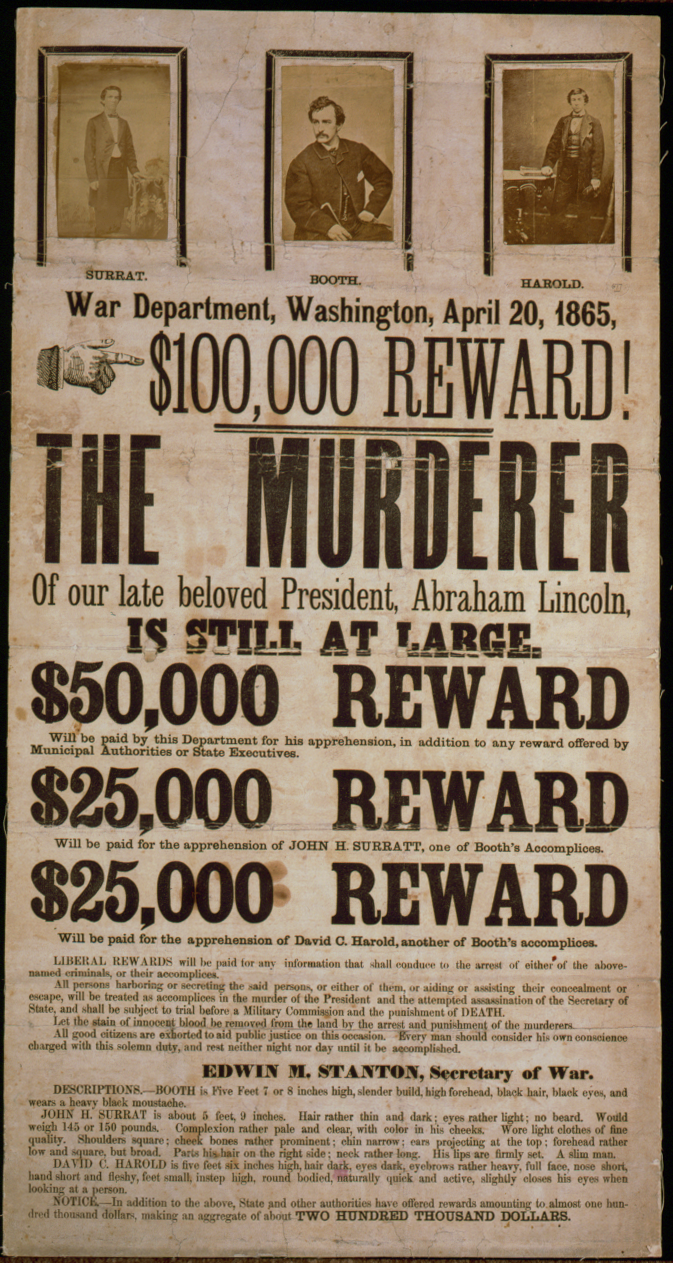
I didn’t devote hours of research, but I can’t find any instance where the police’s handling of citizen information allowing a wanted criminal to be cornered was used as a technicality to deny the citizen a reward. The famous reward poster for John Wilkes Booth required his “arrest,” for example, and it is unclear that he was ever formally arrested. Like Dorner, Lincoln’s assassin was trapped in a burning building; unlike him, he was shot and dragged out shortly before dying. The government still paid out the award money. It would be blatantly unfair to use legalistic parsing to deny a citizen an announced reward when his or her information was instrumental in taking down a public menace and serial killer.
I think the Mayor, the Board of County Supervisors and the City Council will do the right thing, maybe not because it’s the right thing, but because they will be very, very sorry if they don’t, especially when the next Chris Dorner grabs a gun.
______________________
Pointer: Fox News
Facts: TMZ
 Ethics Alarms
I will try to find it somewhere if you don’t first but I know one of the officials said something like- this is who wants to be a millionaire and all the contestants need to do is answer one question; where is Chris Dorner? I don’t know if that statement should play any part in your question but it sticks out in my mind. When I get a few minutes I will try to find it.
When those rewards are published, I doubt very much the authority realizes all the potential connotations and denotations of what they say.
When they say “for the capture” “for the whereabouts” “for the arrest” “for the conviction” “for the such and such” common sense says they mean one thing “for the information necessary for constituted authorities to execute due process in regards to the aforementioned suspect”
But that is just too lengthy to say.
The only other type of poster you see historically is “dead or alive” when actually empowers a citizen to take action vs supply information. I doubt you see that these days.
Found it “”Now it’s like the game show ‘Who Wants to be a Millionaire,'” said Anthony Burke, supervisory inspector for the U.S. Marshals regional fugitive task force. “Instead of one contestant, we’ve got 100,000, and there’s only one question you have to answer. All they have to answer is where he’s at, and we can take it from there.”
http://www.foxnews.com/us/2013/02/12/fugitive-ex-cop-christopher-dorner-reportedly-may-have-had-help-fleeing-to/#ixzz2KqUsV2Ow
If they don’t give out the reward then they can count on some backlash and next time it wont be as effective.
Call me a cynic, but I’d delete the “not” in “clearly not”. It would save much public money. “Public Policy” and ethics are orthogonal if we’re lucky, diametrically opposed all too often.
How many times do we see people vilified and even criminalised for “bringing the game into disrepute” by revealing corruption and malfeasance? Dead men tell no tales, so it’s arguable that when a system is truly rotten – but marginally better than anarchy – it is in the public interest to see that embarrassments are… neutralised. That’s ethically bankrupt of course, but we already have words like “realpolitik” in the language to describe such situations.
I’ve seen far too many cases concerning human rights law in the US where the decision would be a no-brainer – and not in the way you mean.
OK, you’re a cynic. I’ll be shocked if courts allowed LA to duck payment because the police burned up the perp.
How would it save public funds? I thought I read the money was put up from private sources?
The LAPD had no intention of taking Dorner alive. They fired dozens of rounds into one pickup truck despite (1) it was the wrong class of truck, (2) it was the wrong make (3) it was the wrong color (4) the occupants were the wrong age, race, height, weight, and sex (5) they were in a residential neighborhood and may have sent rounds flying into nearby houses. They also rammed a second truck and fired rounds through the windshield at the driver despite the facts that (1) he was just pulling away from a police checkpoint after being cleared (2) it was the wrong make (3) it was the wrong color (4) he was the wrong height, weight, and race. They should definitely pay the informants since they set the stage for him to die. Neither they nor he had any illusions that he would ever be tried.
Does the fact that the reward money was funded by private sources not raise a red flag for anyone else????
Elaborate on the flag. I’d expect the government to seek private funding.
I assume your beef would be that someone with something personal against Dorner ought not be allowed to offer money for information aiding the authorities?
If this assumption is accurate, why is that a problem?
It isn’t.
But something happened that rendered the entire question invalid. Nobody nabbed Dorner at all. He apparently committed suicide. If we were to conclude that the reward parameters intended to make the award available to whoever brought Dorner in for trial, then everyone still falls short. The only one who’d come close would be Dorner himself! Was that counted on by those who posted the reward? Given California’s current economic state, I wouldn’t be surprised!