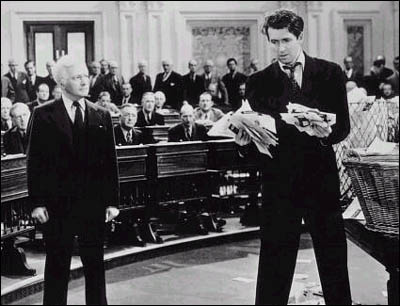
The sequel, “Mr. Smith Gets Stupid” was not a success.
Sen. Rand Paul proved to my satisfaction that he doesn’t have the intellectual chops to be a U.S. Senator with his foolish argument in 2010 that the 1964 Civil Rights Act was unconstitutional, while suggesting that he would have voted against it. (For the record, Paul’s been targeted on Ethics Alarms for various ethics transgressions five times since 2010. He is not our favorite Senator.) You can hide IQ inadequacies a long time on Capitol Hill—look at Joe Biden—but those missing points are telling at the moment, as Paul stages an embarrassing, silly, and wasteful filibuster in the old style, doing his best “Mr. Smith” impression to block the inevitable confirmation of John Brennan as CIA director.
Sen. Paul says he’ll talk until he drops or until the Obama administration states definitively that it doesn’t have the right to “kill an American on American soil.” Why is this such a high priority for Paul? Eric Holder answered his office’s query on the topic with this eminently reasonable response, which Paul has managed to completely misconstrue. Holder said in part,
“The question you have posed is therefore entirely hypothetical, unlikely to occur, and one we hope no President will ever have to confront. it is possible, I suppose, to imagine an extraordinary circumstances in which it would be necessary and appropriate under the Constitution and applicable laws for the President to authorize the military to use lethal force within the territory of the United States. For example, the President could conceivably have no choice but to authorize the military to use such force if necessary to protect the homeland in the circumstances of a catastrophic attack like the ones suffered on December 7, 1941, and September 11, 2001. Were such an emergency to arise, I would examine the particular facts and circumstances before advising the President on his scope and authority.”
This is perfectly reasonable in every respect. Paul’s complaint about it, however, as James Taranto has noted, is bats, and his insistence on a permanent ban on using drones on American soil no matter what the exigency is pointless and wrong. Holder is right (for once): it is possible that a situation could occur in which stopping an individual capable of inflicting massive destruction and loss of life and determined to do so would justify using any tools at the government’s disposal, including drones. Precluding such use prospectively is not merely unwise and foolish, but also naive: no matter what pledges or prohibitions were installed in 2013, if a mad terrorist with a dirty bomb headed for L.A. to employ it could be most quickly and safely eliminated by a drone strike, any responsible President would authorize one and sort out the legal issues later.
Paul is grandstanding, trivializing the filibuster, a device that should be used only under the most extreme circumstances (kind of like drones), and wasting the Senate’s time, which needs to be productively employed on the approximately gazillion things it should be doing, like, say, passing a responsible budget—all for no good reason. Did he really think someone needed to make Republicans look even more obstructionist and obtuse than they already do?
Apparently.
If Jimmy Stewart’s filibuster had been this silly, “Mr. Smith Goes To Washington” would be about as much of a classic as “Bedtime for Bonzo.”
_______________________________________
Pointer: James Taranto
Facts: Slate
Ethics Alarms attempts to give proper attribution and credit to all sources of facts, analysis and other assistance that go into its blog posts. If you are aware of one I missed, or believe your own work was used in any way without proper attribution, please contact me, Jack Marshall, at jamproethics@verizon.net.
 Ethics Alarms
You believe in the rule of man. I don’t. I believe in the rule of LAW, which was Paul’s point. Who gets to define “extraordinary circumstances?” Absent specific rules and procedures to the contrary, the president alone, whoever he may be, gets to assassinate US citizens without due process under this justification. It’s NEVER right, Jack.
1. Where in Holder’s answer do you presume the absence of due process?
2. It worked! I was betting that this one would flush you out!
You are missing the point. Holder and the White House have NOT answered the simple question: “Do you believe that you, as executive, as President, have the AUTHORITY to issue an order to target or destroy a non-combatant American citizen on American soil who poses no imminent threat?” Jack, this is not complicated. Under the rule of law, the Constitution, there is only ONE correct answer. Evasion and avoidance of the question constitutes appropriate concern that the executive DOES INDEED believe that he holds such authority. =FAIL.
I donno, maybe that part of the Oath of Office where the President swears he will support and defend the Constitution of the United States…. (for what it’s worth from this president) that implies drone strikes won’t be used outside of due process. Which, by the way, if authorities attempt to apprehend a violent criminal or terrorist and he/she resists arrest… due process in that situation is still served with a good solid non-collateral producing drone strike.
If you have an issue with a president prosecuting military action against violent militant your really going to hate that Lincoln fellow.
The President, in a true emergency, has authority to do literally anything to preserve the nation, as he so pledges in the Oath of Office…and the Founders would have agreed. Lincoln’s suspending the writ of habeus corpus was every bit as much of an incursion as the hypothetical Paul suggests. The problem comes when Presidents misuse that once in a century option. Nixon, for example.
What part of “… preserve, protect and defend the Constitution….” do you not get? The President affirmatively does NOT have the authority to assassinate American citizens on American soil who pose no direct and imminent threat. Except that this President has specifically NOT excluded that authority on his own. Suspension of habeus corpus was indeed not a good precedent, and was indeed unconstitutional at the time. Now people like you can point to this as an example of how it’s just hunky-dory. The separation of powers has a specific purpose, and a President who says, in the context of gun control, “If Congress won’t act, then I will,” somehow doesn’t get that the will of the PEOPLE (through their elected representatives) is supreme. Only tyrants (and their deluded sycophants) believe otherwise.
Holder’s response implicitly included as a condition precedent a “direct and imminent threat.” You have to impute more sinister douible-talk than even I am willing to attribute to Holder to reach your objection. Yes, absolutely: “The President affirmatively does NOT have the authority to assassinate American citizens on American soil who pose no direct and imminent threat.”
But that isn’t the scenario we are discussing.
OK, so you got me interested in Lincoln and habeas corpus. I, like a lot of people, knew that Lincoln had suspended it in Maryland but not a lot more than that. So I did some checking, on Wikipedia and also a lot on this article by James Dueholm:
http://hdl.handle.net/2027/spo.2629860.0029.205
As it turns out, the Supreme Court never ruled on Lincoln suspending habeas corpus. The original case, ex parte Merryman was heard by Chief Justice Taney, acting as a circuit judge at the time. Taney found that the suspension of the writ was unconstitutional because only Congress had the power to suspend it, not the President.
Lincoln ignored this ruling, and later got a ruling supporting his power by the Attorney General. He reported on this to a special session of Congress, saying (in part) “Are all the laws, but one, to go unexecuted, and the government itself go to pieces, lest that one be violated?”
Congress did, eventually, pass laws authorizing the suspension of the Writ. However, when Lincoln subsequently issued orders suspending it he did so based on his own authority as President, generally not relying on the act of Congress.
Apparently the main controversy lies with who has the authority to suspend the writ — Congress or the President. Dueholm examines the constitutional basis for this, concluding that it lies with the President, and I would concur.
According to Holder, the question Paul asked was about if the President could order an American executed on American soil “without trial.”
I guess technically you could have “due process” without a trial, but I think that’s elevating technicalities over substance. Holder’s answer at best brushed aside the “without trial” part of Paul’s question, or at worse suggests that he doesn’t believe that any sort of trial or process is necessary.
Yes, but can we start playing stump-the-chump with every elected official by asking loaded questions?
The implication behind every elected official’s oath of office is that they will uphold the Constitution, and by extension Rule of Law, and by extension Due Process….the question is already answered by that.
You can’t just pretend like its a whole new set of rules (although it seems like it with this administration) after each election.
“Do you think it is OK for the Chief Executive to order the summary execution of an American on US Soil without any form of trial?” is not a loaded question. I would HOPE that it was, at worst, a rhetorical question.
That no one in the current Administration can give a straight “yes” or “no” answer is distrubing to say the least.
So back to it then, it is a stump the chump question:
It is inherent in the oath of office that the president supports rule of law and due process.
Ought we ask any and every question of elected officials when the answer the question is not explicit (although implied)? Do you know what kind of cynicism we would institutionalize doing that?
It is fair to be uneasy about this administration.
No need to ask it of every elected official. But this administration has proven themselves willing and eager to circumvent ‘rule of law and due process’ at every turn. So when they are asked (yet again) about the limits of their power, and they answer (yet again) that effectively, there are none… why should we give them the benefit of the doubt, again?
If that mistrust is already there, why would you believe their answer anyway?
Yes, we know that Holder is wishy-washy, intellectually lazy, mealy-mouthed and a tool. We knew that years ago. So when a known mediocrity in teh cabinet answers a hypothetical question exactly as he could be expected to answer it (but not unreasonably, at that), this is grounds to hold up the business of the Senate as it considers the nomination of an official who isn’t under the AG?
I’d say that he’s a lot more than “wishy washy:, Jack. I only wish he was! Looking back as his record, I see a fervent leftist ideologue with no respect for the law or the Constitution. After Waco and the Elian Gonzales kidnapping, what person could have been surprised by his continual support for radical, anti-American forces domestically?
But the theme of this thread was Senator Rand Paul. Despite what doubts you (or I!) may harbor about him, the truth is that his filibuster achieved real results. First; it forced media attention on Holder’s record and forced him to back down. Secondly; it united and inspired Republicans and Libertarians together at what may be a critical moment. For that, I congratulate him. Both results were badly needed.
I find it right here…
You see, Holder was specifically asked (and not for the first time, mind you) as to whether the president had the authority to authorize the killing of an American on American soil. Holder’s words might parse to what you say they mean, but his active avoidance of the question he was actually asked tells me far more than his words.
His answer should have been “No.”
Instead he gave a – frankly – rambling and weasel-worded answer about 9/11 and Pearl Harbor, two incidents in which the sort of power the President is claiming would have done nothing to prevent them.
Also…
That is not, in fact, what he was proposing. Paul’s position is that it is unconstitutional for the President to order the killing of an American Citizen on American Soil without Due Process.
And he’s right, unless they have changed the wording to at LEAST three different Amendments.
Yes, it is conceivable that some set of circumstances might arise where use of a drone to kill an American without ant sort of trial in the bush of Texas might occur…
But it is also possible that someone who has legally purchased a gun takes a shot at the President, so by your logic that means that we can confiscate all guns, the rights of the Citizen be damned.
Frankly, even MY imagination fails to come up with a set of circumstances where law enforcement could not stop some terrorist attack – it would be impossible for a drone to be located in a convenient position and law enforcement be no where near unless armed drones were ubiquitous in the skies, and if you don’t begin to see a problem there, you probably think the TSA is a fine and effective organization.
There is ample precedent in history for the President of the United States, under the Constitution’s wiggle room for extraordinary unilateral action, to do that which normally would require a more formal process. I agree with Holder that as long as the circumstances really are exigent and extraordinary, that is a leadership option the President must have. Justice Jackson’s “suicide pact” quote applies.
And in those cases the President has had a LONG line of questoins that need to be answered. The president is claiming un-reviewable power. That it is just something he can do.
Should the impossible happen and an armed drone attack is the best, the only response, then let the president “bet his bars” as the military would say – let him take the risk and let history and the courts judge him afterwards.
To give him pre-approval is to invite abuse.
And it isn’t just because this is Obama we are talking about (though him having this power would frighten me more than Bush 43 or Bill Clinton having it, due to my opinion as to his restraint and judgment). I don’t want any president to have this kind of power. Ever.
“Should the impossible happen and an armed drone attack is the best, the only response, then let the president “bet his bars” as the military would say – let him take the risk and let history and the courts judge him afterwards.”
I agree completely. COMPLETELY. If the situation is not so dire as to justify an exception and a thus an exceptional use of power, then it shouldn’t be an exception at all. If the President’s decision doesn’t involve risk if it is wrong, then it’s doesn’t qualify.
The problem is, the Administration was attempting to claim it as an inherent power, like the veto or the pardon, and thus beyond review.
It takes a bit of paranoia to read Holder’s initial response that way. The President has an inherent power as Commander in Chief to do what is necessary to protect the country.
And within that power, they fully claimed the ability to violate at least three different Amendments from the Bill of Rights.
If he’s the Commander in Chief, and he feels that it would protect the country, can he order the internment of all Americans of Arab decent? All Muslims? Anyone from Egypt or Saudi Arabia?
Would those measures not make us safer?
How about mining the US/Mexican boarder, or placing snipers to fire at those crossing illegally – would that be within the scope of his powers as Commander in Chief?
They do have that ability. They just better not abuse it, or they are toast. All the Presidents, the good and strong ones ones, have understood this.
I would rather die at the hands of a terrorist than be the Government’s collateral damage.
So, I don’t see an imminent threat that would not have collateral damage. If a terrorist was on his way to a populated area, but wasn’t there yet, then I don’t think it is imminent.
So, I stand firmly against Holder on this one. You may see a way to provide utilitarian cover for decisions – balancing the loss of X innocents versus X + Y innocents. That’s simply not a justification I believe we should accept or permit. The slippery slope on this issue is simply unteneable to me.
There is the issue of “would we have shot down the airplanes on 9/11?”
First, I don’t think we would have, and second there is long-standing precedent for such an action – if not, groups like the FBI’s HRT would not exist, as the ending of a threat often involves risk of death for the hostages.
Actually, this seems to me to be one of the only decent filibusters of the last several years. He’s using the filibuster the way it SHOULD be used – to force public discussion of an issue that the Senate seemed prepared to brush under the rug.
The GOP is seen as obstructionist because it’s been using the filibuster rules to obstruct, rather than using it in the right way (as Paul is using it). It’s not fair to blame Paul for the results of hundreds of bad uses of the filibuster (except insofar as he has participated in those filibusters, of course).
How can a filibuster based on a distant hypothetical, a false premise, used to accomplish nothing substantive, asserting the primacy of absolutism over governance, by a guy who would have also filibustered for the inherent right of citizens to refuse to serve races and religions they wanted to persecute, be worthwhile or decent? If someone with the approximate weight of Paul, say, Dan Quayle—he’s a good comp—had chosen to filibuster a pledge from the Reagan administration that the CIA would never use torture to extract intelligence from a terrorist, what exactly would that have accomplished?
All the stuff about ” by a guy who would have also filibustered for the inherent right of citizens to refuse to serve races and religions they wanted to persecute” is ad hominem and carries no logical weight. Besides, there were other Senators who spoke during the filibuster – including Ron Wyden, one of the smartest Senators currently serving – so it’s not just about Paul.
The purpose of the filibuster, when it is not being abused, is to force the Senate to slow down and hear discussion of issues that would otherwise not get attention. That is what Paul was doing. It’s true that I don’t agree with Paul’s framing of the drone and “kill list” issues (although I agree with much of the substance), but so what? Surely the ethics of using the filibuster aren’t based on whether or not we agree with the Senator about the issue he’s discussion. Otherwise “unethical” would just be a term for “doesn’t agree with me about the issue under discussion.”
In this case, the nominee is someone who was crucial to developing the Obama administration’s “kill list” drone policies, making them a relevant thing to discuss.
As for if he accomplished something substantive, trying to raise public awareness of an issue is by nature a cumulative effort. Paul succeeded in generating a lot of press for this issue, and by doing so presumably increased public awareness (and pressure on the administration) by some degree. I think that’s a reasonable thing for a Senator who is honestly concerned about an issue (and whatever you say about Paul, I don’t think anyone can doubt his sincerity on this issue) to do.
Are you really arguing that when one is trying to make a principled argument the messenger is irrelevant? Untrue. Damn right it’s ad hominem. If a Democratic Senator with widespread and bipartisan respect—there’s got to be one—was doing this, then yes, it might do some good. Paul is viewed as a whack-job, and with good cause, in the media and elsewhere. His attachment to the drone issue effectively places the argument in the “extremist obstructionist” camp. If such a filibuster is going to accomplish anything other than becoming a circus, it has to be by the right official, for the right reason, at the right time. I see three strikes there, Barry.
Ron Wyden is a Democratic Senator.
When evaluating whether or not the argument is principled, then yes, the speaker should be irrelevant. A good argument is a good argument without regard to who is speaking it. Especially in this case, in which a group of nearly ten senators – not just one – participated in a filibuster and made a range of arguments, which held in common the central argument that the executive should not have the power to have Americans executed without due process and oversight.
Holder’s response was not responsible or persuasive. Yes, there are imaginable (albeit implausible) situations in which a President would have to order potentially lethal tactics against someone killed, and due to an imminent or ongoing attack no time to consult a judge is available; but that sort of immediate response to imminent violence is active combat.
That’s not the real issue here, and Holder knows it. No one – not even Rand Paul – denies that if some movie-villain type has his finger on the bomb’s trigger and is pressing it, cops or secret service or the national guard or whoever is there has the legal right and moral necessity to use whatever force is necessary, including lethal force. That’s active combat, which is not what we’re discussing here.
That’s not what’s been going on with drones. What’s been going on is that the President has been deciding, without oversight from other branches, to have people (including Americans) killed who are not fingers-on-the-trigger imminent threats. People have been killed while at BBQs and family occasions, for example. There is no reason at all some form of due process oversight couldn’t be added to that process.
You do have a point when you say that the same argument becomes more effective when it comes out of the mouth of a widely respected speaker (by the way, if Ron Wyden doesn’t qualify as a Democratic senator with widespread bipartisan respect, who does?), but you put too much weight on this aspect. It’s true that if some other, more respected and mainstream Senator had led this filibuster, then it would have been even more newsworthy and thus more effective at spreading the word. But that doesn’t make it wrong or counterproductive for Paul to have done this, just less effective than a hypothetical alternative would have been.
I don’t think “being less effective than a hypothetical alternative” makes an act unethical. If I try to rescue a drowning cat, is that an unethical action because if an Olympic swimmer had tried to rescue the same cat, she would have done a better job of it?
And it seems that best spokesman for the job or not – it did accomplish something:
Click to access WhiteHouseLetter.pdf
Now if they go ahead and do it anyway, we at least know that they knew it was wrong.
What do you think it accomplished? I guarantee that if a mad terrorist, domestic or otherwise, is seen as a direct threat to large numbers of citizens, and the best and fastest way to stop her is using a drone strike, the President will find a way to do so with legal cover, and write off this response as “that was different.” Future administrations, meanwhile, will not feel bound by the legal opinion of Obama’s Justice Department.
Pointless.
Posturing.
And again, there is NO situation where a drone strike could POSSIBLY be the best option, unless armed drones are EVERYWHERE in the skies, and are there 24/7.
Oh, I think Tom Clancy would take about 20 minutes to come up with a bunch of examples. I bet you could too.
And in every case, a manned, in-person response would be far, far better.
ESPECIALLY if the target is already inside a city – a drone-strike against a target in a major population center would be nothing short of a debacle.
Shield, now you are no longer arguing against the use of drones from a legal standpoint…ie the stance you took before in which use of drones automatically violates Due Process. Now you are arguing against drones based on practicality or intelligence of their use in particular scenario.
The implication of this is that you do think they are ok to use IF applied legally and IF the specific (albeit rare, as I have alluded to in many posts already) situation warranted it.
The issue is that the claim that they would only be used in “emergencies” could then be used to extend the current, horrible drone program to include 24/7 armed drones in the skies “because how else could we use them to protect us?”
Once you give the government a tool, they will look for every possible excuse to USE that tool (see – Use of armored vehicles to execute warrants on people suspected of running cock-fights).
And, honestly, I really can’t get rid of the feeling that they would like to use drones to keep as few a number of people involved in a “targeted non-kinetic para-police action” (I’m copyrighting that, btw, so no stealsies) so that should something either go wrong or it get used in an improper way, it would be easier to keep quiet.
1. “When evaluating whether or not the argument is principled, then yes, the speaker should be irrelevant. A good argument is a good argument without regard to who is speaking it.”
True in the abstract, but in the real world, you know it’s not true. Charlie Sheen’s pronouncements on the work ethic are not persuasive, no matter how valid they would be coming from Steve Jobs.
2. “Holder’s response was not responsible or persuasive. Yes, there are imaginable (albeit implausible) situations in which a President would have to order potentially lethal tactics against someone killed, and due to an imminent or ongoing attack no time to consult a judge is available; but that sort of immediate response to imminent violence is active combat.”
Barry, this administration told Congress that dropping bombs on Libya wasn’t combat. Combat will mean whatever the administration thinks suits it purposes.
“That’s not what’s been going on with drones. What’s been going on is that the President has been deciding, without oversight from other branches, to have people (including Americans) killed who are not fingers-on-the-trigger imminent threats. People have been killed while at BBQs and family occasions, for example. There is no reason at all some form of due process oversight couldn’t be added to that process.”
I agree with that, but 1) why is Paul focusing on domestic use, which is unlikely and far-fetched, and 2) only Americans, when the drone strikes are aimed at citizens of other nations which the US is not fighting? I heard Paul this morning say his stunt had nothing to do with Brennan. I think holding up nominations of people as a pretense to talk about something else is an abuse of process. Paul might as well have been advertising tooth paste.
“I don’t think “being less effective than a hypothetical alternative” makes an act unethical. If I try to rescue a drowning cat, is that an unethical action because if an Olympic swimmer had tried to rescue the same cat, she would have done a better job of it?”
This is just part of my objection. The other parts are 1) Paul’s justification was a pretense 2) this isn’t what Filibusters are for, and 3) it’s useless and pointless, whatever the Administration says now.
1) If Paul really said that, then I disagree with him. Brennan was one of the architects of the administration’s drone policy, and his confirmation is a logical context for discussing the drone policy.
2) Your point about “combat” supports what I’ve been saying about the need for checks and balances on what the executive does. An executive branch that is not subject to oversight is an executive branch that redefines terms like “imminent” and “combat.”
3) Paul’s choice to focus primarily on domestic use was presumably a tactical decision; he apparently believed that focusing on this narrow point was the best way to get a jaded and irresponsible press to actually pay some attention. I don’t know if he was correct about that or not, and neither do you. But as a matter of general principle, I don’t believe that being ethical requires not having a strategy, or not using tactical thinking.
4) This is precisely what filibusters are for – making the Senate slow down and consider issues that would otherwise be rushed over or ignored.
5) If it contributed to greater public awareness and discussion of the issue, and put pressure on the administration on the issue – and its clear that it has accomplished both these things – then it was neither useless nor pointless.
1) He did really say exactly that, in his interview with Rush Limbaugh—the transcript is on Rush’s site, presumably.
2) How does Paul’s intentional misunderstanding of the domestic drone issue further the cause of oversight?
3) Was he right about Americans being bombed while eating in cafes? About Jane Fonda being obliterated? Being ethical requires a baseline of competence and credibility. McCain was right to focus on the Fonda nonsense. Mark Levin’s defense? ‘Well, you have to say a lot of stuff in a filibuster.” If your going to educate the public, you can’t talk nonsense and hysterical fantasies and argue that you were being responsible.
4) As John Yoo pointed out, Paul mixed up due process and combat situations. There is no due process in combat. Clarification? Education?
No one who served and hasn’t become a complete tool would ever take issue with the lovely mental image of Fonda being bombed from orbit.
*spit*
My father still won’t even say the woman’s NAME.
I can speak from personal experience that this filibuster has triggered heated discussion on the Left, and brought the drone issue to the attention of many people who are reluctant to criticize the President.
And have you seen the administration’s definition of “imminent”? Here it is, from their white paper:
“The memo states specifically ‘the condition that an operational leader present an “imminent” threat of violent attack against the United States does not require the United States to have clear evidence that a specific attack on U.S. persons and interests will take place in the immediate future.'”
Not good enough for me. I think a crisis is exactly the wrong time to give the President such unilateral power.
As much as I dislike Paul, he has, as others have said, used the filibuster in the way he should, and in the way that the rules should require.
Valid point.
The right to a trial by peers is vital – has been, ever since the Magna Carta was penned. Various decisions by the administration have caused many to question their commitment to the upholding of this right. When asked if the president of the united states has the authority to call a military strike which abrogates that right, they did not respond ‘no, we do not have that authority.’ They replied ‘well, we wouldn’t WANT to have to use that authority, but… yes, if circumstances we extreme enough, we’d use it.’ And who decides if circumstances are extreme enough? They do. Who do they go to to check this awesome power? No one. What do we call a leader who reserves the right to use the military against the people he is supposed to be protecting?
As jon mentions above, they have also already declared that on a battlefield, there need be no evidence against a man – they can execute him on the mere suspicion of future wrongdoing. Now it becomes clear there are circumstances where they consider the US a battlefield, so logically, battlefield standards apply.
HOWEVER, unless and until martial law is declared, or the US is declared a field of war – by the senate, not the president, thank you very much – then I do believe the constitution is still the supreme law of the land.
When I ask my children a question such as ‘are you allowed to cut your brother’s hair?’ I expect a swift ‘no’ when the answer is no. When they respond ‘well, if his hair is getting in his eyes, and there’s no one around to help him, and it’s really bothering him…’ I need not take comfort in the fact that they are aware that for the most part, they understand the limits of their authority – I know that via the very use of the weasel words, they seek to retain some measure of that authority which they are expressly forbidden. When someone asks my president ‘are you allowed to bypass the limits of the 4th, 5th, 6th, and 8th amendments?’ and the response is ‘well, if the circumstances are bad enough, and the police can’t do it, and sometimes there’s a crime that can only be stopped by a hellfire missle…’ alarms should be sounding across the land.
And I applaud Rand Paul’s attempt (even if he ISN’T your favorite senator) to draw attention to the situation. The answer should have been ‘No.’ It wasn’t.
The answer, like all answers involving life and death, should have been “usually not, but you never know.” I’d say that’s what the answer was. Forcing leaders into promises they can’t be expected to keep, and that are therefore irresponsible to make, is both pointless and futile.
“Do you promise to not kill Americans without a trial” shouldn’t be all that damned hard a promise to make and keep. If it is, we have some SERIOUS issues.
The White Paper is not relevant to Rand’s question to Holder. The White Paper is an advocacy memo, and a pretty weak one at that.
Amazingly, both the left AND the right came together last night to support Paul. CODE PINK supported him, ffs. There was more public agreement on this than anything I’ve seen the last 5 years…
Except Obama’s budget proposals… 🙂
Oh…well if CODE PINK embraces it, it must make sense. I withdraw my critique.
It’s an incoherent and misguided use of the filibuster to air a catalogue of libertarian lore, and on a false pretense at that. Naturally, since it is not productive but only promotional, people are excited about it. Worst of all, it elevates an absolutist to greater prominence—just what we need in Washington. More influential absolutists.
Your buddies in the ACLU are ALSO on board with Paul on this one. This matter has broad support among a broad spectrum of Americans, Democrats and Republicans, conservatives and liberals, who have become legitimately worried about this President’s numerous Constitutional breaches. This is obvious to all those who are not drinking the NY Times and WashPost Obama Kool-Aid.
The very term “obstructionist” again reflects the “framing” propaganda of the Obama White House and their lackey media. There is the inherent suggestion that, of course, the truth and the light reside in the Obama and Democrat initiatives, and the Republicans are simply “obstructing” the path to (socialist) nirvana. Of course, you don’t see the presstitute media anywhere discussing that Republican Senators are shut out of the legislative process when Harry Reid fills up the “amendment tree” for pending bills with trivial amendments, so the Republicans can’t offer any of their own (personal communication, Sen. John Thune, R-SD). But NO, THAT’S not obstructionist or anything, is it?
Jack, if defending the Constitution, and calling for a return to the RULE OF LAW makes me an “absolutist,” count me in, and count me proud.
The Post today:
“When lawmakers hold nominees hostage to politics and ideology, trampling the legitimate prerogative of the president to staff the government and the judiciary, it degrades the effectiveness of government and the courts, deters qualified people from pursuing public service and poisons the politics in Washington.”
Regarding a different filibuster, but still on point, and my point exactly.
You would have a hard time, searching my comments about the ACLU on the site, to show they are my “buddies.” But they have good reason to be absolutists—that’s their job.
Just as expected from the Post. Misunderstood, misrepresented, and complete obfuscation. The questions raised by Paul (and MANY OTHERS) are legitimate, but, unfortunately, an impediment to the steamroller, “outta my way” tactics of this tyrannical administration.
Bedtime for Bonzo is a great movie! Bonzo is a much better actor then that Rains guy.
If I understand correctly, you find it foolish to try to pin down statements by administration spokesmen when basic ideas are “implicit” in their rambling answers. In this, you are wrong, especially with THIS administration. I want to hear clear unambiguous answers to questions asked, without having to interpret what is or is not “implicit”.. Besides, just what important work is our Senate currently doing (not should be doing) that shouldn’t be interupted?
There are no clear, unambiguous answers possible when the question is a vague hypothetical phrased in absolute terms…now matter which administration is involved. Exigent circumstances and unforeseen crises have always been and must be handled on a case by case basis, as the situation and risks require. Only someone—like Paul— who has never had to render an executive decision in a life-or-death emergency would argue otherwise.
Does our President have the authority to kill an American citizen, on American soil, without due process? A vague hypothetical? We’re not talking of a ploice manhunt of an armed killer on a spree, or even a terrorist with a dirty nuke. Yes, I understand that there are always exceptions to policies……….but I want to hear the policy stated in clear, unambiguous terms. And, sure, Rand Paul has not been in the position to “render an executive decision in a life-or-death emergency”. Our President has, and if the decisions made in Benghazi are an example, I’m not impressed with his skills.
I am as concerned about this policy as I was (and am) about some provisions of the Patriot Act. When a policy contains implied (but not delineated) restrictions, then we wind up having to depend on a benign and intelligent government to make sure that those ambiguous provisions are not abused. My belief is that an intelligent government is an oxymoron. Binignity will vary based on several factors, not the least of which is how convinced the rulers are that theirs is the only possible philosophy under which to govern. Sound familiar?
And, just for informational purposes, SCOTUS found the suspension of habeas corpus to be unconstitutional, unfortunately well after the civil war.
“…who has never had to render an executive decision in a life-or-death emergency….” Huh? The man’s a physician, a surgeon. I can state with certainty that he has rendered MANY more such decisions than 98% of the remainder of Congress, ESPECIALLY the lawyers.
He’s an opthamologist, Peter, not a heart surgeon.
All surgical specialties require a period of GENERAL SURGERY training, in which life-and-death matters are encountered commonly. Some ophthalmologic conditions are systemic, and may involve PARTICIPATION, with other specialists, in life-and-death decisions.
This argument inevitably boils down to rampant mistrust of Obama and his administration. This mistrust certainly may be warranted, but it seems as though the anti-drone side would *completely* hamstring lawful use of a technology by all subsequent presidents because of mistrust of the current administration (a lame duck one for that matter).
If America (and its system of Due Process and faith Rule of Law) were established before the invention of firearms, do you suppose that when firearms were invented, and the government decided “Hey, maybe we could use guns to stop criminals?” there would be an outcry?
No, the debate isn’t about the technology used, but about the process followed and standards applied that ultimately decides when to use a particular technology that is in question. Obviously the administration’s Oaths of Office implies that yes Due Process must be followed before killing someone.
What it seems at this point in the debate, the anti-drone crowd immediately presses the issue that ANY killing of a criminal citizen or expatriate rebelling citizen automatically denies due process. This is a patent false dichotomy. By that defnition then, a police officer killing an assailant who is violently resisting arrest is breaching due process. As it is, and rightfully so: if at any point during the application of due process, the suspect’s behavior warrants lethal force, then lethal force IS part of due process.
Here’s where the anti-drone crowd again betrays a mistrust of the current administration by wanting to hamstring a technology rather than ensure the process is safeguarded. The anti-drone crowd on the right would tend to believe that the current administration’s definition of “behavior warranting lethal force” would include not only terrorists in the act of terrorism, but also a gathering of friends who mention the 2nd Amendment. That is simply hyper-mistrust (of course I won’t begrudge them the mistrust based on the atmosphere that Obama, the Leftist Media, and their party at large have cultivated in our country).
Of course, it is apparantly right that, as an act of *war*, the military may rightly be *authorized* to used whatever force necessary to repel *enemy* invaders or combatants. This should not weigh into the debate at all. Which is one reason why Eric Holder’s response is dubiously untrustworthy, since it only cites war-time conditions as justification for law-enforcement use of drone strikes. Since the debate is the use of drones in a law-enforcement capacity and, again, ultimately boils down to whether or not we trust this administration to believe in Due Process and Rule of Law.
To round it out, on principle, I see no issue with applying any technology as long as the process is followed lawfully – no warrantless surveillance, no drone striking except when ARREST is impossible due to suspect belligerency, etc.
That being said, the debate may just be a waste of time, because the extent of a drone strike’s area of collateral effects may render their likelihood of use to almost 0 on American soil, and the conditions for its *law enforecement* use may never be met that it just isn’t worth authorizing such a power.
Addendum:
If you want to have a responsible debate and have your considered with more rationalism, you’ll stop using the word “assassinate”.
Fine. “Summarily execute”.
Better.
That is a correct principle. But we also have to presume a trustworthy POTUS, or we should just tear it all down and start from scratch. One more reason a competent and independent news media is essential.
You are free to assume trustworthiness wherever you like, but I long ago opted to trust a politician at levels inversely proportional to their office.
I know this PotUS is not trustworthy, and have no reason to assume any to come will be any better. Why do you?
I think we should presume that the POTUS is never trustworthy enough to be exempt from the system of checks and balances. Bush and Obama have both claimed the power to do things like executions and wiretapping without checks and balances from the other branches. That’s wrong, and fundamentally anti-American.
I trust Obama more than I’ve trusted any other President in my lifetime (and yes, I am damning with faint praise), but so what? The reason we want systematic checks and balances has nothing to do with how trustworthy or not we find any individual POTUS.
I’m still in shock over the first sentence of your second paragraph…
I thought you might react to that. :-p As I said, damning with faint praise; it doesn’t mean that I trust Obama (I don’t), it means that I trust the others even less.
Wrong in every respect?
So wrong to *lawfully* use a technology for law enforcement purposes.
Like due process?
Comprehend a whole concept before denouncing it.
It is NOT lawful (at least judging from Amendments IV, V, and VI) to execute someone without due process. Period.
Targeted, willful killing without due process is antithetical liberty. This is vastly different from a cop that shoots a suspect after a chase, even IF it is in error – the officer was not told to do so. And should the officer be wrong, he is punished. The Obama administration was somehow trying to put forward the claim that it was an inherent power of the Office, and THAT should fucking TERRIFY YOU.
Then you didn’t actually read what I wrote.
Thanks for clarifying.
I will posit this:
A large portion of the distrust we have for this administration is due to their undeniable incompetence when it comes to understanding Federalism, the Legislative Process, and nuances of communication.
But for your comfort so we don’t spin off, the rest of the distrust is because of the agenda they support.
Also, there is only one instance where a drone would be a quicker response to an “imminent threat”, and that is if there are armed drones in the skies over all of America 24/7. Otherwise, it simply takes too long to ready, launch, and transit to the target when SWAT or other human assets could respond more quickly.
And will likely far less collateral damage.
UPDATE:
http://news.yahoo.com/blogs/ticket/holder-no-drone-strikes-american-citizens-not-engaged-192118351–politics.html
Good so he’s made a promise to uphold his promise to support and defend the Constitution. Guess we’re back at square one on the trust issue.
Hyper-anti-drone crowd, this is your opening to demand Eric Holder produce the administration’s definition of “combat”.
Wow, I just finished writing that the “in combat” distinction was essential, and then this happens. :-p Thank you, Jan.
First thing I thought of, too. If it’s as ambiguous as their definition of “imminent,” I’m still skeptical.
I’m still skeptical, too. But I think this sort of hemming in of the Administration is a step in the right direction.
Looks like the discussion is well under way but here are my two cents. Holder answered the question poised to him in a reasonable way. If I were under oath testifying before a Senate hearing I might have given a similar answer. In that kind of situation you want to choose your words carefully and give your boss (in this case the President) plenty of wiggle room. You also don’t want to make any statement on camera that will come back to haunt you. The answer is reasonable, understandable and not at all an unusual answer from a public servant of either party.
At the same time the answer is total BS. I bet if you turned off the media spotlight Holder, Obama and Paul would all agree on this issue. Politics creates this weird dynamic where no one can give a straight answer without inserting a lot of BS. Staying really vague and resorting to pol-speak is a good way to avoid controversy, but it also undermines trust in government. Listening to vague pol-speak tends to give the average listener the impression that they are being lied to, or at least that the truth is being heavily shaded.
I don’t see how the filibuster was anything but positive. The Obama administration wasn’t hurt by clarifying its position. The public got to see a perfectly understandable interaction between the President and the Senate that produced a clear answer and understandable result. When was the last time that happened?
A question was sort of answered in a way that was non-binding on an issue that was theoretical at best, raising all sorts of false issues—bombing a cafe? Killing Jane Fonda?—that were products of ignorance an paranoia. I don’t view that as “positive.”
Am I getting paranoid? I might be. I am less and less trusting of institutions and I have less and less faith in my fellow Americans. But I also think it’s important to remember that drone technology is in its infancy and the ethical implications are nowhere near fully understood. Drone technology is extremely cheap. A drone hobbyist can get a pretty sophisticated rig for under $1000. http://store.diydrones.com/
You can make the same arguments for drones in law enforcement that are used for drones in war. Drones don’t put officers at risk and are less expensive than training people. Why isn’t the next logical step to use drones to incapacitate or kill people without putting human cops at risk? How are government officials strapped for cash going to pass up a flying version of a red-light cam that can write tickets.
If anything, Senator Paul may have understated the challenges and dangers posed by drones. The questions isn’t what will we do when the government gets drones? The real question is what will we do when everyone has drones and how will we like the rules of war we have established when countries like Iran or North Korea gets sophisticated drone technology.
Ugh. I see little difference between a drone hunting down a killer in Colorado and a police helicopter with a sniper. If Paul et al. wanted to oppose Brennan, let them do it on the merits, and not by bringing Holder into the argument on the pretense of a domestic due process issue that has never even been raised as a plausible scenario. This is just Libertarian chic, and those who are applauding Paul’s self-promotional stunt now will live to regret it. Paul’s views on America’s right to protect itself are a hop, skip and a jump from Dennis Kucinich, or Daddy Ron, who would have let Hitler exterminate every Jew while we sat out WW II.
McCain and Graham get where Paul is coming from…so naturally they’re being ridiculed.
Marvelous, Jack. Your persistence is admirable, a fine quality in an advocate. Although you have almost no support in these many and well-argued comments, you refuse to give up your untenable position. Quite reminiscent of the Black Knight in Monty Python and the Holy Grail: http://www.youtube.com/watch?feature=player_detailpage&v=2eMkth8FWno
I am, as I thought I would be, sandwiched between those on the left whose bias against the use of Presidential power in situations of military need and special exigencies would render the nation vulnerable and subject to the same kind of legislative gridlock when its existance is on the line that we are seeing in the fiscal realm, and right’s hypocrites who whitewashed the use of torture, a flat out violation of the American creed, but who want argue that drone technology is a threat to core values because, essentially, they think Obama is the anti-Christ, meeting in the abstract la-las land where libertarians like Paul dwell, cheered on by those who don’t recall this exact tactic being used with matters like US first strikes and the use of nuclear weapons. Yes, let’s get the government to tie its hands, and signal to evil-doers exactly what we won’t be able to do. And lets be gullible enough to believe that even a pledge signed in Presidential blood on what we won’t do will—or should—be worth a kettle of warm spit in a true emergency.
I would rather have my dog in charge of the armed forces in a crisis than Rand Paul, who could be counted on to seek “absolute” reasons for fatal inaction while the world burned down around him. And I would certainly prefer to have John McCain, for all his faults, who lives in a real world, and knows what leadership in such a world entails. When MSNBC and Fox News agree on something, that doesn’t mean it’s right. Indeed, it is strong evidence that it is dead wrong. This is an excellent example.
Alot of this intransigence seems to originate from a blurring of the lines between the arguments.
There are 2 distinct ways drones can be used, and to be specific about the scope we are discussing it boils down to: use in a military action against an invading enemy or other form of enemy combatant on American soil AND use in a law enforcement capacity within the limits of due process.
In the former, I don’t see at all how a drone should be limited. It would be war, plain and simple.
In the latter, why would you limit a particular technology as long as the technology is applied following Due Process?
Why disallow use of an inanimate object because some people may use the the object outside the rules of law (sound familiar)? Don’t we try to safeguard the process of using the tool, not stop the tool itself?
Again, in terms of law enforcement capacity, I don’t see too many scenario occurring that would warrant the use of drone strike, potentially rendering the argument moot anyway.
I’ll say it again, this all boils down to a complete lack of trust in this administration’s interpretation of military action vs law enforcement.
“…does the government have the right to target American citizens on United States soil for execution if they are suspected of working against the country but pose no imminent threat to life or property at the moment?” Jack, I don’t know why you keep missing the point. THIS is a legitimate question. If you continue to defend the President’s, or the government’s authority to answer “yes” to this question, you have betrayed yourself as a “statist,” “collectivist” and apologist, on Obama’s side, if not also G.W. Bush’s side, for shredding the Constitution. You continue to obfuscate matters, by not wishing to “tie the government’s hands over a hypothetical.” There is NO justification for allowing government to proceed with such an “execution” (which IS what it is), in the very SPECIFIC instance outlined by Paul, and then later subjecting such a decision to some judicial review. The fundamental issue here is “what ARE the limits of Presidential (executive) power” under the Constitution? Notwithstanding the increasing historical aggrandizement of executive power over the 20th century, accelerating in the last 20 years, what’s wrong is wrong. This overreaching has got to stop!
This is not a “right” or “left” issue, as you should have determined from the various constituencies which have support Rand Paul’s filibuster. He is not a pure Libertarian (as his father is), but a Constitutional Conservative with Libertarian leanings. The conversation about this matter strikes at the very essence of the American idea, that of a government OF the people, BY the people and FOR the people. As John Basil Barnhill said (1914), “Where the people fear the government you have tyranny. Where the government fears the people you have liberty.”
It’s as legitimate a question as “does the administration plan on bombing puppies and muppets?”, is what it is. The question worthy debate was whether a President can just order citizens and residents of foreign nations, including political leaders, murdered from the skies when there is no declared hostilities. Paul muddled the issue by taking a silly stand on a hypothetical issue, rather than a principled stand on a real one.
Ah, yes. The “Black Knight” indeed.
From The Mendeleyev Journal, a blog on Russian and FSU affairs:
Stalin would have loved drones. First, he’d have assured citizens that drones were in the skies only to track traitors and criminals. Like any government with that kind of technology, the USA included, Stalin would have used them to track movements and gather information about the opposition and groups not considered politically correct.
As the people became accustomed to drones overhead, he’d slowly begin to inoculate them into accepting the use of deadly force, just like the proverbial frog in hot water, by killing a criminal here and there with the justification that they were on the verge of doing something really dangerous.
In short order, Stalin would claim the power to kill enemies of the state without due process. Whew, aren’t you glad that nothing like that could ever happen in the good ole USA!
Quotes from Joseph Stalin:
“If the opposition disarms, all is well and good. If it refuses to disarm, we shall disarm it ourselves.”
“Ideas are far more powerful than guns. We don’t let our people have guns. Why should we let them have ideas?”
In a 1932 meeting that included George Bernard Shaw, Lady Astor, and Stalin, Lady Astor opened the conversation with this remark: “Mr. Stalin, how long are you going to continue killing people?” The Soviet Dictator quietly answered: “As long as it is necessary.”
I don’t see the argument. Vlad The Impaler and Dr. Doom would be scary Presidents too. So?
It’s a slippery slope argument.
It’s always easy to see the encroachment of evil 1) in retrospect, and 2) when it’s someone who is obviously not in our “tribe,” like the Soviet Union, or Nazi Germany. We tend to forget that people EVERYWHERE adapt to the slow encroachment upon their liberties until it is too late. The concept that “it can’t happen here, because this is America,” is, of course, bankrupt, short-sighted and foolish. Only someone without a grasp of history and the capacity to look realistically upon current events will believe this.
On the slippery slope argument, you have a point. While looking at the habeas corpus matter I also found that Lincoln, after imposing martial law in Missouri through most of the war, had an exceptionally difficult time getting both the military and civilian leaders there to relinquish those powers. He ended up sending in new military commanders to restore normal civilian government.
I don’t find that hard to believe, as I do recall that Missouri was one of the nastiest theaters of the war. It was much more neighbor against neighbor, knife point conflict than a war of armies.
I personally don’t see a drone strike as significantly different from deploying a SWAT marksman to kill a hostage taker, or the guards at my local naval base who carry shotguns and M16s. The concept of due process being bypassed in the case of “direct and imminent” threat is not new, and just because drones ARE does not mean that they do not already fit into the hierarchy of force, albeit extremely high on that hierarchy. It’s the “Ick” factor more than anything else, I suspect.
If people are wondering, when I speak of the “hierarchy of force”, I refer to the progression from hand-to-hand subdual to various degrees of lethal force.
Well worded. Although I still think it pointless to divorce escalation of force from due process. Due process must take into account belligerency of a suspect, that requires application a proportional escalation of force.
The biggest difference is “a miss isn’t taking out a bunch of people or destroying a not-insignificant part of a building”…
When all is said and done, this is why I support what Rand Paul did…
Those 13-ish hours were hours that the Senate was not engaged in any other action that could curtain my liberty.
This is the same reason I am glad when Congress has hearings on things like steroid use in baseball – the more time they spend on that, the less time they spend governing, and that can only be a good thing.
Pingback: Toke Signals with Steve Elliott | Senator Rand Paul Says Marijuana Makes You Dumb And Lazy