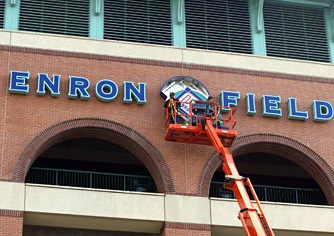
Sometimes those naming deals backfire, you know?
Scott K. Ginsburg, a media mogul who got a J.D. from Georgetown Law Center in 1978, had been wooed by the school’s development team for a major gift when he was riding high, amassing billions in the 1990s. He agreed to contribute some pocket change–five million bucks—to build a new fitness center that would bear his name. The deal was put into writing, and the University issued a cheerful press release. Then, in 1999, shortly after the agreement was reached, the Securities and Exchange Commission filed suit against Ginsburg, accusing him of passing along inside information to his father and brother. A jury agreed with the SEC, and he was orderedto pay $1 million in fines. After a flurry of appeals, the verdict stuck. (NOTE: In the first version of this post, I implied that this was a criminal case. It wasn’t: this was a regulatory lawsuit, and a civil verdict. A dumb error on my part, and I apologize to readers and Mt. Ginsburg for the misinformation.)
While all of this was going on, the Law Center, understandably, got nervous. Although Ginsburg was not a practicing attorney at the time, law schools don’t like having facilities named after grads who have been found to have violated laws or regulations in high-profile cases. In 2002, then-Georgetown Law Center Dean Judith Areen sent Ginsburg a letter thanking him for his support but also asking to revise the agreement, eliminating the promise of naming rights. Areen said the school would find some way to “honor your gift without generating negative media coverage.” Ginsburg, however, refused to sign on. As the years went by and the school continued to promote his gift as enticement to other donors as well as hitting him up for more money, he assumed the Scott K. Ginsburg Health and Fitness Center was under construction. There’s a fitness center, all right, on the GULC campus, but Ginsburg’s name isn’t on it. Now he is suing the Law Center, alleging that it reneged on the deal.
His lawsuit argues:
“It is now apparent that since 2002, Georgetown not only was not in fact committed to recognizing Ginsburg’s generosity by naming the sports center for him, but each of the foregoing oral and written representations to him about its claimed commitment was false, made only to entice him to give Georgetown more money. In reliance on Georgetown’s false representations and manipulation, Ginsburg donated a total of at least $7.5 million to Georgetown, including his completed original $5,000,000 pledge in the Agreement.”
I am honor bound to write about this one, I’m afraid, though it pains me. Not only am I a Georgetown University Law Center grad, I was also its first Director of Development: if I had been on the GULC staff in 1999, I would have been the one angling for Ginsburg’s beneficence in exchange for naming the fitness center after him. That’s how you hook the big donors.
I don’t know what additional facts the law suit will bring out, but I can say this from experience: the description of how the school handled Ginsburg and his gift sounds very familiar. Institutions try to work bait and switches all the time, getting a contribution for one purpose, then going back to the donor later with a sob story about “changed circumstances” and trying to change the deal, often after the money has been spent. Usually, the loyal alumnus or alumna agrees to whatever is requested. This is why Dean Areen’s letter to Ginsburg made a point of citing his “loyalty.” I can also state with authority that development officers and school officials are stunningly arrogant about such requests, and assume that donors will just waive the terms under which they originally agreed to hand over their millions, because most do. Then the university officials resent the rare donors, like Ginsburg, who insist that a deal’s a deal. The next tactic in the playbook is to wait out the donor, and see if he or she is willing to endure the negative publicity that will come from being so petty as to remind a cash-strapped institution of higher learning that the donor really didn’t give the contribution out of love and generosity alone, but because there was something in it for the donor as well. This is called a quid pro quo, and is the essence of bi-lateral contracts, a concept something one would think a prestigious law school would be familiar with. Finally, if all else fails, the school will go to the negotiating table, hoping it can come up with something that will satisfy the donor’s bruised ego while allowing the school to keep as much cash as possible.
If the facts are as they have been revealed so far, the Law Center is squarely in the wrong. It can either name the fitness center after Ginsburg as it promised, or give the money back. Any other result is unfair and dishonest. I doubt that the negotiations will persuade Ginsburg to forgo what he already has paid for.
And oh, the tales I could tell about some of the other individuals Georgetown Law Center has named buildings after….
_______________________________
Facts: scoopblog
Source: ABA Journal
Graphic: CNN Money
 Ethics Alarms
It has always seemed evident to me that a “donor” who gets his/her name on a building as a result of a “generous gift” (that most assuredly comes with a great big tax deduction) is the epitome of arrogance and self-service. The very definition of the word “donation” precludes such acts — “free contribution, gift”. Generosity and altruism are required for the label of “donor” to apply. The simple fact that such a person benefits in such obvious ways negates the very label, in my opinion. Perhaps we should come up with a different word for this behavior that more accurately reflects what it really is. Any ideas?
Anonymous donors are true donors. They donate to help a cause, not to get something out of it.
I mostly agree, but the truth is, sadly, that about 90% of all large donors want the recognition. And it is only good manners to name a building after the donor who funds it. Is it any different if the exchange is merely “understood”? In the fundraising game,, recognition is what the development officer is selling, and the maxim is “Donors give for their reasons, not your reasons.” Do you feel the same about a family honoring a child? The Widener Library at Harvard, the largest collection in the world, was funded by a family gift in the name of a child who dies on the Titanic. Self-service?
No, That was a genuine memorial bestowed for highly unselfish reasons. Can Ginsberg claim the same? It should have been enough for him that he was contributing to his alma mater and to what seemed to him to be a worthy cause; something beyond himself. As the principal grantor, he would have been bound to have had a plaque in his honor in any case. But the naming of the building should be up to the board of regents. That’s just arrogance on Ginsberg’s part. That the dean reneged on the deal only proves that no one involved in it was a worthy personage… and (forgive me, Jack) likely the school itself in its present incarnation.
Ginsberg would have probably have done better with his money to build a number of smaller, newer libraries for some towns that can’t afford them. Then he’d have a bunch of plaques in his honor… and the honor would be for real.
I don’t think it is fair or wise to critique the motive or manner of philanthropy, or the desire to name what one pays for. Walt Disney didn’t have to name his park after himself..that was pretty audacious. He wanted to create something, and he wanted a monument and a legacy. That’s fine. I wouldn’t trust any board of trustees to do justice to a donor without a prior commitment, and Ginsberg is asking for nothing that isn’t usual practice. The main Building is called McDonough Hall, because McDonough’s money paid for it. The library is named for Edward Bennett Williams…same thing. There are buildings all over GULC named like this. When a development officer or a Dean, from any school, anywhere, asks for big bucks, the name and recognition is part of the package offered. No lawyer, and no GULC grad worth his diploma, is going to stand for his own school breaking a contract with its own alum. Nor should Ginsberg.
On the other hand, Disney was the originator and the guiding light behind the entire concept of Disneyland. And it was his money alone that built the other theme parks that followed. Ginsberg gave nothing but his money… and from whatever means he used to obtain it! If an institution wants to name a building after a destinguished alumnus- graduate or not- that’s their option. Georgetown’s sin was in promising and not delivering. We’re agreed on that. But when Ginsberg made his offering on the stipulation that the library was to be named for him, he didn’t raise himself to the level of moral paragon, either.
Since when is raising oneself to the level of moral paragon the criteria for having the right to have commitments honored? And the legitimacy of Ginsburg’s money has never been questioned: he was an much of a creator as Disney, just in a different field—they didn’t buy what he and his partner built for billions because it had no value to society or the world. Insider trading is a weird area that nobody is very happy with—a man can’t allow his family to share in business opportunities–we actually punish people for that. This instance was a very close call, decided on preponderance of the evidence, the civil standard, not beyond a reasonable doubt. This alum is no more or less worthy than any other, and he’s already enriched the school. They owe him gratitude, and need to express it.
And Georgetown should have followed through on it’s commitment. I just don’t think it’s becoming of someone to insist that anything be named after them. That should be an honor freely bestowed.
Well, but if it’s an honor that’s fairly earned, and should be bestowed and isn’t, it isn’t unreasonable to feel mistreated. One needn’t demand a Thank-you for a gift, and that should also be freely bestowed. But if it isn’t, it is a slight, and the one who is slighted has a right to feel so.
Like I said, he’d have every right to expect and receive a plaque on the doorway honoring his contribution. But naming a major building for anyone is a major consideration. It’s like conferring immortality on someone.
I don’t think there is anything wrong with a building being named after someone who donated the money. I think it very fitting that Carnegie had his libraries and his foundation named after him. The same is true of Nobel. This is how wealthy families and individuals show that they contribute to society, their alma matters, and their communities. It also sends a message that this is proper and appropriate behavior for the very wealthy. What really bugs me is when they rename such buildings. At my alma mater, the undergraduate library was donated by John D. Rockefeller. It was very modern-looking when built, but by the 80’s it just looked out of date. A donor was found to put a brick facade on it and they renamed the building after that donor. I would throw a fit if I were the Rockefellers. The Rock is still there, it is just called Shapiro now.
Wasn’t Yale’s namesake basically a pirate? If Georgetown doesn’t want to be the beneficiary of modern day pirates then they should give the money back. Of course they want it both ways, taking pirate money and not acknowledging where the money came from. I think Georgetown should honor the agreement or future pirates will be unwilling to donate. Wow, no honor among thieves these days.
For reasons you should understand, I pay as little attention to Yale as possible.
A couple of points. People gifts gifts from their hearts — but also from their egos — and everyone who has ever raised a dime for a 501(c)(3) knows this. Changing the deal on Scott Ginsburg is unconscionable… especially to ignore that issue and then hit him up for MORE money later (!).
Let’s face it, the biggest foundations in the world (Ford, Rockefeller, Carnegie) were set up by the descendants of 19th century robber barons, who assuaged their guilt by “doing good.” Even the Joseph P. Kennedy Foundation (named for Joe,Jr.) was basically funded by a man who made his fortune bootlegging during Prohibition. If the Nobel Prize, as another example, survives long after people remember that Nobel himself invented nitroglycerine, which assisted in dozens of wars, why then can’t Georgetown just wink at Ginsburg’s civil/legal problems? We wink at all the others. And to go back and have the unbelievable chutzpah to ASK FOR MORE after reneging on their deal is amazing. But development officers (and apparently deans) are mostly savvy, and usually get away with sob stories/excuses for spending designated gifts in undesignated ways. Why do you think Harvard has an endowment that is as large as the 10th largest country in the world? They don’t need more money,but they get it, because they have a core of wealthy alumni and know how to make a case for need they don’t really have… (They also pay their investment managers upwards of $1 million a year…)
If Georgetown is so damn ethical, they really ought to set a policy to “vet” every single gift they get, so they can obviate any tiny semblance of possible problems or embarrassment. Of course they won’t do it: They want the money. And then they treat their donors like (pardon me) shit.
If by robber-barons you mean the guys who’s business savvy reduced costs to consumers ridiculously, thereby making items once affordable to the well-to-do available to the masses, then sure…robber barons.
Or maybe the guys, who in their own lives were unequaled philanthropists and civic givers….then sure…robber barons.
It’s vitriolic class envy phrases like that that discourage entrepreneurship and breed envy between those who don’t try to succeed and those who do.
I have money. I own my own business. I give to charities. The term robber baron (do your homework on the people I’ve listed above) is apt — for the original people I mentioned specifically. You notice I didn’t mention Henry Ford (who invented the assembly line and made automobiles available to average Americans by the millions), or Walt Disney, who advanced science, entertained millions, and never hurt anyone in the process. Do your research on the others.
Agree with the general point, but Ford and Disney were hardly saints either. Especially Ford—think labor union-busting.
Yeah, he wasn’t a fan of labor unions. Funny thing though, last I read, his non-union workers were better paid that his union competition.
I agree that “hired thugs to beat the crap out of” accurately alternates to “not a fan of…”
You did mention Ford.
You also mentioned Carnegie and Rockefeller: Two men who, vilified for success, gave more to charity, philanthropy and civic virtue than can be imagined.
Along with making sure THE MASSES were able to purchase things previously only available to the well to do. How is that not virtuous?
Nobody’s arguing against that proposition…just that in addition to that, these guys exploited the hell out of workers when they could get away with it, used unethical business practices to crush competition, were generally ruthless, venal, and would step on their grandmothers if she stood between them and a nickle. Their philanthropic deeds run afowl of the Ruddigore Fallacy—virtue isn’t a bank account. They had a lot to account for, and most of them, like Carnegie, knew it. I don’t think Rockefeller had an ounce of conscience in his whole, wrinkled body.
You make an assumption that they felt massive guilt for what you then must assume they saw as an evil way of living, if you brush off their philanthropy as merely paying off what they had to “account for”.
That goes against a typical generosity we see you offer up to everyone’s spoken intentions.
Based on my readings, these captains of industry had one pressing goal: lower the cost to the customer. They had several side goals as well: take care of your workers and expect the best of them, eliminate inefficiency.
Yes, it is easy to fall into the narrative that these guys were evil, but hey, we need that anti-initiative bias in education to help stifle “The willingness to take great risks for important goals and objectives…”.
I don’t know that they all felt guilt—I think their families did, as their reputations tarnished over the years. I do know I didn’t claim they were evil, but they were not nice guys, and they did exploit workers, and they were uniformly ruthless. No biographer of any of these men, or even Edison, would deny that. This was rough industrialism before any regulations or laws, and pretty much is how most ambitious, smart, hard-working entrepreneurs will act if you let them run amuck. By the end, they knew their legacies were tarnished by new progressive values in the culture, that social Darwinism had been discredited. If you want to argue that this had nothing to do with their late entry into philanthropy, OK, it’s a theory. I don’t buy it, but in any event, it doesn’t transform them into what they were not.
texaggo4:
I did mention Ford as a robber baron, that was a mistake, and I retract it. I DO NOT retract Carnegie, the first Rockefellers (though his descendants were model citizens and gave generously of their time and money), or Joe Kennedy Sr (whose descendants were NOT like the Rockefellers. Look up the Astors, e.g. So, Ford, despite his dislike of unions, does NOT fall into the robber baron category. The rest do, if you do your research. It’s not the descendants I categorize, it’s the 19th century self-made billionaires that I was talking about. If you look up some of these early family founders, you will see that I’m right, and that it was their children and grandchildren who acted to make up for the sins of their forefathers.
I’ve done my ‘homework’. I’m pretty well read on history. Thanks. I don’t share your conveniently filtered view on things.