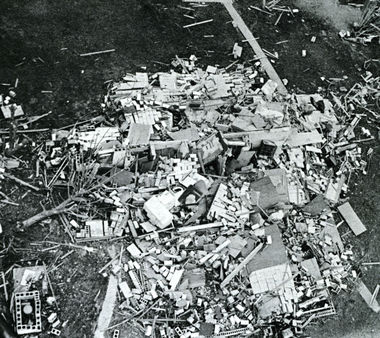
A home in Tanner, Alabama, after the events of April 3, 1974…
Here are the always thoughtful and often profound Fattymoon’s reflections, in the Comment of the Day, inspired by the post, Ethics Dunce: Photographer Jill Greenberg:
“This reminds me of the time I made a critical decision, on the spot, while covering the aftermath of a killing F5 tornado at Tanner, Alabama the night of April 3, 1974.
“Walter McGlocklin was walking away from me, carrying one of his two surviving daughters. He was cradling this little girl, her upper body and tear streaked face peeking just above her father’s right shoulder. The look of utter horror on her face! The lighting was perfect, an eerie cross hatch of flashlights and spotlights – I KNEW I had the picture of the year. I raised my Minolta 35 mm and focused in. And that’s when it happened. Something inside me said, Do NOT violate this little girl’s privacy. Do NOT allow this little girl’s unbearable pain to act as fodder to sell newspapers across the country. I slowly lowered my camera. It’s a decision, one of only a very few, of which I will forever be proud of.”
_______________
 Ethics Alarms
Maybe.. Photos of children in pain convey a very powerful message that the world can relate to.. And it can have an enormous impact.. Remember Phan Thị Kim Phúc, the girl in the picture of the Vietnam War? I’m sure that picture could be considered exploitive, but what was the impact?
http://en.wikipedia.org/wiki/Phan_Thi_Kim_Phuc
I would say, “So what?” Find another way to make the same impact without exploiting a child who would obviously not want to be seen, world wide and forever, in that condition. The ends don’t justify the means, and the Categorical Imperative and Golden Rule apply.
This is an easy call for me. And I don’t believe for an instant that the photographer would have taken that photo if the child wasn’t foreign, Asian, and a stranger.
Photo was taken by Huỳnh Công Út, known professionally as Nick Ut, was born in Long An, Vietnam. So I would say he was taking pictures of his own people. To his credit he did take the girl (who was badly burned) to the hospital before delivering his photo.
http://en.wikipedia.org/wiki/Nick_Ut
And there are plenty of pictures of Holocaust children taken by Jewish Photographers, photos of poor American children living in squalor… All these pictures have had an enormous effect on people because they are universally sympathetic…. Would have to say the world as a whole is better off knowing/seeing this type of pain exists.
1) I should have known that about the photographer, and probably did once.
2) It makes the photo arguably worse.
3) Exploitation is exploitation. The simple answer is, as with torture and other per se unethical things, “Find another way.”
Rationalization. You think that the photograph was wrong, so it must have been done by an exploiting outsider. Once you find it wasn’t an outsider, you should have considered that maybe you’re wrong, and that the photograph was exploitive. Instead, you just attack the photographer more.
I don’t think that documenting existing tragedies is exploitation. If the photographer published the picture anonymously, would their still be exploitation? If these pictures are exploitation, I don’t see how squalor or tragedy could have be non-exploitively documented.
Bullhockey. The photograph was wrong, and I wrongly assumed that only a foreigner would be willing to humiliate an Asian girl for a sensational shot. Now I know a countryman didn’t give a damn about the girl either. Hmmm…which is more disgusting? I’m happy with either candidate.
Then you put words in my mouth. I never said, suggested nor believe that “documenting existing tragedies” is exploitation. I do believe, because it is true, that taking photos of people, especially children, that are recognizable and identifiable for the purpose of showing their pain and horror and publishing them without their informed permission and consent, and profiting thereof, is unethical and exploitive, and extremely so. The case under the discussion is a perfect example. Being napalmed wasn’t bad enough for the girl—the photographer had to ensure that she was displayed fully naked and exposed on the worst moment of her life to complete strangers all over the world, defining her life and identity, without her consent.
If that’s not exploitation, I don’t know what you think exploitation is.
Bullhockey. The photograph was wrong, and I wrongly assumed that only a foreigner would be willing to humiliate an Asian girl for a sensational shot. Now I know a countryman didn’t give a damn about the girl either. Hmmm…which is more disgusting? I’m happy with either candidate.
He took the girl to the hospital. Your claim that he “didn’t give a damn about the girl” is clearly contrary to reality.
Then you put words in my mouth. I never said, suggested nor believe that “documenting existing tragedies” is exploitation.
I didn’t put words in your mouth. I said that your logic seems to lead there to that conclusion, which I think you would disagree with. I apologize if that was unclear.
If the problem is the pictures forever tying the people to the tragedy, then pictures of locations that can be tied to people do the same thing. No pictures can be taken of any part of a tragedy without the proprietor’s informed consent. It’s generally impossible to get informed consent from people who are recent victims of tragedy or who are victims of squalor. The shock of tragedy and the life limitation of squalor preclude such from existing.
—
We should also be clear on what is meant by “exploitation.” If I, say, save a child from a burning car and get asked to do interviews and late night talk shows, exploiting my popularity to show that atheists aren’t necessarily evil isn’t a negative. I’d say there is exploitation in the case of this photograph, but it isn’t negative exploitation.
Taking her to the hospital was nice, and unrelated to exploiting her distress and nudity while making him an award-winning photographer.
The problem is using identifiable photos of children without their consent, when the actual news event wasn’t specifically about them.
What does it matter if the picture is of them directly, or of things that tie back to them?
Please ive me a bit more exposition here. What kind of situation/photo are you referring to in the last part?
I’m pivoting off this: “I do believe, because it is true, that taking photos of people, especially children, that are recognizable and identifiable for the purpose of showing their pain and horror and publishing them without their informed permission and consent, and profiting thereof, is unethical and exploitive, and extremely so.”
It seems to me that your problem is with tying the person to the horrible event. If that’s the case, though, then a picture of a bombed house or the stripped land after a tornado would be just as problematic. A picture of a burnt out house may be recognizable and identifiable of a specific child. A picture of a flattened block could be recognizable as tying to a dozen children. Your rule seems to bar taking pictures that most people would consider okay.
Of course, I could be misinterpreting you, or you could have a different argument than the one you’ve provided so far.
I am only talking about direct, identifiable photos using the images of children who are not specifically the reason the story is newsworthy for dramatic effect. I think the burned and naked Vietnamese child is a borderline example, but over the line. If a girl is kidnapped and recovered or is rescued from a well, she is a news subject. Showing the photo of a terrified girl to show the devastation of a tornado, however, without the child’s consent or compensation, is like that artist who takes photos of his neighbors in their apartments and sells them. Plane crash narrowly missed two children–photos of kids acceptable without consent. Taking photo of horrified child onlooker after plane crashes into the street? Exploitive and a violation of privacy, requiring consent.
There is testimony on Capital Hill by stars asking for legislation preventing their children from being photographed by paparazzi. I think the objective is similar…I think photographing and publicizing the un-named crying kids in the park is worse, however, and an easier call.
Clearer?
Jack,
What needs to be clear is the reasoning for why “direct, identifiable photos using the images of children (who are not specifically the reason the story is newsworthy) for dramatic effect” are unethical. I think your previously explained reasoning also applies to photos that aren’t directly images of children (or other non consenting people), but that could identify children (or other non consenting people.
I agree. Find another way. That goes for pictures of animals in distress as well.
Animals? No privacy, embarrassment, need for consent…How do you figure?
I’d assume wyo figures that instead of takign a picture you should help the animal in question- the problem isn’t with the picture getting out, but with what you were putting off doing in order to capture the picture.
I just don’t like how manipulative it is.
Exploiting the viewer’s emotions doesn’t seem to be Jack and Jeff’s argument.