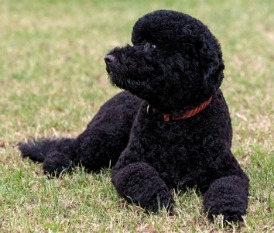
One aspect of being President that cannot be much fun is knowing that anything you do in your very public private life has the potential of permanently altering the culture, like the book about Chicago gangster days left on the developing planet in a famous episode of “Star Trek.” President Kennedy didn’t wear hats because of his bodacious hair (all the better to shag those young girls), and ruined the U.S. fedora trade. Bill Clinton announced that oral sex wasn’t sex after all, and millions of U.S. junior high school students took the hint. Now President Obama and family are being called poor role models because they adopted a new pure-bred puppy from a breeder rather than finding an appropriate rescue dog, as animal welfare activists constantly urge us to do.
Once new Presidential Puppy Sunny was announced to the public, the canine activists barked. Wayne Pacelle, head of the Humane Society, gently chided the President for not adopting a rescue, while using the adoption to stump for other policies as well. This is both expected, routine and to some extent, unfair. It is true that if the President got the First Dog from a shelter, it would probably work to save the lives of many abandoned or abused dogs, present and future, who otherwise would be destroyed, the power of the President’s visibility and cultural magnetism being what it is. Still, Pacelle is making the Obamas targets of protest in order to hitch a ride for his organization’s pet projects (I apologize for that one) and get publicity. It worked. Kick the First Family, make a point. I’d say this is justifiable on utilitarian terms: the puppy controversy is the least of the President’s problems, and Pacella’s job is to save dogs.
The rescue vs breeder campaign is misleading, however. I endorse the adoption of rescue dogs, but the issue is a more than a little distorted. What is Sunny, chopped liver? Whether she was bred in a puppy mill or the unwanted offspring of a backyard affair, she’s still a living, breathing dog, with as much right to a loving family and a safe place to live as any other dog, including one from a shelter. If every dog owner adopts from shelters and rescue organizations, presumably nobody adopts the Sunnys (this is a zero sum game, you know). Then what happens to her? Presumably she gets destroyed…or sent to a shelter, where she is officially purged of the curse of her origins, and now can be adopted without shame.
True, the Obamas missed an opportunity to highlight all the lovely dogs, presumably even some pure bred Portuguese water dogs like Bo and Sunny, awaiting adoption at shelters across the country, and to make having a rescue dog cool by virtue of Presidential preference. They did not, however, do anything wrong by adopting Sunny…just ask her.
Interestingly, the Obamas (or one of their livelier-minded aides) saw the controversy coming, and made a pre-emptive strike by donating to the Humane Society in Sunny’s name before the doggie poop hit the fan. I just heard a morning radio jock say that this proved that the Obama’s “knew they had done something wrong” and wanted to “make it right.” Well, as I just pointed out, they didn’t do anything wrong. They did guess, correctly, that animal activists would say they did something wrong, and thus made the donation.
Yet this kind of gesture does not, can not, and never does “make it right” when genuine wrongdoing is involved. The Humane Society donation is a wonderful example of the Ruddigore Fallacy at work, which I have mentioned here in the past. “Ruddigore” (1887) is the Gilbert and Sullivan operetta that followed “The Mikado.” It’s a wonderful, funny parody of Gothic melodrama involving the travails of a blue blooded family, the Murgatroyds, who labor under an ancient curse that compels the oldest male in each generation to commit a crime a day, or die in agony. The current inheritor of the curse, Despard Murgatroyd, thinks he has figured out a way to save his virtue:
“I get my crime over the first thing in the morning, and then, ha! ha! for the rest of the day I do good! I do good! I do good! Two days since, I stole a child… built an orphan asylum. Yesterday I robbed a bank…and endowed a bishopric. To-day I carry off Rose Maybud and atone with a cathedral!”
W.S. Gilbert assumed that his audience would see the humorous flaw in this thinking, but as the Obamas showed, it still has real world appeal.
The Ruddigore Fallacy is the reverse of rationalization known as “ethics accounting,” in which someone with a distinguished record of good and unselfish deeds decides that he is owed an ethics pass or ten, because he has so many ethics points in his account. In the Ruddigore Fallacy, the wrongdoer thinks that he can erase the stain of misconduct with a timely deposit. No. Unethical conduct is properly evaluated on its own; it is not greater or lesser because of unrelated deeds.
_________________________________
Sources: Christian Science Monitor, Humane Society
Graphic: Humane Society
 Ethics Alarms
I guess the point of the shelter animal advocates is that if people stop demanding dogs from breeders that the breeders would stop breeding.
Bu
But I like your point about what happens to all dogs that are bred and now unadopted. They would possibly get put in a shelter, which seems to go against the desires of the advocates.
I guess the point of the shelter animal advocates is that if people stop demanding dogs from breeders that the breeders would stop breeding.
***************
That IS their point.
If there was no demand for the dogs, people would stop breeding them and less dogs per day would be euthanized at shelters because dog buyers would then become dog adopters.
If you really look into the situation, look at the numbers, go in and look at the conditions and how desperate the waiting animals in cages are, you will be sick over it for weeks.
In fact, I’m still sick over it YEARS later.
It is that bad.
I’ll tell you this much: an animal you take out of that situation is forever grateful to you.
But again, from the point of view of the dog, its still a zero sum game. Why is Sunny less worthy of adoption than her pound puppy equivalents? We don’t judge human children that way, and the cruel fact is, this is and will always be a zero sum game, unless we outlaw breeders.
The ethical problem is not the adopters, is it? The ethical problem is owners who take on the responsibility of a dog and them abandon or abuse it, and those who don’t spay their animals. Of course, if everyone spays their dogs and we outlaw those evil breeders, there won’t be any dogs at all.
Hmmmm. Is a puzzlement!
But again, from the point of view of the dog, its still a zero sum game. Why is Sunny less worthy of adoption than her pound puppy equivalents?
*********
She’s not.
The idea is to stop any more Sunnys from being born at all.
Stop creating more dogs of any kind because the shelters are already overflowing with dogs nobody wants.
So…if you want a dog, get one that is already there.
Also as you mentioned, people need to take responsibility for their actions: spay and neuter your pets, don’t adopt a pet that is not right for your lifestyle, and don’t dump him when you decide to have a baby or when you get sick of caring for him.
Really, the whole mess is created by people who still think of an animal as something you own like a cell phone.
Unfortunately, it is the animals who suffer because of it.
(I typed that with a 14 yr old Calico cat in my lap – a cat who was rescued from neglect and abuse. Try it, it is good for your soul.) 🙂
There are days where my cat might really be the only thing that keeps the murderous rage at bay…
Valid summary of market relationships. But the problem would then be convincing the sub-set of a consumer population that wants a pure-bred such and such to give up their value proposition and settle for a different product. That clinical explanation is cold and calculating when referring to loveable cuddly animals, but it exists nonetheless in people’s minds when they go searching for just the right dog or just the right cat in their mind.
You’d have to get people to make the cultural leap of considering animals the way we ought to consider humans: that phenotypic differences shouldn’t matter. But that will seem very odd to those people who want specific qualities in specific breeds. Some people like dogs (to take a particular pet) for their friendliness (which certain *breeds* show a proclivity for), some people like specific dogs for their better than typical sense of smell, some people like dogs for aggressiveness or pursuit of game purposes.
I can be sympathetic with views that encourage adopting rescue animals vs going purebred. Our dogs are all rescues: one a mix-breed from an agency and the other two, almost pure labs that escaped from somewhere with their pack as puppies. The pack (2 adults and 4 puppies – only about 12 weeks old according the vet we asked later) were running down a busy street chasing a jogger by my wife’s work. Two of the puppies, a black and a yellow, stopped chasing and soon were left behind by the pack. They ran rampant through the parking lot and through the busy street. They ran straight to my wife when she parked and she ignored them initially, figuring the owners would come get them, but after her work day (which was hours and hours later) she came back out and the puppies were still there. She got into her car and they both jumped in after her. Of course I came home and she immediately prefaces our greeting “don’t be mad at me”. Given the residential density of that area, we figured a search of the owners would be futile, so we said “finders keepers”. Jack may have ethical qualms over that. So, that’s how we got our 3 current ones.
I agree with your sentiment, but I think your last line credits too much human emotion to the rest of the animal kingdom. I haven’t met an animal yet that knows what gratitude is (not that they don’t know what it is either, because it isn’t an animal emotion). That’s purely projection to put that human emotion/attitude/psychology onto the other animals.
True, but I don’t think its too much of a leap to assume that any living thing “prefers” being alive than dead, well-fed than hungry, miserable vs. comfortable.
Types of dogs do matter. Many of those abandoned dogs in shelters are abandoned because they were badly matched to their owners. Don’t get a mastiff if you can’t physically handle one. Don’t get a terrier if you want piece and quiet. Don’t get a Basset Hound if you don’t know how to train a dog. Don’t get a boarder collie if you don’t have a job for him. Don’t get a pitbull if you live in Cincinnati. The Obamas want a hypoallergenic dog…that limits the selection.
The phrasing of the Humane Honcho’s blog post was actually right on: CONSIDER a rescue. But a rescue isn’t always the best course.
Well, Obama did say in ’08 that if they got into the White House he’d get a shelter dog…
That people ever expected even that promise to be kept still astonishes me…
Did He? I didn’t remember that. Well, he said that chemical weapons would be a “red line” too. You know…they’re just words.
http://www.telegraph.co.uk/news/worldnews/barackobama/5154973/Obamas-criticised-for-breaking-promise-of-adopting-dog-from-shelter.html
Ah well… It lasted longer than some of his other promises, at least…
That’s purely projection to put that human emotion/attitude/psychology onto the other animals.
**************
I don’t know about that.
My rescued pets are/were always different from the pets I owned from the start.
The other thing the shelters and rescues are trying to put a stop to, with the purebred dogs, is the puppy mill and the backyard breeder.
Since these situations are not good for the animals.
A quality breeder with references and experience is the way to go.
This is the point. There is nothing wrong with going with a reputable breeder. That being said, it would have been nice if Obama rescued a dog or cat, it would have brought attention to this problem. And it is a huge problem — dog and cat populations are soaring. And, he could have educated people about the evils of puppy mills. I’ve had both rescues and purebreds, I think if I were in a position of power, I would absolutely rescue if I wanted to add another pet to the house.