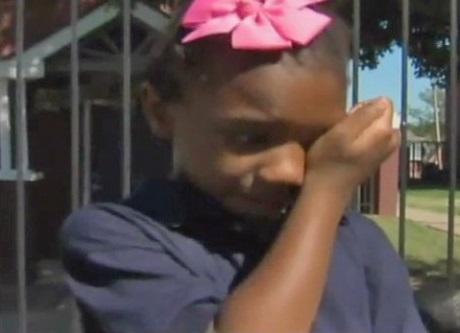
“Quit being so distracting, Triana…”
Deborah Brown Community School in Tulsa, Oklahoma forbids its students from wearing their hair in dreadlocks, afros “and other faddish styles.” Terrence Parker, a barber, challenged the rule by sending his 7-year-old daughter Tiana to class there wearing her hair in dreadlocks. She was told that she could not attend school with her hair in a (stupid and ignorant) rule-violating style. Tiana is now attending another school, while the story, reported on the web in various sources, is holding the school up to well-earned ridicule for a dress code that if not racist in intent, is racist in impact. Eventually, I would think, the school will be shamed into seeing the error of its ways, which is enforcing an inappropriately narrowly-viewed, culturally-biased interpretation of what constitutes a “presentable” hairstyle as opposed to one that might “distract from the respectful and serious atmosphere [the school] strives for.”
This is the way unethical rules get changed. Parker confronted the rule by violating it, and accepted the penalty while publicizing the unjust rule to the greater community, which is making its disapproval known. To those who criticize his conduct, saying that he knew the rules his child would be subjected to and agreed to abide by them, I say that such discriminatory, intolerant, ignorant and offensive school rules harm the community by their continued existence, and Parker’s approach is the most effective and most ethical way to oppose and kill them. Quietly, or even noisily, refusing to send his daughter to that school would simply not get the same degree of attention as first having a seven year-old child be told that wearing her hair naturally was disruptive.
It is unclear from the news reports whether Parker knowingly sent his daughter to the school with a non-conforming hair style. Ethically, I don’t think it makes much difference. If he knew about the rule, as he should have, then he would have been right to view it as unenforceable and not worthy of his respect. If he had forgotten about the rule, the school was still wrong to inflict it on his daughter.
Yet I am very troubled by using a seven-year-old as the engine of civil disobedience here, if that is what happened. It is, on its face, unethical. A young, very young girl may have been intentionally traumatized to make a valid ethical, political and cultural point. I hope that Terrence prepared Tiana for her role (she was too young to consent to it), and minimized the predictable harm to her self-esteem and psyche. If he did not or could not, then his conduct violated an important ethical principle (the categorical imperative: never use human beings as a means to an end) to achieve an ethical result, always a tricky balancing act. When a seven-year old is turned into cannon-fodder on the ethics battlefield to achieve it, it is a trade-off I cannot condone.
Except for the significant flaw of the child’s age, however, this is the right way to challenge and defeat unethical laws, rules and cultures. If Tiana were 18, it would be perfect.
_______________________
Pointer: Jennifer Richter via Facebook
Facts: Huffington Post
Graphic: Raw Story
,
 Ethics Alarms
Poor little thing. I hope her dad was not complicit in her having to face down school authorities. That really catches me the wrong way, if that is what happened. As you said, if the kid was older, I think it would be OK.
Looks like the school is a charter school, so I guess they get to make up their own rules? I am not all that familiar with them, but they appear to be some sort of hybrid of public and private school? Looks like it is centered around African-Americans as well, so I am very surprised at the description of some of the hairstyles mentioned as being “faddish.” At least some of them have been around my entire life.
I was waiting for you to mention the father’s use of a seven year old to make his point. That makes it unethical in my book. As a teacher I see far too much of parents using their children this way and it almost always has bad consequences for the child.
I had a different opinion before I read your piece, Jack.
You have persuaded me you’re correct, despite wyogranny’s very valid concerns.
Just out of curiosity, what was your first take?
Oh fucking bullshit.
What? What do you call making a rule that says that black kids can’t have their hair, like, the way it naturally grows, and if they do, it’s distracting? And while we’re at it, that dark skin color can be distracting to kids who have never seen it before. Better do something about that, too..
This is just a guess on my part, but I think AblativeMeatshield means to imply that the dress code is actually blatantly racist in its intent, and that claims to the contrary are nonsense. I myself am having a hard time believing that anyone who isn’t bigoted could support such a rule.
Unless the rules says anything to effect of “Them darkies can have no corn-rows”, to claim it is racist is retarded.
Let us ignore, for the moment, the fact that no one doesn’t like a fucking moron with corn rows, afros make everyone look like a damned clown, and there are maybe four people alive who don’t look like fuckwits with dreadlocks (and one of them is the fucking alien from the Predator movies).
Anyone with the proper hair length or type (curly hair being rather required for a ‘fro) can have any of the hair styles. Hispanics frequently do corn-rows, as do a many white girls.
The fact that blacks often use those hair-styles does not, on it’s face, make the rule “racist”. That is the same sort of argument the government makes in cases like Magner v. Gallagher and Township of Mount Holly v. Mount Holly Gardens Citizens in Action, Inc.
I can’t currently imagine (though in my defense it is late and I’m a couple of beers into my evening) a situation where the arguments based on “disparate impact” theory to not be deeply, deeply flawed.
Are you suggesting that a rule barring “sagging pants” (you know exactly what I mean) would likewise be racist?
I don’t think the analogy to “disparate impact”—which I agree is a crock—is sound, and in the case at hand, were talking about dreadlocks, not corn rows. If a dog show were to ban dreadlocks, I’d say it was biased against Komondors and Pulis. Wouldn’t you? Just try getting an Irish Setter into dreadlocks…
If you are banning cornrows, afros, and dreadlocks, then you are basically forcing black children to either undergo chemical or heat applications, both of which can lead to burns, and in the case of chemicals, have been linked to reproductive tumor formations. I’m glad that this stupid policy was highlighted, but I do feel very sad that a little girl was hurt in the process.
You’re ignorant on this topic. Black hair IS different. If you don’t allow for these hairstyles, kids have to go through extremely painful and frequent treatments.
Umm…I’m not gonna get into that little challenge to the system that Sydney and her mother did, about the yearbook photo.
But this, and your points, made me think of that – and them – again.
Has anyone looked at this school? My initial instinct was that this policy is racist. Upon visiting the site and discovering that the entire board, most of the staff and most of the student body are African-American, my views changed. The rules may be overly stern for me, however the website clearly says that they have a very strict dress code and strict code of conduct. Since this is not a public school, they have the right to employ such standards and Tiana has the right to change schools. If she were ROTC, she would have to abide by such rules too.
All irrelevant, except that it adds really, really irresponsible and stupid to “racist in impact.” If such a rule is racist with a white board and a largely white student body, explain to me why it isn’t racist if the board and students are all black? If the black board decrees that only black children who dye their hair blonde and wear blue contact lenses and lighten their skin with bleach will be allowed to attend, that magically makes a racist policy non-racist? What if the school decrees that teachers call all students “nigger”? Racist? The school’s policies are hostile to black children, but not to white. Is there a name for that which does not suggest racial impact?
It’s a charter school—irrelevant. The policy is wrong.
They have a right to have stupid and cruel policies. True, and so what? We’re not discussing what they have a right to do. They have a right, as a private, sort-of. school, to teach that 1+1+6 and that the sun revolves around the Earth.
The father agreed to the policies. Again..irrelevant. That doesn’t relieve him of the obligation to purge racist policies from the school if he can, or to challenge bad policies generally.
If or when they have a problem with blue hair, mohawks, etc, they would be prohibited too. It is about law and order. Judging by their remarkable achievement rates in a very challenged neighborhood, they must be doing something right. I wish children in my city had a choice like this school. My city has a 47% graduation rate.
Great assembly of rationalizations, and I am especially grateful for “they must be doing something right”, which is an oldie and goodie that I somehow left off. So if they tortured kids, of bullied them mercifully, you’d still give it a pass as long as the test scores were high? Read your own comments! Are you seriously suggesting that stupid and racially denigrating rules led to the schools’ success? Wouldn’t “law and order” regarding logical, fair and sensible rules work just as well—indeed better?
I am at a loss how you can say that I am wrong to consider this a case of claimed “disparate impact”, while at the same time saying it is “racist in impact”.
I’m pretty sure those phrases mean the exact same thing.
They do. The application of it that the courts allow are ridiculously, unethically, illogically broad. SAT tests are not racist per se because blacks tend to have lower scores on them. The criminal justice system isn’t racist because blacks comprise a disproportionately large percentage of criminals. But when a school’s policies only apply to blacks, for the most part, like a ban on Afros and dreads, that’s a fair application of “disparate impact.”
Of COURSE the policy targets more blacks than whites – there are more blacks than whites at the school to begin with.
And again, all three hair styles can be used by whites. Also, there are indeed non-chemical or heat-related measures besides the three prohibited hair styles – either a buzz cut, or pull it back into a sort of ponytail (and both genders can use both, because Ron Glass looked bad. Ass as Shepard Book with his hair pulled back).
Again, would you consider a policy prohibiting the wearing of pants well below the hips to be racist, even though it is mostly black males that adopt that style?
Everyone wears pants. The only whites who wear dreadlocks are the ones who want to look black…it’s a non-serious argument, like saying that banning mini-skirts doesn’t target girls.
Black hair pulled back in a ponytail is an afropuff…also banned. So the only solution for someone with black hair is to have no hair at all. Nice.
Which isn’t so bad, you know….
LOL. I guess there’s that. But I draw the line at shaving little girls’ hair because of some school policy. Seems insane.
And I will also say that the fact that it is a charter school is absolutely relevant – while it is free, it is a school you CHOOSE to attend. The father made the informed decision to enroll his child there, presumably after reading the rules of expected conduct and appearance.
If he disagreed with them, he should not have enrolled his daughter. This is entirely a conflict of his own making, and that he receives any praise disgusts me – he used his daughter for his own purposes (and I suspect his attempt gain).
A lazy, lazy argument. The issue, again, is whether the rule is fair or ethical, and it’s not. Wrongful rules get fixed when they are opposed, not ignored.
The rule is fair if it applies to everyone, unless you are now accepting the argument of those who oppose voter ID laws; that the laws are racist because they affect more minorities than whites.
You’re just being silly and stubborn. This is the wrong field to fight that battle. The lack of ID is not a racial characteristic. Characteristic Black hair is. Targeting racial characteristics for disadvantageous treatment is, in fact, racially based, and racist in consequence, whatever its intent.
The school removed “Mohawks” from it’s restrictions. Also, if the report is accurate, that she “kept her dreadlocks and went to a new school”, then I’m not certain they know what dreadlocks are or we don’t actually know what her dreadlocks looked like. Because, in the reports she is in, she is sporting corn-rows, and is reported that is the hairstyle she got kicked out with. Corn-rows being acceptable, with a picture of a kid with them on the school’s homepage. Something isn’t adding up about the report.
Depending on the extremity of dreadlocks (not an exclusively African hairstyle by the way – as historically worn by disparate cultures: Hindu mystics, Spartan warriors, Nazirites, Picts, Africans and pretty much any culture with hairstyles developed in pre-modern times), an argument can be made that such hairstyles are distractions or antithetical to a professional appearance.
If the school is primarily populated by African American children, as Ablative suggests, and the school administrators were primarily African American and therefore familiar with trends and fads in that culture, wouldn’t it make sense for their rules to focus on their specific little community in that school? Wouldn’t they most likely list hairstyles they have found in the past to be distractions? Wouldn’t those then be the trendy and faddish hairstyles most likely to appear in their school? Yes.
But, my 1st paragraph is the biggest concern, it doesn’t look like they are reporting accurately.
My understanding is that cornrows/braids and dreadlocks are two different styles.
The little girl in the video appears to have dreadlocks.
If you look at the school’s website, it looks like all of the boys have close clipped hair and the girls are wearing different braided styles and possibly what could be considered dreadlocks.
If you read the schools dress code, it is not clear, but it sort of does sound like they mean boys only on the dreadlocks.
So…there is something missing here in this story, not to mention that it is simply not an example of racism…most of the schools teachers and administrators are black, as are most of the students.
The document containing the dress code also contains a parent dress code and behavior code…I thought that was unique.
Click to access SY%2007%20Parent%20Student%20Handbook.pdf
Upon second viewing, they do look like dreadlocks, although short, 6-8″ long dreadlocks. I think a reasonable interpretation of the prohibition, in context of the follow on sentences, that the target of the rule was the long, bushy style of dreadlocks, not her maintained ones.
I stick with the rest of my commentary.
As for white people wearing dreads, ever been to a Grateful Dead show?
Nothing to do with trying to look black.