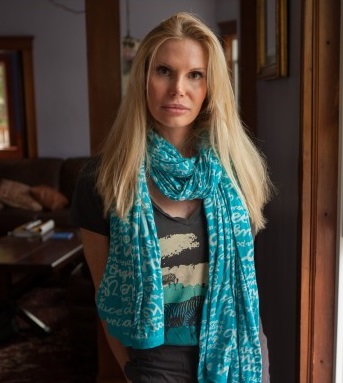
Joanna Leigh
I can not imagine much more heartbreaking plights than that of Boston Marathon bombing victim Joanna Leigh.
By April 14, 2013, Leigh, 39, had a newly minted doctorate in international development, and a promising career as a consultant. On April 15, she was at the finish line of the marathon, waiting for a friend to cross it, when the second of two bombs exploded ten feet from her. She was shielded from the deadly flying metal by other spectators, but still knocked unconscious. When she awoke, there was chaos around her, people screaming, maimed, covered with blood. She helped some injured find help, and then, dazed, walked home. For various reasons, she did not get herself checked out at a hospital until more than a week had passed.
Gradually, however, the symptoms of her injuries began appearing. Soon, it became obvious that the closed head injuries she suffered in the explosion have caused devastating long-term damage to her brain, and it is doubtful that her life will ever be normal again. Today, she says, she has to sleep most of the day. She cannot work or drive, and is easily disoriented, even getting lost on her own block. She has blurred vision, her hearing is impaired and she cannot avoid the constant ringing in her ears. Concentration has become difficult, and the simplest everyday tasks are overwhelming.
The medical and other expenses arising from Leigh’s injuries have reached $70,000, with no end in sight. She is applying for disability payments and food stamps, and selling her possessions to pay bills. She is desperate. Tragically, the local charity set up to assist Boston Marathon bombing victims, One Fund, has turned down her request for help beyond its initial award of $8000.
One Fund, in its efforts to get charitable money to victims as quickly as possible and to distribute the approximate, developed criteria where all the injured except 16 amputees and the families of the four spectators killed by the terrorist attack received funds according to the number of nights they were hospitalized. The first night was worth $125,000; 32 nights netted a victim $948,000. In contrast, the 143 people who, like Joanna Leigh, were treated as outpatients received only the $8,000 each.
Now Leigh and four other attack survivors are petitioning One Fund to develop a new plan for distributing the millions of dollars in donations the charity has received since the first payout, arguing for a formula that will provide them more help, and her lawyer has petitioned the Massachusetts Attorney General to pressure the charity to do so. He argued, in a letter to One Fund, “Donors to the One Fund, to my knowledge, never intended to have their contributions limited in such a way as to leave victims like my client so severely undercompensated.”
I hope Leigh finds the funds she needs, but the aura of entitlement and ingratitude her pleas carry is troubling. One Fund is a charity, and she has no right to receive a penny of its funds. Despite her attorney’s ominous words (hinting, perhaps, at a future law suit accusing One Fund of a breach of fiduciary duty), donors to the charity intended to have their funds distributed to the needy victims of the bombing, and not some precision, infallible dollar to misery index. What One Fund or any charity can provide the bombing victims generously supplements the resources the victims of every other tragedy without high-profile, extensive news coverage and the emotional link to terrorism are limited to: civil damages, insurance, and government assistance. One Fund provides a generous option that the victims of natural disasters, fires, drive-by shootings, domestic attacks, drunk drivers and every other kind of unexpected and random catastrophe do not have. If Leigh is upset that she received “only” $8000 (of money given in sympathy and kindness by her fellow Americans), imagine how those victims who lost family members, children, limbs, sight and cognitive ability in tragedies where terrorism was not involved. When someone else receives a generous and kind gift, which is all a charitable grant is, the ethical response is 1) hurray for the charitable, 2) happiness for those who received the charity, and 3) “Thank you!” These responses—“Why did they get more than I did?“; “That’s unfair–I need some of that money;” and “That wasn’t enough for me; I deserve more” are not ethical, though understandable and perhaps forgivable. They are envious, ungrateful, jealous and selfish.
“I’m really saddened that my society hasn’t rallied to help me,” Leigh told the Post. Pardon me? Society is doing a lot to help her. Insurance has paid $40,000 of her bills; there are government disability programs she will receive assistance from, including Social Security, that will help her; the civil justice system may find her money in the form of tort damages; the press, through the Washington Post, has just given her tens of thousands of dollars of free publicity for her plight that will, I am guessing, probably prompt someone touched by her tragic circumstances and blonde good looks to launch a charity effort just for her. If that charity raises a million dollars or so, should some fat, balding, African-American marathon victim who also found his life shattered with the bomb blast but who didn’t spend a night at Mass General attack her charity for not giving some of its bounty to him?
We seem to be creating an attitude of entitlement in which Americans, traditionally a self-sufficient people who believe in both helping each other and also in accepting personal responsibility for making the best of the hands dealt each of us by life, increasingly are encouraged to believe that they not only can demand government assistance and compensation for misfortunes, whether they are self-inflicted or not, but also the charity of fellow citizens. But forced charity, ordered charity, charity lobbied for and coerced by compassion bullies, media pressure and manufactured guilt, isn’t charity any more. Once we sanction that, we pit the needy and desperate against each other, and charity, like the growing entitlement system in our government, becomes nothing more than another spoils system.
I repeat: the correct response when you receive a thousand dollars from a kind donor and see him give another person in need $10,000 is not “Why didn’t you give me that much?” It is “Thank you! You are very kind.”
There is nothing ethical about charity on demand.
______________________
Sources: NPR, Washington Post 1, 2
Graphic: Washington Post
Ethics Alarms attempts to give proper attribution and credit to all sources of facts, analysis and other assistance that go into its blog posts. If you are aware of one I missed, or believe your own work or property was used in any way without proper attribution, please contact me, Jack Marshall, at jamproethics@verizon.net.
 Ethics Alarms
Exactly right yet again.
Its a scam.That’s Sandra Bullock in makeup. This is all part of an ongoing, highly sophisticated psyop.
“Insurance has paid $40,000 of her bills” is not an example of society supporting her; assuming she paid for that insurance, it’s her supporting herself. The insurance company is paying her money because they’re legally obligated to do so, not because they’re being nice.
In general, I think the answer would be universal taxpayer-funded healthcare providing a “floor” of coverage for everyone, supplemented by private insurance for folks who want more.
You’re quibbling, I’d say. The point is that insurance, part of our society, provides a means to receive help for such catastrophes. It does not have to be free or altruistic to be an example of society helping her out. She pays into social security too, but it’s still a safety net.
We can’t afford a floor, but if we could, I’d support your solution.
Have any of the fifty states tried Ampersand’s solution?
Well, it seemed like you were trying to paint her as a moocher who just wants to live through others; in that context, it matters that she in fact has been providing for her own care, to some extent. So I don’t think it’s just “quibbling.”
I think the barriers to my solution are political, not affordability. We spend far, far more on medical care per capita than any other country, yet we get similar or worse results. Switching to something like the French system would mean that we’d be spending about half the money we are now, for better results.
But the political barriers are pretty large, obviously.
Barry, there is nothing in that post that accuses her of “mooching”—it is about expectations and gratitude. If money is there for her to take or receive, she should take it. The issue is demanding charity, and not being grateful for whatever amount you get. Talk about confirmation bias—what possibly would make you think the post is about “mooching”? If someone sets up a charity for people like her, I’m giving to it. As a donor to One Fund, I would write to it and suggest that they try to find a way to help people like her too…but it’s not for her to force or criticize how anyone chooses to help her.
Apologies for misreading your post, then. I thought that your description of her responses as “envious, ungrateful, jealous and selfish” implied moocherism; I stand corrected.
Regarding “One Fund,” I wonder if they’ve solicited opinions from victims as to how they should disperse their money? I suspect they have. If they have, then I don’t think it’s wrong for her to make her opinion known.
In general, I think that charities that include people they’re trying to help in the process are superior to those that do not. A charity that listens to, and includes, those it is helping is likely to be more efficient and effective. So I don’t agree that “it’s not for her to… criticize how anyone chooses to help her,” when the “anyone” is a charitable organization. I of course agree that she shouldn’t use “force.”
Envious, because she is basing what she wants on what other received. Ungrateful, because she is asking for more, after receiving a generous gift. Jealous, because resents that others are getting what she is not. Selfish, because the funds are not without limit, and she has already received some of them.
None of which involves “mooching” in any way.
Fair enough! I withdraw the mooching comment.
“Switching to something like the French system”
But the French system works in France, and we are not France; heck, I bathed just an hour ago. Saying we could switch to the French system, and implicitly expecting that we would get identical or even similar results, is like suggesting that i could switch (at age 45) to being a mathematician instead of a writer and expect to see the same income. It ignores the cultural, historical, and social elements that make every country unique – not least of which, the resistance there would be (on the part of those Americans who don’t much care for the French system) to its implementation here. As we are learning, having the votes to pass a legislative change to a system once, does not create the political will or the popular enthusiasm to make the implementation of the system a success. (The party line vote certainly didn’t help the political will side of the equation.)
Add to that the real differences in underlying polities, and it becomes clear that this type of facile let’s-just-do-X switcheroo is easy to say but of considerably greater difficulty to actually do.
Remember when Medicare wasn’t ever going to work in the US because Americans would never accept it? Remember, Medicare was incredibly controversial when it was proposed, with major figures (including Ronald Reagan) predicting it would be the end of freedom in the USA. Plus, Medicare required that medical practices and waiting rooms be desegregated – no one’s going to accept that! Although the parties weren’t nearly as separated in the 1960s, It probably couldn’t have passed if there hadn’t been twice as many Democrats as Republicans in the House.
And yet here we are, and Medicare is very popular, especially among those who use it. And every American who is lucky enough to live long enough to qualify for Medicare, seems to make the transition willingly.
And keep in mind, Robert, that the French system isn’t THAT different from the US system. Virtually all doctors in France are in private practice; the system works by making sure that everyone in the country has good health insurance, covering medical and dental. Most French people get their insurance payments automatically deducted from their paycheck, like most Americans. If you want more than the standard insurance package you got through work, you can buy more on the free market (also true in the US today, although most of us don’t bother).
Unlike the US, virtually all French doctors accept all French insurance carriers, so you can walk into any doctor’s office and your insurance will be accepted without any extra fees. There are a mix of private and public hospitals (more private hospitals in France than in any other Euro state), just as in the US.
In other words, what is arguably the best medical system in the world today is actually not all that far from what Americans are already used to. The change to something like France’s system from our current system, would be a less radical change than when Medicare and Medicaid were added to our system.
I don’t think it would be politically easy, but I don’t see any reason to think that it’s not possible.
I didn’t say it wasn’t possible; I said that you were dropping the notion much too glibly, as though it were trivial. Your boys in Congress thought glibly, we’ll win this vote and that will be the end of it. Surely you can see that things were a bit more complex than Team Liberal predicted.
I both agree and disagree. I don’t think that anyone who is wonkish about policy process thought that it was “just pass the bill and then its smooth sailing.” I don’t think it’s just a happy coincidence, for instance, that most of Obamacare’s funding is set up so it keeps on running even during a government shutdown, or that Obamacare starts during an off-year in the election cycle; a lot of people understood that the rollout wouldn’t be smooth and would be resisted.
So I think your caricature is inaccurate, or at least not universal.
But I do think the depth and passion of Tea Party resistance to Obamacare has taken people by surprise, yes. So to that extent you’re right.
I don’t think I actually suggested that switching to France’s system would be trivially easy – you’re beating a straw horse there. It is much easier to bring up ideas in freewheeling policy discussions like this than it is in Congress, but surely that’s the way it should be.
Medicare has unfunded liabilities of around 40 Trillion, pays less than the cost of tests and procedures, and has a higher refusal rate than private insurance.
Please stop acting like it’s some kind of victory. Medicare is why hospitals charge private insurance $40 for an aspirin.
Having had a limited experience with Asian and European healthcare, and extensive experience with American healthcare, I will dispute your comment on the results. I would not want to be treated medically anywhere else in the world. The medical progress that has been made in this country in the last 15 years or so is absolutely amazing, especially so since it has come about in spite of government meddling. The government started to control medical costs in 1985 with DRGs (Diagnostic-Related Groups) which begat medical codes, the bible of medical billing. It took several agencies months to sometimes figure out how to code certain maladies and billing mistakes are still being made. There is too much waste in modern healthcare today partly because of the complexity of the system and partly because government has too much control over something most politicians know nothing about. And we ain’t seen nothin’ yet!
Well, that’s your anecdote. Here’s mine: I just know too many Americans who need health care and can’t afford it to think the American health care system is perfect. I even know Americans who end up doing medical tourism because they can’t afford to get treated in the US.
That said, I don’t put too much stock in anecdotes. In any system that treats millions of people, there are going to be anecdotes that make it sound great, and anecdotes that make it sound awful. There is no system so perfect that no one will ever have a bad experience with it.
Non-anecdotal evidence – that is, data – indicates that countries like France have outcomes as good or better than the USA, while spending much less per capita.
First off, France has far lower survival rates for little things like cancer – their treatment of and their detection of cancers of the prostate and the like are FAR worse than ours (over 90% survival for prostate cancer, while Europe has a rate of only 57%). This is the norm there, and it has to do with the fact that they do not use the treatments we do, and they don’t screen like we do (they don’t use the same tests, and the test less often).
So that gives them a savings right there – if you don’t treat well, and you don’t even bother testing, then you save a shit load on medical costs.
Add in rationing (the UK is quite famous for withholding treatments of you are deemed to be “not worth it”), and you get further savings.
And then you get to infant mortality, where we often get dinged. The simple fact is that we count every single birth, regardless of how early it comes. The UK, for example, has famously denied any and all care for infants born even a day under what they consider to be “viable”. So they not only get to claim better infant survival, they get to save MORE money.
And let’s not forget Canada, everyone’s favorite socialized healthcare system. Not only are they moving to change that, but what they have now is abysmal. Anyone who can afford to comes here for their major surgery, and for infants? Forget about it – their hospitals in major urban centers have fewer resources than Bloomington/Normal and our meager population total of a little over 130k. We probably have more neonatal capacity than the entirety of Toronto.
And then you get to my favorite part of your asinine claim – that they spend less.
No, they don’t. Not only do they have huge taxes to pay for their system, they have reduced their militaries to token forces (to the point they can’t put together an effective battalion for their “EU Response force” they want to have to deal with European issues (like Bosnia and the like), and to the point that our NATO allies couldn’t defend their borders for 48 hours). Their systems are deep, DEEP in the red.
And you want us to be more like them?
Sorry, I’ll pass. I’ll take surviving over “spending less” every day of the week.
Not to mention that it is antithetical to American liberty to cede to the government the ability to control your personal decisions through your health care options. Add to that the possibility of millions of American’s personal medical information and private information landing in the hands of little Edward Snowden types. Add to that, the fear that I’d never want to attribute to an American government, but now the infrastructure fully exists, via mental health and government control thereof to quietly and slowly imprison people without trials who don’t “think right”, via a simple insanity diagnosis and institutionalization. I don’t for once believe America would do that…now…but the infrastructure certainly exists for it.
1) You’re talking about “survival rates,” but that’s not an accurate measure, since every needless diagnosis of a healthy patient – and we have a lot of those in the US – increases the “survival” rate. What matters is mortality rates, not survival rates – and when you look at those, the US advantage disappears. From a Reuters article by Sharon Begley:
If you look at the mortality figures, the differences are small. The US does slightly better on breast cancer and prostate cancer, but worse on many other types of cancers, including lung cancer (which kills more people than breast and prostate cancer combined).
The most meaningful comparison is one called “rate of death that would be amenable to healthcare intervention,” which means deaths among people that good medical care could save (mortality among people under 75 years old who die from heart attacks, strokes, etc). The U.S. figure for this is 96 deaths per 100,000 people; in France, it’s 55 per 100,000.
2. I agree, the UK health care system is deeply flawed. Canada isn’t that great either. We tend to hear a lot about those countries’ medical systems because they speak English and lazy American journalists find it easier to report on those systems, but by worldwide standards they’re mediocre. (But so is the US’s medical system.)
3. You’re wrong on infant mortality. What you’re claiming (and it’s a common claim) is that other countries lower their infant mortality rates by classifying as “stillborn” – that is, born dead – infants that we in the US would count as “infant mortality.”
It’s easy to empirically test your claim, by combining infant mortality and stillbirth rates into a single figure, so that no death is uncounted due to classification. But when you do that, as I did in this post, the US still has a far higher death rate than any other wealthy country. No matter how you measure it, babies are more likely to die in the US than in other wealthy countries.
Also, there’s an enormous racial component – essentially, our infant mortality rate is much, much, higher among black babies than white babies, which is hard to account for under your theory, unless we suppose that doctors in hospitals try much harder to save black babies than white babies.
4. Yes, their taxes are higher – but that is accounted for in the comparison figures. The fact that other wealthy countries spend less per capita on health care than the US is too well-established to be worth arguing about; this isn’t a matter of opinion, it’s a matter of I know what I’m talking about, and you don’t.
To quote the health research site Epianalysis:
YES
What is the average life expectancy in Canada vs USA? And how much out of pocket do Canadian pay vs USA?…. Our health system is an industrial joke of the world… 32 of 33 industrialized countries have a National Health Care system, and they spend less and live longer..
Yeah things are fine they way they were before the Affordable Care Act..LOL
If universal health care was so great, why has not one of the fifty states ever tried it?
What is stopping Hawaii, Massachusetts, or West Virginia from adopting universal health care?
I doubt he’ll bother to inform you that many nations. even the ever-touted French, are all operating their ‘universal’ health systems horribly in the red, to the point they have to cut other government functions. Often to the point that they are considering reforming their systems to be more like ours, even though we have been bamboozled into chasing their socialist pipe dreams.
Citing life expectancy as a measure of health system success is somewhat amateurish. Statisticians know that life expectancy varies wildly and is caused by multiple factors, of which health care systems seem to have little impact. The United States ranks 33 out of 193 nations. Sounds dismal, but just an appeal to emotion. The spread between #1 and #40 is 5 years. The United States comes in 4 years lower than #1. That is hardly significant given that health care has little to no impact on determining life expectancy. The State of Utah and of Nevada have nearly identical health systems and their average life expectancies are spread by 3 years. So much for that statistic.
“I agree, the UK health care system is deeply flawed. Canada isn’t that great either. We tend to hear a lot about those countries’ medical systems because they speak English and lazy American journalists find it easier to report on those systems, but by worldwide standards they’re mediocre. (But so is the US’s medical system.)”
Yet, comparisons to them are far more valuable, because culturally speaking, we are closest to them. Analyzing how universal medical insurance fits into their overall society is very apt in anticipating how well it will fit into our society. As for “worldwide standards”, that’s a joke. Those world-wide standards are a solid set of circular arguments. Most are inevitably derived from getting a higher rating based on having a more governmental solution or having a more forced ‘equality’ system. So no duh the results are skewed when the standards involve dubious rating schemes.
“It’s easy to empirically test your claim, by combining infant mortality and stillbirth rates into a single figure, so that no death is uncounted due to classification. But when you do that, as I did in this post, the US still has a far higher death rate than any other wealthy country. No matter how you measure it, babies are more likely to die in the US than in other wealthy countries.”
No, it isn’t easy to empirically test that claim the way you did. Your sample set of nations is extremely selective to make the United States look bad. Additionally, the other nations’ stillbirth rates still aren’t reliably tracked with any ability to claim your numbers are accurate. Additionally, your numbers fail to include the explanation that the US infant mortality rate is bumped up, because Americans are far more willing to risk bringing a child with known prenatal conditions into this world *because our health care system is so superior* a baby with fetal anomalies is more likely to survive than in another country. To analyze this, you’d need to add to your already dubious numbers the quantity of human beings with pre-natal conditions that people in other nations cavalierly abort ‘for their own good’.
That being said, the difference between 11 and 8 (ignoring all other relevant classes of ‘non-surviving’ infant) out of 1000, amounts to .3 %…read that again: .3%. That is infinitesimally insignificant to attribute to “universal health care” when a wide plethora of other factors impact infant survival rate. Certainly not worth risking the nation upsetting trillion dollar megislation that is Obamacare.
“Also, there’s an enormous racial component – essentially, our infant mortality rate is much, much, higher among black babies than white babies, which is hard to account for under your theory, unless we suppose that doctors in hospitals try much harder to save black babies than white babies.”
I think what you meant to say is there is a ‘socio-economic’ component. You see, you lefties can’t pretend consistency and decry people who say “blacks do worse in school and commit a higher ratio of crime” and demand that people attribute that to socio-economic factors and then turn right around and use race for your own arguments. Of course, it was inevitable; leftists can’t go one discussion without subtly hinting that our system is based on racism (which is what you are doing).
“Yes, their taxes are higher – but that is accounted for in the comparison figures. The fact that other wealthy countries spend less per capita on health care than the US is too well-established to be worth arguing about; this isn’t a matter of opinion, it’s a matter of I know what I’m talking about, and you don’t.”
And yet, their systems are almost all consistently operating in the red. Forcing them to make severe budget changes in other aspects of actual government business, as Ablative has demonstrated to you before. The inefficiencies of their systems have pushed several to begin consideration of a more US style system (all while we are careening towards their socialist systems).
What hasn’t been tried here (and economically known to work) is a market based system. A consumer driven system that compels competition (not between insurers, but between hospitals and providers) will inevitably drive down prices while increasing quality / $ ratio.
you realize how the French system started?
Basically, it grew out of the health care provided by Allied troops in the aftermath of World War II, which devastated France.
Good luck trying to bring about World War III.
Read the headlines in the Boston Herald about this poor ‘victim’ – she was just sentenced for fraud – in addition to a moocher – she is a low-life thief!!
I suspect there’s a confusion here arising from vocabulary.
On the one hand, nobody may demand charity as a right; in this, I follow the 38th of the Articles of Religion of the Church of England (but without the selective editing that can emphasise one limb of it by neglecting the other). I also disagree most profoundly with the Catholic who presumed to tell me that the “ought” in its language was the same as a “must”, and that there was a duty of charity implied in there, so that it was basically empty and amounted to the Catholics’ views on the matter.
However, I do believe that this victim has a perfect right to put such a point to this “charity”, for the simple reason that it is not actually a charity at all but rather the legal framework for giving expression to charity – a distinction obscured by vocabulary. If, say, I sent a cheque to someone for my own motives but the bank for some reason paid it over to someone else with the same name, I would feel that the intended payee was ethically entitled to raise the matter with the bank, as a matter of convenience if nothing else, even though strictly speaking only I would have been wronged. The intended payee would be conveying a better estimate of my wishes and interests than the estimate the bank was using, and more promptly than my own views could be ascertained directly (if, indeed, anyone but the intended payee could ever have known that things had gone astray and so been in a position to seek a correction). Likewise, the victim here is entitled to challenge the “charity”, i.e. the formal organisation, for failure of substratum or similar – for not being or doing what the contributors intended – but not entitled to challenge the contributors for not living up to what the victim supposes charity, i.e. the abstract virtue given actual expression, ought to be. The former isn’t demanding charity at all, but only demanding fidelity to purpose (from which charity would be given expression).
Well said, P.M.
You’re analysis is upside down. If the bank transferred money to someone with the exact same name as the person you intended the money to go to, and you failed to thoroughly clarify your intentions to the bank, the failure is yours. The onus to rectify the error is on you as well, not the intended receiver of the money, lest any person with the same name comes forward claiming to be the rightful recipient. The originator of money knows the full intention for the destination of the money. Should the intended receiver of the money also know that intention, but the originator failed to fully clarify the intent to middle-man, the middle-man has no reason to rely on any individual claiming to be the receiver, but only to rely on the originator.
In your rebuttal, you end with ” The former isn’t demanding charity at all, but only demanding fidelity to purpose (from which charity would be given expression).”
That’s incorrect. The former is demanding charity, because the self-assumed receiver of the charity communicates their preferred intent of the charitable motivations of the donors. The proper correction of this can only originate with the donors…not self-assumed receivers.
‘The medical progress that has been made in this country in the last 15 years or so is absolutely amazing’
But….not everyone can access those wonderful treatments. I won’t go into detail, but the care my parents received was abysmal. From the answers I got when I talked to say, my father’s cancer center, the cutting edge treatments aren’t used on older people. You’re SOL if you’re over 70. If I lived in the US and had the time to pursue it, I would like my father’s doctors’ heads on a platter…and yes, it’s an anecdote, but the attitudes I encountered are, I believe, indicative of policy.
Why would they deny treatment if someone were willing to pay for it?
God only knows. He was treated worse than a dog. Typical responses to calls to the cancer center for nutritional supplementation, or a brace or other treatment for his broken back bones (engulfed by a tumor) were ‘You do realize he’s terminal!?’ and ‘More medication? Those are expensive, we can’t give those out like candy!’ He had clear symptoms of steroid narcosis, because as his weight dropped no one ever adjusted his dosages. I called about readjustment and the nurse practioner who is in charge of answering the phones there said ‘Oh that means the cancer has spread to his brain, his brain is full of tumors and it’s making him hallucinate” *Click* Tumor development advanced enough to cause visual and auditory hallucinations in a brain that was clear on MRI less than a month previously? He was terminal, they couldn’t be bothered to treat him. It was a travesty, unforgivable.
uhh Are you accusing this victim of being unethical, or her lawyer?
Because accusing this women would just seem cruel, given that she has sustained brain damage, as you have stated. She might be phrasing her thoughts much differently than she did before this accident.
And if you’re accusing her lawyer for being unethical, well then you must realize that a lawyer is an ADVOCATE for his client and should take all means legal on her behalf… Sounds like he’s doing his job.
*woman
Note that I didn’t even give the name of the lawyer. It’s her cause, not his. As for her, I’m describing and discussing her conduct. You’re suggesting that she isn’t responsible for it. Nothing in any of the reports suggests that is the reason for her arguments—if so, what’s the excuse of the media reports supporting her efforts? It’s not cruel to describe unethical conduct by the brain-injured as what it is, any more than it is cruel to criticize conduct by the insane or stupid. The post isn’t interested in the reasons why an individual might conclude that charities have a duty to give them more money. The point is, it’s wrong.
I’m sorry Jack but that is fundamentally unfair… Just like you wouldn’t judge a person with dementia, a person with PTSD, a brain beat ex NFL player or a person with a brain injury, you shouldn’t take this woman’s words per se, even if every media circus is circulating it.
The reason I feel ths is terrible unfair is because I had a mother with dementia who said some pretty awful things to my siblings and me…. Just not going to forgot who she was BEFORE her illness.
Now we do not know if this woman would have been as self absorbed before her accident, or as desperate.. I would like to give her the benefit of the doubt that she would have chose her words more carefully, and seem more ethical.
“Because accusing this women would just seem cruel”
Ick Factor, one of the basic emotionalist responses. Her situation sucks, quite thoroughly, but the nature of charity is not that it is an entitlement, it is other people *giving* money and support they otherwise didn’t have to give. To demand more of something that was given freely is the problem here. If there is an issue with how charity is distributed, it’s the problem of the donors to rectify…since authority to determine how their money is distributed is theirs. Since there seems to be little uproar by the donors, it would seem the organization entrusted with distributing the charitable donations are do so in a manner copacetic with donors’ intent.
” She might be phrasing her thoughts much differently than she did before this accident.”
Speculation. Fair speculation, but speculation nonetheless, still doesn’t change the fact that she has demanded more of something that was given and otherwise didn’t have to be given….the root of the problem.
I don’t necessarily see an issue with petitioning the donors for a reevaluation of how the charity is distributed, but her method of going about it…subtle hints of litigation…undermines her efforts.
She’s felt entitled to compensation for “all the good she’s done in the world” for YEARS. Her phrasing is completely true to form.
Pingback: Decent Debate About Health Care Going On At Ethics Alarms | Alas, a Blog
First off, thanks to Ampersand for the link to this discussion she posted on her own excellent blog.
I agree with OP that a sense of entitlement has seemingly altered our perception of the nature of charity. Whenever disaster strikes, it seems to be assumed that its victims are to be compensated either by government or by some kind of bureaucratic charitable entity formed for that purpose. The idea that individual citizens who are motivated to “do something” should give directly to victims seems to have gone by the wayside.
Because of the dual assumptions that (a) victims are entitled to compensation, and (b) such charitable relief must be funneled through some kind of governmental or otherwise bureaucratic channel, we get cases like this in which an obviously devastated woman has slipped through the cracks, so to speak, and everybody is outraged about it.
Seems that, in the interests of trying to cast a wider social safety net, we’ve de-personalized the idea of charity and turned it into a collective responsibility rather than an individual virtue. Victims of charity just want — and indeed expect — a check to arrive in the mail. Donors just want people taken care of — by others — and for their own roles to be limited to writing a check or clicking a mouse.
Chaos of a free market actually can lead to GREATER charitable giving. Don’t show the leftists.
I know this woman. She’s been a liar her entire life. She almost “died” for unknown reasons a month before the marathon. She’s had health, mental and money problems her entire life. She’s a grifter. And not particularly good one.
Then you need to present proof to the proper people.
Gladly and easily. Luckily, she hasn’t taken it that far. It wouldn’t be a wise decision on her part.
There was also never a mention of her being knocked unconscious when I spoke to her. She was fine for weeks after. No one has come forward to say she’s helped them. She’s also quite articulate on her website. She has, and always will, thinks the world owes her.
Well, I think you had this woman pegged. http://www.bostonglobe.com/metro/2015/03/26/jamaica-plain-woman-indicted-for-allegedly-cheating-marathon-victims-fund/guaGwMSCy9wHFSDgK7pqQN/story.html
Why yes, I did!
Oooops! I misread the article and didn’t complete it. You nailed it from the beginning.