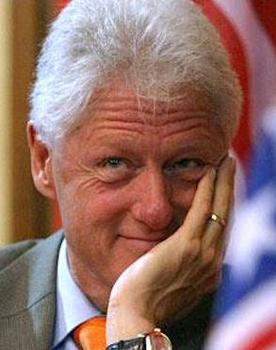
This is almost too much for my mind to handle, and any moment I might just have a cerebral meltdown, like those computers Captain Kirk used to destroy on “Star Trek” by feeding them paradoxes. Bill Clinton appears to have passed the integrity test.
There must be something in it for him.
Clinton, of all people, told an interviewer that President Obama should honor his oft-repeated pledge and allow people to hang on to health care plans that are being canceled as a result of the Affordable Care Act:
“I personally believe, even if it takes a change in the law, that the president should honor the commitment the federal government made to those people and let them keep what they’ve got.”
Of course this would be the right thing to do. But it’s a no win for Obama, who would both get the result he intentionally allowed his law to prevent, and still be lumbered with the proof that he intentionally misled the American public to get his law passed. Clinton making this suggestion is obviously an unexpected boon for Republicans; it took Speaker of the House John Boehner about five minutes to respond,
“I applaud President Clinton for joining the bipartisan call for President Obama to keep his promise to the American people. These comments signify a growing recognition that Americans were misled when they were promised that they could keep their coverage under President Obama’s health care law. The entire health care law is a train wreck that needs to go. And while the two parties may disagree on that point, it shouldn’t stop reasonable Democrats from working with us to shield Americans from its most egregious consequences – like the millions of current health plans being canceled.”
Gee..thanks, Bill!
You wouldn’t have had to read much here to know that I wouldn’t trust Bill Clinton to drop off my shirts at the dry cleaners, so it will not surprise you to know that I am suspicious of his motivations for this. Bill always has an angle. This also raises a persistent, nagging dilemma in ethical analysis: if someone does the right thing for the an unethical reason, is it still right?
My answer usually is yes, and I suppose it is here, too. But Bill Clinton, inexplicably the most popular American politician (but then, consider the competition) , just tossed his party’s struggling President an anchor when he needed a life raft*, while making himself look like the good, wise, ethical ex-leader (I think I just threw up in my mouth)…and I’m wondering why. I have my theories.
What are yours?
* The fair and responsible way to do this, from Obama’s perspective, would have been for Clinton to make that recommendation privately—as Clinton well knows.
___________________________
Sources: Daily Standard, USA Today
 Ethics Alarms
A shame there is no way to force companies to put people back on the policies that they lost…
Jack, lemme tell you something. Milk just went up my nose, and I don’t drink milk. Does this make sense? Course not. All I can say is something is afoot. Like I’ve posted on Facebook several times (and had a midnight visit from Homeland Security because of those posts), Obama is done. Finished. Kaput.
Nope: didn’t read this post either. Just like Barack Obama, I pay no attention to what Bill Clinton says. The Pope and Tim Tebow could decree that Clinton is Jesus Christ returned to earth, and still I would continue ignoring both 45th President Hillary, and Bill Clinton, completely.
Should people still be allowed to pay for a shitty product, most of which don’t actually cover much, if anything, just to keep a poorly worded “promise? Which one would cause he greatest harm, a broken promise, or people who are paying thousands of dollars for a product which essentially does nothing when you need it to?
All health plans must:
-End lifetime limits on coverage
-End arbitrary cancellations of health coverage
-Cover adult children up to age 26
-Provide a Summary of Benefits and Coverage (SBC), a short, easy-to-understand summary of what a plan covers and costs
-Hold insurance companies accountable to spend your premiums on health care, not administrative costs and bonuses
Grandfathered plans DON’T have to:
-Cover preventive care for free
-Guarantee your right to appeal
-Protect your choice of doctors and access to emergency care
-Be held accountable through Rate Review for excessive premium increases
In addition to the above, grandfathered individual health insurance plans (the kind you buy yourself, not the kind you get from an employer) don’t have to:
-End yearly limits on coverage
-Cover you if you have a pre-existing health condition
http://www.courier-journal.com/apps/pbcs.dll/article?AID=2013309240089&nclick_check=1
https://www.healthcare.gov/what-if-i-have-a-grandfathered-health-plan/
“Should people still be allowed to pay for a shitty product…?”
1. Stop right there. The government has no right to “allow” or “disallow” what I think is the best use of my money, and how dare anyone assert otherwise”?
2. It was not a promise. A promise is guarantee of future action, and conditions change. It was a statement of intent, then a representation of fact, neither of which was true. That’s called a lie, not a “promise.” Calling it a promise is also a lie, unless someone doesn’t understand the difference.
Of course the “progressivist” screen of the collectivist movement can tell you what is best for you. Their overriding suppressed premise (and first principle) is that the masses are incapable of choosing what is best for themselves.
1. Stop right there. The government has no right to “allow” or “disallow” what I think is the best use of my money, and how dare anyone assert otherwise”?
All cars must have seatbelts.
Houses must be built up to a certain code.
Foods must meet certain requirements.
Drugs must function the way the manufacturers say they must.
Even if you wanted to use your money to buy one of a shitty product that doesn’t do/have those things, the government won’t allow it. Very few people, except the pure libertarians, have a problem with that.
I can buy drugs that don’t conform to standard, they just aren’t approved by the FDA. Food indeed must meet requirements, it’s why federal law enforcement can go after those villains who sell raw milk. Houses must be built to code, unless you already had an old house that didn’t- then you can get away with certain minor modifications and be fine. The last time we did work at my grandma’s place we didn’t have to replace the ancient wiring because we were replacing floorboards, and when I HAVE helped to bring a house up to code I’ll thank you to note that we didn’t have to evacuate the house and move into Government mandated housing.
Uh, your examples are indeed government doing things to “promote the general welfare”, but they pale in comparison to the government consuming 1/6 of our economy and compelling individuals to devote what could easily be 1/5 of each of their individual budgets.
These are all safety regulations, with direct–direct—impact on preventing injuries or death with reasonable regulations. There is court sanctioned exceptions for such acts, but also an acknowledgment that they should be exceptions only. Only certified individuals can sell certain services, too. But the principle you are defending, that a government entity can interfere with my choices to purchase products and services based not on safety or the prevention of criminal activity but just that it deems the product or service “crummy” is a direct assault on basic human rights. This is why, by the way, the individual mandate could only survive as a tax. The government can ban transfats, but not Cheetohs. (Though I’m sure the Democrats will try, eventually.)
@deery;
Just curious; what do you think the NAIC or State Insurance Departments are tasked with?
Do you have any earthly idea how regulated the insurance industry “was” before all this?
The industry has co-opted the regulators some time ago. And it’s not the insurance industry’s fault. They are there to make a profit. And pretty much the only way to make a profit is to pay out as little as possible by denying claims, making it hard for people to make claims, and making sure you avoid the type of people who are most likely to make claims. It makes perfect sense. But I think their profit motive is in conflict with the general welfare of society, and thus should be strictly regulated to prevent abuses which are commonplace. But I wanted a public option, so I guess there’s that.
You do know that if a business doesn’t make a profit, there is no business, right? If insurance isn’t profitable to sell, then no insurance. For anybody. With logic like yours driving national policies, no wonder things are a mess. No wonder we get corrupt leaders whose primary tactic is misleading the uneducated, half-awake, desperate, naive and gullible. How do people become so irrational? I’d love to find out.
See, here is the problem. If insurance companies drop people when they are sick and only cover healthy people, it isn’t insurance that they are selling.
Nobody is saying that insurance cannot be profitable. It can be. Businesses used to operate with medical loss ratios of 90-95%. The law requires 80 or 85 depending on the kind of coverage written.
I’ve tried to just let you be an utter fuckwit, but I’m getting sick of this bullshit you keep spouting…
And that isn’t what they did, for a couple of reasons.
First, as I keep fucking telling you, MEDICAID rejected more treatments and dropped more coverage than private insurance.
Second, if an insurance company dropped people as frequently as you seem to think they did, they would be out of business because one of three things (or more likely, a couple of them) would happen: 1) the massive regulatory regime would crash down upon their head, and probably end up closing shop due to being facing prison terms and massive fines due to – essentially – fraud, 2) companies would cease getting coverage through them, eventually forcing them to close shop as they ran out of idiots willing to sign up through them, and 3) they would be sued by the people they dropped to force coverage.
But in your way, youre shit out of luck because you can’t sue the government for fucking you over. Sure, in some very, very limited instances you can sue, but those amount to cases where your civil rights are violated, and grandma not getting dialysis isn’t that.
Your entire world view seems to stem from the notion that government knows better than us what we need…
So I guess that means we were right to go to Iraq, right?
I mean, the government said it was, and they know best, right?
You have the righteousness of the anointed, you do. You will justify any action so long as it fits within your idea of what is best for me.
Well fuck you, cuntwad. The day I need some busybody pile of shit like you to make my decisions for me is the days I eat a fucking bullet.
Come on, ablative, good argumentative logic, terrible terrible argumentative execution. Not cool bro.
I do know this. Which is what I’ve already stated. Insurance companies are in the business of maximizing profit by dropping people, denying claims, and making it hard/impossible for the sickest people to sign up for it. It doesn’t make them evil, just logical. All insurance does that, not just health insurance.
But from a broader, logical societal perspective, I have to wonder about it. Wouldn’t it be better to just skip the middleman of insurance companies and have a nationalized health care? Our current method of insurance doesn’t work, and is specifically designed not to work for those that need it the most. Obamacare slaps some bandaids on some of the most egregious offenses (Pre-existing conditions, lifetime limits, etc), but I don’t think it goes far enough. The vast majority of us will need healthcare sooner or later. Yet the cost of it would bankrupt all but the richest among us. There has to be a better way.
As an insurance lawyer, I will again repeat that insurance doesn’t make sense for medical care because everyone needs it. Insurance only works and is truly profitable for things that “might” happen — like a house burning down, a flood, a hurricane, a horrific car accident, malpractice, etc. Everyone needs to see a doctor from birth on — and many things you can’t plan or prepare for, like mental illness, Type 1 diabetes, a premature child, the list is endless. The problem with this debate is that everyone is right to a certain degree. So the only solution is to remove the “insurance” aspect. We need to have a single payer system or a country where you accept a large amount of “casualties” for people who cannot afford basic care and those people who have chronic conditions.
The medical insurance industry, at the end of the day, is really just a jobs program to regulate claims — and those costs get passed on to all of us. There’s no actual benefit to the consumers or the providers.
“The medical insurance industry, at the end of the day, is really just a jobs program to regulate claims – and those costs get passed on to all of us. There’s no actual benefit to the consumers or the providers.”
Beth that’s a lot for me to chew on, but I’ll just chew quietly for now (lucky you, lucky Jack)…
Beth: I gather that you favor some kind of “central health care expenses bank.” That is, a kind of “revolving” account that everybody pays into (and that everybody is required to pay into), all through their lives. Or, maybe more precisely, you prefer an account that payments are required to go into on behalf of every survivor of abortion, for as long as a person lives. (That would require someone who actually earns income, or who has some kind of liquid assets, to pay-in for certain dependents, such as natural children, at least until those dependents can earn their own income, build their own estates, and join in paying-in their own “fair share.”)
You want mandatory centralized investment in health risk management. Correct?
From that bank or account, all disbursements are made to defray the costs of all patients’ health care, at all times. Demand for disbursements would be expected never to out-demand supply, no matter what is demanded and what can be supplied. Controllers of the bank would be expected to control not only the funds in the bank. They would also control the suppliers, their prices, and suppliers’ liberty to supply to demanders. Controllers would probably do (or have done for them) actuarial calculations to determine what each person is required to pay in each month or year, so that the fund is always sufficient, always solvent, always able to balance demand and supply.
Do I get what you are getting at? (I think you have made yourself clear.)
But don’t you see? Can’t you foresee? You are calling for just yet another fraudulently “fenced-off” fund that will get raided and drained, for any and all kinds of purposes besides health care. That raiding and draining would be forever beyond the control of (1) the stakeholders who are required to pay in and who originate demand as patients, plus (2) every subset of those stakeholders (health care providers and their enabling industries) who might be willing and able to deliver what is demanded. The parasitic effects of such a rack-….er, “enterprise,” on other economic activity necessary to sustain the “enterprise” in the first place, would assure a continually destructive spiral, economically, to universal destitution – and lousy public health.
Worse still: Such a bank or account would be the slush fund for the epitome of the kind of “enterprise” which validates the truism, “Absolute power corrupts absolutely.”
I love your objection, because obamacare (as well as collectivized systems) are economically unviable. But, its not abou being economic: it is about control. And that should be the 1st objection to it before the economic argument against it.
I agree with you Tex, but we are evidently vastly out-numbered.
Um, what? Did you read my response above? I said I’d favor a system of single payor OR (note the or because it is important) a system of no insurance at all. It is this middle ground that is f***ing everything up.
And, I have never articulated what I meant by single payor — but it would not cover everything. It would cover basic health care. If you wanted to buy a plan on top of that (like an umbrella policy on your house insurance) you could.
Beth,
Let’s be honest: Here’s what you actually said –
“We need to have a single payer system or a country where you accept a large amount of “casualties” for people who cannot afford basic care and those people who have chronic conditions. “
Notice the loaded language you used there which indicates your ACTUAL preference. Don’t pretend like your adjusted –
“I said I’d favor a system of single payor OR (note the or because it is important) a system of no insurance at all.”
– which contains neutral language is what you said.
Back to your original statement (the loaded language one): we have to accept a large number of ‘casualties’ for people who cannot afford basic care.
Deceptive, since in a single payer system, as has been proven in other countries, rationing and decreased quality of care will inevitably lead to more ‘casualties’ than a free market system.
Free Market Option – we can have some loss of coverage and cry UNFAIR
Collectivized Option – we can have a ton of lost coverage, but at least we can pretend like it’s fair.
Good catches, Tex, on the bold print in your Nov 14-10:51 am. Thank you.
Beth: In reply to your Nov 14-10:16 am, first, thanks for replying to my Nov 13-4:36 pm. You and I discussed your either/or idea in another thread and hit a dead end, last I noticed. (But I don’t know right now if I could even find our discussion, so I don’t know if you made any more replies to me.)
I can’t (won’t) call a self-sustaining system, that involves voluntary and diversified investments by risk-owners as hedges against risks of unbearable financial burdens to a particular risk-owner (in the event that risk-owner’s risk goes to 100%) as “middle ground” that f***s up anything – if the system is sufficiently free of self-sabotaging incompetence and corruption, and free of destructive meddling by external forces. I will call that basic free enterprise; I will call that insurance.
I also will not call an organization proven to defeat itself on its ostensible mission via pandemic incompetence and corruption – an organization which extracts, via mandates, “investments” for a single, centralized financing scheme to “make affordable” both eventualities and risks owned by captive “investors” – an “insurer,” or a “provider” of ANYTHING, let alone call it an insurer or provider of any kind of “care.” I will call that organization a racket; I will call that organization’s hierarchy, minions, supporters and enablers – culpable, whether they are knowing or unknowing, and ethics literacy deficient, whether they are beneficiaries or benefit-givers in the scheme – racketeers.
With governments in the U.S. in their current state of rewarding non-ethics (even anti-ethics), it pains me to say this, being ex-military, but I no longer even trust that our national security resources will be used effectively, come the next big blows from an enemy, any enemy, of the U.S. It’s going to get deathy, even if it is not terribly bloody. Before it’s over, there won’t be a health care system like we have known. It’ll be much like the 1860s all over again – with churches; hotels; restaurants; malls and groceries; movie theaters with chair-denuded floor space; schoolrooms; stadiums, and some residential buildings converted into “hospitals.” Good luck with getting help from a health care specialist then.
I used “casualties” because that is what I meant. There will always be a large percentage of the population who cannot afford healthcare and that will affect that entire family’s well-being (physically and financially). But you know what would be better for those poor and middle class families than the current system that we have? NO insurance at all. Because health insurance just drives up the cost of health care for everybody. It’s billions of dollars spent on nothing else than regulating claims.
I would prefer single payer, but if I can’t have that, I would want the elimination of “insurance for everyone.” I have consistently spoken out against the ACA since day 1. It cannot work because it is just taxpayer dollars subsidizing an overpriced system to begin with. I am ecstatic over certain provisions of the Act (like preexisting conditions, age of children, etc.) but otherwise I am not a fan.
“Stop right there. The government has no right to “allow” or “disallow” what I think is the best use of my money, and how dare anyone assert otherwise”?”
So government cannot stop you from contributing money to terrorist organizations? I mean, I would assert that government has every authority to prevent you from sending money to Al Qaeda.
If that makes me unethical, so be it. But that would be a strange definition of ethics.
Context matters. Jack’s absolute assertion is thoroughly valid when discussing Free Market principles in regards to the collectivization of an entire industry. I’m certain Jack would not consider his comment an absolute if expanded to discussing ideas involving the funding of our nation’s enemies.
Guess what? Found THE LOST COMMENTS you lamented yesterday! For some reason, they were spammed…not even locked in moderation. I can’t figure out why. Anyway, this was the last of your three tries at this comment. I trashed the earlier drafts, as well as the “test.” And there’s another in this thread that is finally up. I’m sorry, and I’ve asked WordPress to explain.
NSA probably commandeered Word Press.
Now that you’ve seen the originals I have to retract my paragraph indicating they were all thoroughly research legal, ethical, economic and political analyses with footnotes.
I wonder if its related to the IP address I sent from? I sent those from my work desktop.
Keep in context. I think Jack made his absolute assertion in regards to the Free Market while discussing purchasing major items from service providers, especially as it relates to the take over and ultimate goal of collectivizing medicine.
I’m sure if we were discussing foreign policy and the global economy, Jack wouldn’t consider his assertion to be absolute. I doubt he endorses financial support of our enemies as ethical.
Supporting terrorist organizations is completely separate, involving active support of terrorism, an international crime. Providing goods and services obviously means legal good and services, and even then, example where purchasing a prohibited service that does not involve a direct harm against anyone else is exceedingly rare.
Is that the best exception you can come up with? There are exceptions to every rule, but the right of contract is a basic freedom, recognized in law, ethics, and culture.
You made an absolutist statement. All I needed to counter your absolute is something that shows your absolute to be false.
Now, how you spend your money SHOULD be your business unless how you spend your money has the risk of impacting others in a negative way.
For example, someone might say that government has no authority to tell you how much you can drink. However, there are laws against public intoxication. There are laws that require bars to cut you off if you appear too drunk. This is another requirement of government interfering with private business transactions. But it is done because if you get behind the wheel of a car while drunk, you may cause physical and financial harm to somebody else.
Then the auto insurance example comes up. You are compelled to have auto insurance IF you own a car. Why? Because your actions could cause economic and/or physical harm to others. You CAN guarantee that you will never own a car and as such you can make it so that you will never have to buy auto insurance. However, You cannot guarantee that you will never use the ER without the ability to pay.
So with this law we have a prohibition that you cannot walk around without some sort of insurance coverage. This is made to protect us paying customers from having to shoulder more of your burden than we have to. The law doesn’t punish people who are too poor to pay for that insurance, it provides expanded medicaid or subsidies. (Unfortunately the SCOTUS ruling overturned the requirement for states to accept the Medicaid expansion and as such there is a bubble of people who make too much money for Medicaid but not enough for a subsidy).
There is no such thing as an absolute. This fact doesn’t invalidate the utility of absolute principles in the real world. That is how people like you end up with no principles, just gut instincts. Certain principles need to be regarded as absolutes, or they won’t work at all. We also reserve the flexibility to behave rationally when anomalies appear…as they always will, eventually.
So there are absolutes with exceptions?
Jack actually specified exceptions earlier in the thread. Not that a reasonable person wouldn’t assume that his “absolute” excluded things like aiding terrorist organizations.
“These are all safety regulations, with direct–direct—impact on preventing injuries or death with reasonable regulations. There is court sanctioned exceptions for such acts, but also an acknowledgment that they should be exceptions only. Only certified individuals can sell certain services, too. But the principle you are defending, that a government entity can interfere with my choices to purchase products and services based not on safety or the prevention of criminal activity but just that it deems the product or service “crummy” is a direct assault on basic human rights”
I call quibbling. Normally, I would say trolling, but I know your serious.
If someone makes an absolutist statement that has obvious exceptions, its almost always that they took those exceptions as granted (by both parties in the argument) and didn’t feel the need to spend time or energy enumerating and integrating them into the flow of their argument.
God knows that’s why I do it. If I exhaustively qualified every assertion I make, my already long responses would be Tolkienic in length.
Whats more, the exception you pointed out is already qualified. Your counter argument is flawed not only in it’s theory, which is to say it attempts to make major logic from petty distinctions, but the exception you mentioned wasnt even a valid one to base that argument on. Terrorism clearly falls under the crime qualifier that Jack already used in his larger argument.
So either youre an idiot (which I know is untrue) or youre attacking inconsequential points in an attempt to win some Pyrrhic emotional victory after your larger argument has been debunked – e.g. quibbling.
2. It was not a promise. A promise is guarantee of future action, and conditions change. It was a statement of intent, then a representation of fact, neither of which was true. That’s called a lie, not a “promise.” Calling it a promise is also a lie, unless someone doesn’t understand the difference.
*******
Personally, I think the “keep your insurance” lie is also “the icing on the cake” lie.
People are just fed up with the deceit.
It isn’t about wanting to keep a crappy policy.
It is about having to put up with an arrogant punk of a president that can’t stop his GD lying.
Why do I have to buy a health care plan that “must” do any of those things? I bought a car that doesn’t have antilock brakes, because even though they’re a great thing and I like them the car that fit my budget and other needs didn’t have them. A consumer has the right to choose a product that fits their needs and budget even if that product isn’t perfect, or doesn’t have features that some random-ass person decided the consumer MUST have. For their own good, of course.
Does a customer have the right to make certain choices IF that choice increases the risk that you will cost other customers money?
The right to swing your fist stops right before it hits my face. The right for you to refrain from certain economic activity should stop right before you cost me money out of my pocket.
Based on those statements you should utterly hate Obamacare or collectivized medicine of any form.
Based on those comments you should utterly hate obamacare as well as collectivized medical solutions.
Ridiculous. My refusal to buy from your crappy store ALSO costs you money. My decision to hire X for a job takes money out the pocket of A,B, C and Z. The decision of someone not to come to my theater will cause me to raise prices for those who will come no matter what. Your precious right to choose irresponsible life styles costs me money in taxes for government assistance. You’re in favor of “choice,”, except when you’re not. You have no principles—you are making them up as you go along to justify results you want. The end justifies the means, masked by rationalizations.
No, your refusal to buy from a store doesn’t take away from money I have earned. It just doesn’t add to my gross receipts. Huge difference there.
If someone doesn’t come to your theater it means demand for your good has gone down and you will likely LOWER costs to increase demand, not raise them.
And just because you claim someone doesn’t have principles it doesn’t make it so. Each circumstance needs to be looked at from its own merits and not the merits of others.
That I support choice in almost every case in abortion, in many (if not most) cases when it comes to guns, but less choice in the decision to choose to have insurance or not doesn’t mean I am unprincipled. It just means that on each issue I look at that issue and what I feel is reasonable for that issue. It means I wont goosestep to what any one political ideology tells me I should. It means I come to my own conclusions and will stick to them unless provided with a logical argument otherwise. And then I will change my point of view, not because I lack principles but because if the logic is sound it means that I may very well have reached the wrong conclusion.
The logic is blotto, Dan. Any money a business doesn’t make is potential earned money lost. Someone being forced to buy a “better” product that costs more is having HIS earned money taken away, directly. That’s not debatable. How my being able to keep an insurance plan I want and can afford takes money away from you is highly dubious.
And I run a theater company, you don’t. Non-theatergoers don’t go, no matter what the price is, and theater-goers will pay more, if that’s what it takes. You don’t get markets, you don’t think people should have the freedom to spend or save money according to their needs and wants as THEY assess them, not your favorite paternal dictator in Washington…and you call yourself a liberal.
I am not talking about potential earned money lost. That is your twist.
I am talking about actual harm done. You are not HARMED by someone choosing to not do business with you. You are HARMED if someone steals from your business.
Now, you may be forced to pay more for a plan that has more coverage than what you think you might like to use. Personally, I hope I never have to use any of the benefits on my healthcare plan. But if you are waking around underinsured, you are risking that everyone else will be forced to pick up your slack.
If you are able to charge theatergoers more money then that just means you were giving them your services at a discount and were not maximizing your profits from the start.
I am unsure how people are able to assess what medical costs they might need in the future without a psychic. I think it is completely reasonable to suggest that IF we are to have a system that cannot turn you away in an emergency where those costs are passed on to paying customers that individuals should be required to have some level of insurance to cover them in such cases where their actual healthcare costs shoot above what they anticipate.
Need to take the theater out of these examples. You’re talking about a recreational activity — like tourism and restaurants, you’ll always have a core clientele who goes regardless of cost but many can only go if finances allow.
No, it’s still a business, regardless of why people use the service. And that business response is accurate. The more people go, the less we will charge. The non-theatergoer costs the theater-goer money, and for the same reason as health insurance—the smaller the pool, the greater the cost.
A law forcing everyone to come to The American Century Theater productions would be easier to manage, would only cost people an extra 160 bucks or so a year, children still get free “coverage,” and the website is already up and running.
But there’s another part to this analysis which also makes this analogy inappropriate. It doesn’t cost the theatergoer more money because — at the end of the day — you only have so many seats. The primary driver for your company most likely is demand. Even the Kennedy Center doesn’t fill every seat during its free performances. Tickets for Book of Mormon cost an arm and leg because of high demand and limited seats — the more people that want to see that show, the higher the price. Demand and price reflect the size of the theater, the costs of the production, and the desire to see the show. Everyone needs medical care. It’s just the wrong analogy here.
So you are saying if you have higher demand you lower costs? Seriously?
With insurance the smaller the pool the greater the cost because the pooling effect with larger pools reduces the amount of money required to insure each individual person.
When you put on a production, that cost is fixed regardless of how many people attend.
Wrong. Have someone else explain it to you.
Your objection doesn’t compute at all, taken to it’s completion absolutely no economic system involving a direct compensation (money) for your efforts with which you can then turn around and purchase other people’s efforts would be viable.
Of course I have the right to make choices that will cost other people money. Let’s look for some examples, shall we?
My company makes a range of similar products, the details of which I won’t go into. One of our earlier ones was inexpensive but not particularly precise, but it remained popular with small customers who didn’t need high precision. Most of our main customers perferred a nicer, more expensive product, so we stopped production on the cheap one. Their decision will cost the small customers money, as they will have to upgrade to a more expensive product to get the results required.
I buy the last of a certain car part the junkyard has in stock. The guy behind me wanted the same thing, and will now have to order it new.
I can make one major claim a year on my homeowners insurance without it affecting my premiums, deductible, or anything else. I find one thing a year to claim in the maximum amount possible, maximizing my value but minimizing the company’s profit from me. If I only claimed things I absolutely HAD to, and let years go by without major claims, premiums overall wouldn’t need to be as high. A drop in the bucket, perhaps, but my decision to milk my insurance for max value incrementally adds to everyone else’s load.
All this is aside from the fact that even a basic grip of economics will tell you that lost income and opportunity cost have value, it’s a complete logical fallacy that counts “money out of your pocket” as worth more than “money you could have had in your pocket but never came.”
“it’s a complete logical fallacy that counts “money out of your pocket” as worth more than “money you could have had in your pocket but never came.””
Amazing. Just… amazing. Never did I make that comment or assertion.
So you are the one making the fallacy because you just errected a strawman.
“No, your refusal to buy from a store doesn’t take away from money I have earned. It just doesn’t add to my gross receipts. Huge difference there.”
“I am not talking about potential earned money lost. That is your twist.
I am talking about actual harm done.”
Two examples from this thread, wherein you claim that money you didn’t earn and money you spent are different. Money that came in as receipts and went back out as an unwanted expense isn’t yours, any more than money that didn’t come in. Ditto that “potential earned money lost” IS “Actual harm done.” The second statement, especially, specifically says that lost potential is not harmful whereas lost money is.
Yes they are different. I didn’t say the money would have had a different worth or value.
I am saying that an action that takes away money from you that you already earned is different than an action where money isn’t earned by you in the first place.
In one case you earn the money and it is taken.
In the other case you don’t earn the money.
That is pretty darned simple.
No, you didn’t specifically say that the two dollars had a different monetary worth. You said that an event causing you to not make money you would have earned is not harm, but an event causing you to spend money you earned is harm. This values the money you have earned higher than the money you can/should/planned on earning.
But now I get it. This is the EXACT same argument you make on Obama’s behalf, below. You somehow think that your arguments deserve to be taken PRECISELY at face value, without any context or obvious deductions. Just like he never specifically said there weren’t exceptions, you never specifically said that a dollar of potential income was worthless. This lets you hide in technicalities, saying something with a very obvious intention and then doubling back and acting as though words are being put in your mouth when people understood you to mean anything but the strictest dictionary definition. That does explain why you think his argument makes a damn bit of sense, though.
Actually I demand that Obama’s words be taken within the context in which they were given.
Any attempt to attach meaning to the words (be they mine or Obama’s) other than the context in which they were given is dishonest.
Here—I’m sure this won’t do you any good, since your mind is closed like window painted shut , but James Taranto did his usual nice job on this issue today:
Exactly.
The essence of deceit. The Deceitful always say that what they said was literally true, though in Obama’s case, it doesn’t even past muster as deceit. It’s an outright lie. When you address the public and say “you,’ you cannot claim that you didn’t mean ALL the public, unless you said so AS YOU SPOKE.
Deery’s original post completely ignored the fact that many of the people losing their coverage had SUPERIOR PLANS to what is now available through Obamacare. Superior, as in, covering more, more relevant items to the consumer, and costing less.
Without realizing it, deery provided an excellent example of why Obamacare is, in the end, just another creepy, soulless bureaucracy destined to fail while chipping away at people’s individual freedoms: what the government determines to be “better care”, replacing a so-called “shitty product” is, quite often, just good old-fashioned Soviet-style rationing, with unlucky “losers” and “winners” who “win” generations of inescapable dependency.
Deery’s comment was based on talking points, not facts, and he’s an INFORMED and INTELLIGENT voter. Imagine how misinformed and confused the rest are by now…as was intended.
But if I was single and 23, I wouldn’t need most of that. Plus, cut through the lies. The ‘government sanctioned’ plans have deductibles over $4,000. I have never used $4,000 worth of healthcare in one year in my life. I definitely didn’t in my 20’s. The only year my family used $4000 in health care was the year my son was born and that still came to less than $5000 for the year. What someone in their 20’s needs is good catastrophic coverage. They don’t need preventive care (which isn’t that expensive), they don’t need coverage for children they needed to travel back in time to conceive. In my 20’s I just needed a cheap plan that covered me if I was in an accident or got an expensive disease. I wouldn’t care about a $1 million lifetime coverage maximum because that only covers a plan I am on now and if I reach it, the hospital will waive the extra costs (that is the point of the maximum). If I racked up $300,000 in bills due to an accident, I would be on a different plan in 5 years and the maximum would no longer apply.
What you call a crappy plan, people who know how to do math and statistics call a good deal.
“I wouldn’t care about a $1 million lifetime coverage maximum because that only covers a plan I am on now and if I reach it, the hospital will waive the extra costs ”
HA! That is funny.
The hospital would bill you for the extra costs, force you into bankruptcy, and make the rest of us pay for your being underinsured.
Could it be that Clinton thinks the feces is going to hit the ventilation on this one eventually, so he decided to be seen as a bold leader of the charge? That may not be particularly noble, but it seems that you (and me, and a lot of people) have been bemoaning the fact that nobody from the left has been honest enough to own up to the facts without lots of cushioning and apologetics. Clinton seems to be, even if it’s just to make himself look like a crusader for public good, or to get out of the house before it collapses.
Is it wrong to pull someone out of a burning car, if you arrive and see a big crowd standing around and know you’ll be seen as a hero and get lots of praise? Even if you wouldn’t risk yourself unless that credit and praise were a factor? You may not be as good or noble of a person, but the act itself seems to have signature significance.
Uh… His motives?
He wants to be back in the White House as the 1st lady in 2016.
I don’t think this needs exposition.
I agree with this.
I agree as well.
Not very subtle is it?
Obviously. He would likely throw whomever he has to throw under the bus to get Hillary elected.
Sad really because with the list of nothingness coming from the GOP side of the aisle all Hillary Clinton needs to do is keep breathing and she will win the next Presidential election.
Sad really because with the list of nothingness coming from the GOP side of the aisle all Hillary Clinton needs to do is keep breathing and she will win the next Presidential election.
***************
As much as it pains me to admit it, I think you are right.
Then America will follow The Lying Liar Leader Who Couldn’t Lead with The Leader Who Killed Four Americans In Benghazi And Faked a Head Injury.
I know I will be proud of that. @@
I think your fears are greatly exaggerated on that score. She couldn’t win in her own party running against a completely unqualified tyro, with less relevant experience than Sarah Palin. Her record as Secretary of State will show basic deceit and incompetence, and the Democratic brand could be even more damaged than the GOP. Anything could happen, but I’d bet against Hillary.
How does Clinton suggest Obama change the law without the help of Congress?
What does Clinton want? To make a law to force insurance companies to offer people insured by them when the law was passed to provide the same plans to the people who were insured at that time?
Does he think the GOP would go along with that?
Boehner is being dishonest too. Do I believe that Boehner would work with Obama to change the law in order to require insurers to keep those plans in force? Obviously not. Boehner wants us to go back to the status quo. He wants to return us to the land where insurers only insured people who were healthy and dropped sick people at their earliest convenience. That isn’t insurance folks. (Oh yeah, and he wants insurance companies to be able to circumvent state law by allowing them to claim some other state as their home state).
I guarantee you there is one reason why those companies took the actions that they took to make sure those policies were not grandfatherable. That is because those policies were likely policies with poor claim histories and as such they took action to change the policies so that they couldn’t be grandfathered in. They used the law as an excuse to drop those people. (Or in the case of Humana in KY, used the law to try and mislead people into thinking that their only chance to get a plan was through them with a much higher rate).
And, of course, I still stand by the idea that people who believe Obama was talking about anything other than what the law requires are fools at the very least or liars at the very most.
If you think Obama meant you could keep your doctor NO MATTER WHAT then you believe the law granted imortality to doctors at the price of required work until the end of time.
If you think that Obama meant you could keep your plan NO MATTER WHAT then you believe that Obama meant that if you had employer based insurance and you quit that you could keep that plan for the rest of your life. That the employer would be forced to keep you as part of their group and that the insurer would be required to keep that plan in force for the rest of your life.
Of course both are nonsense and the people holding Obama to those statements outside of the context of what the law requires are being dishonest.
You are flunking, indeed have flunked, the integrity test yourself, raising my earlier question about how many on the Left can face the truth squarely in the face and admit it. Obama said exactly what he intended to say, and the argument that he “meant” something else while emphasizing that he did not marks the speaker as a fool, a tool, or a liar. There is no fourth alternative. He has no cliam to trust at this point—indeed had passed that point long before. I am sorry, as in, sympathetic, as I have also written here before. It is tough to realize that leaders you followed are not fit to lead. But this has left the realm of opinion, where reasonable people may disagree. The only people who disagree now are unreasonable, or just plain bad.
And I vehemently disagree with you and believe that it is those who insist on taking those comments outside of the context of what the law requires as being the ones who have failed the integrity test. Which is why I take your assessment of me and my integrity with the appropriate grains of salt.
Yes, he said what he meant to say. And he said no more. You assign more meaning to his words than what existed. That is where you fail.
And for the really great content you have here and really good points that you make, it really is shocking to me that you are jumping on the bandwagon along with the other critics who are trying to assert that because people are losing their plans BECAUSE OF INSURANCE COMPANY ACTIONS that Obama somehow wasn’t being honest.
Could Obama have worded it differently. Sure. But he shouldn’t have had to.
And stop trying to paint this as some sort of blind obedience. There are plenty of things I have been critical of this president of. I don’t like the changes made to Title IX. I don’t like that he said he woudn’t use signing statements and then he did. He didn’t follow through on GITMO. And while I am less worried about some of this military actions and drone strikes than others I know, some of his actions have bothered me in that regard as well. You want to talk about those things then I will stand with you and offer my criticism of the President. But on this, you have gone into the land of the absurd along with the political hacks.
Again, I expect more from you.
” You assign more meaning to his words than what existed. That is where you fail.”
Riiiight. He said you can keep your doctor and plan, PERIOD, as in “no matter what,” and I assign the following meaning: “you can keep your doctor and plan PERIOD.”
Honestly, I don’t know how you (and others) can write this stuff. The law was written to require insurance companies to drop plans that people had and wanted to keep. The insurance companies react exactly as the law and Obama intended, and as he assured the public, knowing this, that they would not, and you blame the insurance companies!
Here–read the Liberal Washington Post, Liberal Dan.
I am exactly the kind of insured who is going to benefit from Obamacare, even though I will have to pay more. I have no stake in watching it fail. But it was dishonestly sold and passed, incompetently vetted and constructed, will not accomplish what it was designed to do, has been horribly managed, and bids fair to be an expensive and divisive fiasco that does more harm than good, at the worst possible time for the nation. It exemplifies the President’s political incompetence and leadership deficit. There are legitimate alternative interpretations, but none that you have lighted on, and denial is not a respectable or ethical rebuttal. Any ethical argument must begin with acknowledging that a lie is a lie, and the President lied. Absent that, you are just wasting my time….
Did you see the link I gave texagg04 below? It had a more complete example of what Obama was meaning. When he spoke to Congress he said: ““Here are the details that every American needs to know about this plan. First, if you are among the hundreds of millions of Americans who already have health insurance through your job, or Medicare, or Medicaid, or the VA, nothing in this plan will require you or your employer to change the coverage or the doctor you have. Let me repeat this: Nothing in our plan requires you to change what you have..” ”
So when he said the shorter “If you like your plan you get to keep it” it is shorthand for that longer statement he gave to Congress in 2009.
PERIOD. So stop being dishonest.
I cannot help that someone from WAPO couldn’t be bothered to read a story from their own website and be bothered to understand what the President meant when he said what he said.
And the Insurance companies read the law and made the changes to their plans SO THEY COULD DROP THE PLANS. They took the actions. They had a door they could open and go through to keep plans granfatherable. THEY chose not to go through that door yet you still blame Obama. That is dishonesty.
Omitting key information isn’t honesty, it’s deceit, Dan. I dealt with this already and in the original post. Making an accurate statement once that doesn’t apply to everyone, then making a general statement to everyone—“you”—over and over and over again for three years that isn’t true is still a lie, and still an intentional lie. The statement you alluded to described the situation regarding those with employer plans—still a lie, by the way, as Obamacare has forced many of those plans to be stopped as well—but it does not address personal plans. The repeated statement does address those plans, because it is not limited.
This is obvious. You’re smarter than that—why are you spinning?
“This is obvious. You’re smarter than that—why are you spinning?”
I wonder the same of you in this instance.
Hopeless and sad.
How does Clinton suggest Obama change the law without the help of Congress?
Valid concern. Of course, Obama would have a hell of an easier time if he hadn’t spent his ENTIRE presidency vilifying and demonizing his opposition as opposed to being the kind of leader the President is called to be.
Boehner wants us to go back to the status quo. He wants to return us to the land where insurers only insured people who were healthy and dropped sick people at their earliest convenience. That isn’t insurance folks. (Oh yeah, and he wants insurance companies to be able to circumvent state law by allowing them to claim some other state as their home state).
You mean return to a land where insurance was slightly closer to a free market (although not much closer) so that costs won’t sky rocket? Since when is changing one’s residency, circumventing state law?
I guarantee you there is one reason why those companies took the actions that they took to make sure those policies were not grandfatherable.
I’d submit the one driving reason is based on the ACA, most of those policies would be no longer economically viable and to perpetuate them would require marking up some other product or service exhorbitantly to cover the costs.
And, of course, I still stand by the idea that people who believe Obama was talking about anything other than what the law requires are fools at the very least or liars at the very most.
If you think Obama meant you could keep your doctor NO MATTER WHAT then you believe the law granted imortality to doctors at the price of required work until the end of time.
If you think that Obama meant you could keep your plan NO MATTER WHAT then you believe that Obama meant that if you had employer based insurance and you quit that you could keep that plan for the rest of your life. That the employer would be forced to keep you as part of their group and that the insurer would be required to keep that plan in force for the rest of your life.
Awfully constructed strawman. No one has once claimed that Obama’s statement guaranteed that emergent market forces unrelated to the ACA would never cause changes to insurance. What has been claimed, and obvious when Obama made the statement he made is that the ACA would not cause conditions in the market that would force insurance companies to either drop particular services or go out of business. It did cause those conditions, and Obama knew it. Therefore, he lied.
Of course both are nonsense and the people holding Obama to those statements outside of the context of what the law requires are being dishonest.
Brother, you are the only one projecting Obama’s statements outside of the context of what the law requires.
Funny, it was the GOP from day one who met up at a clandestine meeting to agree to just block everything Obama wanted. Seems to me you have a confused recollection of history and who was responsible for not working with the other side of the aisle.
“You mean return to a land where insurance was slightly closer to a free market (although not much closer) so that costs won’t sky rocket? Since when is changing one’s residency, circumventing state law?”
I mean that Boehner wants to return to the world where insurance companies are not selling insurance.
An insurance company declaring a home state to avoid the rules and regulations of another state it wishes to do business is circumventing state law, in violation of the 10th amendment, and is exactly what the current GOP counter proposal to the ACA does.
“What has been claimed, and obvious when Obama made the statement he made is that the ACA would not cause conditions in the market that would force insurance companies to either drop particular services or go out of business. It did cause those conditions, and Obama knew it. Therefore, he lied.”
Absolutely not. His statements did not imply that. In fact, he later CLARIFIED his comments by saying “Here are the details that every American needs to know about this plan. First, if you are among the hundreds of millions of Americans who already have health insurance through your job, or Medicare, or Medicaid, or the VA, nothing in this plan will require you or your employer to change the coverage or the doctor you have. Let me repeat this: Nothing in our plan requires you to change what you have..” September 9th 2009 http://www.washingtonpost.com/blogs/post-politics/wp/2013/10/31/timeline-obamas-promise-that-people-can-keep-their-insurance/
CLEARLY in his statements he was taking about what the plan requires of you. NOTHING MORE. NOTHING LESS. To suggest otherwise is dishonesty.
“Funny, it was the GOP from day one who met up at a clandestine meeting to agree to just block everything Obama wanted. Seems to me you have a confused recollection of history and who was responsible for not working with the other side of the aisle.”
Apples and oranges. A party whose platform is in opposition to the party of the President has every right to plan on opposing the platform of his party and to be decidedly hardnosed about it given his virulent attitudes towards them. The President however, having been called since the Founding to be a non-partisan leader who speaks from an attitude of unity and consensus building has absolutely no right to speak so divisively and vitriolically about 50% of the nation he is called to preside over.
“I mean that Boehner wants to return to the world where insurance companies are not selling insurance.”
Making things up doesn’t help your case.
“What has been claimed, and obvious when Obama made the statement he made is that the ACA would not cause conditions in the market that would force insurance companies to either drop particular services or go out of business. It did cause those conditions, and Obama knew it. Therefore, he lied.”
Absolutely not. His statements did not imply that. In fact, he later CLARIFIED his comments by saying “Here are the details that every American needs to know about this plan. First, if you are among the hundreds of millions of Americans who already have health insurance through your job, or Medicare, or Medicaid, or the VA, nothing in this plan will require you or your employer to change the coverage or the doctor you have. Let me repeat this: Nothing in our plan requires you to change what you have..” September 9th 2009 http://www.washingtonpost.com/blogs/post-politics/wp/2013/10/31/timeline-obamas-promise-that-people-can-keep-their-insurance/
CLEARLY in his statements he was taking about what the plan requires of you. NOTHING MORE. NOTHING LESS. To suggest otherwise is dishonesty.
Jack and everyone else here who regards honesty with high esteem have debunked you on this time and time again. To repeat: you are the one adding meaning and misconstruing context. At this point you are dishonest reprehensible cur.
Also, I’d love to hear you address the fact that I identified your strawman.
Republicans have floated various, excellent alternatives to Obamacare, and have been doing so since before Obamacare existed, many of which include all of the major reforms touted by Obamacare. I personally quite like Mitt Romney’s suggestion- allowing individual states to craft manageable, smaller health-care systems (like Romney’s own “Romneycare”) that fit the needs, wants, and capabilities of the states.
I agree that many House Republicans likely wouldn’t work hand and hand with the President to tweak Obamacare, for the simple reason that Obamacare is destined to be an inefficient, budget-destroying mess for decades to come, with or without tweaks. It just makes more sense to scrap it and start over, and you can still make the necessary reforms. You’d think something like national health care would be worth taking plenty of time to get right, anyway.
HR 3200 (iirc, it has been a while) actually had a provision that would allow a state to craft its own alternative to the federal type of system if it so desired.
HR 3200 also had a better way to handle the “mandate”. If you didn’t have insurance you just paid more in taxes and you got on the “public option”. You could also choose to be on the public option.
This was wrongly classified as “death panels” by the GOP and the tea party.
Perhaps the Republicans should think about that for a bit. If you lie about something too much and kill it, what you get afterwards might be much worse (in their minds) than what you initially hated.
I would be interested to see which GOP plan you are referrign to as being a good option. If it is the one that forces high risk pools on the state and requires a state to allow insurance to be sold within its state lines that they cannot regulate, then that is garbage.
That isn’t even remotely what was referee to as “death panels”, and either you know that and are a lying little shit, or you are actually that fucking stupid.
I honestly can’t tell anymore with you…
“This was wrongly classified as “death panels” by the GOP and the tea party.”
Sorry Dan, but this is smoking gun proof that you haven’t been paying attention, and know not of what you speak. No wonder you think Obama was telling the truth.
“Death panels” was coined by Sarah Palin to refer (in the most pejorative way possible) to health care rationing, which is unavoidable and inherent in any collective health or insurance plan. Though the Left denied it, what Palin was talking about was indeed in the bill, and in fact exist now. My mother in law was denied expensive cancer treatment by a “death panel.” Palin is misled (miss-LED) to think that rationing isn’t unavoidable if health care costs are to be kept under control, but ACA supporters were dishonest to deny her claim…Paul Krugman thinks that’s funny, and intentionally and approvingly uses the term now.
That’s “death panels.”
Nope… In a system that has as its primary concern the reduction of cost (or even the reduction of the rate of cost increase) plus the expansion of consumption (the increased use of a think) then rationing is 100% inevitable – without a freely set price to find equilibrium between supply and demand, shortages will happen. This is a basic law of economics.
This rationing can take the form of long waits (like Canada or the NHS), or the outright denial of care, but it will happen.
To suggest otherwise is to deny basic fundamentals of economics, which is why I’m not shocked that Krugman does it – if you compare what got him his Nobel Prize verses what he has been saying for the last 13 years or so, you would wonder who killed the prize winner and assumed his identity. He literally preaches the antithesis of what won him the award.
You confused me. Why “nope.” You seem to be agreeing that rationing is inevitable..as does Klugman.
Sorry Jack, but “this is smoking gun proof that you haven’t been paying attention, and know not of what you speak.”
What Palin said was “The America I know and love is not one in which my parents or my baby with Down Syndrome will have to stand in front of Obama’s ‘death panel’ so his bureaucrats can decide, based on a subjective judgment of their ‘level of productivity in society,’ whether they are worthy of health care. Such a system is downright evil.”
Palin was explicitly talking about people being made to stand before a panel of bureaucrats who’d determine to give them health care or not based, not on medical need, but on their “level of productivity in society” That – not what you’re claiming – is what “death panels” meant, according to Palin herself.
Palin’s spokesperson explicitly said that Palin was referring to Section 1233 of bill HR 3200, which would have provided funding for patients who wanted end-of-life consultations with their doctors. My grandmother and my father, both medical professionals, both chose to have consultations like that near the end of their lives; it’s an option that all dying patients should be made aware of and have access to.
What Palin said was a clear-cut lie, and if you defend it, then you are no better than, and no different than, those now claiming Obama did not lie.
Incidentally, because of the fuss Palin made, Section 1233 was dropped from the ACA. As a result, a lot of people will end up suffering a lot more in their final weeks than they need to.
1) Neither version is what Liberal Dan was referencing. So my post to him stands.
2) Section 1233 of bill HR 3200, as you point out, does NOT describe what Palin said, at all. Thus, after her initial silly statement, the term “death panels” acme to be used in the larger sense to embrace health care rationing, except by Democrats, who chose to keep the focus on Palin since a) she was an easy target and b) it allowed them to avoid talking about rationing.
3)Even the Wikipedia entry, which calls death panels a “myth,” explains that it came to have a broader meaning, which even Palin adopted:
“In a September 2009 speech, Palin said the term was “intended to sound a warning about the rationing that is sure to follow if big government tries to simultaneously increase health care coverage while also claiming to decrease costs.”
Thsi statement is NOT a lie, and NOT a myth, but an inconvenient truth, and it was this statement and others like it that I was referring to. I was not defending the initial Palin phrasemaking moment—indeed, I was not even aware of it, and so what? She started it, she certainly should be able to redefine it, though the term was already being used by Krugman and others to embrace rationing.
Because Liberal Dan referenced not Palin but “Republicans,’ many of whom DID use Palin’s catchy term to apply to health care rationing (as his Robert Reich), there was nothing wrong with my statement at all. I do not consider Palin’s typically hyperbolic first statement on the matter definitive or conclusive, and indeed, by the time I reached the issue, death panels had long since stopped being spoken of in that extreme and misleading way.
I think it’s touching how you will rush to the defense of anyone with “liberal” in their name, but this kind of misleading cherry=picking doesn’t help advance understanding. You would rather use an old quote to illegitimately challenge my integrity in a statement of what you know is true—that rationing is a key ethical issue in the health care debate, and that the buzz phrase for them has come to be “death panels”—than fairly advance the discussion.
Here is what Dan wrote:
HR 3200 (iirc, it has been a while) actually had a provision that would allow a state to craft its own alternative to the federal type of system if it so desired.
HR 3200 also had a better way to handle the “mandate”. If you didn’t have insurance you just paid more in taxes and you got on the “public option”. You could also choose to be on the public option.
This was wrongly classified as “death panels” by the GOP and the tea party.
Go ahead–explain how that is anywhere near the matter—which is what I said. You want to play “gotcha.” In this month of 2013, “death panels” means “rationing,” and has for years. What Palin said to initially spark the debate is irrelevant.
And another thing Barry—while Palin’s melodramatic personalization of the ‘death panel’ was off the wall, the fact of inevitable rationing was not, and her meaning was clear, though intellectually sloppy, like everything she says. Will future preemies with low liklihood of survival be denied care by a “panel” or some other body? Will a future Mickey Mantle be told, as someone who already destroyed one liver by drinking, that he can’t get another one? Will future seniors be sent to hospices rather than being permitted to spend hundreds of thousands of dollars in their last desperate months? If you deny that aspect of collectivized healthcare policies, which is what Palin was aiming at, not “end of life consultations,” then you are the one who is being dishonest.
No one has floated a free market option. Which history has shown time and time again to simultaneously reduce price and improve quality, while maintaining the morally defensible position of maintaining people’s freedom of choice, autonomy and privacy.
Yes…OVER…
You can delete that. I’d written a half dozen responses to deery and liberal dam from my desktop and for some reason not a single posted. Then I tried that test from my phone and it worked. I’m perplexed.
Needless to say the lost posts were all thorough analyses from legal, ethical, political and economic angles. Fully researched and foot noted. Organized chiastically. Probably worthy of publishing for mass consumption.
But alas, gone forever like the works at the library of Alexandria.
NSA took it?
The same thing happened to me! And my posts were certain Pulitzer Prize winners. Darn it all.
Why is this happening?
Whoops! I was just joking. Ignore my report.
For some reason this reminds me of this quote: “Giving money and power to government is like giving whiskey and car keys to teenage boys.”
P. J. O’Rourke
This is the strange “bed fellow” style politics. Mr. Oval Office Honey Bum (Bill) is working strategy for his wife who he NEEDS to get in the WH. He sure didn’t stop Obama from preaching about the ACA before it was voted in. Clinton still ain’t got no ethics.
Ya think???
Jack,
This (your discussion with Liberal Dan) is masterful logically and ethically. You get it and you can articulate it. Where are the Jack Marshall politicians?
Probably too smart to run.
My first thought on Clinton is that he had a senior moment, but I don’t think that’s the case. And I think this has nothing to do with the Clintons’ beliefs, obviously the ACA is near and dear to both of their hearts and they don’t give a damn that some of the plans aren’t compatible under the ACA. I think it’s a set-up. He’s challenging Congress to amend the Act. He knows it won’t get done and that all the Republicans will do is try and repeal it. The Republicans don’t care about the fact that some people will lose their plans, they don’t want the Act to exist at all so they won’t cooperate even if the Democrats come to the table on this one issue. So, the Republicans will look bad and Hillary can take the stage as the President who will fix it or move us to a single payer system. The Clintons can just throw Obama under the bus at this point because they don’t need him to get the nomination.
I disagree with you Jack about Hillary. I do think she will get the nomination. The country wanted a new face in 2008, but the time is right for her. I don’t know who else the party would put in that slot.
Oh, she may get the nomination, but the Democrats will regret it if she does. She has more baggage than Bill, no executive experience, was an indifferent Senator, a lousy Secretary of State, complicit in her husbands lies, and a serial schemer and liar herself. And the thought of Smirking Bill being back in the white House, in any capacity, might drive me to Canada.After the Obama experience, I’ll be stunned if the public will embrace another stone ideologue without a governing track record who is divisive to boot.
I’m not advocating for her, but I do think she will get it. She obviously has the experience — you may think she’s lousy, but she’s got tons of experience. Are you saying that you have to be a Governor to be qualified for the presidency?
Except in cases where the candidate is in a legislative leadership position—Senate majority leader, Speaker—absolutely. Generals, VP’s, Mayors and Governors make better Presidents than Senators and House members. Or community organizers.
The Senators who weren’t in any of the other posts is a scary list: ; John Quincy Adams Senator, 1803-1808; President, 1825-1829, Martin Van Buren Senator, 1821-1828 President, 1837-1841; Franklin Pierce Senator, 1837-1842 President, 1853-1857; James Buchanan Senator, 1834-1845 President, 1857-1861 ; Andrew Johnson Senator, 1857-1862; 1875 President, 1865-1869; Warren G. Harding Senator, 1915-1921 President, 1921-1923; John F. Kennedy Senator, 1953-1960 President, 1961-1963; Barack Obama Senator, 2005-2008 President, 2009- present. I left off Benjamin Harrison, because he was a brigadier general, but he could be added. He doesn’t improve the list.
Amazing, no? Not a successful President on the list, with Obama the only one who was re-elected, and he shouldn’t have been. Meanwhile, the four worst Presidents, pretty much by consensus, ARE on the list, and I would put Obama in the bottom five.
(Yes, I stipulate that Lincoln had less experience than any of these guys.)
Generals? What kind of General? Eisenhower was great, but being a military leader doesn’t necessarily equate to running a successful government or coalition building. I think being Secretary of State prepares one sufficiently. You can argue that the person did not do a good job, but it’s great experience of course.
The test should always be whether or not that person is good for the job. Obama obviously has experience being the President, yet you still bring up the “community organizing.” We’ve had rotten Mayors and Governors all over this country, but people always seem to point to that experience as a necessary qualification for President. It’s not – it’s whether or not that person is good at the job.
Beth, the list speaks for itself.
Meanwhile, Washington, Jackson, Eisenhower, and Grant ran massive operations, dealt with complex politics, and had to be both administrators and leaders. Obama after his first term is obviously not germane to the topic (though citing experience when a first term is a political and leadership mess is pretty lame).
Unfortunately, we can’t find out who is actually, “good at the job” until they get elected and we find out if they suck or not. However, candidates with a history of actual leadership/executive experience have a leg up in that they had to make real, hard decisions, and were alone responsible for those decisions.
Other than age making you ineligible to run for the next Presidency, I would have written you in. But, only if you reinstituted fireside chats that consisted of nothing but streams of swear words.
Interestingly, you could say that Lincoln had less experience than just about any of the other members of the list (Hell, at least John Quincy Adams was an excellent Secretary of State). Obviously, he was an amazing outlier that was the right man at the right time.
I’ve always liked Grover Cleveland for having a nice-looking resume – police chief, mayor, governor – until you realize that he never served a full term of anything until he was elected President.
Don’t forget sheriff. But collectively, it’s a lot of executive experience. Cleveland is like the major league rookie who shoots through A, AA and AAA in breeze. And Grover was a natural leader. Teddy had the best resume, other than Nixon, who spent a lot of time as acting President.
As I so stipulated. And Buchanan had one of the most extensive government resumes imaginable…a bit like Bush Sr. The degree to which the nation was lucky with Lincoln is hard to overstate.
Beth, I also have a bias in favor of presidential candidates who have previously been governors – not so much in favor of generals, or CEOs (of for-profits or non-profits), or even mayors. (That last clause is a dig at my brother, who is mayor of a small town.) Senators do not impress me as well-qualified to be presidents. Period. (NOT a Barack-ish “Period.”)
I would not want prior state governorship to be added to the Constitution as a prerequisite for a President. But I do feel far more comfortable with a candidate who has already proved able to endure the rough road of campaigning for an elected executive position, then, shown ability to lead the government of a state for a full term. I also respect the toughness and experience of someone who has weathered, say, a top-level White House staff job, then demonstrated executive effectiveness in some other capacity. (I am thinking Rahm Emanuel – giving him time for one or more terms – not so much thinking Condoleezza Rice, despite my admiration of her.)
Having said all that, I do not contend that 45th President Hillary is necessarily experientially unqualified for the office of POTUS. But I do not trust her. And I do not think she has the character, ability, or good health that will be required of her to do the job well for the best interests of The People. Furthermore, I have little doubt that her staff will also fail, despite all hopes that they would be successful. I fully expect a Humpty Dumpty Hillary regime.
I actually agree with just about everything you wrote here.
If the economy is on the upturn in 2016, then Clinton will beat anyone the Republicans put forward. If it’s on the downturn, then the GOP will win. None of the rest of the stuff seems to be all that important for who wins a modern Presidential election.
If by “upturn” you mean “significantly better than now,” I think that’s right. If taxes are on the rise and unemployment is still hovering around 7% (or worse), then any Democrat is in trouble. Also if Obamacare just crashes and burns…which I think is very possible. Romney couldn’t make it the Democrats’ burden, but any other GOP candidate can.
And if Biden runs, there will be no hope. Imagine the idiotic things Joe would say over a whole campaign…
I don’t think “idiotic things candidates say” usually end up mattering. They cause a bump for a week or two, if they’re REALLY huge, but that seems to be it. So the main trick is to avoid saying anything really stupid in the final two weeks.
I’m not sure Obamacare will be a slam-dunk issue for the GOP, even if it crashes and burns. It’s easy to be anti-government critics; it’s a lot harder to be a candidate who actually has to make a proposal.
If a Democrat proposes “okay, let’s scale back Obamacare to just the Medicaid expansion and a few other popular programs, and we’ll expand Medicare to cover those 55 and over,” and the Republican says “let’s return health insurance to what it was during the Bush administration,” I don’t think you’d be wise to assume that the public will prefer the Republican plan.
I agree with that.
Biden doesn’t make simple gaffes, though. He makes Dan Quayle-like “ohmygodthisguyreallyisamoron” gaffes, and regularly.
It won’t be improved. We will have sub 3% GDP growth, Probably 18.3 trillion debt, and we’ll probably be looking at both inflation and really high energy costs…
Look up Japan’s Lost Decade… We have instituted the same policies and we are getting the exact same results and you idiots are surprised…