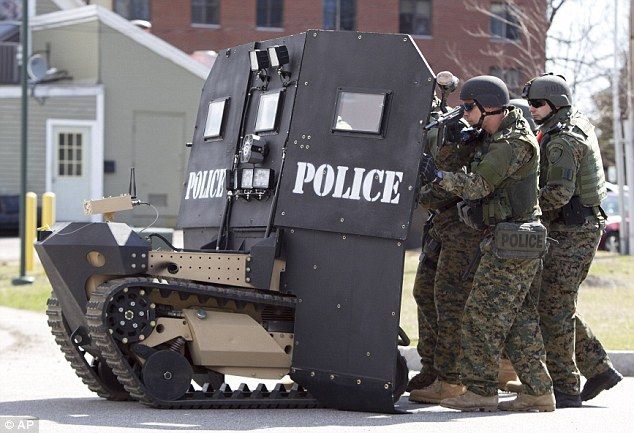
ABC News Political Analyst and former Bush advisor Matthew Dowd said on ABC’s This Week that the recent cases of police violence involving unarmed African Americans were as much due to the militarization of police forces as race.
“We basically dress up officers as if they’re machines,” Dowd said. “And then we expect them to act like human beings. So what happens is, they confuse power with force. Most of the officers in this country do a great job. But when we militarize our police force and dress them up like machines, they act like machines.”
Technically, he was right: there is no evidence that those tragedies were caused by race or militarization. He had exactly no evidence or documentation that the “militarization of police” caused these deaths, or that alleged militarization has caused any deaths. This appears to be emerging conventional wisdom, just one of those things someone says and everyone nods in agreement with no real thought. Why is the so-called “militarization” of police forces such a threat or cause to distrust police? If police are not trustworthy, that’s a reason not to give them fire-power, but having more fire-power doesn’t make them less trustworthy. It simply makes it more important than ever that police be well trained and responsible.
I was preparing a post about this emerging theme as an example of bias, in this case, pre-existing anti-police bias, being translated into false and discourse-warping assumptions by activists and the police when stalwart commenter dragin_dragon delivered this, the Comment of the Day, on the post The Perils of Over-Regulating the Police: A Case Study:
Police departments have been quasi-military for many years, and it has not seemed to hurt their ability to enforce the law. As early as 1974, Austin, Texas P.D. referred to it’s officers on patrol as “the troops”. S.W.A.T. units have traditionally used what they thought of as “Military” weapons, tactics and mode of dress; never mind that a properly trained infantry squad could and would wipe them out in minutes. Note, also, that most states and/or cities ban the mounting of weapons on the surplus (obsolete) armored and tracked vehicles or helicopters. They do NOT ban a man carrying a weapon being mounted on those vehicles. I also point out that many police officers are ex-military so are bringing to the job an environment with which they are already familiar. Rank structures are similar, and the police in the United States, at least, carry weapons, perhaps as a holdover from the Old West, perhaps not.
Given the rise in crime rates (see Chicago, Detroit), many of these escalations of Police equipment and training are needed. This became evident a number of years ago when a Los Angeles bank robbery went south and the robbers began shooting at the converging police with automatic (not the semi-automatic versions described as automatic, but rock-and-roll full automatic) assault weapons. The out-gunned police (9 MM pistols and shotguns) did the best they could and, like Israel, vowed “Never again”. Strangely enough, many in the National Media agreed, at the time. So, what we are referring to as the “Militarization” of the Police is being undertaken for 2 reasons: 1) to provide a higher likelihood that the officers will get to, at the end of the day, go home to family, and 2) so that the public, which they are sworn to protect and defend, will also, at the end of the day, get to go home and family.
Does this increase the likelihood that a perpetrator may not make it to trial? Quite likely. Do I care? Not so much. As I am sure will be pointed out repeatedly, death tends to be relatively final, with no appeal. And, after all, the most dangerous criminal has the right to due process. Unfortunately, crime, violent crime, is not something one does accidentally. It requires a conscious decision, often along with a misplaced almost arrogant sense of invincibility. Getting shot, and probably killed is the most natural consequence in the world of that attitude. Ask Michael Brown. Like it or not he jeopardized the well-being of an armed police officer, apparently arrogantly disregarding the consequences of his behavior and, quite probably putting the officer’s life at risk. I am assuming that Wilson, like many police officers these days, was wearing a very militaristic bullet-proof vest under his shirt, but, since Ferguson is a fairly poor community (and rapidly becoming poorer) possibly not, so he might have been better off if Brown had shot him, first. At least he would still have a job.
All this is by way of saying that militarization of departments is not necessarily a bad thing. The use to which the training and equipment is put may be a bad thing, but I have not seen, in any report, any attempt to oppress or exert Nazi-like control over the citizenry. So, am I in favor of the “Militarization”? You bet. I am in favor of anything that makes it more likely that they will be able to survive the work day. And make no mistake, that is always a question for a police officer, just like it is for the combat soldier. Am I also in favor of more and better training? Also, you bet. Need I repeat? And the management, or “command” element of the police need to be taught How and When to use the equipment and training.
 Ethics Alarms
Thanks, Jack. This was something I felt like I needed to get off my chest. Never expected a COD.
This was definitely a COD piece.
This was definitely a COD piece.
************
Yes. Good job, Dragon.
Thanks to both you and Tex. I never expected to get a COD, and I am honored that this was good enough.
Well deserved. Plus you saved me a post.
Well done
And concur: the technology isn’t bad. It is how it is used, when it is used, and how much we trust / identify with the users that matters.
A minuscule caveat: human beings are hard-wired to play with new toys.
When critics speak of the “militarization” of the police, not all are looking at it from the same viewpoint. Some are, of course, sociopathic or are conspiracy theorists. Some have swallowed the loudly flaunted concept that policemen are evil racists, corrupt ward heelers in uniform or just about anything heinous, as they represent law as an absolute, not a relative.
There is a rational based distrust, however. Many of us grew up in a time where the police still walked a beat or patrolled his neighborhood in a squad car, armed with nothing more than a revolver. We’re also the product of an old tradition of law enforcement that stems from the British mold. Unlike the continental European system of paramilitary gendarmes, we adapted a system of localized lawmen, run by an elected county sheriff. The metropolitan police department is still a relatively new phenomenon, started in late 19th Century London.
To many citizens, police who are unaccountable to a directly elected chief and who sport automatic weapons strike a sour note. But recently, people have been seeing them acquiring armored vehicles, military assault training and a tendency to wearing black uniforms. They’ve also noted an increased likelihood of these tactics and weapons being utilized and the increased incidence of “no knock entries”. Likewise, citizens have been imaging police making arrogant idiots out of themselves and caused other cops to become ever more touchy about cell phones, whether they’re right or wrong.
These and other factors have been serving to create a gap between the citizens and the police. That’s never a good thing, of course, because that trust is vital in a free society. Citizen distrust only deepens when they perceive policemen in whom this sense of civil mastery is full blown. As a former military cop, as a private citizen and as a friend or relative of a lot of civilian cops, I’ve seen all this from different angles. I’ve also seen the divide deepen in recent days.
One small note. The funding of police units on all levels directly from federal sources coincides with the worry by many that state and local police units may be more or less within the pocket of federal departments. The actual militarization of once innocuous federal police units and the memory of Obama’s projected National Civilian Defense Force has resulted in fear that this is an intentional part of a program to create an instrument of oppression. For myself, I highly doubt that any street cops would lend themselves to some “martial law” based takeover of the homeland of America. What I’m not sure of, though, is how many in higher authority have not conceived of the notion and would execute it if they could.
Again; it’s vital that the bonds of trust be strengthened between the police departments and those law abiding citizens whom they “serve and protect”. They must never- ever- be heard to make disparaging remarks about “civilians”, as that only deepens the gulf. In the Army Military Police Corps, the official motto is “Of the troops and for the troops”. It’s a good motto. It should also carry over to every local police or sheriff’s department in America. “Of the citizens and for the citizens”. Policemen who embrace that attitude will seldom go wrong. Both they and the communities they serve will benefit.
I’m not sure if this comment best fits here or in the next post / COD. I fully agree that the SHOOTING had nothing to do with police militarization of the police. After all, the only weapon used was a side arm. Had it been a six shooter, the results would be the same.
The response is different though. What I saw as unique in Furgison was a bunch if pointing of automatic weapons at the crowds. As someone trained in firearm handling, you don’t point a fitearm at something you don’t intend to destroy. It is too easy to accidentally discharge and kill.
No doubt others saw the same thing and were equally bothered by this. Police from the military were trained otherwise there so this has to be police training. It is foolish behavior.
Agreed, the response to the protests is a different issue. Which means it’s a different issue.
“…having more fire-power doesn’t make them less trustworthy.”
I think human behavior is more complicated than that. It’s fair to assert that with great power comes (at least) great temptation to use that power unethically. Even a few of the formerly trustworthy (even the most trustworthy), once equipped with certain capabilities beyond their ability to resist temptation, will fall and abuse others with their power.
I for one am greatly displeased with, and am at great unease with, local police forces having firepower sufficient to overwhelm what I will call, for lack of better terminology, “platoon-sized aggression,” or, “multi-on-multi” engagements. Maybe I am just in denial about the times we live in; maybe I am stuck on some archaic notion of local cops being officers of the peace.
I understand: There are gangs, criminal enterprises, with vast firepower and tactical advantages in certain locales. There are also “riot-ready” constituencies in some locales, like there are presumably “shovel-ready” jobs in some locales. I further understand: A local cop deserves sufficient local community and extra-community support to be equipped and backed-up so as to feel assured that he can serve daily without unreasonable risks of being harmed or killed.
What I do not understand is the proliferation of S.W.A.T. and similar capabilities among municipal police forces. There is a level of “back-up” that ought to be available, but not under local command. I just do not think that S.W.A.T. and riot-control forces should be stood-up in, and beholden to, any particular town, city or county government. If the violence or threat of violence becomes that great in any one locale, I want my Army (not the National Guard, either) to move in and restore localized peace and order.
Lucky, under posse comitatus, passed June 18, 1878 (two days before my birthday), the armed forces (not the National Guard) cannot be used solely to keep the peace by enforcing state law, except in the event of an actual insurrection/rebellion, inside the United States. Both the National Guard, sometimes called the No-Go’s (though rarely to their faces) when operating under state control and the Coast Guard are exempted from this law. So, we are stuck with either the police or the National Guard, sent by the Governor.
Thanks DD; I was vaguely aware of the term posse comitatus and knew it had something to do with employing federal troops on U.S. soil against U.S. citizens, or rather, barring such employment. I first heard the term posse comitatus back when Reagan was President – in two contexts: One, in a debate among legal scholars about legality of using Air Force surveillance planes to detect and track drug traffickers, and two, in association with a group in the U.S. that called itself Posse Comitatus. (I read one article about them, 30 or more years ago – they seemed like revolutionaries, but not of the “Red” type.)
You are probably knowledgeable where I am ignorant, and could correct me if I am wrong: Is it true that the National Guard carries empty weapons? I confess to not knowing anyone in the NG, so I have never had the chance to ask a Guardsman if, when the NG deploys, they receive orders or instructions about using (or not using) the weapons they carry. Anyway, that understanding of mine is the main reason why I said “(not the National Guard, either)” above. The other reason why I said that is because I have doubts that the NG is all that well-trained to deal with extreme localized disturbances like gang wars. gang rampages, or riots.
I do like the idea of each state governor having command of S.W.A.T. forces at that level. But I don’t like seeing such forces under local command, because that seems to me like just more local gangland terrorism, only government-sponsored.
OK, where to begin…yes, the NG can carry loaded weapons, depending on the reason for the deployment. In Katrina’s aftermath, for example, those units deployed to deal with looters carried loaded weapons. As far as instructions on when to use or not use those weapons, that’s “Rules Of Engagement”, and as a general rule, leaves some leeway for the Guardsman’s judgment. And the Guard is at least partially staffed, if that’s the word, with veterans, because the active reserve component of an enlistment can be served in the Guard.
A funny, if satisfying example of posse comitatus was seen in the movie “Tank”, with James Garner.
“Who you callin’ a ‘pussy communist’??”, rasps the evil sheriff.
THAT’S THE LINE!!! Obviously, you’ve seen the movie. Good one, huh?
I’ve wanted my own Sherman tank ever since!
It’s not such a different issue.
Jack: “having more fire-power doesn’t make them less trustworthy. ”
Texagg04: “the technology isn’t bad. It is how it is used, when it is used, and how much we trust / identify with the users….”
Luckyesteeyoreman: “with great power comes (at least) great temptation to use that power unethically.”,
Me: caveat 12/9 12:55am, same as Lucky’s.
Jack: “It simply makes it more important than ever that police be well trained and responsible”
Seems to be a circular argument here that needs to be addressed: it’s come up before, and there’s nothing simple about it.
And it doesn’t seem to me to be a different issue. Stirred as well as exploited by media on both sides wherever the actions occurred over the last five decades, the (cumulative) incidents of police wrongly or over-reacting to perceptions of illegal behavior as well as the (escalating) individual and public reactions of civil or criminal lawlessness have created an ongoing powderkeg situation that goes deeper than its racial/economic overtones would suggest.
If it were merely a matter of the police being better trained physically, mechanically and socially — somehow magically overcoming the psychological dichotomies, such as defending and protecting a public who fear, distrust and, yes, hate you … while at the same time living with them, being related to them, defending and protecting yourself from them … we would be seeing better results by now, not worse ones.
Once an adversarial relationship as explosive and unreasoning as this has developed, both sides have to be “trained” and made responsible by their trainer/leaders, not just one. And there is nothing simple about that.
#3
Just stop teaching entire subsets of the greater community to hate the police. Nudge Nudge mass media, pop culture, education system, moms, dads…wink wink, I mean y’all.
Stats suggest that we ARE seeing better results. This is like the shark panic of 2001.
That was Hollywood’s fault.
In 2001? No, they were both caused by the 24 hour news cycle. We just heard about episodes that didn’t used to be treated as national news. (9-11 made everyone stop talking about sharks.) Police violence is considerably less than it used to be, according to the statistics I’ve seen. That doesn’t make episodes like Cleveland and Staten island any less horrible, but the claim that the problem is worse than ever is just nonsense.
I was just leaving a more serious response when yours arrived and I realized we were talking about two different things. The stats I’m concerned with are on the Other Side, and we are not seeing meaningful stats on this yet, just numbers on some body-count-measurable activities in public view, much less the general darkening mood and slow but steady polarization (racial and generational as well as cops vs. civilians).
And even if I thought some major catastrophe would snap people out of it — and I can’t see one for the general public: the police coming to the rescue like the firemen on 9/11? — I don’t think it would slow the trend particularly. Nightmarish as the media could make them, sharks were avoidable. As great-grandmama sang, “Hang your clothes on a hickory limb, but don’t go near the water.”
I live in a city with lots of Officer Friendlies, including a squad on bicycles, and those-who-walk and talk with you in your neighborhood, and who have even been known to smile. When the recent (and probably ongoing) anti-police demonstrations took place, the police line with spaces you could walk through stayed well beyond them, seeing to traffic, answering tourist questions politely, calm and steady, with the usual sidearm holstered, and their naked FACES showing. In a nearby city, out came the black helmets with opaque facemasks, full arms and armor — the military gear — rolled out with attitude, rank on rank, shoulder to shoulder (great granddad’s marching song), beefed up if not entirely made up of imported troops known popularly as “mercenaries.” Not a pretty sight. Much scarier than sharks.
One makes the 11 o’clock news, the other doesn’t. It’s the difference in the police behavior, attitude, weaponry and appearance. Which one will be joined by more righteous, young, angry, frustrated (and/or attention-seeking, wannabe looters, etc.)
next time?
The rain may flood it out and Christmas season may dumb it down for awhile but the effect is cumulative. As you, Jack, have noted already, each incident is piled on the ones before, regardless of fact or rational thought — the hands-up gesture is added to the hoodie, the voices are loud for distrusting the entire justice system (the legal system went down that scale long ago), the so-called victims or villains become a litany, pro and con respectively, and that apocryphal experience with the ‘vicious’ traffic cop that was had by cousin Mary’s second husband’s uncle is exaggerated even further.
I don’t doubt that the stats are correct and that police violence on the whole has decreased. But those are mere facts, Jack. They have nothing to do with belief.