Jack and The Christmas Gasoline Can

gas-can

OK, it’s not exactly “The Homecoming,” but the way they’re scraping the barrel for cable Christmas movies, you might see this one on LMN yet. I just hope I’m not played by Wallace Shawn

Everything was going swimmingly this Christmas morning. We had opened presents, and now Grace and I were making our contributions to the family dinner later today at my sister’s house. A main feature was Grace’s mother’s recipe for a holiday salad that was part of her family’s Thanksgiving and Christmas meals for decades, and now ours. The recipe:

Two bags of cranberries, chopped

2 chopped navel oranges, with peel

2 chopped Red Delicious apples, also unpeeled

2 cups of chopped walnuts

2 diced celery hearts

1-2 cans of cranberry juice concentrate

Sugar to taste, or not (we leave it out.)

All was well until I cored the apples, bought supposedly fresh yesterday at Harris Teeter. They went “squish,” despite being all shiny and crisp on the outside. This would not do, so I was dispatched to the store to pick up suitably fresh apples, without which grandmother’s famous salad just wouldn’t be right.

I jumped into our car (the one that replaced its predecessor that  had burst into flames for no apparent reason in a mall parking lot—one of the many delightful events of our 2014). The gas-tank-low light was on, as it had been the day before. The gauge now said that I had five miles left, and the nearest station was only a bit more than two away. Well, these things aren’t perfect: my car stopped about 200 yards from the exit to the station, and in the middle of the street.

I called home, and my wife and son prepared to take his car to the station to get enough gas to let me drive the last leg of the journey, but his car, as is its wont, was dead. Meanwhile, I tried to push mine out of the middle of the street on my own, realizing too late that cars in neutral tend to pick up quite a bit of speed going down a grade, and are remarkably hard to steer and brake from outside the vehicle. I was barely able to stop the car from plowing into a parked Volvo by turning it to roll over the curb onto someone’s lawn. I was loath to leave it there untended while I hiked to the gas station, and I didn’t feel like paying fifty bucks or more for roadside assistance, but I was running out of options. Also time, if I was going to find fresh apples while a grocery store remained open.

I hadn’t seen a single car on the road, until an SUV stopped next to me. The driver, a woman in her thirties who was accompanied by her two teenaged sons, asked it I needed help. I explained my plight, and the two young men assisted me in rolling my car off the lawn into something approximating a legal parking space.

“Stay here: we’ll be right back,” the woman said. She was as good as her word, for she soon reappeared, with one of her sons carrying a festive red plastic gas can filled with fuel. The older son helped figure out how to work the damn spout, which had to be assembled. “See, here’s the flaw,” I explained. “The device solving this problem should not require more intelligence to operate than someone getting into this stupid situation is likely to have.” He agreed, politely. Then he poured all the gasoline into my empty tank.

I prepared to reimburse this family of Good Samaritans, but they refused. “Just pay it forward,” the mother said. “We’re glad we could help out.” I shook her sons’ hands, and hers, and wished them all a Merry Christmas. Then I got the apples, and the salad was perfect.

In the Marshall household, this will forever be known the Miracle of the Christmas Gas Can.

Let us sing!

(to the tune of “Good King Wenceslas” :
1. Jack’s wife said “You must go out.
We’ve an apple crisis!”
Never would he dare refuse ;
Better to fight ISIS.
So he set out in his car,
Though t’was low in fuel
Til it sputtered to a stop
(Boy was he a foo-oo-el!)

2. Shifted into neutral then,
It rolled t’ward disaster.
Jack would soon be chasing it,
As the car rolled faster.
Pulling hard with all his might,
He changed its direction
Rested then on somebody’s lawn
Waiting for collection.

3. Up now rolls an SUV
Driven by a stranger
“Trav’ler, tell us, how can we
Help you stave off danger?”
Her sons helped him move the car;
There would be no ticket.
Jack composed a secret wish,
As if he could pick it.

4. “Find a can, and bring me gas
This would be a blessing.
Yet I’d be a total ass
Their Christmas to be messing.”
Suddenly they all drove off,
Telling him to stay there
Still he doubted they’d return
Heeding his mayday there.

5. Damn! The time was running out,
And the stores were closing.
Should he not get gassed up soon
Hope would be foreclosing.
Hark! The SUV returns,
With a gas can brimming
Welcome sight more lovely than
Firs with all their trimming.

6. “Let me pay you,” Jack implored.
For I owe you greatly.”
“No, my friend, just pay it for’d.
That’s what’s right innately”
Therefore learn the lesson well
Be you high or lowly
If we all are ethical
Every day is holy.

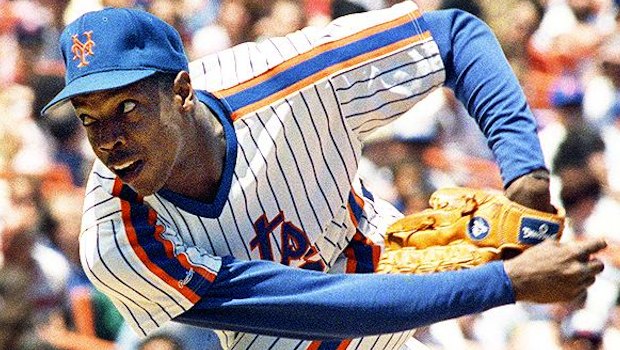
Ethics Hero, Ghost Of Christmas Past Edition: Dwight Gooden

Dwight-Gooden

For me, Christmas triggers not only memories fond and bittersweet, but also regrets, realizations, and discovered clarity about where I have been and how I got where I am. This was really what Charles Dickens was expressing in “A Christmas Carol, and why it resonates even with the kinds of people who would be tempted to put a zombie Nativity on their front lawn.

Last week, former New York Mets pitching ace Dwight Gooden, known in his prime as “Doctor K” (a “K” is a strikeout, and if you didn’t know that—wow) and eventually just “Doc,”penned a brave and inspiring piece for The Player’s Tribune, in which he addressed his younger self, warning the young, cocky kid with the world seemingly begging to be his playground and cheering section in 1984 about the traps and landmines lying in his path.

Gooden, for those of you who face life every day without the accumulated wisdom bestowed by the love of baseball, and who somehow live through cruel winter without the promise of Spring Training warming your nights, looked like he might become the greatest, coolest, most unhittable pitcher in baseball history when he arrived on the big league scene in ’84, winning 17 games with a deadly curve and a 98 mile per hour fastball at the tender age of 19. He became the youngest player ever to pitch in an All-Star Game that year (he struck out the side), and the next season, at 20, he won 24 games, lost only four, and led the National League with a miniscule 1.53 earned run average.

And he was never that good again. He began losing speed on his fastball the next year, and steadily declined thereafter. Eventually there were drug problems, alcoholism  and other embarrassments, and Doc Gooden, instead of being the lock for the Hall of Fame that he seemed at 20, was washed-up at 35, and an unofficial member of the Pantheon of Disappointing and Fallen Sports Heroes.

Today, as the former pitcher nears 50, Gooden is a dedicated father and grandfather to  his children and grandchildren. He is the president of Best of the Best Sports Management, where he works with his oldest son, Dwight Jr. and is also a spokesman for PinkTie.org , a Long Island-based charity dedicated to fighting breast cancer.

In his essay, titled, “Letter to my Younger Self,” Gooden is frank, uncompromising, wistful, self-critical, funny, and never indulges in self-pity. He ends it this way:

Drugs and alcohol are only a false sense of security. Neither thing will fill the void you feel. Unfortunately it might take you a few missed Christmas Days with your family to learn this.

You will want to try to fix your issues on your own. This is how you think a man handles his problems. It isn’t. Being a man is about reaching out for help when you need it. If your curveball isn’t working, you’ll know how to fix that. If the control on your pitches is off, you’ll know how to fix that. But you will face a lot of hardship because of your inability to realize that you can’t fix yourself.

Finally, please know this: I love you. It’s going to take you a long time and a lot of pain to realize this, but accepting it will go a long way towards healing. The journey will be trying, but it ends in a good place.

Keep getting those Ks,

You’re a hero after all, Doc.

Merry Christmas.

I’m Dreaming Of A Zombie Christmas

Zombie Nativity

I didn’t say it was a pleasant dream.

Hmmm, how should I describe this? I would say that a law is being used to violate the First Amendment rights of an unethical jerk who is intent on abusing them.

Or, in the alternative, Jasen Dixon may just be an idiot.

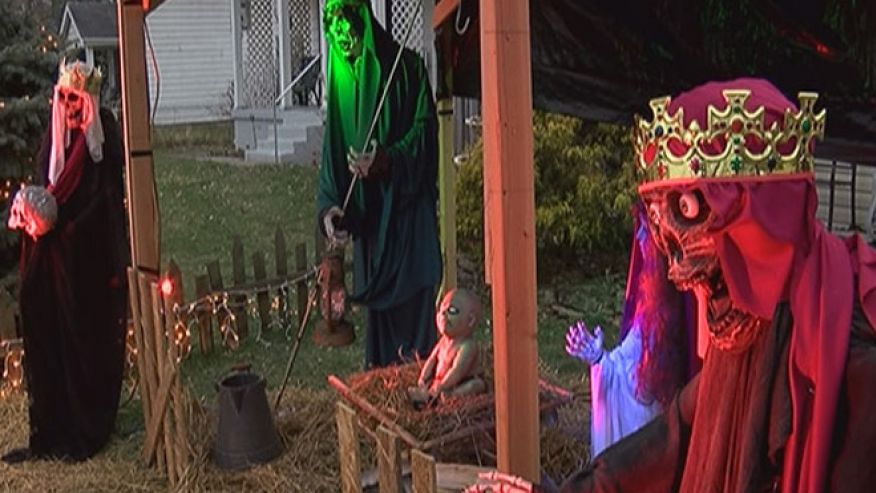
Sycamore Township, which is just outside Cincinnati, has responded to complaints by neighbors by applying various ordinances against Dixon’s unusual Nativity scene that he constructed in his front yard. It features life-size figures portraying Joseph and Mary as the walking dead, and a zombie baby Jesus, who has pale skin and pure white eyes. Here, here’s a close-up of Zombie Baby Jesus:

Zombie-nativity-scene

Awwwww!

Dixon suspects that the township laws, which prohibit structures in the front or the side yard of a residence that occupy more than 35 percent of its total area, and require that the primary structure must be 3 feet from the street and 6 feet from the dwelling, are really being selectively enforced against him because his holiday display offends some people….well, almost everyone. I suspect this as well.

Poor Jason says he doesn’t mean any harm: he’s just doing the best he can to celebrate the birth of baby Jesus. “I wanted a Nativity and I worked with what I had,”  says Dixon, who manages a nearby haunted house called “The 13 Rooms of Doom.” He says his First Amendment rights are being infringed.

“I’ve lived here for 15 years and I’ve never had a violation of any kind,” Dixon said. “It’s a holiday decoration. I know if it was a real pretty Nativity scene they wouldn’t be saying anything.”

I’ll agree with that too. Continue reading

Unethical—But FUNNY!: The Under-Age Italian-Hungarian Fake Pandas

sad_panda_in_christmas_hat

[ Lots of ethics matters to write about, and little time to do it, as my wife keeps bugging me to help prepare the homestead for the holiday festivities, as brim as they are likely to be. Let’s see how much I can cover, and how many typos I’ll be able to avoid writing these posts in five minute increments. May your Dec. 24th be less stressful than mine is going to be!]

Because nothing says “Old Fashioned American Christmas” like an Italian circus fake panda story, Ethics Alarms offers this:

A circus in northern Italy charged a fee for children to have their photos taken with two rare pandas, or what the kids thought were pandas. Sharp-eyed Italian police, however, moved in and confiscated the beasts, which were really painted chow chow dogs.

Fake Panda

The owners have been charged with animal cruelty, and—get this—using false passports to import the dogs from Hungary, since they were six months younger than the documents. Charging the circus with fraud has somehow slipped the mind of the police, but I’m sure they’ll figure it out eventually.

Italian Merry Christmas

________________________

Pointer: Fark

Graphic: Deviant Art


Just A Reminder: I Warned About This From The Start, Almost Three Years Ago

Poor Cassandra. I know how she felt.

Poor Cassandra. I know how she felt.

The Ferguson Ethics Train Wreck, which encompasses the shooting of two police officers in New York City, is just the second section of the Trayvon Martin-George Zimmerman Ethics Train Wreck. The coordinated effort to represent the American justice system as hostile to blacks, and white society as determined to harm them, was launched in Florida in early 2012, nearly three years ago.  It might have failed then, as it deserved to since there was no genuine racial element in the actual Martin-Zimmerman episode, had not the President of the United States used his bully pulpit, credibility with black Americans and the power and influence of his office to declare the local incident as emblematic of societal hostility to African-Americans, and Obama personally. This, as I wrote earlier this week, lit the fuse that exploded into racial violence against police this past week.

I saw it then. I have seldom seen anything more clearly.  So I wrote:

What does {Obama] think he’s doing? Teens, children and adults are murdered every day, many of them right where Obama lives, in Washington, D.C. Aren’t all of the violent deaths “tragedies”? Why is this one, and only this one, worthy of specific presidential attention? Is it because black leaders called for the President to overstep his proper role? Who cares what activists call on the President to do—certainly he shouldn’t. Does this now justify their calls for retribution and violence, or validate high school students who are staging walk-outs to protest law enforcement officials investigating a case before they make any arrest? (Are high school students now empowered to dictate law enforcement policy? Suspend every single one of them.)

What earthly difference does it make what Trayvon looked like, who his death makes the President think about, or whether he looked like the son Obama never had? So what? What if he looked like my son? Not good enough? When a white, Hispanic or Asian kid in a hoodie is shot by some gun-wielding hysteric, can those parents also count on a statement of concern by Obama? What if they are just run down by a drunk driver, or killed by being left in an over-heated car? Not tragic enough? Doesn’t strike the same chord of of “seriousness”? Or will these tragic deaths not be viewed as sufficiently important to the President’s “base” in an election year? Do you think these questions are unfair? Who laid the groundwork for them?

Misusing his office and prestige in such matters simultaneously diminishes the presidency and warps its function. The position has always included the role of Mourner-in-Chief, at times of genuine national tragedies, such as the Twin Tower bombings, the Challenger disaster, and Pearl Harbor. Cheapening this solemn function by intervening in local crimes and contentious race-charged controversies accomplishes nothing positive: it is divisive, intrusive, and dangerous.

Got that? Dangerous. I chose that word deliberately. March 12, 2012.

Reading the comments again now is fascinating: readers conservative and liberal denounced my criticism as unfair, after the usual “Bush did it too” spin from the reflex Obama defenders.

Arthur in Maine wrote: Continue reading

Comment Of The Day: “After The Brooklyn Cop Murders, The Sound Of Spinning: WindyPundit Takes On My ‘Smear'”

Neil Dorr is among my favorite regular Ethics Alarms commenters, because he is passionate, articulate and fearless, and because he disagrees with me about 85% of the time. I’m also fond of Neil because he is part of an esteemed father-son team here: Karl Penny, his dad, had registered his commentary at Ethics Alarms since its launch. Neil informed me this month that his father had died, suddenly and unexpectedly. It is strange: I had never met Karl face-to-face, but I feel like I have lost a friend, so vivid and good-natured were his periodic communications here. Neil, of course, has lost far more, and my heart and good wishes go out to him and his family.

Someone had to register this response to my conclusions regarding the assassinations of two police officers in New York. I assumed that this would be the reaction of many and perhaps the majority, which is why I almost didn’t post my position. I know it walks into the spinning propeller of predictable resistance to truth-telling on this issue.

The media is already doing a bang-up job confusing the public and muddying the water, primarily by misrepresenting the situation as a) a dispute over “police abuse,”when the issue is the presumed racism of the system; b) focusing on NYC Mayor De Blasio, who is a minor player at best, and c) making it seem like the consequences of the despicable “Hands up!” propaganda are a local New York issue only. In this they have been ably assisted by clumsy blow-hards like Rudy Giuliani, who virtually made a straw man and handed it to his critics. “Is Giuliani correct in saying that President Obama started a propaganda campaign four months ago that “everybody should hate the police”? asked Washington Post “Fact Checker” on the way to giving Rudy four “Pinnochios.” Of course he wasn’t correct. I, however, am correct when I conclude that Obama and others have created an environment where African Americans fear and distrust the police, the justice system, and their fellow citizens who happen to be white more than any period since the Civil Rights movement. I know that Obama supporters  disheartened Democrats hate to hear this, and will resist accepting it like the approach of grim death. They can take solace, perhaps, in the fact that my influence on and ability to enlighten public perception is negligible, so with the help of the news media, accountability can be ducked once again, at least for a while. Maybe after the death toll rises sufficiently, people will be ready to listen….to someone else with a bigger megaphone, presumably.

Here is Neil Dorr’s Comment of the Day on the post “After The Brooklyn Cop Murders, The Sound Of Spinning: WindyPundit Takes On My ‘Smear,'” and yes, I will have a rebuttal at the end: Continue reading

Remembering Christmas Music

nativity

It is slowly dawning on me that Christmas music, one of the annual joys of my childhood and perhaps yours, is in a perilous state, both culturally and aesthetically. The best of the songs musically are religious in nature, which means that schools won’t pass them along to their charges as happened routinely when I was a child, and even playing them on the radio is likely to be regarded as a religious statement. I just loved the music, as I think most kids would if they ever got the chance before they were brainwashed into believing the ancient songs were subversive.

A full court cultural press is underway to make those songs as rarely heard outside of church as hymns, and I don’t see the trend as reversible. One obvious bar to a comeback: current pop stars don’t have the pipes to sing most of them without causing a sound pollution emergency. Or, if one of the few singers who could actually hit the notes dared to cover a carol like “O Holy Night,” he or she would feel required to apply flourishes of the sort that make every rendition of “The Star Spangled Banner” at a major sports event an invitation to PTSD.

Even for the more secular Christmas repertoire, the clock is running out. The most listenable versions, and the definitive ones in most cases, are by performers of the past who are not just dead, but also long forgotten by the current culture. An hour of classic Christmas recordings on the radio is now a reminder of how old I am and close to joining great singers like Bing Crosby, Judy Garland, Andy Williams, Nat King Cole, Jo Stafford, Burl Ives, Gene Autry, Frank Sinatra, Dean Martin, Elvis—dead, dead, dead. I guess Brenda Lee is still alive, so “Rockin’ Around The Christmas Tree” is a little less depressing, but it’s a minor classic at best. It’s gotten so bad that when I hear “The Little Drummer Boy,” I find myself wondering if the whole Harry Simeone Chorale is dead too—Harry died in 2005, and the recording is 56 years old, after all.

Meanwhile, our post-modern culture is sneering at the whole idea of Christmas songs, and Christmas itself. Most modern Christmas songs either are making fun of Christmas, about sex, or just lousy. The tradition is being undermined in more creative ways, too: this week I watched a 2012 straight-to-video movie called “12 Disasters of Christmas,” based on the loopy premise that “The Twelve Days of Christmas” was really a coded recipe for stopping the 2012 apocalypse predicted by the Mayan calendar. “The Mayans knew that the knowledge would have to be preserved for centuries, so they devised a song that would carry the secret and would be passed on and learned by children for generations,” explains the old codger who’s figured it all out. (But why would they choose such a monotonous and stupid song?) Come on, guess: How does the “Chosen One” stop the end of the world? [Answer below.]*

The movie is on to something, though. The Christmas songs that have the best chance of persevering though this age of  cynicism and cultural illiteracy may be those that either tell a story  or that have an interesting one related to their creation. The simple and beautiful tune of “Silent Night,” for example, as one of those films they used to show in school assemblies every year before some anti-religious hysteric sued, was composed for guitar in response to a Christmas Eve crisis for a small church in the Austrian alps in 1818: the church organ wasn’t working.  I have found that Irving Berlin’s “White Christmas”  affects me far more deeply since I learned that the Berlins’ infant son died on Christmas day, and that while his children celebrated Christmas as a cultural holiday, Berlin and his wife did not. They spent each Christmas after their son’s death in mourning. The song is a wistful remembrance of a happier time that the composer will never experience again.

Maybe another Christmas song will persevere if its origins are remembered; I was reminded of its history this week as a result of the thaw in U.S. relations with Cuba. Though my wife hates it, the song is one of my favorites, perhaps because it brings back warm memories: I watched the song’s first national broadcast with my sister and parents, and the Marshalls bought the recording the next day.

It was 1962. Noel Regney and Gloria Shayne were a husband and wife songwriting team of modest success. They were saddened by the lack of any spiritual content in popular Christmas songs then; imagine what they would think today.

Like all Americans, they were petrified during the thirteen days of the Cuban Missile Crisis, when the world stood on the brink of nuclear annihilation. As the crisis intensified, Regney found himself inspired to write down a simple poem with a Christmas theme. (Later, the couple would say that neither of them could ever sing the song through, because of the strong emotions it recalled.) When the nation could finally take a deep breath of relief as the threat ended,  Gloria devised a melody for her husband’s words, though he had always been the composer when he and wife wrote songs together.

The result of this unique variation on their collaboration was recorded before the end of 1962, but it wasn’t until the following year, when Bing Crosby sang the team’s creation live on ABC’s  “Hollywood Palace,”  that it became widely known. The song written during the Cuban Missile Crisis became a best-seller, Crosby’s last hit Christmas record, and also the last popular Christmas song to have a religious theme.

It was, and remains, a prayer for peace.

____________________________

* By finding and wearing FIVE GOLDEN RINGS, of course!

After The Brooklyn Cop Murders, The Sound Of Spinning: WindyPundit Takes On My “Smear”

None for me, thanks.

None for me, thanks.

Mark Draughn, a.k.a Windypundit and the Ethics Alarms 2013 “Blogger of the Year,”  has swallowed the Kool-Aid, apparently, and decided to defend the race-baiters, from the tippety top of our government to the stygian depths of MSNBC, who have finally managed to get police killed in retaliation for the “racist murders” of Michael Brown, Eric Garner, and others. In his most recent post he challenged my analysis, and ended up making me feel pretty good about it. I love Mark’s blog and admire Mark’s mind, and if can’t do any better than this, I am obviously on firm ground.

I want you all to visit Windypundit, for Mark is terrific (usually), so I’m not going to go through the whole post, which you can read here. I will make a few salient observations though. Let’s play “Mark Says”:

Mark Says:

“I knew there would be people who would take Brinsley’s reputed motive and use it to smear protesters and activists who had spoken out against police abuse.”

1. Mark wrote this before my straw man post, and sure enough, he followed the script. It’s about “police abuse.” Right. Not race. Not the racism of whites, the hunting down of black men; not about how blacks can’t get justice even when they have been gunned down with their hands in the air. Indeed, it’s not “about” any of the irresponsible, exaggerated, inflammatory accusations that we have been hearing since Trayvon Martin was shot…and not by a cop, either.

2. “Reputed motive.” Mark thinks I am unfair to conclude that a killer who wrote online that he was going to kill some “pigs” in retaliation for police killing Mike Brown and Eric Garner killed the two police officers in retaliation for police killing Mike Brown and Eric Garner.  Got it.

3. I’m smearing protesters! These are, recall, protesters who, by their use of the “hands up, don’t shoot” theme, were smearing a specific police officer with the false claim that he was a racist and a murderer, though the evidence says otherwise, and smearing the integrity of the citizens on the grand jury who refused to indict him.  By extending this smear to police generally, they were also asserting that this—that is, the fictional racist murder of that “harmless, unarmed black teen” who had just tried to take the officer’s gun and was charging all 300 pounds of his body at Officer Wilson—was the potential orientation of all white police.  I was smearing them by pointing out that this was divisive, inflammatory, dishonest and irresponsible. Continue reading

The Straw Man Cometh: Confronted With The Inevitable Results Of Their Race-Baiting, The “Hands-Up!” Crowd Claims It Was All A Misunderstanding

strawmanargument

Don’t let them get away with this.

The Straw Man logical fallacy occurs when a person ignores the actual issue being debated and substitutes a distorted, exaggerated or misrepresented version of the opposing position that is easier to rebut. For years, there has been an organized effort in the Obama Administration, the progressive movement, the civil rights movement and among black activists to represent American society as racist, along with the American law enforcement system and justice systems, and to maintain  the false narrative that racism was responsible for several high-profile deaths of black men, and that specific police officers, such as Darren Wilson, were guilty of racist executions and exonerated by a racist system.

The strategy has been richly fertilized by relentless accusations that white voters and the Republican party hold racial animus against Barack Obama because of his race. The deliberately divisive effort has resulted in a level of fear, anger and distrust of white Americans in the African American community not seen in over half a century, with white police officers serving as the immediate targets. Predictably, two New York City cops were assassinated by a deranged black man after posting social media messages referencing the deaths of Mike Brown and Eric Garner, and critics have correctly stated that the reckless race-baiters have “blood on their hands.” Sensing that a looming tipping point may be going against their divide and conquer agenda, they are ducking and weaving like Muhammad Ali in his prime. Continue reading

Just In Time For Christmas, Here Are All The Bad Arguments And Rationalizations Against Tipping So You Can Feel Self-Righteous About Being A Scrooge

See? The rest of the world knows how to deal with you sexist, racist, aristocratic poverty perpetuating, self-esteem destroying bastards!

See? The rest of the world knows how to deal with you sexist, racist, aristocratic poverty perpetuating, self-esteem destroying bastards!

Vox has published an entertaining screed against tipping, massing all the contradictory, facile rationalizations and faulty arguments against demonstrating one’s gratitude when someone serves you well. This is Vox, remember—Ezra Klein’s uber-progressive website with an agenda. Think about what the alternative to tipping is, and where the critics of tipping are going with these claims. Hint 1: It has nothing to do with democracy or individualism. Hint 2: The piece argues that tipping is classist, racist, sexist, “lookist”…the works.

The full illogical, ethically confused character of this junk has to be read to be fully appreciated, but here is a quick overview:

1. Hoary old quotes. There are these, for example:

English author Lynne Truss on visiting New York: “In this great financial capital … tips are not niceties: give a ‘thank you’ that isn’t green and foldable and you are actively starving someone’s children.” No, Lynne, you’re being cheap, that’s all.

The Village Voice’s Foster Kamer: “It reinforces an economically and socially dangerous status quo, while buttressing a functional aristocracy.”   Ah. You see, if lower paid service professions are treated like robots and underpaid, they will rise up and overturn this monstrosity called capitalism.

 Michael Lewis: “I feel we are creeping slowly toward a kind of baksheesh economy in which everyone expects to be showered with coins simply for doing what they’ve already been paid to do.” Who is being “showered with coins?”

2. “Tipping lets employers off the hook.” Translation: It gets in the way of the progressive “living wage” campaign. Mandatory salary levels drive businesses out of business and reduce jobs. Want to see all restaurants go to the iPad, self-ordering, system running rampant at airport restaurants—and no, I don’t tip a runner who just carried my food to the table—by all means, force restaurants to pay “a living wage.”

3.  “Tipping is undemocratic.” This is the George Orwell, “Peace is War” argument. The government should stop me from giving my money to whoever I want in the name of democracy. Continue reading