Beverly Johnson, the super-model whose Vanity Fair article about being drugged by Bill Cosby decades ago when she was summoned for an “audition,” will be a guest on the Boston NPR station, WBUR, as former “Tell Me More” host Michel Martin stands in. After Johnson, a panel will discuss various issues legal, ethical and cultural about the Cosby allegations, and I’m on it, along with Renee Graham, music and pop culture critic for NPR’s Here & Now. Op-ed contributor at the Boston Globe, and Debra Katz, partner at the law firm Katz, Marshall and Banks. You can catch up on some of the ethical implications of the Cosby mess here, and some more details about the show here. If you can get the show on the radio or web, you’ll hear it at 10 AM, E.S.T., this morning. Continue reading →
I try to be fair to Dick Cheney, whose character has been distorted beyond all recognition by his partisan foes. Sunday, however, he was apparently attempting to validate all the most terrible things anyone has said about him, as well as providing future students of ethics real life examples of ethical fallacies.
The one quoted above is the pip: so much for the jurisprudential principle that “It is better that ten guilty persons escape, than that one innocent suffer.” Chuck Todd reminded Cheney that 25% of those detained were apparently innocent. The Cheney variation: “It is OK if some innocent persons are unjustly punished as long as the bad guys get what they deserve.”
It is hard to pick the most unethical assertion, however; there are so many horrible statements to choose from. Such as: Continue reading →
On December 7, 1914, as the horrible, pointless, world-disrupting “War to End All Wars” was only five months old, Pope Benedict XV suggested a truce for the celebration of Christmas. The governments of the battling nations rejected the idea, but in the days leading up to Christmas and after, many of the soldiers in the trenches of this ugly conflict took the Pope’s advice.
On December 20, Germans soldiers in some areas took in British wounded from the no man’s land between the warring armies. A German soldier reported on December 22 that both sides had been heard singing Christmas Carols in the trenches. German troops arriving into the lines had begun bringing Christmas trees, and some men placed them on the parapets of the fire trenches. Then, on Christmas Eve, many German and British troops serenaded each other across the lines. Allied soldiers reported that sometimes their singing was accompanied by German brass bands. Then, Christmas Day, 1914, some of the German soldiers left their trenches and carefully approached Allied lines, shouting“Merry Christmas” in French and English. Allied soldiers climbed out of their trenches, and shook hands with the men who had only recently been trying to kill them. Some even exchanged exchanged gifts of cigarettes and and food. There were even instances where soldiers from opposing sides played soccer: in England, one organization is holding a match next week against a German team to commemorate such contests. Continue reading →
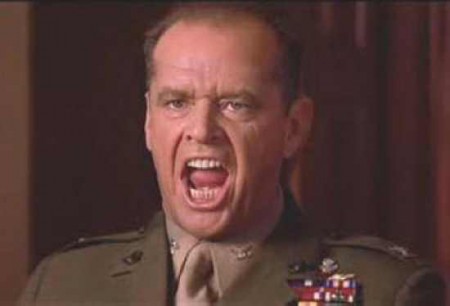
“You want the truth? Well, you can’t have the truth because I’ve decided that it isn’t newsworthy!”
“I understand that news outlets routinely use stolen information. That’s how we got the Pentagon Papers, to use an oft-used argument. But there is nothing in these documents remotely rising to the level of public interest of the information found in the Pentagon Papers. Do the emails contain any information about Sony breaking the law? No. Misleading the public? No. Acting in direct harm to customers, the way the tobacco companies or Enron did? No. Is there even one sentence in one private email that was stolen that even hints at wrongdoing of any kind? Anything that can help, inform or protect anyone? The co-editor in chief of Variety tells us he decided that the leaks were — to use his word — “newsworthy.” I’m dying to ask him what part of the studio’s post-production notes on Cameron Crowe’s new project is newsworthy. So newsworthy that it’s worth carrying out the wishes of people who’ve said they’re going to murder families and who have so far done everything they’ve threatened to do. Newsworthy. As the character Inigo Montoya said in “The Princess Bride,” I do not think it means what you think it means.”
—-Acclaimed screenwriter, playwright and Hollywood liberal Aaron Sorkin, reprimanding the news media for publishing material from the Sony computer hacks in an Op-Ed in the New York Times.
There are many other titles for this post I considered, like “Jaw-dropping Hypocrisy of the Month,” “Self-serving Delusion of the Month,” and “This Is The Tragedy of Partisan Delusion: Won’t You Give Generously To Help Aaron”?
I’ve got to give the man credit: it takes world class gall for to write something like this self-serving for international consumption. Self-righteous, Freedom of the Press-promoting (Sorkin is the creator and writer of “The Newsroom” series on cable) Hollywood liberals applauded and screamed for blood when a near-senile billionaire’s private comments made in his own bedroom were surreptitiously recorded by his paid female mistress and plastered all over the media, because the private, private, private words suggested that he held racist attitudes, and no matter what he actually did (which was sufficient to be named an NAACP “man of the Year,” a distinction Aaron Sorkin has never earned), that meant that he had to be publicly humiliated, fined millions and stripped of his business. We didn’t hear Sorkin protesting that this wasn’t newsworthy. Nor did the Sorkins of an earlier generation protest when the very same newspaper carrying his essay published criminally stolen Defense Department documents that, whatever was contained in them, were part of a sincere effort to win a war. Continue reading →
I’m watching “It’s A Wonderful Life,” Frank Capra’s ultimate ethics movie. Don’t forget to review its ethics dilemmas, conflicts and conundrums with the handy
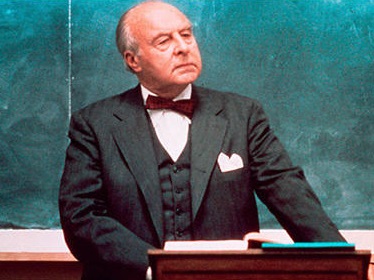
“Go ahead, tell Prof. Kingsfield that his exam is unfair because it triggers your emotions and you can’t think straight. I dare you.”
A Constitutional Law exam at UCLA Law School included this question:
CNN News reported: On Nov. 24, St. Louis County prosecuting attorney Robert McCulloch announced in a publicized press conference that Police Officer Darren Wilson (who has since resigned) would not be indicted in the August 9 shooting of Michael Brown. Michael Brown’s stepfather, Louis Head, was with hundreds of protesters assembled outside the police station, listening on loudspeakers and car radios when they learned Officer Wilson was not being charged. Standing on the hood of a car, Mr. Head embraced Michael Brown’s mother. Mr. Head asked someone for a bullhorn but it was not passed to him. He turned to the crowd, stomped on the hood and shouted, repeatedly, “Burn this bitch down!”
Police Chief Tom Jackson told Fox “News,” “We are pursuing those comments … We can’t let Ferguson and the community die [as a result of the riots and fires following McCulloch’s announcement]. Everyone who is responsible for taking away people’s property, their livelihoods, their jobs, their businesses — every single one of them needs to be prosecuted to the fullest extent of the law.”
County Attorney Robert McCulloch asks lawyers in his office whether to seek an indictment against Head by relying on a statute forbidding breach of the peace and another prohibiting rioting (six or more persons assembling to violate laws with violence). A recent hire in the office, you are asked to write a memo discussing the relevant 1st Amendment issues in such a prosecution. Write the memo.
The question is a fair and legitimate one, and very typical of law school exams, which often ask students to apply course content to current events. Nonetheless, it provoked a controversy.
Shyrissa Dobbins, a second-year law student in the course and is chair of the Black Law Students Association, complained, “Daily I think about Michael Brown and Eric Garner, and I have a challenge. Every day I think about this injustice and how I’m in a law school that won’t even make a statement about it.” Hussain Turk, a second-year law student who took the exam, argued that exams should not ask students to address controversial events, and that the question was unfair, as it could be more emotionally difficult for black students to answer. “These kinds of questions create a hostile learning environment for students of color, especially black students who are already disadvantaged by the institution,” Turk said.
There is only one proper rebuttal for this foolishness:
“Grow up, deal with your biases, start thinking like lawyers or find a profession you can handle.”
Pathetically, the law professor, Robert Goldstein apologized in an email in an e-mail to students, saying, “I recognize … that the recent disturbing and painful events and subsequent decisions in Ferguson and New York make this subject too raw to be an opportunity for many of you to demonstrate what you have learned in this class this year,” and promised to discount scores students receive on the question if it lowers the overall score of the student.
Law school Dean Rachel Moran added to the misplaced sensitivity-fest, and her e-mail, said…
“In retrospect, however, he understands that the question was ill-timed for the examination and could have been problematic for students given the anguish among many in our community over the grand jury decisions in the Michael Brown and Eric Garner cases.”
The model mom and Keith Driscoll were charged with cruelty toward children and infliction of mental injury on a child.
Good.
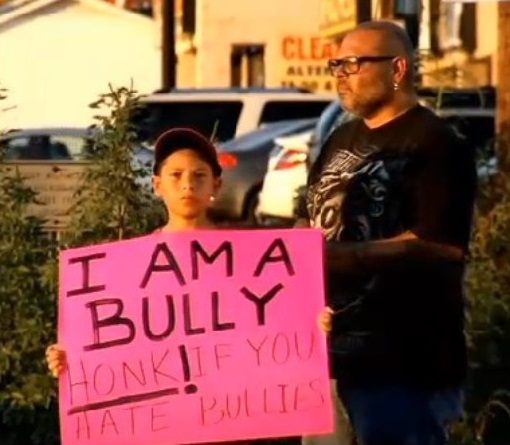
I’ve written about web-shaming children before, and characterized it as child abuse, which it is. A maxim here is that when ethics fail, the law must take over. It is a poor second option, but for this couple and those like them, including the parents of the boy in the photo to the left, it is a necessary and an ethical one.
Police learned about the abuse after one of the boy’s relative saw posted photos of the boy dressed as a girl and wearing makeup. He was crying. I wonder how many of Prado’s friends “liked” those photos on Facebook? Prado told police that Driscoll came up with the idea to dress her son like a girl as a way to discipline him, went along with it because she “did not want to cause problems with her living situation.” Oh, well, that’s all right then, ma’am—you can go now. Driscoll, you see, is her sleep-in landlord.
Yechhh. I wonder what else she’ll do to her son to keep that cozy relationship peaceful? Cigarette burns? Whipping? Water-boarding?
The child cruelty charge is a second-degree felony. I’m all in favor of expanding such charges to apply to the parents who post photos of children holding signs that read “I pooped on the floor” and other self-incriminating screeds compsed by mom and dad, even those who aren’t doing it to interfere with their sex-for-rent arrangements. In fact, I’d expand it to include those Jimmy Kimmel fans who make YouTube videos of their children crying because their Christmas gift appeared to be old sweat socks or broccoli, in the hopes that Jimmy will make their exploitation of their own kids go viral. (An excellent discussion of everything that is wrong with child-shaming on the web can be found here.)
Using the web to humiliate your powerless children—forever, remember—is wrong, but if parents are so stupid, cruel and ethically inert that they can’t fathom this basic Golden Rule principle, it should be illegal too.
I’m late to the blog today, because I spent it giving a special program for the Smithsonian Associates called “From Stagecoach to Django Unchained: The Hollywood Western and Its Influence on American Values, Aspirations and Culture.” It consisted of me talking, a terrific Powerpoint presentation by the gifted Grace Marshall, and almost three hours of clips from classic Westerns—the whole session was five hours. My primary message is that anyone who is not literate regarding the Hollywood Western really doesn’t understand the myths and archetypes that powerfully influence U.S. culture to this day. Within that “anyone” are the majority of pundits and journalists, a large percentage of citizens under 50, and the vast majority of women and minorities. This is a problem.
For example, no one can consider the vast influence of the Western genre on American culture and be the least bit surprised that gun control has an uphill battle with the American public. No other culture has as its primary source of heroes, legends and lore figures and events so dependent on firearms as a means to right wrongs, protect the innocent, and punish evil. Frankly, if a pundit doesn’t understand why John Wayne (who died in 1979) just set a Harris poll record by being included in its annual list of top ten most popular movie actors for twenty consecutive years, from 1994 to 2014, I don’t think they can comprehend the nation sufficiently to opine on it.
Joe Biden, however, understands. I have been critical of Joe, as he is frequently an embarrassment, and there was a lot wrong with his comments today as he was honored with the “Voice of Solidarity” award by Vital Voices, a women’s rights charity, at their event celebrating “men who combat violence against women.” Still, Biden proved that whether he knows it or not, he is more atuned to U.S. culture than most of his colleagues. He deserves credit for that, if nothing else.
You see, Biden told a fascinating personal anecdote from his childhood. He related:
“I remember coming back from Mass on Sunday Always the big treat was, we’d stop at the donut shop…We’d get donuts, and my dad would wait in the car. As I was coming out, my sister tugged on me and said, ‘That’s the boy who kicked me off my bicycle.’ So I went home—we only lived about a quarter mile away—and I got on my bicycle and rode back, and he was in the donut shop.”
Biden said the the boy was in a physically vulnerable position,“leaning down on one of those slanted counters,” so he took immediate advantage:
“I walked up behind him and smashed his head next to the counter.His father grabbed me, and I looked at his son and said, ‘If you ever touch my sister again, I’ll come back here again and I’ll kill your son.’ Now, that was a euphemism. I thought I was really, really in trouble… My father never once raised his hand to any one of his children—never once—and I thought I was in trouble. He pulled me aside and said, ‘Joey, you shouldn’t do that, but I’m proud of you, son.’”
The lesson, Biden said, was that one should to “speak up and speak out” to correct wrongdoings. Like much of what come out of Biden’s mouth, this was nonsense in the context of his own story, and was not what the lesson was at all. The lesson was that force, punishment, violence and intimidation is sometimes necessary to stop bullying, discourage misconduct, protect the innocent and vulnerable, set standards, and give more than lip service to core values. Little Joey Biden didn’t “speak up”: he bashed a bully’s head and threatened to kill him. Apparently it worked, too. America, Americans, the culture and our history—as well as the Duke–have long believed that sometimes violence is necessary to stop violence, and send important messages, and can therefore be virtuous and ethical. Biden understood that when he was ten, and somewhere deep in that mess of mush he calls a mind, he understands that now. Continue reading →
You can’t make this stuff up. First North Korea apparently hacks Sony’s emails to punish it for producing a Seth Rogen comedy,—which, by the way, would justify a national response if the current leadership didn’t object to necessary retaliation on principle: this is a foreign attack on American soil, just not a fatal one—-then the revealed e-mails showing enthusiastic Obama supporters Amy Pascal, Sony Pictures co-chair, and movie producer Scott Rudin making racist jokes worthy of the readers of Chimpmania.
Of course, Buzzfeed shouldn’t have published hacked e-mails—private is private— but it couldn’t resist. Let’s see: Buzzfeed, Pascal, Rudin, North Korea…let’s throw in our government being unwilling to stand up against vile foreign governments cyber-attacking citizens and businesses: yes, I’d say this qualifies as an Ethics Train Wreck.
Here was the email exchange between Pascal and “The Social Network” producer Scott Rudin, when Pascal sought his advice on what she should say to the President at an upcoming Hollywood fundraiser:
Rudin: Would he like to finance some movies [?]
Pascal: I doubt it. Should I ask him if he liked DJANGO?” [ The violent Tarentino “Escaped-slave-kills-white-guys” Western mash-up revenge epic ]
Rudin: 12 YEARS [A Slave]”
Pascal: “Or the butler [“Lee Daniels’ The Butler”]. Or think like a man?” [ Steve Harvey comedy “Think Like A Man”]
Rudin: Ride-along. [“Ride Along,” a failed cop buddy movie-action flick starring a mostly black cast] I bet he likes Kevin Hart.
Let me focus for the nonce, however, on the absurd and self-indicting apology by uber-hypocrite Amy Pascal, who said: Continue reading →
“Agreed, then: you can call us racist murderers, as long as you keep the donations coming….”
Let us be undiplomaticly clear about what the five St. Louis Rams players did when they came onto the field at the start of a Monday Night Football games with their hands in the air like the fictional, idealized, sanitized, imaginary and politically useful version of Michael Brown—you know: the angelic young college-bound African-American male who did nothing whatsoever to cause the circumstances of his own death.
The players were saying, on national television, with millions of people watching, that Officer Darren Wilson executed Mike Brown in cold blood; that the St. Louis police do such things, want to do such things, and will do such things, because they routinely target young black men for harm; and that police generally, around the nation, are virulent racists. That’s what the gesture meant, and that is what it was devised to convey. Continue reading →




 Ethics Alarms