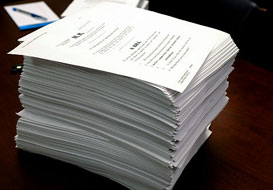
“Don’t blame us for all the mistakes in the law—look at how long it is!”
…on the Affordable Care Act and King v.Burwell, at his news conference. When President Obama was asked about the soon to be announced Supreme Court decision in King v. Burwell, he launched in an epic of unethical assertions and rhetorical games. I’ll highlight the unethical—not merely dishonest in some cases—statements and elaborate afterwards.
THE PRESIDENT: What I can tell state leaders is, is that under well-established precedent, there is no reason why the existing exchanges should be overturned through a court case. (1) It has been well documented that those who passed this legislation never intended for folks who were going through the federal exchange not to have their citizens get subsidies. (2)That’s not just the opinion of me; that’s not just the opinion of Democrats; that’s the opinion of the Republicans who worked on the legislation. The record makes it clear. (3)
And under well-established statutory interpretation, approaches that have been repeatedly employed — not just by liberal, Democratic judges, but by conservative judges like some on the current Supreme Court — you interpret a statute based on what the intent and meaning and the overall structure of the statute provides for. (4)
And so this should be an easy case. Frankly, it probably shouldn’t even have been taken up. (5)And since we’re going to get a ruling pretty quick, I think it’s important for us to go ahead and assume that the Supreme Court is going to do what most legal scholars who’ve looked at this would expect them to do. (6)
But, look, I’ve said before and I will repeat again: If, in fact, you have a contorted reading of the statute that says federal-run exchanges don’t provide subsidies for folks who are participating in those exchanges, then that throws off how that exchange operates. (7)It means that millions of people who are obtaining insurance currently with subsidies suddenly aren’t getting those subsidies; many of them can’t afford it; they pull out; and the assumptions that the insurance companies made when they priced their insurance suddenly gets thrown out the window. And it would be disruptive — not just, by the way, for folks in the exchanges, but for those insurance markets in those states, generally.
So it’s a bad idea. (8)It’s not something that should be done based on a twisted interpretation of four words in — as we were reminded repeatedly — a couple-thousand-page piece of legislation. (9)
What’s more, the thing is working. (10)I mean, part of what’s bizarre about this whole thing is we haven’t had a lot of conversation about the horrors of Obamacare because none of them come to pass. (11)You got 16 million people who’ve gotten health insurance. The overwhelming majority of them are satisfied with the health insurance. It hasn’t had an adverse effect on people who already had health insurance. (12)The only effect it’s had on people who already had health insurance is they now have an assurance that they won’t be prevented from getting health insurance if they’ve got a preexisting condition, (13)and they get additional protections with the health insurance that they do have.
The costs have come in substantially lower than even our estimates about how much it would cost. Health care inflation overall has continued to be at some of the lowest levels in 50 years. (14)None of the predictions about how this wouldn’t work have come to pass.(15)
And so I’m — A, I’m optimistic that the Supreme Court will play it straight when it comes to the interpretation. (16)And, B, I should mention that if it didn’t, Congress could fix this whole thing with a one-sentence provision. (17)
Wow, that’s even worse that I thought. Have there been more dishonest, deceptive, irresponsible statements by a President of the United States? Maybe. I don’t see how there could have been one that was much worse, though.
I’ll try to be brief, or else this will be a book. The numbers correspond to the bolded sections above…
(1) Intentionally misleading and untrue: there’s a very good reason, if the Court decides that it applies. The reason would be that legislation passed by Congress that doesn’t work should be fixed by Congress, as the Constitution directs, not by executive fiat, just because that would make life easier for the President. Only a leader who does not view the Constitution as important would say such a thing.
(2) The folks who “passed” the law didn’t read it. The belief that legislation in a major democracy can consist of good wishes and nice intentions without the law itself actually embodying and executing those intentions and wishes in easily understandable language is irresponsible and absurd. In legislative drafting, as in law generally, the words matter.
(3) A lie: the record isn’t clear at all. Jonathan Gruber, who recent documentation shows was indeed as integral to the development of the Affordable Care Act as Democrats have denied that he was, was recorded explaining that the language in the law which stated that only state exchanges could provide subsidies was intentional, and designed to force states to set the exchanges up.
(4.) See here, here, and here, just as a start. It isn’t that simple, and in this case, where the intent is ambiguous, it isn’t simple at all. Here’s a quote from one of the scholarly papers, this one by Prof Ron Rotunda, who I know a bit. Smart guy, Ron:
If the Court allows administrators carte blanche to change the very words of a statute, we will have come a long way towards governance by bureaucrats. Over the years, Congress has delegated many of its powers, but it has never delegated the power to raise taxes or spend tax subsidies in ways that no statute authorizes.
For example, the ACA [ ] provides that territories of the United States (e.g., Guam) are “States,” for purposes of this law. Section 1323 provides [ ] that if a “territory” creates an Exchange, it “shall be treated as a State” under this law. Congress knew how to define “state” to include more than “states.” It did that when it defined “territory” as “State.” It also says that the District of Columbia is a “State” for subsidy purposes. A section provides, “In this title, the term ‘State’ means each of the 50 States and the District of Columbia.” However, no section of the law defines “State” to include the Federal Government. An earlier version of the bill — one that Congress did not enact — provided that “any references in this subtitle to [any] Health Insurance Exchange…shall be deemed a reference to the State-based Health Insurance Exchange.” That would treat Federal Exchanges the same as State Exchanges. Congress did not enact that version.
When lawyers say that a problem is simple and a proper result is obvious, it often means that they don’t have as strong an argument as they would like everyone to believe.
(5.) Ethics foul. That’s not Obama’s opinion to announce in public: the Supreme Court justices don’t opine on whether its time for boots for him to order on the ground to battle ISIS. This is a leadership ethics breach particular to Obama. The Supreme Court’s standing with the public has declined during Obama’s administration to the lowest point in history, and his refusal to treat the Court with respect and deference is a prime reason.
(6.) See (4) above. Obama is falsely claiming a scholarly consensus that doesn’t exist.
(7.) There is nothing “contorted” about it, as the example in (4) points out.
(8.) It’s a bad idea to make certain that Congress reads laws, doesn’t pass laws so long and convoluted that members can’t read them, causing hidden or perverse provisions to slip through, thus either making the law impractical or forcing a violation of the Constitution and rule of law by amending it by fiat? To the contrary, it’s a bad idea to allow this to continue without sending the message that sloppy, unprofessional, lazy, irresponsible lawmaking has consequences.
(9.) Oh, brother. Again, a) reading the words to mean what they mean is not “twisted,” and b) who allowed the law to be so long? What’s the argument, that the longer and more impenetrable a law is, the more that poor and ambiguous drafting should be tolerated and ignored? This is an insulting argument designed to appeal to the dim-witted. It makes no sense, and is intellectually dishonest.
(10.) Yet.
(11.) It is unbelievable that Obama would dare to say this, after lying about how anyone who wanted to keep their plan and doctor could. Well, maybe not so unbelievable, come to think of it.
(12.) and (13.) This too. Having to change plans and doctors, and pay more in the bargain is certainly an “effect,” and not a good one.
(14) As has even been pointed out by liberal “fact-checkers,” the causality is unclear, and costs are projected to start rising again. This statement is misleading.
(15,) A false blanket statement of certainty that is still far from certain. As usual for this administration, Orwellian denial is the policy.
(16.) “Play it straight” is despicable, suggesting to the public that there are only two alternatives for the Court: deciding Obama’s way, or making a corrupt ruling based on partisan bias. This is nothing less than an ad hominem attack on the integrity of the Justices, terribly damaging to public respect for the process, and the high water mark of a shameless Machiavellian.
(17.) And Congress fixing it is the way the Constitutions says that it should be fixed. Nonetheless, this is blame-shifting. If the clause is interpreted to mean that only state exchanges can provide health insurance subsidies and chaos results, the blame should be squarely on the party that passed a flawed bill without due care in the first place.
17 unethical statements in a single response, while barely pausing to take a breath. Impressive!
3, 5, 11 and 16 are the worst of the worst.
__________________________________
Sources: Washington Post 1,2, 3, 4
 Ethics Alarms
I don’t think Obama gives a damn, and neither do his supporters.
I will say one thing about 12. I had a *very* good insurance plan. After the law passed it would have cost my employer 25% more to keep it – and that’s just taxes, other increases due to the forced extra coverage were never revealed. Fast forward a couple years I’m paying more and have to deal with a gigantic pile of paperwork that I didn’t have to before. I had insurance and the law had an adverse effect on me.
Or maybe I’m not one of the people he’s talking about, maybe I’m a special snowflake and any adverse effects on me can be blamed on global warming.
Nah! It’s George Bush’s fault. Ultimately, even global warming is. Didn’t know Bush could control so much of the solar system.
DD….not Bush! It’s the Koch Brothers! They actually control Bush.
mumble… mumble… illuminati…
Oh, and CHENEY who brought Haliburton along as part of the conspiracy.
…and that Trilateral Commission!
And the Masons……what am I saying? I AM a Mason.
Wait—now don’t they have to kill you?
Not for admit…uh, claiming to be a Mason, but if I divulge any of their secrets, it’s Katy bar the door. I actually had a Mason tell me once, in Virginia, that they could LEGALLY execute me if I divulged any secrets. Heinlein divulged more than most in ‘Revolt In 2100’. Crazies in any group, I guess.
I am right there with you, Alex. My family and I had a health care plan that cost a ton of money each month (because I am a sole practitioner and not part of an employment pool). In November, our carrier sent us a letter stating that they were ‘pleased to advise us’ that our monthly premium would increase a mere 38%, the deductibles and co-pays would increase and certain medications were no longer covered. Also, our child’s pediatrician advised us that the practice would no longer accept our healthcare plan.
jvb
No, John, there must be some mistake! Our very own President, who would not lie to us, said very clearly that “It hasn’t had an adverse effect on people who already had health insurance.The only effect it’s had on people who already had health insurance is they now have an assurance that they won’t be prevented from getting health insurance if they’ve got a preexisting condition, and they get additional protections with the health insurance that they do have.”
You are confused, somehow.
Whew!! I am glad you cleared that up for me. I must reeducate myself on government policy. “All is for the Best.”
jvb
I think Obama honestly believes all statutory interpretation is outcome-based and therefore bullshit. He knows if he were on the Supreme Court he would just rule the way the left wants, and he is pretty sure in his own mind that he has four Justices who will do that. Rightly or wrongly he projects the same motives to his perceived adversaries on the Court.
He can think that, but it’s revolting to instruct the public that the Court is just another politically determined branch. A judge, an ethical one, has to be able to say, “I hate this result, but it’s what the law demands.” And the Court–past and current— has often had such rulings.
Like that judge who found racial bias in that New York teacher’s exam?
I thought the rule on statutory construction was pretty simple: courts only delve into the enactors’ intent (if there’s any reliable record of it) when and if the statute is ambiguous on its face. The language in question in the ACA has never struck me as ambiguous. Isn’t “State” an initial-capped, defined term in the statute? So the court should just say “No subsidies for federally run exchanges is what the statute says. If there’s a problem, have Congress fix it, Ms. Burwell.” Bang the gavel. “Next case.”
But thanks for the explication. The president seems to be paying Paul Begala to draft his out of school comments on the Supreme Court. Really awful and incredibly corrosive. He’s demeaning and diminishing the presidency.
And I wish to Hell he’d stop talkin’ bout “folks” all the time. So condescending. Makes me want to re-think my dislike for LBJ’s wooden “my fellow Americans.”
The one that set my teeth on edge was McCain’s “my friends.”
And the Supreme Court at the same time, and Scotus doesn’t deserve it.
I think he thinks that he can afford to do this, because the Supreme Court does not have the Rockstar bankability that he has. as such, any diminishing of them can only serve to increase the power of the presidency, which is really what he wants to do. The weakening of separation of powers is not going to serve this nation well, but I don’t think that the Democratic Party of the cares about separation of powers, particularly when it involves a dimunition of their own power. Should we reach. Again where the parties are reversed with the Republicans in the White House and the Democrats in control of the legislature I’m sure they will complain mightily about the presidency being too powerful, but they will have brought it on themselves. As for the Supreme Court, there are going to increasingly be marginalized and thought of as merely confirmers of the view of whoever here agrees with their decisions. if they rule in such a way that someone agrees with they got it right, if they do not then they are being partisan hacks.
And let us not forget, our President was a professor of Constitutional Law.
He has consistently shown public contempt for The Supreme Court and Congress, since the first day of his Presidency. He flatly stated that he had to issue an immigration executive order because Congress refused to give a bill he liked. He dressed down the SCOTUS at this first State of the Union over “Citizens United”. I don’t recall any other sitting president doing that, besides Nixon (but I was only 10 at the time and more concerned about Hot Wheels and Lincoln Logs, so my memory is a little hazy).
jvb
We have touched on him being like Woodrow Wilson a few times, seeing himself as the new visionary and everyone who disagreed with him as just in the way.
Between 2 and 3:
No Republicans worked on the legislation. They were shut out.
No Republicans voted for it either.
Ohhhh…so THAT’s what he meant by “The record makes it clear.”
Clever girl, that politiraptor, Barack. DC and hellth care have gone Jurassic.
It’s amazing what a man can pick up in the way of rhetorical rhubarb by flitting around some classy colleges for years on somebody else’s dime (whose?) and achieving little else of note.