KABOOM! Most Unethical Defense For Child Rape Ever…

headexplode

If your head doesn’t blow over this one, it’s missing something.

Richard Keenan, 65, the former mayor of Hubbard, Ohio from 2010-2011 and a self-proclaimed devout Christian, confessed in a group therapy session to having sex with a little girl over three years beginning when she was four. He’s now facing life imprisonment for rape, if his statements are admissible.

Prof Jonathan Turley discusses the legal issues involved with using admissions made in a clinical setting, and you can read about them here. I am posting to commemorate the ex-mayor’s other defense position, which is why my head is on the ceiling and walls of my office. Are you ready?

Keenan says that the sex was consensual, because the four/five/ six /seven-year old was a“willing participant, ” and..

…she initiated it.

I think that’s all I want to write about this now, or ever.

I’ve also got to go get an armful of paper towels.

Oh—how’s your head?

Comment of the Day: “A Daughter Sues Her Parents For Being Assholes. Good.”

growth-sequence

Having just returned from an eight-day (and partially laptop-less) speaking tour  that has me about ten posts behind, it was nice to have Steve-O-in-NJ deliver a textbook Comment of the Day, expanding on the original post with relevant and useful observations about photography -obsessed parents and photography ethics.

I do object from an ethical standpoint to his tit-for-tat endorsing last line.

Here is his good and thoughtful work in response to the post, “A Daughter Sues Her Parents For Being Assholes. Good.”

What are the ethics of taking 500 pictures of your child? I wish that I could say that the ethics of taking large numbers of pictures are always the same but they are not. I am in the middle of a two-week vacation and I have been taking a large number of pictures. I see absolutely nothing wrong with shooting a large number of pictures during an air show, particularly where the opportunity to get a particular shot is very limited. I see absolutely nothing wrong with taking a large number of pictures at a place like Colonial Williamsburg, where the actors are deliberately dressed up in costumes designed to attract attention. The same ethics generally applies to any event where there are costumed individuals who are seeking attention. The same ethics probably apply to sporting events. Of course the shooting of inanimate objects like in a museum is perfectly all right, subject to whatever policies the institution puts in place and makes known. Continue reading

Ethics Dunce: CNN’s Chris Cuomo

Clinton surrogate Chris Cuomo...but it's OK, everybody's doing it.

Clinton surrogate Chris Cuomo…but it’s OK, everybody’s doing it.

Mainstream broadcast news media’s all-in, full-throated support for Hillary Clinton and biased coverage of Donald Trump is pervasive and disgraceful, but since they all enable each other and have successfully isolated Fox, nobody whom anyone pays attention to is going to call foul, and as this abandonment of journalism ethics is gathering momentum. nobody can stop it, either. Trump was attacked far and wide for saying the election was rigged; and who knows what he meant (who knows what he ever means?), but when a democracy’s journalists cover the campaign by acting as relentless partisan advocates for one candidate, that’s one way to rig an election.

It is shocking how openly this is being done. One has to wonder how the networks will ever be trusted again, or how they can return to ethical norms. Continue reading

A Daughter Sues Her Parents For Being Assholes. Good.

photo

An 18-year-old Austrian woman is suing her parents for continually posting embarrassing childhood photos of her on Facebook without her consent. Since 2009, she alleges, they have willfully humiliated her by constantly posting intimate images from her childhood—about 500 to date. Among them are potty training photos and pictures of her having her diapers changed.

The abused daughter told reporters, “They knew no shame and no limit – and didn’t care whether it was a picture of me sitting on the toilet or lying naked in my cot – every stage was photographed and then made public.” Her parents have  700 Facebook friends.

The technical term for them is “cruel and merciless assholes.”

They have refused to delete the photos, with her father arguing that since he took the photos he has the right to publish them to the world.

Oh, what does the law have to do with this? If the parents had any decency, and sense of fairness, respect and caring, the law wouldn’t have to be involved in any way.  Their daughter feels humiliated, as most of us would be, by having such photos published. There is no ethical principle under which publishing photographs (or videos) of anyone that were taken without consent when the subject objects or one knows or should know that he or should would object can be justified. This controversy, if ethical parents were involved, would be settled with a simple exchange:

Her: “Please don’t put anymore of those photos on Facebook, and take down the ones that are up now. They are embarrassing.”

Them: “OK!”

How hard is that? I know it’s hard for parents to resist posting photos of their adorable infants and toddlers while they are too young to protest, but the protest should be presumed. The Golden Rule rules, and I go further: this is an absolute. Children should not have their lifetime privacy scarred by parents selfishly indulging themselves by treating their children like pets. Children should be able to trust their parents to respect their sensibilities and vulnerabilities, and not to sacrifice them for cheap Facebook “likes.”  Obviously, many of them can’t.

Continue reading

“Flipping A Man’s Meat” Ethics

Is this what the culture has accomplished with its hard won respect for and acceptance of gay Americans? Really?

Neil Patrick Harris has done a series of quirky, benign spots  for Heineken Light, perhaps to lure us into a false sense of ease.  For in his most recent commercial,  Harris notes, as he stands next to a man grilling barbecue, that Heineken Light makes it OK “to flip another man’s meat.”

This is another in a long and growing list of TV ads based entirely on the assumption that adults think it’s hilarious to suggest obscene or vulgar innuendos. I’ve written about this phenomenon before, which is merely the normalization of crudeness in our discourse, nothing more, but nothing less either. So now we have gay sexual innuendo  by an openly gay actor to advertise beer. Isn’t that great? Boy, Heineken must be so proud.

The grill guy replies to the puckish—or flirtations?—former-Doogie that no man can do that, but late,  Harris asks him: “Can I flip your meat?”

Wow, that’s just hilarious! Why is it hilarious? Because it’s naughty? Because it’s daring? It’s certainly not clever, and if virtually defines the word “gratuitous.” It it a challenge to viewers, daring them to question the taste of joking about “flipping a man’s meat” when they routinely accept gross commercials with vulgar and gratuitous—you know, like this —heterosexual double entendres?  Is the assumption that gays will giggle, guffaw and slap each other on the back when they see this! “Good own, Neil!” Really? How insulting.

I can’t wait for the masturbation double-entendres in credit card and bank commercials. Continue reading

Sometimes It All Comes Together…But First, A Song!

As those who have read here for a while know, among my fondest passions, virtually life-long, are baseball,  theater and ethics. Today, I have the pleasure of seeing them all come together in a single event. How often does that happen?

At noon, I will be giving my most recent musical Continuing Legal Education ethics seminar, “Ethics Cabaret,” at Nationals Park in D.C. prior to the Mets-Nats game. “Ethics Cabaret,” like its six predecessors, presents legal ethics hypotheticals  as parodies of pop, rock, Broadway or country-western standards, presented by a professional performer. In this case, the performer is American Century Theater veteran Esther Covington, who accompanies herself on the keyboard. I write the songs that make the young lawyers cry, but she sings them, beautifully and often hilariously.

Speaking of Barry Manilow, my favorite segment of the seminar is the parody of one of his signature songs, which you can hear above—it’s an ear-worm, so be careful. The legal ethics version is about “Bridge of Spies” and the many quandaries raised in the film, which I examined in this post earlier this year. The parody is called “Who is the Client?,” lyrics-only copyrighted by ProEthics. Here they are….you can sing them along with Barry’s version! Continue reading

Unethical Quote Of A Quote Of The Month: CBS News

CBS should have run this photo with Bill's  cleaned up interview. Doesn't she look nice and healthy?

CBS should have run this photo with Bill’s cleaned up interview. Doesn’t she look nice and healthy?

It must be reassuring, I’d think, to know that the news media will do everything in its power to cover for you, slant news to bolster you, ignore gaffes, and whenever possible, use clever edits to clean-up annoying little hints that you might not be all you’re cracked up to be.

Here is what Bill Clinton said in an interview with Charley Rose this week, when Rose asked if there was any chance her problems over the weekend could be a sign of a serious health issue. Clinton, saying that he didn’t believe that, added,

“Well if it is, it’s a mystery to me and all of her doctors because frequently—well not frequently, rarely—but on more than one occasion, over the last many, many years, the same sort of thing happened to her when she got severely dehydrated.”

Interesting slip by Bill, don’t you think? Suggesting that Hillary frequently suffers fainting spells would add to the speculation about her health and the fact that she has not been her usual, honest, transparent self on that issue. Bill catches himself and says, in effect, “Did I say frequently? When I say frequently, I mean almost never.” Could mean nothing, could mean something, but he said it.

Can’t have Bill causing more trouble for his wife, though, so when CBS broadcasts the interview again that  night, it magically comes out like this: Continue reading

Observations On A Bad Police Stop


The ACLU of Colorado last week posted the above  video of an Aurora, Colorado police encounter with two black citizens last February.

The sequence, drawn from one of the officers’ body camera, shows Darsean Kelley and another man being stopped by police after they had received a call about a man allegedly pointing a gun on a child, but with no description of the man. Kelley and his companion were standing on the sidewalk in the vicinity of the alleged incident. Police asked the men  to sit down, which Kelley said was impossible to do because he had a groin injury. Officers then told both men to put their hands behind their heads and turn around. As his friend remained silent and apparently compliant, Kelley kept his hands raised and asked why he was being detained. Immediately after he said, “I know my rights!” one of the officers shot him in the back with a stun gun. He fell backwards into the street.

The police then arrested Kelley on a charge of disorderly conduct for failing to obey a lawful order. In his report, the officer wrote that he thought he might be reaching for a weapon. The ACLU of Colorado then filed a motion to dismiss the case arguing that Kelley was unlawfully detained and arrested without probable cause or reasonable suspicion.

Observations:

1. Kelley and the other man were unlawfully detained and arrested. Were they unlawfully stopped? No. The police could stop men in the vicinity of a complaint like the one they had received in order to investigate it. When people become belligerent or uncooperative during such legal stops, cops sometimes become suspicious, or decide to use their power to stick it to an individual who shows hostility when the officers feel they are just doing their jobs, or trying to. This is when such situations escalate.

I’m sure the officers regarded the “I can’t sit down” claim as suspicious and provocative. I would. Note that no harm befell the other man, who remained quiet and followed the officers’ instructions. This is the correct way to respond.

2. I’m sure Kelley felt that he was being “stopped for being black.” I would if I were him. How are police officers today supposed to allay this suspicion at the outset of a legitimate stop? (Or maybe they WERE stopped for being black…)

3. What is the policy for tasing? The typical hierarchy for the use of force in police departments used to be this:

Table 1: Use-of-Force Continuum
Suspect resistance Officer use of force
1. No resistance 1. Officer presence
2. Verbal noncompliance 2. Verbal commands
3. Passive resistance 3. Hands-on tactics, chemical spray
4. Active resistance 4. Intermediate weapons: baton, Taser, strikes, nondeadly force
5. Aggressive resistance 5. Intermediate weapons, intensified techniques, nondeadly force
6. Deadly-force resistance 6. Deadly force
(Adapted from the Orlando, Florida Police Department’s Resistance and Response Continuum)


After the introduction of more powerful electronic control devices, many departments changed  their use-of-force directives  for handling suspects who were only passively resisting the lawful orders of the officer, and increased the required level of resistance by suspects to warrant use of stun guns or tasers from passive resistance to active, physical resistance.

Table 2: Levels of Resistance Defined

Passive Resistance The subject fails to obey verbal direction, preventing the officer from taking lawful action.
Active Resistance The subject’s actions are intended to facilitate an escape or prevent an arrest. The action is not likely to cause injury.
Aggressive Resistance The subject has battered or is about to batter an officer, and the subject’s action is likely to cause injury.
Deadly-Force Resistance The subject’s actions are likely to cause death or significant bodily harm to the officer or another person.
Adapted from the Orlando, Florida, Police Department’s Resistance and Response Continuum

I don’t know what the Aurora police policy is, but certainly under the kinder, gentler, saner revised standards above, stunning Kelley was excessive. Police brutality is not an unfair description of what he experienced. Continue reading

Ethics Hypothetical: Rules, Compassion, Integrity, Fairness, And A Looming Race Card

clock2

[The hypothetical is inspired by two recent events I witnessed in the past week.]

Preface: The state requires new bar admittees to take a one-day course covering the basics of practicing law in the jurisdiction—how the courts work, special procedural rules, unique aspects of local practice, horror stories, the works. They must complete the course or they can’t be certified, and the court-ordered series of lectures and presentations is held only once a month.

A company runs the mandatory curriculum under contract to the state, and is required to confirm in writing to the courts that its requirement have been fulfilled. One key requirement is that every attendee must be present for every minute of the presentations, except for brief emergencies, like using the rest rooms. The course administrators carefully monitor attendance. The published description of the course directs that once the course begins, theoretically at 9 am sharp, no late-comers will be admitted.

As you might imagine, missing the session can be quite a hardship, as participants often live and work in other jurisdictions.

The Event: It is 9:08 am on the day of the program, and the introductory video that begins the orientation is almost finished. It consists of interviews with members of the bar about the benefits of practicing in the state, the importance of ethical practice, etc: to say it is not substantive is an understatement. Literally nothing that is said and shown in the video is anything but boilerplate.

A young man, sweating profusely, bursts in the door, looking unhappy and desperate. “I’m sorry I’m sorry!” he babbles. He says that he had to drive up from a neighboring state and had an accident. “Can I still get in?” he pleads.

The male staffer responsible for the session chats briefly with an associate. The program was late starting, and this late arrival will miss nothing if he goes in now. “All right,” the honcho says as the young man heaves a sigh of relief. “I shouldn’t do this, but you haven’t missed anything.” As he goes into the auditorium, one can here the opening remarks of the first speaker, a judge. It is now 9:12 am, and another young man bursts through the door on a dead run. “My crazy cabbie’s been driving me all over the city for an hour!” he shouts. “I flew in last night from Arizona! Please, please, don’t make me do this again…I barely was able to afford this trip.” The administrator is wondering if he had seen the previous guy go into the auditorium. He’s heard this judge’s spiel many times: all that has been missed, to be honest, are a few (lame) jokes. “All right, all right, get in there quick!” he tells the new supplicant. “I’ll finish your paperwork during the break!” The kid looks like he’s going to cry, he’s so relieved.

I’m there, watching this (I’m on the program) and say to the administrator, “I bet this happens every time.” He says, “It does. I know that nobody misses anything that isn’t in the printed materials until 9:15, so it’s a hard stop after that.”

And another late arrival bursts through the door. It’s a bit after 9:14. The staffer has just told me that the final final deadline is 9:15, and it’s not that yet. This poor guy is bleeding through his pants,  has a big bruise on his face, and is saying something about a bicycle accident. By the time he gets himself settled—he is told that there is no time to clean up—it’s past 9:16. He starts toward the auditorium door as the other staffer says, “OK, that’s IT,” and starts to take the registration materials and lists away….just a very stressed young African-American woman enters, in plenty of time to see the bicycle rider, who is white, enter the auditorium. I can hear the judge through the open door. He’s still telling jokes, longer this time than usual.

Issues and Observations

1. The young woman was not admitted, and told that she had to come back another month. She too was from out of state. She also had a legitimate-sounding excuse.

  • Was that fair to her?
  • Should it have mattered that the program had not yet reached a serious stage?
  • She was told that 15 minutes was the absolute, unwaivable deadline. That was true, but it was not the deadline the company was contracted and pledged to enforce. That deadline was 9:00 am.

2. Should the explanations used by the latecomers play any part in the decision to allow them in? Why? Continue reading

The Ethical Dilemma Of The Successful, Failing, Local Small Business

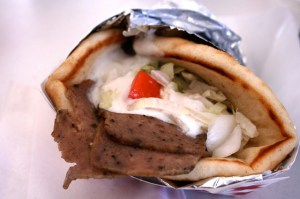
Now THIS is a gyros sandwich!

Now THIS is a gyros sandwich!

The little restaurant opened the same year my wife and I moved into the neighborhood. It specialized in yummy Greek fare like gyros, souvlaki, and Greek salads, but also made terrific hamburgers, subs and pizzas, and quickly became our reflex fall-back when we were too tired to make dinner or wanted a treat for lunch. The place was a family operation: the tiny, spunky middle aged woman who seemed to run the place—taking the orders, filling bags, taking the payment—had a Greek accent that reminded me of my grandmother and all of my relatives from her generation; her husband, silent, imposing, who was the chef; and over time, the two children, both of whom worked there when they weren’t in school.

The food was consistently delicious, fresh and authentic, but it was also satisfying to see an old-fashioned family business growing and thriving. A restaurant consultant would probably have said it was too old-fashioned, for the menu never changed, the faded prints of the Parthenon and the Aegean coast were the only decorations in the place, and it dealt only in cash. Still, the little Greek lady greeted you with a knowing smile when you walked in the door, and you knew you were going to be treated like a neighbor.

Then suddenly, the family was gone. The couple decided to sell the place and retire, and a long-time employee who had worked in various jobs over the years took the restaurant over. I knew him, of course, and we talked often. He’s a nice guy, determined, ambitious, hard working. He threw himself into the job of making the business boom. Now the restaurant accepts credit cards and delivers, is open on Sundays, has daily specials, and sports a newly-painted and (somewhat) less austere decor. He also jacked up the price on everything.

The new owner’s formula for success worked almost immediately. The restaurant, he told me, has almost doubled its business. The problem is, as my family gradually discovered, is that the entirely non-Greek staff, including the owner,  has no idea what their food is supposed to taste like. You know you’re in trouble when the entire staff mispronounces everything on the menu, (It’s GIR -Os, hard G, not, ugh, “JY-row,” like the name of the goose inventor in Donald Duck comics), but it’s worse than that. The feta cheese in the Greek salads, which are suddenly mostly iceberg lettuce, is scant and low quality. The once-marvelous cheese steak subs are bland; the onion rings are charred, and every now and then a carry-out order includes something inedible, like the freezer-burned veal parmigiana I had a few months ago. The owner was apologetic, but his candid “I thought that meat looked funny when I microwaved it” didn’t inspire confidence. Continue reading