From The Appearance of Impropriety Files: Justice Scalia’s Hunting Trip

ScaliaCheney

A partyist, ignorant hack named Andrea Paysinger, who is banned from further commentary by the Ethics Alarms “too dumb and biased to contribute” rule, just wrote a comment to the Clinton-Lynch post making the typical ratioanalization-rotted argument that “all the brouhaha over this is ridiculous, childish on the part of all the RIGHT WING jerks who SAW NOTHING WRONG with JUSTICE SCALIA taking gifts and spending vacations PAID FOR by those who actually had cases coming up before SCOTUS AND NOT ONE FUCKING TIME DID HE RECUSE HIMSELF.”

I just love it when people accuse me of being a partisan hypocrite without bothering to check what I have written. As it happens, I wrote a great deal about Scalia’s infamous hunting trip, which I unequivocally condemned as creating the appearance of impropriety. (It was, however, factually less troubling than the Clinton-Lynch meeting, as Scalia and Cheney were never alone during the trip in question.) So for people like Andrea (though not Andrea herself, who won’t be able to get back on this site if she recruits an army of Myrmidons), I will hereby post the two Scalia essays, which currently reside only on the Ethics Scoreboard, now an archive of my ethics commentary prior to 2010.

Unfortunately, the site’s search function stopped working when I had to change platforms recently. If you want to check out the Scoreboard now, just use Google: type “Ethics Scoreboard” and the subject or topic. If there was commentary, you’ll find it.

To give due credit, Andrea did identify real hypocrisy on the Lynch issue. Many of the Democrats exposing themselves as corrupted by partisan bias by now trying to defend Lynch also furiously attacked Scalia’s appearance of impropriety. They—your idols, Andrea— have no integrity. I do.

Here was what I wrote about Scalia’s clear appearance of impropriety in 2004.

Good Judge Hunting: Antonin Scalia and the Cheney Case

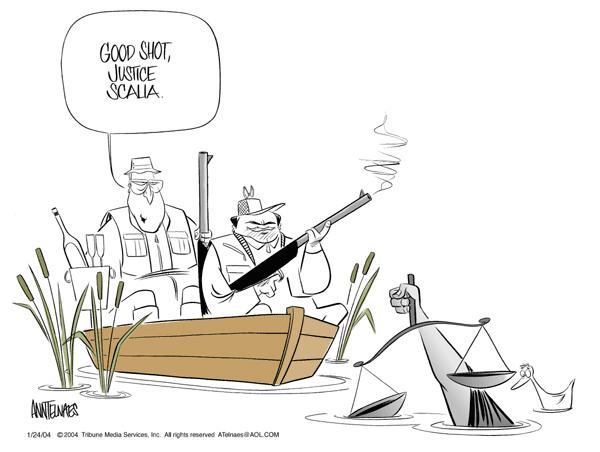
Supreme Court Justice Antonin Scalia recently went hunting with Vice President Cheney, even as the Supreme Court prepares to rule on whether the documents pertaining to Cheney’s meetings with energy company officials regarding future US energy policies must be made public. This has led to critics calling for Scalia’s recusal from the case, on the grounds that the social contact renders his objectivity in the matter suspect. Scalia, feisty as always, denies this, and maintains that he is fully capable of ruling objectively.

And I’m sure he is, but that’s beside the point. In the case of judicial independence, it is often appearances that count, and because this is an issue particularly charged with partisan passions, the Supreme Court must avoid any hint that cronyism or personal loyalties are playing a part in the outcome of the legal showdown. Scalia should remove himself from the case.

Justice Scalia has pointed out that personal friendships between the justices and Washington leaders are commonplace, and that mere friendships among professionals should not raise the specter of favoritism or bias. Indeed, had Scalia maintained exactly the same collegial relationship with Cheney, but avoided the hunting trip, there would be no issue. But the outing conjures images of male bonding and frank talk by the campfire (lobbying, perhaps?), and if Justice Scalia were to rule Cheney’s way (and Scalia’s past opinions would suggest that this is likely), the legitimacy of the ruling would be, in the eyes of many, tainted. But there is more.

According to the L.A. Times, Scalia was flown to the hunting reserve on the small jet that serves as Air Force Two. That could be interpreted as a gift to a judge from a pending litigant. The trip has value, and judges are not supposed to accept things of value under circumstances where it calls their objectivity into question. This alone would justify a recusal. And there’s a “strike three.”

The Times reports that the reserve where the duck hunting took place is owned by Wallace Carline, the head of Diamond Services Corp., an oil services firm that is on 41 acres of waterfront property in Amelia, La. The company provides oil dredging, pile driving, salvage work, fabrication, pipe-rolling capability and general oilfield construction. There is no indication that he has a direct stake in the case, but he is an energy executive. So we have a Supreme Court Justice ruling on whether materials should be released regarding the input of the energy industry into national energy policy in meetings held by the Vice-President, after he spends a hunting trip with the Vice-President, who has also provided charter jet transportation, at a hunting reserve where he is the guest of an energy executive.

Come on, Justice Scalia. Continue reading
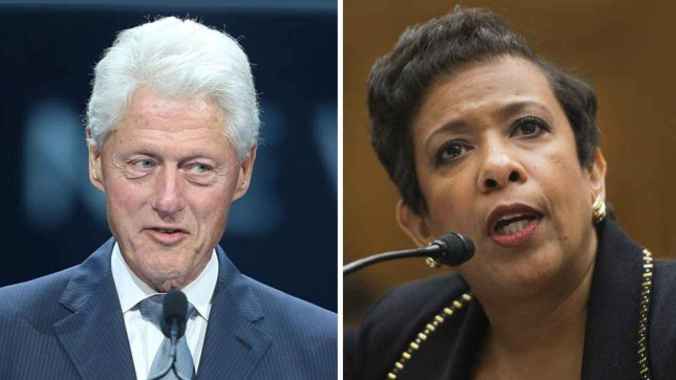
Attorney General Lynch, Meet The Appearance Of Impropriety! Funny, I Assumed You Were Acquainted…

Clinton Lynch

U.S. Government officers and employees are directed to avoid engaging in conduct  “creating the appearance that they are violating the law or the ethical standards promulgated pursuant to this order. ” Some of those officers, like those who work in law enforcement and the justice system, shouldn’t require Executive Order 12674 – Principles of Ethical Conduct for Government Officers and Employees to know that the appearance of impropriety, including bias, favoritism, influence peddling and conflicts of interest, is unethical, since judges have a prohibition against creating such appearances in their codes of conduct no matter where their courts are located. They also know that as  professionals charged with making sure the rule of law works equitably and efficiently for all, rich and poor, high and low, the public trust is essential and indispensable. If the public doesn’t trust the fairness, objectivity, competence and wisdom  of those who enforce the law, then the public will not trust the law itself, and the rule of law, and democracy itself, will be threatened.

This is ingrained into every government lawyer’s hide, and so core to the principles of justice professionalism that the news that Attorney General Loretta Lynch met privately with  former President Bill Clinton this week just defies explanation. Supposedly President Clinton walked uninvited from his plane to her government plane, which were both parked on a tarmac at Phoenix Sky Harbor International Airport to chat.

Her only proper and ethical response to Clinton is undebatable:

“I’m sorry, Mr. President, but my Department is in the midst of investigating your wife, and it is crucial that the public does not detect any evidence of collusion or influence occurring, and observes no evidence that would cause it to question in any way the ultimate determination by Justice regarding any possible legal action. You certainly must understand my position…and by the way, since you do understand, what the hell are you doing here? Go! Now!”

She did not say this, however.

She met with him.

Game over.

Appearance of impropriety. Continue reading

Freddie Gray Prosecution Update: A Law Professor Formally Accuses The Unethical Prosecutor Of Being Unethical

finger-pointing

George Washington Law School Professor John F. Banzhaf III has filed an ethics  complaint against State’s Attorney Marilyn Mosby with Maryland’s Attorney Grievance Commission. Banzhaf accuses Mosby in his 10-page complaint of breaching Maryland’s rules of professional conduct for lawyers, which requires that a prosecutor refrain from prosecuting a charge unless it is supported by probable cause, in her conflicted and incompetent prosecution of six police officers involved in the arrest of Freddie Gray. The complaint also flags Mosby’s improper use of public statements to bias the administration of justice.

Good.

Of course he is right, as I have repeatedly explained here, here, here, here, and here. I assume there have been other complaints before this one, but he has made the issue a high profile one, and that’s excellent news.

Mosby has earned the Mike NiFong treatment: the unethical prosecutor in the Duke Lacrosse rape case was disbarred, briefly jailed, and sued. She is black, female, and a Democrat, and NiFong remains one of the very, very few prosecutors to be punished significantly for unethical conduct. I will be amazed if the commission does anything momentous or sufficient to discourage grandstanding prosecutors like Mosby in the future, even though such prosecutors are willing to ruin lives for political gain.

I hope I am wrong.

(But I’m not.)

KABOOM! The Tale Of The Third-Grader’s Racist Brownie Offense: No, I Don’t Understand This At All

brownies explosion

This story made my head explode, and thus it will be tagged “Kaboom!” Unlike most such Kaboom! posts, however, this one is likely to make my head explode every time I read it. Or think about it. Forever.

On June 16, a third grader made a comment about the brownies being served to his class during an end-of-the-year class party at the William P. Tatem Elementary School in Collingswood, New Jersey.  After another student opined that the remark was “racist,” the school called the Collingswood Police Department.

Okay, stop. I’m puzzled already, and my head exploded again just writing that:

  • How could a comment about brownies be racist? Did the child say, ” As with human beings, the blonde brownies are innately superior to the dark ones”? Somehow, I doubt it.
  • Another third grader pronounced the statement as racist. Not a teacher, now. An eight-year old. How can that trigger anything, in a sane world, but a discussion led by the teacher about what is and isn’t racist, and how people shouldn’t leap to such  inflammatory observations, because it makes human interaction difficult if not impossible?
  • The school called the police department? For what? A threatened brownie massacre? How is this conceivably a police matter? Why did the police come?

“What is the nature of your emergency?” “A third-grader in my class made an inappropriate remark about brownies!” “Calling 911 with prank calls is a crime, ma’am. Don’t do this again.” 

It is per se unethical and irresponsible for any police department to treat such trivia seriously.

All right,slogging on… Continue reading

The Unethical Courtroom Exchange Of The Century!

believe-it-or-not-1024x442

This would have been rejected by “Boston Legal” as too ridiculous.

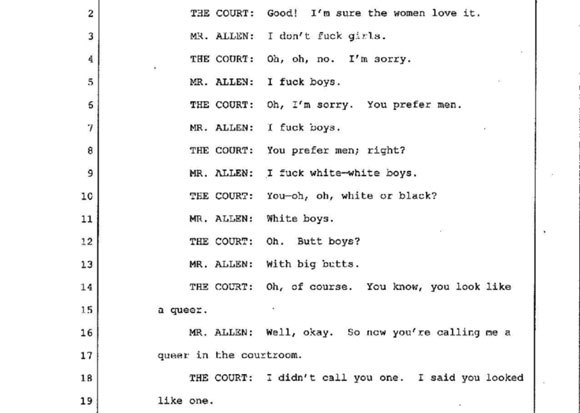
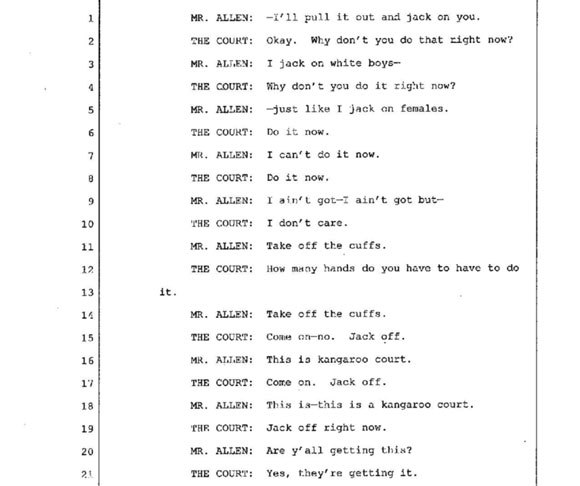
In a Rome, Georgia court room, as others looked on, Floyd County Superior Court Judge Bryant Durham allowed himself to be provoked by a defiant murder suspect named Denver Allen.

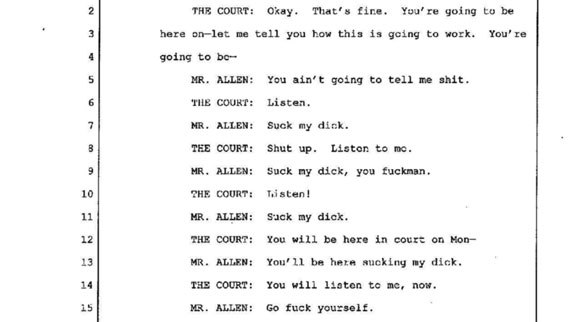
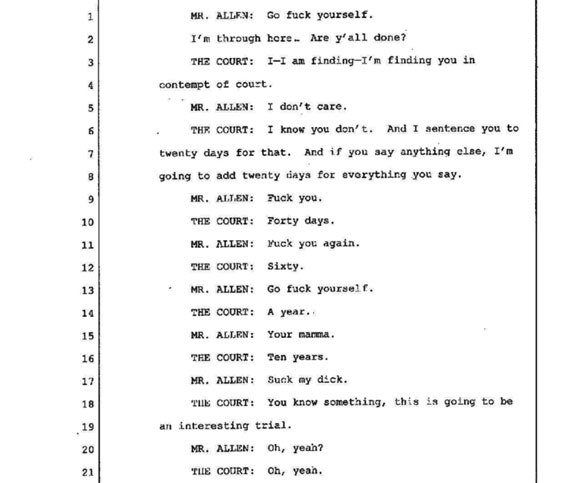
What resulted was a rare (thank goodness) example of a judge lowering himself, his position, the court and the justice system to the level of those with no respect for the law or society. Here is a portion of the transcript:


dialogue 1

dialohue 2dialogue 3dialogue 4


Stay classy, Judge Durham. Continue reading

Gene Autry Misinformation Update: Believe It Or Not, It Happened Again!

"Wild Bill" Donovan, who should have had nothing whatever to do with my ethics seminar today, but did anyway...

“Wild Bill” Donovan, who should have had nothing whatever to do with my ethics seminar today, but did anyway…

Yesterday I wrote about a lawyer in a legal ethics seminar interrupting me with a revelation about Gene Autry that was completely false.

Today I taught another legal ethics seminar, this time for a government agency. I was discussing was the various government ethics dilemmas in “Bridge of Spies,” the story of how lawyer Jim Donovan helped secure the release of downed U.S. flyer Francis Gary Powers in a famous incident during the Cold War. Many of the issues covered in my presentation were explored in this Ethics Alarms post.

As the film portrays it, Donovan, an insurance lawyer, does such a tenacious job defending an accused Soviet spy from U.S. government prosecution that the CIA recruits him to broker the trade of his now-former client, convicted and in prison, for Powers. In discussing the classic government lawyer dilemma of “who is the client?,”  I noted that the CIA agent who recruited Donovan told him that he would have no client. “Why did the CIA trust Donovan?” I asked socraticly. “Why did Donovan, an insurance lawyer, think he was qualified to engage in this kind of representation, it it was a representation?”

For the second time in nine days, an attendee piped up with an amazing piece of information.

“I suspect some of the answer to both questions is that James Donovan was the son of “Wild Bill” Donovan, who is considered the father of the Central Intelligence Agency,” he said. Continue reading

California’s High Speed Rail Fiasco

The question posed by the unfolding California high-speed rail cataclysm is why the reaction to it should be a partisan or ideological issue at all. Are human beings capable of managing bias and learning hard truths from new information, or aren’t they?

High speed rail was promoted in California  as a green and virtuous way to propel commuters  from San Francisco to Los Angeles along at 220 miles an hour, completing the trip in a about  two and a half hours. It was going to involve minimal tax-payer cash,  with  billions arriving from private investors. It would be profitable, not requires state subsidies and be much less expensive than flying. Thus enthused and enlightened,  53.7 percent of approved the plan and a $9.95 billion bond.

It was a scam, a hustle, and a pack of lies.  Virginia Postrel writes at Bloomberg…

“California’s high-speed rail project increasingly looks like an expensive social science experiment to test just how long interest groups can keep money flowing to a doomed endeavor before elected officials finally decide to cancel it. What combination of sweet-sounding scenarios, streamlined mockups, ever-changing and mind-numbing technical detail, and audacious spin will keep the dream alive?”

Well said. I would add, “And will anyone learn from this fiasco?” Specifically, will anyone learn that ideologically-driven officials will always press policies in defiance of reality, if the public lets them, or more precisely, trusts them.

The Los Angeles Times published a stunning report on how corrupt this enterprise has been from the start. Here’s sample:
Continue reading

No, Ashleigh, That Isn’t “Libel,” And Why Are You Hosting A CNN Show Called “Legal Affairs” When You Don’t Know That?

Ashleigh-Banfield

In an epic clash of incompetents, CNN’s Ashleigh Banfield challenged Michael Cohen, one of Donald Trump‘s advisers over his retweeting an internet meme that said that Hillary Clinton “murdered” the victims of the Benghazi mission assault.

After the House Benghazi Select Committee released its final report on the 2012 terror attacks, Cohen delivered his tweet featuring this…

Cohen tweet

It is about as stupid, lazy and inflammatory as most political memes, and the fact that Cohen would think it worth circulating tells us all we need to know about both him and the man who pays him, who would have probably tweeted this junk himself if Cohen hadn’t. Remember Cohen? He’s the Trump lawyer who crudely threatened the Daily Beast and went on to proclaim that spousal rape was legal, when it isn’t. Cohen is, by definition, a thug, a creep, and a crummy lawyer. Naturally, he’s also a Trump advisor. (Tell me again how Trump, that keen judge of legal talent,  can be trusted to appoint better Supreme Court justices than Clinton would. Or that Honey Boo-Boo would.)

Sparring with Cohen on her show “Legal Views,” Ashleigh Banfield lectured the lawyer and told him, “This is libel.” thus making exactly as accurate a statement of law as Cohen’s earlier one about spousal rape. It was not libel. It was inflammatory political speech in a satirical context (would anyone think Clinton actually said this, as the meme suggests?) about a public figure, clearly an opinion rather than a statement intended to be taken literally, and no more libel than “Bush lied and people died.” Banfield’s diagnosis was 100% wrong, and the fervor with which it was delivered is the calling card of a Clinton defender. Continue reading

The Washington Post’s Ethical Unethical Accurate Stupid Tone-Deaf And Dangerous Headline

Go ahead, keep deriding "the people." Can't do any harm...

Go ahead, keep deriding “the people.” Can’t do any harm…

The big problem with the “elites” that conservatives and Trumpeteers keep demonizing is that they insist on acting and talking as if they are exactly as insolated and contemptuous of “the masses” as they are accused of being. Witness this headline on the Washington Post website, on the Wonkblog column:

Headline Post1

Talk about walking into a haymaker! This headline went viral on the conservative media and social media, with such comments as, “Know your place, peasants!” and  “Stand aside and pay attention to your betters!” As with many such incidents, the headline signals that some ethics alarms aren’t functioning in high places. How could this headline make it to the web without anyone seeing it and thinking, “Whoa! Hold it! That sure sounds like (another) call to authoritarian government, and this is the major paper in the Capital of what is supposed to be the cradle of liberty! We can print that, and if we think it, we have to be a lot more clear about what “some things” are.” What does it tell us that nobody had that thought at the Washington Post?

This is the realm of headlines, which, like internet memes and bumper stickers and Twitter posts, are not safe for expressing complex ideas, and should not be used by competent journalists to do so. Ultimately, in a representative democracy, the people do decide such things indirectly, by electing their representatives and punishing them with their votes if they don’t make decisions the public finds competent and beneficial. The Post web headline asserts an ugly and arrogant dichotomy between “the people” and what, their rulers? The intelligentsia? The aristocracy? The 1%? Journalists? Since trust in our institutions are at a dangerous low point, this is a mind-blowingly stupid thing to print, and plays directly into the hands of the anti-establishment hucksters like Trump and Bernie. Continue reading

Four Supreme Court Decisions: Abortion, Guns, Affirmative Action, Corruption…And Ethics. Part I: Fisher v. University of Texas

Abigail Fisher: Not dark enough to get "an equal shot"

Abigail Fisher: Not dark enough to get “an equal shot”

The under-populated U.S. Supreme Court recently made four decisions on issues with ethical principles involved. This is the first of four posts reviewing the ethics implications of the decisions.

I. Affirmative Action: Fisher v. University of Texas

The University of Texas’ admissions program guarantees admission to top students in every high school in the state. It is dubbed the  Top 10 Percent program, though the percentage cutoff is flexible. A second part of the admissions program admits other students from Texas and elsewhere using standards that take into account academic achievement and other factors, including race and ethnicity. Many colleges and universities base all of their admissions decisions on such grounds. The case before the Court challenged that part of the program, and presented an opportunity for the Supremes to finally declare affirmative action unconstitutional, as previous opinions hinted they might do some day.

This was not the day, however. Justice Kennedy, writing for the majority, said courts must give universities significant but not total autonomy in designing their admissions programs, writing:

“A university is in large part defined by those intangible ‘qualities which are incapable of objective measurement but which make for greatness.’ Considerable deference is owed to a university in defining those intangible characteristics, like student body diversity, that are central to its identity and educational mission.But still, it remains an enduring challenge to our nation’s education system to reconcile the pursuit of diversity with the constitutional promise of equal treatment and dignity.”

This defines either an ethical dilemma, which the Court’s majority is punting, or an ethical conflict…which the Court majority is punting. Is diversity an ethical objective, or a practical one, that is, a powerful non-ethical consideration? It is hard to argue that diversity in a student body isn’t desirable—to enhance the educational experiences of students, to avoid having a permanent, under-credentialed underclass, to “look like America.” However, fairness and common sense argue that admitting one candidate over another who is better qualified simply because of ethnicity or race is per se wrong. I don’t blame the Court at all for not making a clean call.

As usual, President Obama described the result in simplistic terms. “I’m pleased that the Supreme Court upheld the basic notion that diversity is an important value in our society,” he told reporters at the White House. “We are not a country that guarantees equal outcomes, but we do strive to provide an equal shot to everybody.”

Thank you, President Obvious. The crux of the case, however, was what should be done when using race as a standard for admission to attain that diversity denies an “equal shot” to someone who has the misfortune to be white, like Abigail Fisher, or Asian-American. Continue reading