Ethics Dunce: Marcia Clark

Bill Buckner's error: he didn't kill anyone, but to many Red Sox fan, this was worse.

Bill Buckner’s error: he didn’t kill anyone, but to many Red Sox fan, this was worse.

“I did not want [Simpson] to try on the evidence gloves. I never did,” failed O.J. prosecutor Marcia Clark tells”Dateline NBC” in a TV special airing this week. “That was [Darden’s] call. … I was miserable from the moment that Chris said, ‘No, I’m doing this.’ And I never expected anything good to come of it.”

Unbelievable. How petty, unfair and low of Clark at this late date to start trying to blame others on the prosecuting team for losing a murder case that should have been won! It is decades later, the story is part of U.S. legal, racial and cultural lore, and everyone has known that Darden was tricked into the bloody gloves trap by Johnnie Cochran for almost all of that time. There is no justification for Clark to turn on her colleague now. Continue reading

The Case Of The Involuntary Naked Teacher

This isn't a picture of Leigh Anne Arthur; this is 2014 Naked Teacher Principle victim Kaitlin Pearson. But even if this had been the picture on Arthur's cell phone, she wouldn't have deserve to be fired...

This isn’t a picture of Leigh Anne Arthur; this is 2014 Naked Teacher Principle victim Kaitlin Pearson. But even if this had been the picture on Arthur’s cell phone, she wouldn’t have deserved to be fired…

The Ethics Alarms Naked Teacher Principle (NTP) states:

A secondary school teacher or administrator (or other role model for children) who allows pictures of himself or herself to be widely publicized, as on the web, showing the teacher naked or engaging in sexually provocative poses, cannot complain when he or she is dismissed by the school as a result. The first formulation of the NTP can be found here.

I suppose I need to circulate this more widely, because some schools apparently are confused, such as Union County High School in South Carolina. In a completely warped and unfair application of the NTP, school district officials in Union County demanded and received the resignation of engineering teacher Leigh Anne Arthur after a student stole her phone, examined its contents and found a semi-nude selfie (intended for her husband’s enjoyment only), which he shared with his classmates.

 The district’s David Eubanks said that the district’s position was that the 13-year teaching veteran was at fault for leaving her phone unlocked on her desk when she went out of the room, and that she had, in effect made the pictures available to her students. He also said that the engineering teacher’s actions may have contributed to the delinquency of a minor.

The technical terms for Eubanks are unethical, unjust and illogical. The kid stole the phone before he knew what was on it. He would have stolen it even if it had been locked. Arthur didn’t make him a delinquent; he was already a delinquent. How far would the school board take their absurd logic? If the kid stole her purse, found a key in an envelope with a bank account number on it, and the student took it to a bank and got into her locked storage box, and in there was the combination to a warehouse storage locker that contained a nude oil painting of her that was painted when she was an artist’s model, and he stole the painting and held an exhibit of it in his garage, charging admission, would the school system fire the teacher, or expel the student for an outrageous invasion of privacy, as well as theft? Continue reading

Super Tuesday Ethics: Bill Clinton’s Ultimate Arrogance

laws_for_little_people_anti_hillary_clinton_2016_This kind of thing is what makes people cynical about democracy. Well, this and the fact that Donald Trump can win so many primaries.

In Massachusetts, Bill Clinton clearly violated the law repeatedly by lobbying primary voters on behalf of his wife at polling places. Not only is this against the law in every state, but it is obviously wrong, as in cheating. The law:

Voting and Counting Procedures for the Commonwealth of Massachusetts 

Within 150 feet of a polling place as defined in 950 CMR 53.03(18)(c), no person shall solicit votes for or against, or otherwise promote or oppose, any person or political party or position on a ballot question, to be voted on at the current election.

Never mind—when did trivia like law and ethics ever apply to the Clintons? According to a report filed from boston.com, the former President “chatted up voters, kissed an old lady on the head, posed for photos, and bought a cup of coffee.”   After Bill visited a number of polling stations throughout the eastern portion of the state. Massachusetts officials “reminded” the Clinton campaign about the statute, as if they didn’t already know about it. In New Bedford, Bill Clinton’s presence interfered with the voting, and one annoyed voter videoed the scene and placed it on YouTube. Continue reading

Cutting The Racial Gordian Knot: What Are The Ethical Implications Of The Terrible Economic Disparity Between Black And White In America?

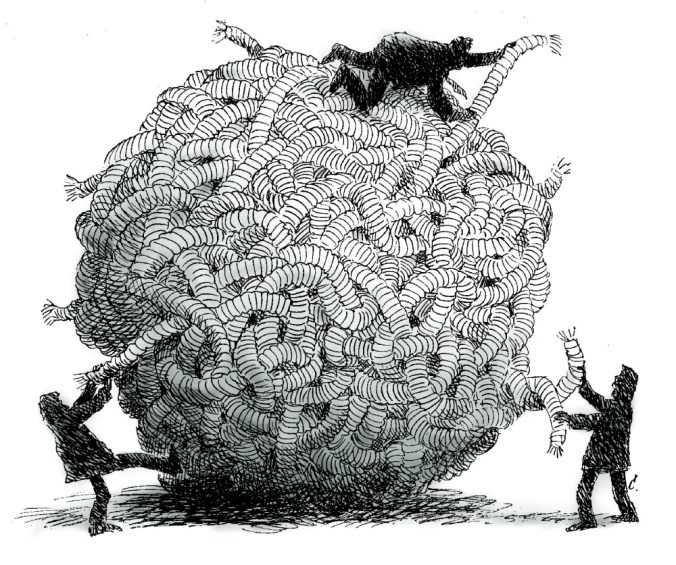
Gordian Knot

The question raises the ethical implications to all American citizens and our shared obligation to our nation and its society of a disastrous, crippling problem that poisons our culture. and society: the persistent plight of Black America.

Back when I was a senior in college majoring in American Government and the U.S. Presidency, I took a course  from Professor Thomas Pettigrew, then as now one of the foremost scholars on race, prejudice and public policy. It was about the challenges facing blacks as they tried then to benefit from new legislation and opportunities created by the Civil Rights Act and other policies, such as school busing. I was very impressed by Pettigrew’s even-handed, objective and non-political approach, even though, at my college, political teaching was the rule, not the exception.

I have never left a course so discouraged. Pettigrew, himself a pretty optimistic man, led us into one dead-end after another: black families, education, neighborhoods, political behavior, crime and more, all dysfunctional or suffering. All areas of black society interfered with or blocked improvements, progress, remedies and policy initiatives that showed promise to address racial inequality in other areas.

Late in the course I asked him if he saw any hope that in 50 years, black America would be approaching parity with white America. “I have hope,” he said. “But I honestly don’t see how we get there from here. There is a path, but we haven’t found it.”

It appears that my discouragement then was an accurate reading of the problems ahead.

Last week, these charts from the Brookings Institution’s Social Mobility Memos blog were posted to the web by other sources. They show how deeply the problems I was warned about have failed to improve in 50 years. Here is what they show:

1. Upward mobility is much more unlikely  for black than white Americans. 51% of the black Americans born into the lowest fifth of the earnings distribution remain there at age 40:

Unethical Donald Trump Quote Of The Day: Whatever It Was That He Told The New York Times “Off The Record” That The Times Unethically And Unprofessionally Allowed Its Staff To Talk About, Putting Trump In An Impossible Bind That He Should Have Been Able To Rely On A Respected News Source Not To Put Him In…

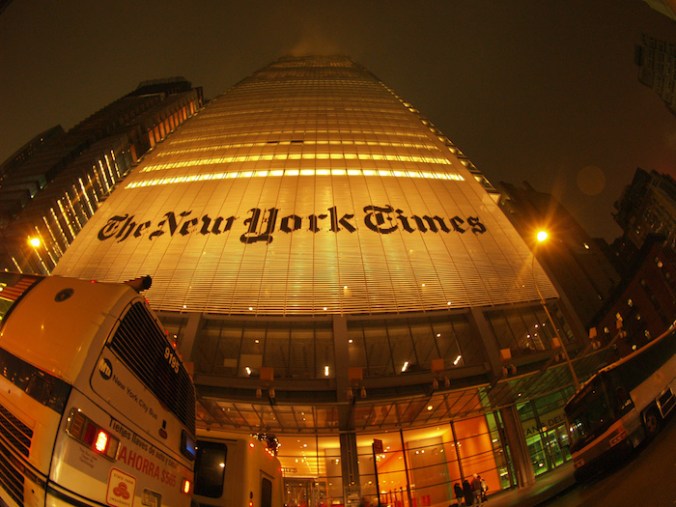
new-york-times-nytimes-building-cc

Let me be clear: The New York Times has shown itself to be partisan, untrustworthy, and no longer fit to be regarded as the flagship of American journalism. The fact that they did this at the expense of Donald Trump, an existential danger to U.S. culture and governance, in no way mitigates the betrayal of journalistic ethics the Times’ conduct represents.

From Buzzfeed:

The New York Times is sitting on an audio recording that some of its staff believes could deal a serious blow to Donald Trump, who, in an off-the-record meeting with the newspaper, called into question whether he would stand by his own immigration views.

Trump visited the paper’s Manhattan headquarters on Tuesday, Jan. 5, as part of a round of editorial board meetings that — as is traditional — the Democratic candidates for president and some of the Republicans attended. The meetings, conducted partly on the record and partly off the record in a 13th-floor conference room, give candidates a chance to make their pitch for the paper’s endorsement.

After a dispute over Trump’s suggestion of tariffs on Chinese goods, the Times released a portion of the recording. But that was from the on-the-record part of the session.

On Saturday, columnist Gail Collins, one of the attendees at the meeting (which also included editor-in-chief Dean Baquet), floated a bit of speculation in her column:

The most optimistic analysis of Trump as a presidential candidate is that he just doesn’t believe in positions, except the ones you adopt for strategic purposes when you’re making a deal. So you obviously can’t explain how you’re going to deport 11 million undocumented immigrants, because it’s going to be the first bid in some future monster negotiation session.

Sources familiar with the recording and transcript — which have reached near-mythical status at the Times — tell me that the second sentence is a bit more than speculation. It reflects, instead, something Trump said about the flexibility of his hardline anti-immigration stance.

So what exactly did Trump say about immigration, about deportations, about the wall? Did he abandon a core promise of his campaign in a private conversation with liberal power brokers in New York?

Sure, I’d like to know. I’d love to know if the single issue that has made Trump the most unqualified and unfit Presidential nomination front-runner in U.S. history has been manipulated by him to gull his easily gullible, “poorly educated” supporters. Maybe the knowledge that he has no intention of deporting millions and building a wall would make them see him as the cynical con man he obviously is. That doesn’t matter, though. We shouldn’t know what Trump said off the record, and we shouldn’t  know that any off-the-record comments were made. That the New York Times’ staff is so undisciplined and unethical that it would gossip about such a session shows the paper’s commitment to principles of journalism ethics to be inadequate for a small town weekly rag. Continue reading

Apparently Hunter S. Thompson Was Nostradamus

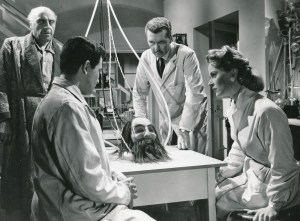
This is only tangentially related to the post, but it may be my only chance to proudly note that my great uncle. actor George Coulouris (that's him in the upper left) played a Greek tycoon with brain cancer who reanimates the head of Nostradamus so he can get a transplant. The film is called "The Man Without a Body," and consists of long scenes with Uncle George arguing with a rubber head.

This is only tangentially related to the post, but it may be my only chance to proudly note that my great uncle, actor George Coulouris (that’s the old Mercury Theater ensemble member in the upper left) played a Greek tycoon dying if  brain cancer who reanimates the head of Nostradamus so he can get a transplant. The film is called “The Man Without a Body,” and consists of long scenes with Uncle George arguing with a rubber head.

This is going to cause me to reconsider a lot of assumptions.

Hunter Thompson is fading from cultural relevance now, and when he was alive, I would have said, “Good.” He was a classic product of the Sixties, contemptuous of American and the political system, relentlessly negative and cynical,  habitually stoned and proud of it. He was also a very funny, witty, skilled writer, if you could stand being bombarded by Abie Hoffman/M*A*S*H/ drug glamorizing political propaganda, which cleverly satirical as it often was, I could not. Thompson was bitter, angry and nihilistic; I would label his a largely wasted life. It was no surprise to me that he committee suicide. I was surprised he didn’t do it sooner, but then, he had been killing himself slowly with drugs and alcohol for decades. Thompson’s legacy is preserved to some extent in the person of the gun-toting, drugged out, corrupt Uncle Duke character in Doonesbury.

Thompson’s observations in his two most famous books, “Fear and Loathing on the Campaign Trail ’72” and “Fear and Loathing in Las Vegas” seemed like typical criticism from the “drop-out, turn-on” set then. It never occurred to me that he had access to a crystal ball. In a thorough and wise analysis of today’s political upheaval deftly titled “Has Everyone Lost Their Freakin’ Minds?” (I cannot recommend it more highly), Tyler Durden begins with a series of Thompson’s quotes. Here they are… Continue reading